The Medal for the Liberation of Kuwait (Egypt)

The Medal for the Liberation of Kuwait (Egypt) was instituted in 1991 and awarded to armed forces personnel who served in the Gulf War.

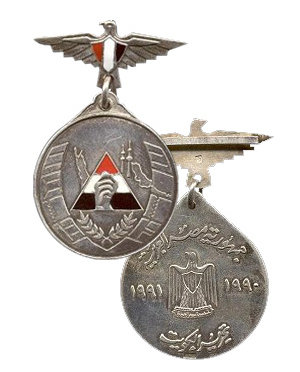
The Medal for the Liberation of Kuwait (Egyptian version) was instituted in 1991 and awarded to armed forces personnel who served in the Gulf War during the months of August 1990 – March 1991.

The Medal for the Liberation of Kuwait (Egypt Version) Design

The Egyptian version of the medal is silver and round. The ribbon has nine equal stripes: red, white, black, red, white, green, red, white and black.

The Medal for the Liberation of Kuwait (Saudi Arabia)

The Medal for the Liberation of Kuwait was instituted by King Fahd ibn Abdulaziz of Saudi Arabia for service during the Gulf War.

The Medal for the Liberation of Kuwait (or Naut Tahrir al-Kuwait نوط تحرير الكويت‎ in Arabic) was instituted by King Fahd ibn Abdulaziz of Saudi Arabia for service during the Liberation of Kuwait campaign.

The Saudi Arabian version of the medal was awarded to members of the Coalition Forces who participated in Operation Desert Storm and the liberation of Kuwait between the dates of January 17, 1991 and February 28, 1991. Unlike other medals, it recognizes service in a relatively short period of time whereas the Kuwaiti version of the medal is granted for service over three years. The Saudi Arabian version is also senior in U.S. precedence, owing to its having been authorized for several years before the Kuwaiti version was offered.

The Medal for the Liberation of Kuwait Design

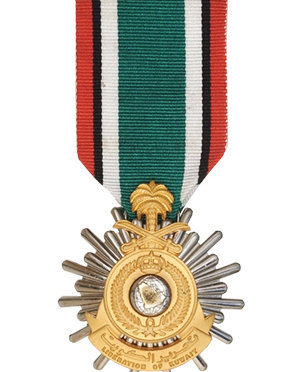
The Saudi version of the Kuwait Liberation Medal consists of a silver star of fifteen rounded points (with shorter rounded points between them) surmounted by a gilt medallion which contains a wreath tied at its based and a crown at its top. In the center of the gilt medallion is a silver representation of the Earth, over which is superimposed a gilt representation of the Kingdom of Saudi Arabia.

Above the gilt medallion are the crossed swords and palm tree taken from the Royal Cypher. Beneath the gilt medallion is a swallow-tailed scroll with its ends folded back and point upward so they follow the contour of the gilt medallion. On the scroll are the words, LIBERATION OF KUWAIT in English, and the same inscription above it in Arabic.

Buy a Medal for the Liberation of Kuwait

Note: As an eBay partner, I earn from qualifying purchases. This is all done automatically when you use a link and at no extra cost to you.

Right Now on eBay 
Clicking a link to eBay may result in a referral commission being paid if a purchase is made.
Loading...

The Medal for Defense Service Abroad (Norway)

The Medal for Defence Service Abroad is a Norwegian military medal originally awarded for service during military operations in the 1990s.

The Medal for Defence Service Abroad (or Forsvarets Innsatsmedalje in Norwegian) is a military medal established 1 January 1993 in Norway and originally awarded for service during military operations that took place in the 1990s. The later establishment of the Medal for Defence Operations Abroad rendered the first obsolete, however in 2009 it was reintroduced as an achievement medal.

It was awarded for distinguished bravery and courage, beyond what is normally required during combat operations. The medal’s color was changed from bronze to gold, and the ribbons of the medal would vary, depending on the area of operations.

The Medal for Defense Service Abroad Design

The medal is round, embossed in gold colored metal. On the obverse is a sword pointing up, with an oak branch on either side. On the reverse are the words FOR DIN INNSATS with oak branches above and below.

The award is suspended from a ribbon in the colors of the Flag of Norway and the Norwegian Armed Forces’ colors. The ribbon is blue with red edges, the red edges are bordered in the inside by a thin white stripe. In the center is a stripe of light blue.

During the first period of its existence, the medal was always awarded with a rosette. Finally, in 2012 the medal was further changed to a single ribbon design for all awards. The medal may be awarded with rosette for particularly meritorious distinction.

The Commemorative Cross for the Operations in the Persian Gulf

The Commemorative Cross for the Operations in the Persian Gulf is an Italian award for participation in Operazione Locusta.

The Commemorative Cross for the Operations in the Persian Gulf is an Italian award created to commemorate Italy’s participation in the Gulf War (1990-1991). Italy has been a part, in accordance to its long history of peacekeeping activities, of numerous UN missions and sub-regional peacekeeping efforts in Somalia, the Balkans, Afghanistan and Iraq. Some of these missions were accompanied by a series of crosses and distinct ribbon combinations.

The code name given to the contribution of the Italian Air Force in the Gulf War was Operazione Locusta. Following the invasion and annexation of Kuwait by Iraq (September 25, 1990) the Italian Government sent eight multi-role fighter bombers Tornado IDS to the Persian gulf. The bombers belonged to the 6º, 36º and 50º Stormo, which were deployed at the Al Dhafra Air Base, in United Arab Emirates. The deployment of Italian aircraft was part of the international security system implemented by UN Security Council Resolution 678.

The use of Italian aircraft as part of the Desert Storm operation represented the first operational employment in combat missions of Italian Air Force aircraft after the end of World War II. The RF104-G returned to Italy on March 11, 1991.

The Cross for the Operations in the Persian Gulf Design

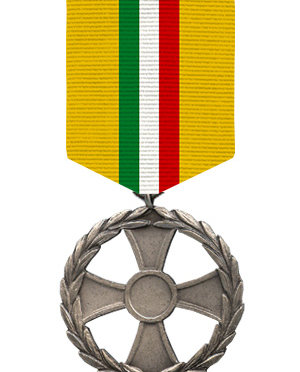
The medal is a silver cross. The ribbon is yellow with a central green, white and red stripe.

In some cases the mission medals were issued with bronze (silver in the case of Afghanistan) bars to denote the specific mission. For earlier missions, the planchet was engraved with the name of the mission.

Find This Medal

Right Now on eBay 
Clicking a link to eBay may result in a referral commission being paid if a purchase is made.
Loading...

The Southwest Asia Service Medal

The Southwest Asia Service Medal (SASM or SWASM) is a military award of the US Armed Forces to recognize duty during the Persian Gulf War.

The Southwest Asia Service Medal (also known as SASM or SWASM) is a military award of the United States Armed Forces created by order of President George H.W. Bush to recognize those military service members who performed duty during the years of the Persian Gulf War between August 2, 1990, and November 30, 1995.

Individuals awarded the Southwest Asia Service Medal must have participated in or supported military operations in Southwest Asia, including participation in Operations Desert Shield or Desert Storm. To receive the award, a service member had to be attached to or regularly serving for one or more days with an organization participating in ground/shore military operations; aboard a naval vessel directly supporting military operations; participating as a crew member in one or more aerial flights or serving on temporary duty for 30 consecutive days or 60 nonconsecutive days.

The award is not authorized for those who performed support of the Persian Gulf War from European or Pacific bases, or for service members who performed “home service” during the Persian Gulf War.

The Southwest Asia Service Medal Design

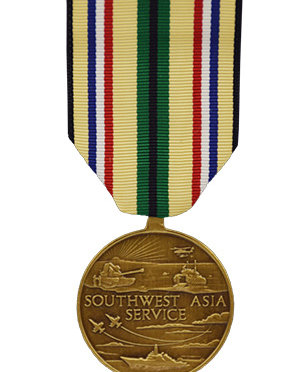
The medal was designed by Nadine Russell of the Army’s Institute of Heraldry. The colors of the ribbon are tan, representing sand, with the black, white, red, blue, and green colors symbolizing the colors of coalition countries’ national flags. The maximum number of bronze service stars that are authorized to be worn for the Southwest Asia Service Medal’s ribbon or streamer is three.

Ribbon devices:
  • Bronze service star: for participation in each designated campaign. Each recipient of the medal should wear at least one campaign star.
  • Fleet Marine Force Combat Operation Insignia: for naval personnel on duty with and attached to a Marine Corps unit that participated in combat.

Designated campaigns:

  • Defense of Saudi Arabia. From August 2, 1990 to January 16, 1991.
  • Liberation and Defense of Kuwait. January 17, 1991 to April 11, 1991.
  • Southwest Asia Cease-Fire. April 12, 1991 to November 30, 1995.

In April 2016, the appearance of the suspension and service ribbon of the SASM was slightly modified. The DLA made the two vertical green bars and one vertical black bar in the middle wider than in the original 1991 version.

Find This Medal Online

Right Now on eBay 
Clicking a link to eBay may result in a referral commission being paid if a purchase is made.
Loading...

The Order for Service to the Homeland in the Armed Forces of the USSR

The Order for Service to the Homeland in the Armed Forces of the USSR was a Soviet military order created in 1974 in three classes.

The Order for Service to the Homeland in the Armed Forces of the USSR (or Орден За службу Родине в Вооружённых Силах СССР in Russian) was was a Soviet military order created on October 28, 1974 and awarded in three classes for excellence to military personnel. It’s also known as the Order for Service to the Motherland in the Armed Forces of the USSR.

The Order was awarded to soldiers of the Soviet Army, Navy, of Border or Internal Troops for achievements in combat and political training, for maintaining high combat readiness and developing new military equipment; for high performance in service; for the successful fulfillment of special command tasks; for courage and dedication displayed during the performance of military duties; for other services to the nation while serving in the Armed Forces.

The Order for Service to the Homeland in the Armed Forces of the USSR was divided into three classes, first, second and third, the first class being the highest.

Recipients of all classes had the right to priority in the choice of living quarters, yearly free round trip personal travel, free personal use of all types of urban passenger transport, free vouchers to a sanatorium or rest home and a 15% increase in pension.

The Order for Service to the Homeland in the Armed Forces of the USSR Design

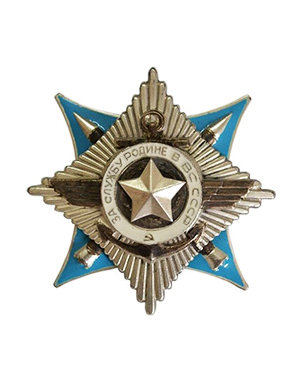
The Order consisted of two 58mm by 58mm four pointed stars crossed at a 90° angle, the top star having the vertical and horizontal points. The rear star was enameled light blue with gilt edges and two crossed convex oxidized silver rockets pointing towards the upper left and upper right. The rockets’ nose cones and tail sections were gilded.

The top star was made up of diverging rays, at its center, a circular medallion containing a convex five pointed star within an oak wreath on a blue background, surrounded by a white enameled ribbon with the inscription: “For Service to the Motherland in the Armed Forces of the USSR” (За службу Родине в ВС СССР) on the sides and top, and the image of the hammer and sickle at the bottom. The central medallion was superimposed over an oxidized silver anchor and wings protruding from the top, bottom and both sides. The Order weighed 64,5 grams.

The three classes of the Order:

  • 1st class – top four pointed star and central five pointed star were gilded;
  • 2nd class – top four pointed star was silver and the central five pointed star was gilded;
  • 3rd class – top four pointed star and central five pointed star were silver.

The Order of Friendship of Peoples

The Order of Friendship of Peoples (or Орден Дружбы народов in Russian) was an order of the Soviet Union established on December 17, 1972.

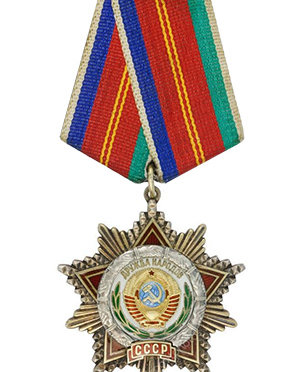
The Order of Friendship of Peoples (or Орден Дружбы народов in Russian) was an order of the Soviet Union established on December 17, 1972 and awarded to persons (including non-citizens), organizations, enterprises, military units and administrative subdivisions of the USSR for accomplishments in strengthening of inter-ethnic and international friendship and cooperation, for economical, political, scientific, military, and cultural development of the Soviet Union.

It was established on the occasion of the 50th anniversary of the creation of the Soviet Union and abolished in December 1991.

The Order of Friendship of Peoples Design

The design of order was created by Alexander Zhuk.

The Order of the October Revolution

The Order of the October Revolution is the second-highest Soviet Order, created for the 50th anniv. of the October Revolution.

The Order of the October Revolution (or Орден Октябрьской Революции in Russian) is the second-highest Soviet order and was instituted on October 31, 1967, in time for the 50th anniversary of the October Revolution. It was conferred upon individuals or groups for services furthering communism or the state, or in enhancing the defenses of the Soviet Union, military and civil.

The Order was awarded to the citizens of the USSR and foreign citizens, soviet enterprises, establishments, organizations and other groups of workers, the military units and formations, as well as republics, krais, regions, cities and towns and for the revolutionary activity, a major contribution to the formation and consolidation of the Soviet rule, outstanding services in the building of socialism and communism, for a particular courage demonstrated during the struggle with the enemies of the Soviet state, outstanding merits in the strengthening of the country’s defense system, for the active development and intensification of the friendly relationships between the Soviet Union nations and other states, for the peace consolidation between the nations.

The re-awarding of the Order was rare. In total there have been over 100.000 holders of the Order of the October Revolution.

The Order of the October Revolution Design

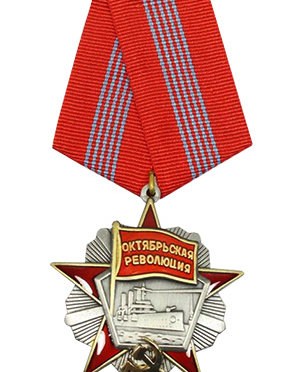
The insignia of the Order is a red star with golden rays between the arms badge.

At the centre of the badge was a pentagon bearing the image of the cruiser Aurora participating in the October Revolution. Above this was a red flag bearing the words “October Revolution” (Октябрьской Революции). A Hammer and Sickle emblem was placed at the bottom.

The badge was worn on the left chest with a red ribbon bearing five blue stripes at the center.

The Cross to the Heroic Valour in Combat (Argentina)

The Cross to the Heroic Valour in Combat (or Cruz la Nación Argentina al Heroico Valor en Combate in Spanish) is the highest military decoration of the Argentinian Republic.

The medal was first issued in 1982, and according to the Laws 22 607 (1982) and 24 229 it’s to be awarded to military personnel, security forces personnel, civilian police force, Argentinians or foreigners who, in combat motivated by extraordinary circumstances, exhibit heroic acts in the function of war, isolated or in the exercise of command, or ponderable actions or distinguish themselves in conduct.

A totally of 21 medals were given to Argentine heroes of the Falklands War, all of them having fought
in the war, and eight of them having given the medal post-mortem.

The Cross to the Heroic Valour in Combat Medal Design

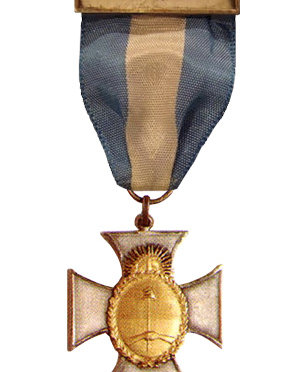
The medal is a circular medal cast in bronze and silver. The decoration consists of a silver cross pattée bearing the Coat of arms of Argentina in gold.

The medal is suspended from a chest ribbon of equal light blue-white-light blue stripes.

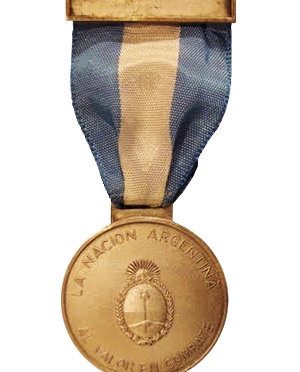
The Argentine Nation to the Valour in Combat Medal

The Argentine Nation to the Valor in Combat Medal (or Medalla de la Nación Argentina al Valor en Combate in Spanish) is the second highest military decoration given by the President of Argentina (the highest one being the Cross to the Heroic Valour in Combat).

The conditions for its award are to “recognize acts during the Southern Atlantic war for merits, valor and heroism in the defense of the Motherland“. The medal can be given to Argentinian citizens as well as foreigners, from the military, police or civilian personnel. A total of 56 people have received this award: 24 Officials, 21 NCOs and 11 soldiers.

The Argentine Nation to the Valor in Combat Medal Design

The medal is a circular medal cast in bronze. The obverse depicts the Coat of arms of the Argentinian Republic and the words “The Argentinian Nation” (“La Nación Argentina“) and “Valor in Combat” (“Al Valor Heroico“).

The medal is suspended from a chest ribbon of equal light blue-white-light blue stripes.