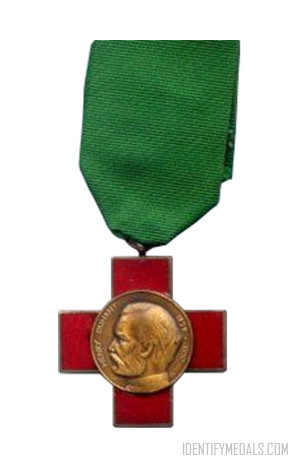
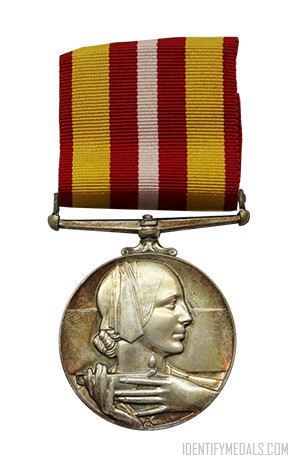
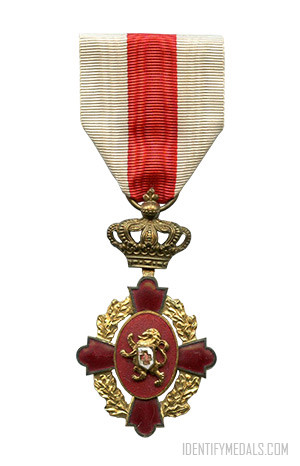
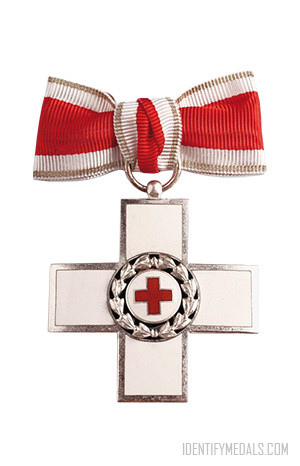
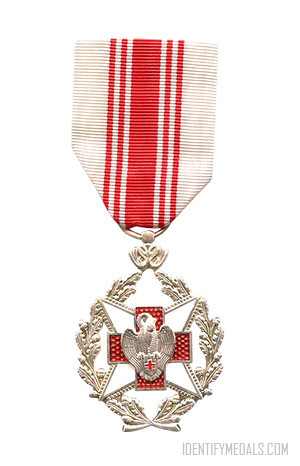
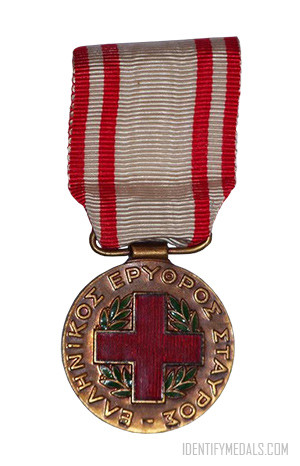
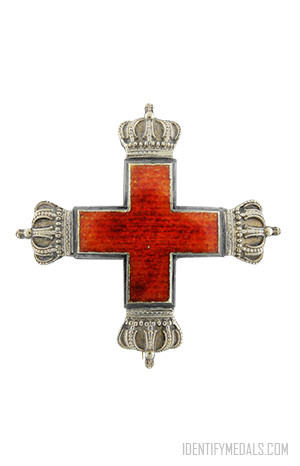
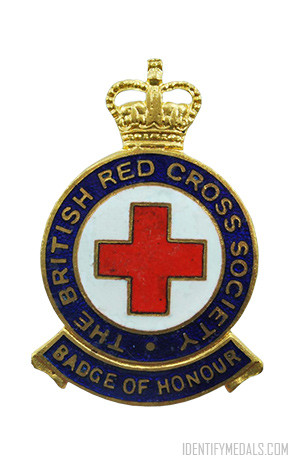
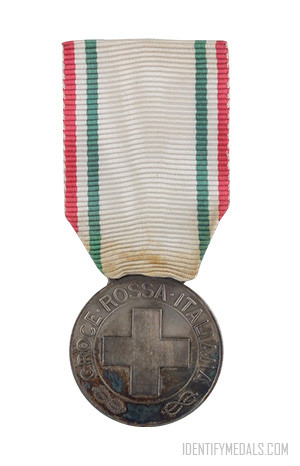
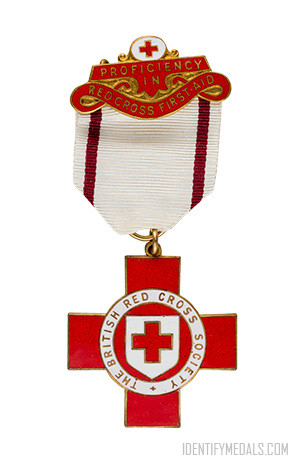

The Henry Dunant Medal is the highest award of the Red Cross. It was created in 1963 and named after the founder of the Red Cross Movement.
The Mexican War Cross was instituted in 1949 in three classes to be awarded to military in time of war or armed conflict for acts of bravery.
The War Cross (or Cruz de Guerra in Spanish) was instituted by Presidential Decree on 25 July 1949 in three classes to be awarded to military in time of war or armed conflict for acts of bravery.
Cuauhtémoc was an early 16th Century Aztec ruler who fought heroically against the Spanish conquistadors and was tortured and then unjustly executed by Cortés. Today, Cuauhtémoc is revered in Mexico whilst the world has largely forgotten the victorious Cortés.
The medal is a gilt and deep red enamel cross pattée with concave stepped ends to the arms and a loop for ribbon suspension.
The obverse shows the gilt head of Cuauhtémoc in eagle war headdress imposed on a circular central deep red enamel medallion within a gilt ring inscribed in red letters ‘CRUZ DE GUERRA PRIMERA CLASE’ (War Cross First Class). The reverse is plain, with a ribbon with laurel-decorated gilt top bar mounted for wear.
The Mexican Legion of Honor is an order of merit awarded to soldiers, veterans, and others who have made outstanding contributions to Mexico.
The modern Mexican Legion of Honor (or Legión de Honor Mexicana in Spanish) is an order of merit awarded to soldiers, veterans, and others who have made outstanding contributions to the national defense, security, or sovereignty of Mexico.
An earlier, post-revolutionary version was organized as a military reserve force, a forerunner to the modern Legion that was founded in 1917 under President Venustiano Carranza to provide an “honorable location for excess officers of the Constitutional Army.” It was available for use as a reserve force in case of national emergency, and also provided training for new recruits.
The modern Mexican Legion of Honor was created in a 1949 decree by President Miguel Alemán Valdés to “honor soldiers during their lifetime” who had contributed to the national defense, or who had contributed in some form to the social achievements enshrined in the Constitution. Eligibility changes included admission for those who had served the country, or completed at least thirty years of active military service.
A 1994 amendment to the original act established some organizational changes, including an official name change to Legión de Honor Militar Mexicana, and added eligibility to those who had “participated in the most preeminent events” of Mexican history, carried out “heroic actions“, or in some way contributed to the military defense of the nation, to guaranteeing national security, or to maintain national sovereignty and independence.
The 1949 reorganization opened the membership first to civilians, and then to women. Although some women were recognized as members, without recognizing either their military rank or their pensions.
The Presidential Medal of Freedom is an award bestowed by the President of the United States. It is the highest civilian award of the USA.
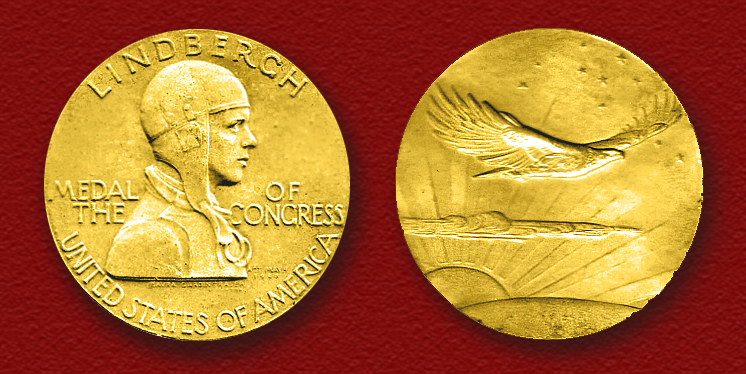
The Congressional Gold Medal is an award bestowed by the Congress and one of the three highest civilian awards in the United States.
The Royal Order of Sports Merit (or Real Orden del Mérito Deportivo) is a Spanish civil Order of Merit established 18 June 1982.
The order is indented to recognize distinguished service in sports, in teaching physical education, or the management, organization, promotion and development of physical education and sports. The order may be presented to individuals in one of four classes. It may also be presented to legal personalities, organizations, and other entities in one of three classes.
The Spanish Constitution of 1978 contains in article 43.3, a guiding principle in the conduct of public authorities to promote physical education and sport. The Royal Order of Sports Merit is a tool of this constitutional mandate to promote, advertise, and propagate physical culture and sports.
Individuals may be awarded the Royal Order of Sports Merit in one of four classes:
Groups and organizations may be awarded in one of three different classes:
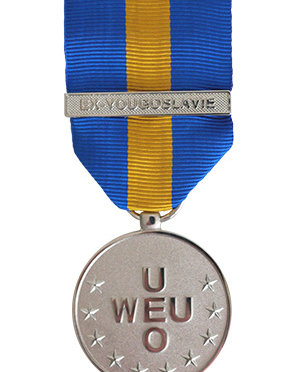
The Western European Union Mission Service Medal, is an international military decoration awarded to individuals, who served with Western European Union (WEU) military missions.
The WEU first acted in military operations in the context of the Iran–Iraq War. In 1987, mines were laid in the Persian Gulf, restricting the freedom of navigation in international waters. A joint mine sweeping effort was undertaken by member nations of the WEU.
The WEU next took part in military operations during the Yugoslav Wars in 1992. The WEU undertook Operation Sharp Fence starting in 1992, in tandem with NATO who was executing Operation Maritime Guard. WEU and NATO joined their operations together in a single command as Operation Sharp Guard in June 1993.
The medal is circular, made of silver-colored oxidized metal, 36 mm in diameter.
The obverse of the medal displays the letters WEU arranged horizontally for “Western European Union”. Above the letter E is the letter U and below the letter O. UEO is the acronym for the French equivalent, Union de l’Europe Occidentale. Below the acronyms, arranged along the edge, are ten five pointed stars.
The reverse bears the Latin words in relief, PRO PACE UNUM, meaning “one for peace”, or idiomatically as “united for peace”.
The suspension ribbon of the medal is blue with a central stripe of yellow-gold. Worn on the ribbon are clasps naming the mission for which the medal is awarded. The service ribbon is the same as the suspension ribbon, utilizing miniature versions of the clasps.
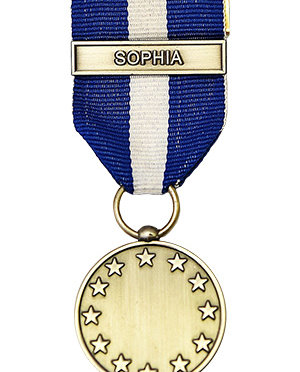
The Common Security and Defence Policy Service Medal (or European Security and Defence Policy Service Medal prior to 2009), is an international military decoration awarded to individuals, both military and civilian, who have served with CSDP missions.
Since the 1990s the European Union has taken a greater role in military missions both in Europe and abroad. These actions were taken under the Common Security and Defence Policy (CSDP), which is implemented by the European Union Military Staff, a department of the EU.
The medal is 36 mm in diameter, made of a silver colored metal. All versions share a common design.
The obverse of the medal is plain except for a circle of twelve five pointed stars around the outside edge of the medal. The reverse contains the Latin phrase, Pro Pace Unum, meaning “United for Peace”.
The words are arranged in three lines one word above the other in the center of the medal. The medal is suspended from a 36 mm ribbon in EU blue with either a wide gold center stripe for headquarters and combat forces, or a wide white stripe for planning and support. Each operation is identified with a different clasp with the name of the operation worn on the ribbon of the medal. A miniature version is worn on the ribbon bar, when medals are not worn.
To recognize service in these missions the EU authorized the creation of a medal with a common obverse and reverse, to which clasps featuring the missions’ name are attached to the ribbon bar.
The Long Military Service Cross is a military decoration of the Spanish Armed Forces and Civil Guard for long service.
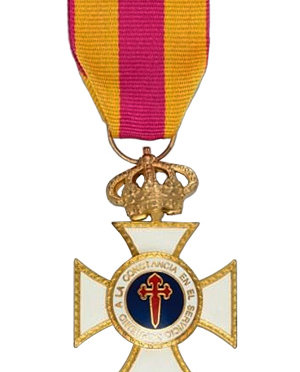
The Long Military Service Cross (or Cruz a la Constancia en el Servicio) is a military decoration of the Spanish Armed Forces and Civil Guard, designed to reward long and meritorious service below the level required for induction into the Royal and Military Order of Saint Hermenegild.
The medal was established by the Spanish government on December 26, 1958, and approved by Juan Carlos I in Royal Decree 682/2002. Regulations for the award were later modified in 2011, by Royal Decree 1385/2011.
The Long Military Service Cross may be awarded to all members of the Spanish Armed Forces, as well as to members of the Civil Guard at or below the rank of Corporal (OR-3). It can be presented in three grades, depending on time of service:
The ribbon of the medal is yellow, with a central stripe and thin border of magenta. The medal is a white cross pattée, bordered in either bronze, silver, or gold, and suspended from a crown.
At the center of the cross is a deep-blue enameled medallion, circumscribed by a white-enameled border which reads PREMIO A LA CONSTANCIA EN EL SERVICIO (Award for Constant Service). At the center of the medallion is a red Cross of Saint James, in the style of the Order of Santiago.
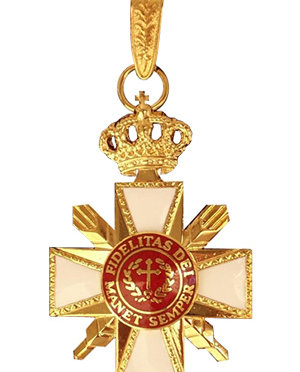
The Fidelity Cross (Cruz Fidélitas) is a medal of the Spanish Armed Forces, primarily awarded to military chaplains to reward service.
The Fidelity Cross (or Cruz Fidélitas) is a medal of the Spanish Armed Forces, primarily awarded to military chaplains. It is awarded by the military archbishopric to reward faithful service by chaplains, as well as services to the archbishopric by deserving civilians, institutions and other military personnel.
The decree established the award as a decoration of the Archdiocese of Spain, rather than the military, and stipulated that only the current military archbishop had the authority to award grades of the Cruz Fidélitas. However, he may temporarily delegate the power to award any class of the award to any chaplain he sees fit, other than that of Grand Cross.
There are three classes of the Cruz Fidélitas that can be awarded to military chaplains:
The ribbon of the medal is purple, with two white stripes extending down each side. From the ribbon hands a white-enameled cross bordered in gold, with gold spikes extending between the arms.
In the center of the cross, in the obverse, is the emblem of the Military Archbishopric of Spain, enameled in red. The reverse of the medal features a capital letter “F” relieved in the center of the cross, and the year “2007” on the lower arm, also in relief. A gold crown is used to suspend the cross from the ribbon.
Aside from that of the Cross of Honor, the ribbon bars of each grade also bear a device, dependent on the grade received. The ribbon bars of the Plate, Commendation, and Cross of the Cruz Fidélitas bear a Latin cross fleury, in gold, silver or bronze, respectively. The ribbon bar of the Grand Cross features a Spanish Royal Crown.