The Air Force Medal (Spain)

The Air Force Medal (or Medalla Aérea) is the maximum military award of Spain in peacetime for the air force branch.

The regulation for the issue of this medal is modified by the Royal Decree 1040/2003, 1 August (BOD. Núm. 177).

The Air Force Medal Design

The medal is made of oxidized iron, oval, 42 millimeters (1.7 in) on its vertical axis and 28 millimeters (1.1 in) on its horizontal axis.

On the obverse, surrounded by a silver edge, is a rising sun behind the sea and a matron stands, representing Spain, offering, with the right hand, a laurel wreath and holding a sword with the left. At the top of the oval are the words: “Al mérito distinguido”.

On the reverse is the emblem of the Air Force. The ribbon is 30 millimeters (1.2 in) wide and divided in three parts: the central with the national colors (red and yellow) and at the sides blue. Each medal has a clasp attached to the ribbon with the legend of the action done in black.

The Navy Medal (Spain)

The Navy Medal (or Medalla Naval) is the highest peacetime military award issued by Spain’s navy.

The regulation for the issue of this medal is modified by the Royal Decree 1040/2003, 1 August (BOD. Núm. 177).

The Navy Medal Design

The medal is made of oxidized iron, oval and measures 42 millimeters (1.7 in) on its vertical axis and 28 millimeters (1.1 in) on its horizontal axis.

On the obverse, surrounded by a silver edge, is a rising sun behind the sea and a matron stands, representing Spain, offering, with the right hand, a laurel wreath and holding a sword with the left. At the top of the oval are the words: “Al mérito distinguido”.

On the reverse is the emblem of the Navy. The ribbon is 30 millimeters (1.2 in) wide and divided in three parts: the central with the national colors (red and yellow) and at the sides dark blue. Each medal has a clasp attached to the ribbon with the legend of the action done in black.
The Army Medal (Spain)

The Army Medal (or Medalla del Ejército) is the maximum military award of Spain in peacetime for the army branch.

The regulation for the issue of this medal is modified by the Royal Decree 1040/2003, 1 August (BOD. Núm. 177).

The Army Medal Design

The medal is made of oxidized iron, oval and measures 42 millimeters (1.7 in) on its vertical axis and 28 millimeters (1.1 in) on its horizontal axis.

On the obverse, surrounded by a silver edge, is a rising sun behind the sea and a matron stands, representing Spain, offering, with the right hand, a laurel wreath and holding a sword with the left. At the top of the oval are the words: “Al mérito distinguido”.

On the reverse is the emblem of the Army. The ribbon is 30 millimeters (1.2 in) wide and divided in three parts: the central with the national colors (red and yellow) and at the sides dark green. Each medal has a clasp attached to the ribbon with the legend of the action done in black.
The Order of Merit of the Italian Republic

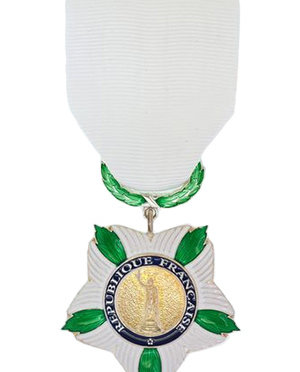
The Order of Merit of the Italian Republic (Ordine al merito della Repubblica Italiana) was founded by the second President in 1951.

The Order of Merit of the Italian Republic (or Ordine al merito della Repubblica Italiana) was founded as the senior order of knighthood by the second President of the Italian Republic, Luigi Einaudi in 1951.

The highest ranking honor of the Republic, it is awarded for “merit acquired by the nation” in the fields of literature, the arts, economy, public service, and social, philanthropic and humanitarian activities and for long and conspicuous service in civilian and military careers. The post-nominal letters for the order are OMRI.

Investiture takes place biannually on 2 June, the anniversary of the foundation of the Republic and on 27 December, the anniversary of the promulgation of the Italian Constitution. However, those awards on Presidential motu proprio, related to termination of service or granted to foreigners may be made at any time.

The order is bestowed by decree of the President of the Italian Republic, as head of the orders of knighthood, on the recommendation of the President of the Council of Ministers. Except in exceptional circumstances, no one can be awarded for the first time a rank higher than Knight. The minimum age requirement is normally 35.

The Order of Merit o the Italian Republic Design

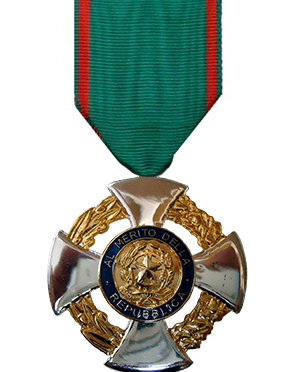
The badge, modified in 2001, bears the inscription Al Merito della Repubblica encircling the national coat of arms on the obverse and the Latin Patriæ Unitati (the union of the country) and Civium Libertati (the liberty of the people) encircling the head of Italia Turrita on the reverse.

The five degrees with corresponding ribbons are as follows (with numbers to June 2013):

  • Knight Grand Cross with Colla
  • 1st Class / Knight Grand Cross
  • 2nd Class / Grand Officer
  • 3rd Class / Commander
  • 4th Class / Officer
  • 5th Class / Knight

The Order of Tahiti Nui

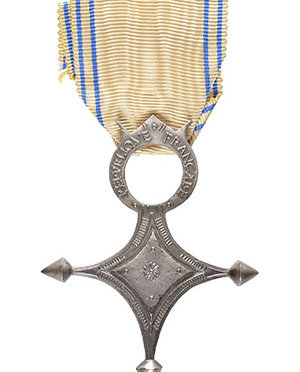
The Order of Saharan Merit (or Ordre du Mérite Saharien) was established in 1958 and rewards services for the development of Saharan regions.

The Order of Saharan Merit (or Ordre du Mérite Saharien) was established in 1958 as a reward for social, scientific, economic or administrative services rendered by French or foreign persons who participated in the development of Saharan regions.

The medal is fashioned in the form of the Agadez cross, a traditional emblem of the Tuareg clans inhabiting the area of the former Sultanate of Agadez in Agadez, Niger.

The order was deprecated by decree on 3 December 1963, and superseded by the Ordre National du Mérite. Extant members of the order are permitted to wear their original decorations.

The Order has three classes:

  • Commandeur (Commander)
  • Officier (Officer)
  • Chevalier (Knight)

The Order of Saharan Merit

The Order of Saharan Merit (Ordre du Mérite Saharien) was established in 1958 for social, scientific, economic or admin services in Sahara.

The Order of Saharan Merit (or Ordre du Mérite Saharien) was established in 1958 as a reward for social, scientific, economic or administrative services rendered by French or foreign persons who participated in the development of Saharan regions.

The medal is fashioned in the form of the Agadez cross, a traditional emblem of the Tuareg clans inhabiting the area of the former Sultanate of Agadez in Agadez, Niger.

The order was deprecated by decree on 3 December 1963, and superseded by the Ordre National du Mérite. Extant members of the order are permitted to wear their original decorations.

The Order has three classes:

  • Commandeur (Commander)
  • Officier (Officer)
  • Chevalier (Knight)

The Medal for Internal Security

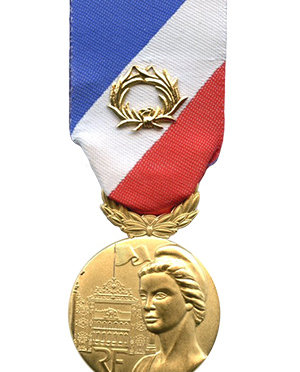
The Medal for internal security (or Médaille de la sécurité intérieure) is a French civil and military medal established on 28 March 2012.

The Medal for internal security (or Médaille de la sécurité intérieure) is a French civil and military medal established by Decree No. 2012-424 of 28 March 2012.

The Medal for internal security is awarded to by the Ministry of the Interior without regard to rank or position and is typically awarded on 1 January and 14 July. However, award may be made at other times for exceptional circumstances. Approved missions may have taken place in France or abroad.

Nominations for award of the medal are reviewed by a committee of eight members representing the Minister of the Interior, General Directorate of Local Authorities, General Directorate of National Police, General Directorate of National Gendarmerie, General Directorate for Internal Security, General Directorate of Civil Security and Crisis Management, and the General Secretariat of Immigration and Integration.

The following individuals are eligible for the medal:

  • Personnel under the Ministry of the Interior
  • Civilian and military personnel, professional or voluntary, placed under the authority of the Ministry of the Interior
  • The Municipal Police officers
  • Volunteers working in associations for homeland security missions
  • Any person, French or foreign, who has distinguished himself or herself by an act relating to internal security.

The National Medal of Recognition for Victims of Terrorism

The National Recognition Medal for Victims of Terrorism is a national medal of France awarded to French victims of terrorism.

The National Recognition Medal for Victims of Terrorism (or Médaille nationale de reconnaissance aux victimes du terrorisme) is a national medal of France awarded to French victims of terrorism.

Established by presidential decree on July 12, 2016, it may be awarded to French or foreign nationals who are victims of terrorism in France or abroad. The medal may be awarded to a retroactive date of January 1, 2006.

The medal was created to give a proper recognition to the sacrifice of terrorism victims while still maintaining the award criterion of existing national honors such as the Legion of Honor.

The Military Health Service Honor Medal

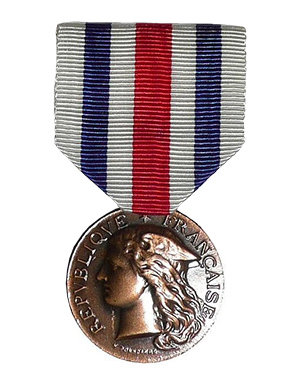
The Military Health Service honour medal (or “Médaille d’honneur du service de santé des armées”) is a French decoration created 30 August 1962.

The medal recognizes individuals who have contributed or lent their support to the French Defence Health service and were particularly marked by their services or their dedication. It is presented in four different levels: gold, vermeil, silver, and bronze. It may be awarded to members of the military as well as civilians.

The four levels are awarded under the following conditions:

  • Bronze Medal for 10 years service;
  • Silver Medal for 15 years of service and the Bronze Medal
  • Vermeil Medal for 20 years of service and the Silver Medal;
  • Gold Medal which is awarded only in exceptional cases.

On the occasion of exceptional circumstances, especially during epidemic periods, nominations could be made for people that do not meet the length of service conditions.

The Medal for the War Wounded

The Medal for the War Wounded (Médaille des blessés de guerre) was a ribbon insignia awarded for wounds received in the line of duty.

The Medal for the War Wounded (or Médaille des blessés de guerre) was originally a mere insignia in the form of a ribbon awarded for wounds received in the line of duty while facing an enemy.

The insignia was established by the law of 11 December 1916, based on an idea by the nationalist writer Maurice Barrès. Although originally established as a temporary measure, the insignia survived for a century in some form or another. It could be awarded to wounded soldiers, prisoners of war, to World War II deportees and internees from the French resistance and to soldiers wounded in more recent conflicts.

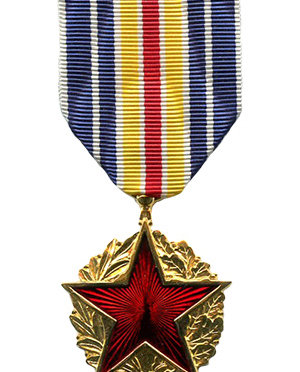
A variety of unofficial medals in the form of a red enameled star suspended by the same ribbon appeared very early on and although tolerated for wear by the authorities, were not official until recently.

The Medal for the War Wounded can be worn by:

  • Military personnel suffering from a physical or mental war wound, ascertained by the army health service and approved by the Minister of Defence;
  • Prisoners of war, physically or psychologically wounded during their detention.

The Medal for the War Wounded Design

The Medal for the War Wounded is made of gilded bronze with a 30 mm diameter. It is mainly composed of a large bright red enameled five-pointed star atop a crown of half laurels (left) and half oak leaves (right).

The medal is suspended by a ring from a 35 mm wide silk moiré ribbon composed of vertical stripes in the following colors: white 1 mm – blue 5 mm – white 1 mm – blue 4 mm – white 1 mm – yellow 3 mm – white 1 mm – beginning ou the outer edge on both sides of a 3 mm wide central red stripe.

Small enamel red five pointed stars are added to the medal ribbon and undress ribbon for each additional wound.