The Operational Service Medal Iraq and Syria

The Operational Service Medal Iraq and Syria is a British armed forces campaign medal awarded mostly to military personnel.

The Operational Service Medal Iraq and Syria (also known as Operation Shader Medal) is a British armed forces campaign medal awarded mostly to military personnel who served in the operational area of, or in support of Operation Shader.

The Operational Service Medal (Iraq and Syria) was first announced by former Defence Secretary, Sir Michael Fallon on 19 September 2017 and was first awarded in July 2018 in London by Defence Secretary Gavin Williamson. The medal is awarded either for 30 days continuous, or 45 days cumulative, service in theatre.

The Operational Service Medal Iraq and Syria Qualifying Criteria

This Operational Service Medal is the first to be awarded to individuals who served outside of the operational area, reflecting the changing nature of warfare. The Operational Service Medal (OSM) was established in 1999 to replace the General Service Medal (1962) for all new operations.

Clasp: Iraq & Syria clasp awarded to those recipients who served in the operational area. A silver rosette denotes the clasp when worn on the ribbon bar.

The Operational Service Medal Iraq and Syria Design

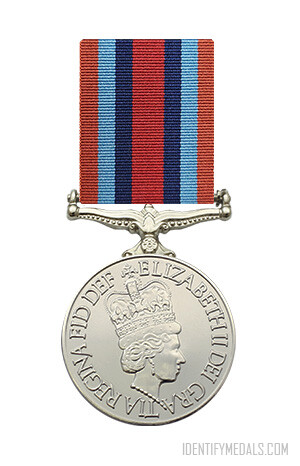
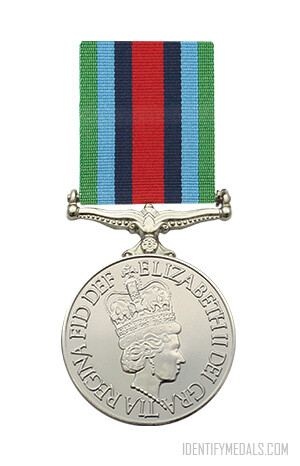
The Operational Service Medal for Iraq and Syria is struck in silver and circular in shape.

The obverse shows the crowned effigy of Queen Elizabeth II with the inscription ELIZABETH II DEI GRATIA REGINA FID. DEF. 

The reverse displays the Union Flag, surrounded by the inscription FOR OPERATIONAL SERVICE and the four major points of the compass with, between the points, four Coronets: Royal (top left), Naval (top right), Mural-Army (bottom left), and Astral-Royal Air Force (bottom right).

The ribbon is a broad central red stripe, flanked each side by a stripe of navy blue and one of light blue, to represent the three services, with an outer stripe of grey.

The General Service Medal Variants

The OSM has been awarded for four separate campaigns, each with a distinctive ribbon. The other three are:

Buy an OSM Medal Online

Right Now on eBay 
Clicking a link to eBay may result in a referral commission being paid if a purchase is made.
Loading...

The Ebola Medal for Service in West Africa

The Ebola Medal for Service in West Africa (also known simply as the Ebola Medal) is a service medal issued to the Armed Forces and to civilians, working either for Her Majesty’s Government or for non-governmental organisations, in support of the British Government’s response to the Ebola crisis in West Africa between March 2014 and March 2016.

The medal is the first medal awarded by the UK Government for a humanitarian crisis response.

The medal is awarded either for 21 days of continuous service within the operating area, or 30 days accumulated service on working visits of 48 hours or more to the operating area. The following groups are eligible for award:

  • Military personnel under the command of Commander, Joint Operations, and other members of UK Armed Forces providing direct support to HM Government’s response.
  • Any volunteer or employee directly deployed by the Department for International Development (DFID), UK-Med, Public Health England, the National Health Service or the Stabilisation Unit in support of HM Government’s response.
  • Any member of Her Majesty’s Civil Service.
  • Any UK national employed by an NGO funded by the DFID supporting HM Government’s response.
  • Any UK national responding to the Ebola crisis in support of HM Government’s response whose service can be verified.

The Ebola Medal for Service Design

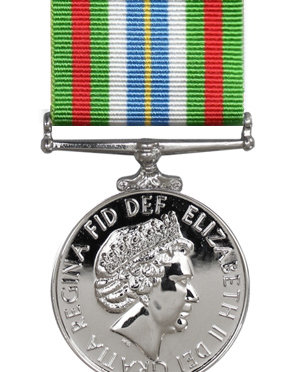
The medal is circular, struck in nickel-silver and manufactured by Worcestershire Medal Service. It measures  36mm diameter and is suspended from a ribbon by way of a swivel straight bar.

The obverse was designed by Ian Rank-Broadley, has the legend “ELIZABETH II DEI GRATIA REGINA FID.DEF.” and the effigy of Elizabeth II wearing the Girls of Great Britain and Ireland tiara.

The reverse is designed by John Bergdahl, and features a flame on a background depicting the Ebola virus – above this are the words “For Service” and below “West Africa Ebola Epidemic”.

The name of the recipient (name and title if civilian; name, rank and serial number if military) is engraved on the rim of the medal.

The ribbon is a central yellow stripe, flanked by blue and white stripes, and symmetrical red stripes flanked by green stripes either side. These represent the colours from the national flags of the countries in West Africa affected by Ebola.

The Civilian Service Medal (Afghanistan)

The Civilian Service Medal (Afghanistan) is a medal awarded by the British government to civilians (and members of the UK Armed Forces in certain non-combat roles) to recognize service since 19 November 2001 in the transition to democracy in Afghanistan.

The medal can be awarded to:

  • Crown servants, whether recruited in the United Kingdom, Afghanistan or elsewhere;
  • who have served in the geographical territory of Afghanistan on or after 19 November 2001, for 30 days continuously, or 45 days aggregated;
  • No minimum qualifying period for those killed, captured, wounded or disabled during service;
  • The medal was not awarded to those eligible for the Operational Service Medal for Afghanistan.
  • Locally employed civilians were not eligible.

The Civilian Service Medal Design

The Civilian Service Medal (Afghanistan) is circular and measures 36.07 mm in diameter and 4 mm thick. It’s struck in cupro-nickel with a rhodium plating/coating.

On the obverse, the medal has the Ian Rank-Broadley effigy of Queen Elizabeth II with the wording ELIZABETH II DEI GRATIA REGINA FID DEF.

On the reverse, there’s an Afghanistan mountain scene with the word Afghanistan written in Latin and Arabic lettering. The recipient’s name is inscribed on the rim.

  • The medal has a plain, straight suspender. The 32 millimeter-wide ribbon is sand-colored with a broad green central stripe and narrow pale grey stripes towards each edge. The ribbon is the same as for the Iraq Reconstruction Service Medal but with grey, rather than blue thin stripes.

The Iraq Reconstruction Service Medal

Time Period: Post-WW2
Year of Institution: 26 June 2004
Country: Great Britain

The Iraq Reconstruction Service Medal is a British service medal awarded to civilian public servants, contractors and consultants, and to members of the Armed Forces working with British Government Departments, who were either appointed, deployed or employed by Her Majesty’s Government (HMG) to work in Iraq, and who had served at least 40 days. The medal is distributed by the Foreign and Commonwealth Office.

The Iraq Reconstruction Service Medal was not awarded for service that also qualified for the Iraq military (campaign) Medal, although both medals could be awarded for different periods and types of service.

There are no clasps for this medal.

The Iraq Reconstruction Service Medal Design

The medal is circular, made of plated cupro-nickel and produced by the Royal Mint. It measures 36 mm in diameter.

The obverse has the Ian Rank-Broadley effigy of Elizabeth II, with the legend “ELIZABETH II DEI GRATIA REGINA FID.DEF.”

On the reverse are cuneiform symbols which can be roughly translated as “land bringing forth life”, with the stylized depiction of two rivers, based on a relief carving from Mesopotamia in the British Museum. Below is the word “IRAQ”.

The recipient’s name is inscribed on rim of the medal. The ribbon is 32 mm wide and sand-colored with a broad green central stripe and narrow blue stripes towards each edge.

The Iraq Medal

The Iraq Medal is a campaign medal issued to members of the British Armed Forces and certain attached personnel who served between 20 January 2003 and 22 May 2011 on, or in support of, Operation Telic.

The Iraq Medal is a campaign medal issued to members of the British Armed Forces and certain attached personnel who served between 20 January 2003 and 22 May 2011 on, or in support of, Operation Telic – the designation for British operations during the 2003 Invasion of Iraq and its aftermath. It was authorized on 23 February 2004.

The medal was awarded to those meeting the qualifying period of service within the defined operational area. Eligibility was extensive, and included both Regular and Reserve members of the armed forces, foreign and Commonwealth exchange and attached forces, Ministry of Defence civilians, members of the Royal Fleet Auxiliary and embedded journalists.

The medal was awarded with the clasp “19 Mar to 28 Apr 2003″ to British service and attached personnel who:

  • served in Zone 1 (Iraq) between 19 March and 28 April 2003, and:
  • completed seven days continuous service; or
  • served as aircrew flying into Iraq and who completed two or more operational sorties.

A silver rosette denotes the clasp when worn on the ribbon bar.

The Iraq Medal Design

The Iraq Medal is made of cupro-nickel and measures 36 millimeters (1.4 in) in diameter.

The obverse shows the crowned effigy of Queen Elizabeth II facing right, with the inscription ELIZABETH II DEI GRATIA REGINA FID DEF. The reverse shows an image of a Lamassu (an ancient Assyrian statue) above the word IRAQ.

The ribbon measures 32 millimeter (1.25 in) wide and is sand color with three narrow central stripes of black, white, red representing the Iraqi flag.

Find This Medal

Right Now on eBay 
Clicking a link to eBay may result in a referral commission being paid if a purchase is made.
Loading...

The OSM for the Democratic Republic of Congo

The Operational Service Medal for the Democratic Republic of the Congo is a British armed forces campaign medal awarded to military personnel who had served between 14 June and 10 September 2003 on Operation Coral.

The medal with clasp is awarded for 25 days continuous service in Bunia in the Ituri Province of the Congo, or five return operational flights between Entebbe and Bunia, between 14 June and 10 September 2003 on Operation Coral.

The medal was established in 1999 to replace the General Service Medal (1962) for all new operations.  It has been awarded for three separate campaigns:

A DROC clasp awarded with every medal. A silver rosette denotes the clasp when worn on the ribbon bar.

The General Service Medal for Afghanistan Design

The Operational Service Medal for the Democratic Republic of Congo is struck in silver and circular in shape.

The obverse displays the crowned effigy of Queen Elizabeth II with the inscription ELIZABETH II DEI GRATIA REGINA FID. DEF.

The reverse shows the Union Flag, surrounded by the inscription FOR OPERATIONAL SERVICE and the four major points of the compass with, between the points, four Coronets: Royal (top left), Naval (top right), Mural-Army (bottom left), and Astral-Royal Air Force (bottom right).

The ribbon is a broad central red stripe, flanked each side by a stripe of navy blue and one of light blue, to represent the three services, with an outer stripe of ochre, to represent the Congolese landscape.

The Operational Service Medal for Afghanistan

The Operational Service Medal for Afghanistan is a campaign medal awarded for service by British Armed Forces in support of the Afghan War.

The Operational Service Medal for Afghanistan is a campaign medal awarded for service by British Armed Forces personnel in support of the post-2001 Afghan War by the Ministry of Defence of the United Kingdom.

The Operational Service Medal was established in 1999 to replace the General Service Medal (1962) for all new operations. A separate medal of the same design is awarded for each campaign, differentiated by a distinct ribbon and, where appropriate, a specific clasp.

The General Service Medal for Afghanistan Qualifying Criteria

The Operational Service Medal for Afghanistan can be awarded both with and without a clasp inscribed ‘AFGHANISTAN‘. A silver rosette on the ribbon denotes entitlement to the clasp when no medal is worn.

The medal is also awarded to UK civilians employed on Ministry of Defence contracts in support of the British Forces in Afghanistan.

The General Service Medal for Afghanistan Design

The GSM for Afghanistan medal is struck in silver and circular in shape.

The obverse shows the crowned effigy of Elizabeth II with the inscription “ELIZABETH II DEI GRATIA REGINA FID. DEF..”

The reverse bears the Union Flag, surrounded by the inscription FOR OPERATIONAL SERVICE and the four major points of the compass with, between the points, four Coronets: Royal (top left), Naval (Navy, top right), Mural (Army, bottom left), and Astral (Royal Air Force, bottom right).

The ribbon consists of a broad central red stripe, flanked each side by a stripe of navy blue and one of light blue, to represent the three services, with an outer stripe of light brown, to represent the Afghan landscape.

The General Service Medal Variants

The OSM has been awarded for four separate campaigns, each with a distinctive ribbon. The other three are:

Buy an OSM Medal Online

Right Now on eBay 
Clicking a link to eBay may result in a referral commission being paid if a purchase is made.
Loading...

The Operational Service Medal for Sierra Leone

The Operational Service Medal for Sierra Leone is a campaign medal awarded for participation in the Sierra Leone Civil War.

The Operational Service Medal for Sierra Leone is a campaign medal awarded for participation in the British military intervention during and after the Sierra Leone Civil War, from May 2000 to July 2002. The medal was established in 2000 by the Ministry of Defence of the United Kingdom.

The Operational Service Medal (also known as OSM) was established in 1999 to replace the General Service Medal (1962) for all new operations. A separate medal of the same design is awarded for each campaign, differentiated by a distinct ribbon. 

The General Service Medal for Sierra Leone Qualifying Criteria

The length of service to qualify for the medal is determined by the mission participated in:

  • 1 day of service on Operations Barras or Maidenley
  • 14 days continuous or accumulated service on Operation Palliser
  • 30 days continuous or accumulated service on Operations Basillica or Silkman.

No clasp was issued for this medal. A large South Atlantic Medal type silver rosette is worn on the medal for operational service within Sierra Leone during Operations Maidenly and Barras. A smaller rosette is worn on the ribbon bar.

The General Service Medal for Sierra Leone Design

The Operational Service Medal for Sierra Leone is struck in silver and circular in shape.

The obverse shows the crowned effigy of Queen Elizabeth II with the inscription ELIZABETH II DEI GRATIA REGINA FID. DEF.

The reverse bears the Union Flag, surrounded by the inscription FOR OPERATIONAL SERVICE and the four major points of the compass with, between the points, four Coronets: Royal (top left), Naval (top right), Mural (Army, bottom left), and Astral (RAF, bottom right).

The ribbon consists of a broad central red stripe, flanked each side by a stripe of navy blue and one of light blue, to represent the three services, with an outer stripe of green to reflect the jungle landscape of Sierra Leone.

The General Service Medal Variants

The OSM has been awarded for four separate campaigns, each with a distinctive ribbon. The other three are:

Buy an OSM Medal Online

Right Now on eBay 
Clicking a link to eBay may result in a referral commission being paid if a purchase is made.
Loading...

The Conspicuous Gallantry Cross and Medal

The Conspicuous Gallantry Cross (CGC) is a second level military decoration of the British Armed Forces created in 1993.

The Conspicuous Gallantry Cross (also known as CGC) is a second level military decoration of the British Armed Forces created in 1993 after a review of the British honors system as part of the drive to remove distinctions of rank in awards for bravery.

The CGC now serves as the second level award for gallantry for all ranks across the whole armed forces. The CGC may be awarded posthumously, “in recognition of an act or acts of conspicuous gallantry during active operations against the enemy“.

All ranks of the Royal Navy, Royal Marines, British Army, and Royal Air Force may be awarded the CGC in recognition of qualifying acts of gallantry. Recipients are entitled to the postnominal letters CGC

The Conspicuous Gallantry Cross and Medal Design

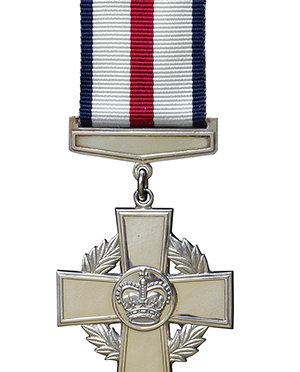
The medal is in the shape of a cross pattée and truck in silver. Arranged behind the cross, visible between the arms is a laurel wreath.

On the obverse, the circular medallion in the center depicts St. Edward’s crown. The reverse is plain which allows room for the engraving of the rank, name, and unit of its recipient.

The award date is also engraved on the reverse of the medal. The medal is suspended by a white ribbon with two narrow dark blue stripes at the edge and one center stripe in crimson.

The Gulf Medal

The Gulf War Medal is a British campaign medal issued to officers and men of British forces who served in Kuwait and Saudi Arabia during Operation Granby.
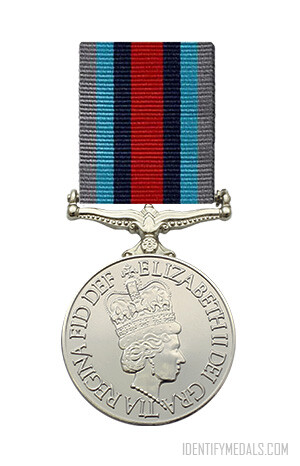
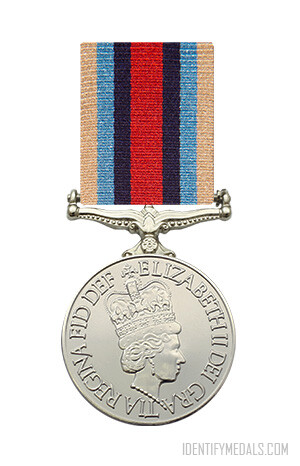
The Gulf War Medal is a British campaign medal issued to officers and men of British forces who served in Kuwait and Saudi Arabia during Operation Granby (the Liberation of Kuwait) in 1990–91 and approved in 1992.

It was instituted to recognize and honor the service of British and Commonwealth military personnel who participated in the Gulf War (also known as Operation Desert Storm) and subsequent operations in the Persian Gulf region in the early 1990s.

The Gulf Medal was established in 1992 and was awarded for various periods of operational service in the Gulf region, depending on the specific campaign or operation. The medal comes in several variations, each with its own distinctive ribbon and clasp, denoting the specific period and theater of service.

In addition to the Gulf Medal, there is also a separate medal called the Iraq Medal, which was awarded for service in later operations in Iraq, particularly during the post-9/11 period.

The Gulf War Medal Clasps

Two clasps were authorized for those who served in Kuwait during the Iraqi invasion, and for those who took part in operations to liberate Kuwait:

  • 2 Aug 1990: Awarded to the members of the Kuwait Liaison Team who were in Kuwait on the said date, and who were taken hostage by the invading Iraqi Army.
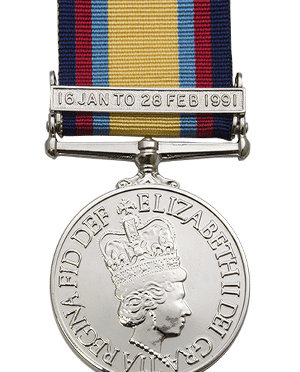
  • 16 Jan-28 Feb 1991: Awarded for seven days continuous service between these dates in the designated Theatre of Operations. This clasp signifies service during the actual war.

In undress uniform, a rosette is worn on the medal ribbon to denote the award of either clasp.

The Gulf War Medal Design

The Gulf Medal is made of cupro-nickel and measures 36 millimeters (1.4 in) in diameter.

The obverse shows the crowned effigy of Queen Elizabeth II facing right with the inscription ELIZABETH II DEI GRATIA REGINA FID. DEF. The reverse display an eagle in flight above an automatic rifle superimposed on an anchor, representing the three services, with THE GULF MEDAL above and 1990-91 below. The recipients details were impressed in capitals on the edge of the medal.

The Gulf War Medal ribbon measures 32 millimeters (1.3 in) wide, and shows a sand-colored broad central stripe flanked by narrow stripes of dark blue, red and light blue which represent the three services. A dark blue line appears on both outer edges.

Find This Medal

Right Now on eBay 
Clicking a link to eBay may result in a referral commission being paid if a purchase is made.
Loading...