
The Resistance Memorial Cross

The Resistance Memorial Cross or Commemorative Cross is a medal awarded to members of the Dutch resistance during the Second World War.

The Resistance Memorial Cross or Resistance Commemorative Cross (or Verzetsherdenkingskruis in Dutch) is a medal awarded in the Netherlands to members of the Dutch resistance during the Second World War.

The medal was instituted by Royal Decree (No. 104) on 29 December 1980, after the 35th anniversary of the liberation of the Netherlands. The cross is only awarded at the request of a person eligible to receive it. Approximately 15,000 have been awarded, recorded in the Gedenkenboek verzetsherdenkingskruis.

The Resistance Memorial Cross may be awarded to:

  • Members of resistance groups recognized in the Royal Decree dated 5 September 1944 or to any resistance group known to the Council on Extraordinary Pensions or the 1940-1945 Foundation.
  • Anyone recognized by the Council on Extraordinary Pension as a participant in the resistance, regardless of whether they were awarded a pension.
  • Individuals defined by the Law on the Improvement of the Legal Status of Resistance Fighters (law of 1/20/76, Stb. 19) adjudged as having spent time in service to the resistance.
  • Soldiers of the Dutch Internal Armed Forces in occupied territory.
  • Those who participated in actions during World War II in Japanese or Japanese-occupied territory, which after the war, were designated as resistance of the enemy by the committee.
  • Anyone who does not meet any preceding provisions, may still be considered a participant in the resistance in the judgement of the committee.

The Resistance Memorial Cross Design

The medal comprises a silver cross hung from a striped ribbon. The obverse of the cross bears a vertical flaming sword, surmounted by the Dutch royal crown. Below the sword are the dates 1940 above 1945. The horizontal arms of the cross are inscribed with the words DE TYRANNY VERDRYVEN (“to destroy tyranny”), a line in the Dutch national anthem.

The reverse bears a Dutch lion, and the date of institution, 1980. The cross is suspended by a ring from a ribbon colored with asymmetric stripes: the left half is red-white-blue (for the Dutch flag) and the right half orange (the national color of the Netherlands) with a black border on each edge.
The Order of the Golden Ark

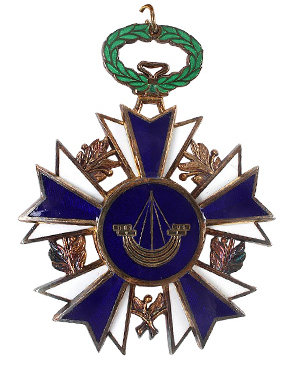
The Most Excellent Order of the Golden Ark is a Dutch order of merit established in 1971 by Prince Bernhard of the Netherlands.

The Most Excellent Order of the Golden Ark (or Orde van de Gouden Ark in Dutch) is a Dutch order of merit established in 1971 by Prince Bernhard of the Netherlands.

The order is awarded to people for major contributions to nature conservation. Although not awarded by the government of the Netherlands, it is considered by the government as a recognized chivalrous order.

Since its inception, over 300 people have been recognized by the award. Now that Prince Bernhard has died, the future of the order is uncertain.

The order has three grades:

  • Commander
  • Officer
  • Knight

The Order for Loyalty and Merit

The Order for Loyalty and Merit (or Orde van Trouw en Verdienste in Dutch) is a house order of the Dutch Royal House of Orange-Nassau.

The Order for Loyalty and Merit (or Orde van Trouw en Verdienste in Dutch) is a house order of the Dutch Royal House of Orange-Nassau. The Order came into being as a result of Queen Juliana‘s reorganization of The House Order of Orange in 1969.

The Order for Loyalty and Merit is conferred “upon those persons who have loyally and faithfully, and with merit and character assisted the Head of State or the members of the Royal House during their obligations and their daily work.”

The order has two grades:

  1. Cross for Loyalty and Merit in Gold;
  2. Cross for Loyalty and Merit in Silver.

The Order for Loyalty and Merit Design

The cross in gold or silver is worn on a ribbon on the left chest. The decorations are awarded after 25 and 40 years of service.

The monarch is lenient as far as the number of years in her service are concerned. Hardly anyone manages to work until his or her 65th birthday. Many servants of the Queen receive their Cross of merit for Loyalty and Merit in Gold after 35 years in the Royal Household.

The Order of the Crown (Netherlands)

The Order of the Crown is a house order that came into being as a result of the reorganization of the Order of the House of Orange.

The Order of the Crown (or Kroonorde in Dutch) is a house order of the Dutch Royal House that came into being as a result of Queen Juliana‘s reorganization of the Order of the House of Orange in 1969.

The 18 classes of the house order were no longer felt to be appropriate in the ever more egalitarian Dutch society of the 1960s. The Order was divided into five subdivisions. As a house order, it is not subject to ministerial responsibility or influence but is awarded at the discretion of the Dutch monarch alone.

The Order of the Crown is intended for “foreigners who have rendered special service to the Dutch King or his House“. The former queen, Beatrix, instituted a silver medal to commemorate state visits.

The Order of the Crown has the traditional five grades and three medals. This allows the Dutch monarch to dispense the decorations according to rank especially during state visits.

The Order of the Crown Design

The insignia vary considerably depending on the grade:

  1. Grand Cross (Grootkruis) – badge may be worn on a sash on the right shoulder, plus a 4-pointed star on the left chest;
  2. Grand Honorary Cross with Star (Groot erekruis met Plaque) – wears the badge on a necklet, plus a 4-pointed star on the left chest;
  3. Grand Honorary Cross (Groot erekruis) – wears the badge on a necklet;
  4. Honorary Cross with Rosette (Erekruis met Rozette) – wears the badge on a ribbon with a rosette on the left chest;
  5. Honorary Cross (Erekruis) – wears the badge on a ribbon on the left chest;
  6. Medals in Gold, Silver and Bronze (Medaille in goud, zilver en brons) – wears the medal on a ribbon on the left chest.

The Indochina Campaign Commemorative Medal

The Indochina Campaign commemorative medal (or Médaille commémorative de la campagne d’Indochine in French) is a military decoration established on 1 August 1953 to recognize participation in the Indochina War by the members of the French Far East Expeditionary Corps, regular and reserve.

The conflict in Indochina started right after the end of World War II with the French forces initially under the command of general Philippe Leclerc. During the first eight years of the conflict, French and colonial troops received the Colonial Medal with the “EXTRÊME-ORIENT” clasp, but this award couldn’t be earned by all in theater and outright excluded indigenous personnel.

Politicians and generals alike petitioned the government for a dedicated commemorative award available to all participants under French command. The Indochina Campaign commemorative medal was awarded to soldiers of the army, navy and air force involved, for a minimum of ninety days, in a regular or supplementary unit in the Indochina campaign between 16 August 1945 and 11 August 1954. The medal could also be awarded to civilians, citizens of France or of the French Union, members of the Merchant navy or civil aviation.

The Indochina Campaign Commemorative Medal Design

The medal measures 36mm in diameter, is circular and struck in bronze.

On the obverse a 24mm wide by 5mm high rectangular panel bearing the relief inscription “INDOCHINE” is supported by a seven headed naja, five of its heads being below the panel, two being above the upper corners, one on each side. Atop the panel, a three headed elephant surrounded by the relief semi circular inscription “RÉPUBLIQUE FRANÇAISE” along the medal circumference.

On the reverse in relief, a 25mm in diameter wreath of laurels and oak leaves surrounded by the inscription “CORPS EXPÉDITIONNAIRE FRANÇAIS D’EXTRÊME-ORIENT” (“FRENCH FAR EAST EXPEDITIONARY CORPS”) running along the entire medal circumference.

The ribbon suspension ring is adorned with a 20mm high by 25mm wide bronze twisted dragon. The ring passes through a loop atop the medal which hangs from a 39mm wide green ribbon bearing four 5mm wide yellow stripes set 5mm apart starting 2mm from the edges.

The Commemorative Medal for United Nations Operations in Korea

The Commemorative medal for United Nations operations in Korea (or Médaille commémorative des opérations de l’ONU en Corée in French) is a commemorative war medal established on 8 January 1952 and awarded to members of the French armed forces who fought in the Korean war.

On 25 June 1950, North Korean forces invaded South Korea in an effort to unify both countries under the northern communist government. A United Nations military force composed of seventeen nations soon began to arrive in theatre. France joined the U.N. forces in a 23 August with a battalion of 1,051 volunteers setting sail from Marseille on 25 October 1950. This battalion was under the command of general Raoul Magrin-Vernerey.

The French particularly distinguished themselves at the battles of WonjuChipyong-ni and Heartbreak Ridge. Out of 3,421 Frenchmen who fought in Korea, 262 were killed, 1008 wounded and 7 remain unaccounted for.

The United Nations operations in Korea commemorative medal was awarded to soldiers of the French United Nations detachment and to naval personnel with a minimum of two months in theatre.

The Commemorative Medal for United Nations Operations in Korea Design

The medal measures 36mm in diameter, is circular and struck in bronze.

The obverse bears on a background of sun rays radiating out from its center, the relief image of the national emblem of the Republic of South Korea on a flower-like eight lobe geometric form superimposed over a lit torch with its flame extending 7mm over the medal’s upper edge and forming the suspension loop. The torch also bisected a relief laurel wreath extending along all but the upper most of the medal’s circumference. The straight ribbon mount was adorned with a bronze decoration resembling the top of a pagoda.

The reverse bears the relief inscription on seven lines “MÉDAILLE” “COMMÉMORATIVE” “FRANÇAISE” “DES OPÉRATIONS” “DE L’ORGANISATION” “DES NATIONS UNIES” “EN CORÉE” (“FRENCH COMMEMORATIVE MEDAL OF THE OPERATIONS OF THE ORGANIZATION OF THE UNITED NATIONS IN KOREA”) surrounded by the relief circular inscription “RÉPUBLIQUE FRANÇAISE”.

The medal hangs from a 36mm wide silk moiré ribbon in the colors of the United Nations and France. It’s multicoloured vertical stripes were disposed as follows beginning with three central equal width light blue, white and light blue stripes totalling 20mm, these were bordered by three equal width dark blue, white and red stripes totalling 8mm, the dark blue being closer the ribbon’s edge.

The German Armed Forces Deployment Medal

The German Armed Forces Deployment Medal is a decoration of the Bundeswehr awarded for military service in a designated military campaign.

The German Armed Forces Deployment Medal (or Einsatzmedaille der Bundeswehr in German) is a decoration of the Bundeswehr, the armed forces of the Federal Republic of Germany, awarded for military service in a designated military campaign.

It is awarded to all German soldiers regardless of rank. It is also the only type of German campaign medal awarded, the only difference is the campaign bar worn on the medal and ribbon.

The decoration has three grades. The grade is awarded without consideration of rank but by the time a served in the designated campaign area:

  • Bronze for 30 days in theatre.
  • Silver is for 360 days in theatre.
  • Gold for 690 days in theatre.

The medal has been awarded for 56 different operations or missions since its establishment. The medal is issued with a clasp denoting foreign the operation recognized by the medal. Like the medal the clasp is either, bronze, silver or gold.

The German Armed Forces Deployment Medal Design

The medal is round, on its center in the obverse is displayed the German eagle surrounded by a wreath of laurel leaves, the reverse side is plain. The combat version differs slightly from standard grades in that the medal is always golden with a black and red rim and a black eagle.

The ribbon has two black stripes on the edges with two red stripes beside it and two golden stripes on the in side with another bold red stripe in the middle, the ribbon bar has the campaign bar attached to it.

The Combat Action Medal of the Bundeswehr

The Combat Action Medal of the Bundeswehr is a military decoration awarded by the German Bundeswehr for active participation in action.

The Combat Action Medal of the Bundeswehr (or Einsatzmedaille Gefecht in German) is a military decoration awarded by the German Bundeswehr for active participation in combat actions or for the suffering from terrorist attacks.

It is awarded only once and, if the recipient was killed in action, posthumously. The medal was initiated by then minister of defense Karl-Theodor zu Guttenberg and introduced by the President of Germany, Christian Wulff in 2010.

The date of qualifying operations is from 29 April 2009 to the present. In 2011, the medal was awarded to a non-german soldier for this first time.

The Combat Action Medal of the Bundeswehr Design

The Combat Action Medal is a special class of the German Armed Forces Deployment Medal and shares many design features and the same ribbon.

The medal is gold in colour, with a black and red enameled border around the edge. The German Federal Eagle in the center is enameled in black. On the suspension ribbon of the medal, and the service ribbon worn in undress, is a gold coloured clasp with the word Gefecht(Combat).

The Badge of Honor of the Bundeswehr

The Decorations of Honor of the Bundeswehr are a series of military decorations of the Bundeswehr awarded for loyal service.

  • Time Period: Post-WW2
  • Institution: October 29, 1980 and October 10, 2008
  • Country: Germany

The Decorations of Honour of the Bundeswehr (or Ehrenzeichen der Bundeswehr in German) are a series of military decorations of the Bundeswehr awarded as a “visible commendation for loyal service and exemplary execution of duties“.

The decorations were introduced in 1980 on the occasion of the 25th anniversary of the Bundeswehr by then Minister of Defence Hans Apel and subsequently approved by President of the Federal Republic Karl Carstens.

The first awards were made on November 6, 1980. In 2008, the decorations were updated and received three grades exclusively reserved for heroic deeds. The new awards were the result of a petition by German citizens to restore the order of the Iron Cross.

Receiving one grade of the award is not a requirement for receipt of the next higher one. If earned, all grades of the award may be worn at the same time.

The Badge of Honour of the Bundeswehr Design

The Medal is round, shows a German eagle on a Cross pattée surrounded by a wreath of oak leaves.

On the reverse it reads FÜR BESONDERE VERDIENSTE BUNDESWEHR (For special merits — Bundeswehr). There is an oak leaf above the word Bundeswehr and that side is also surrounded by an oak leaves wreath.

The ribbon is black with two red stripes beside it and golden stripes on the edges as the colors of the German flag, the ribbon bar has a small clasp of the decoration grade attached to it.

The Bundeswehr Cross of Honor for Valor

The Bundeswehr Cross of Honor for Valor is the highest military decoration of Germany and their first combat valor award since World War II.

The Bundeswehr Cross of Honour for Valour (or Ehrenkreuz der Bundeswehr für Tapferkeit in German) is the highest military decoration of the Bundeswehr, and the highest class of the Bundeswehr Cross of Honour. The decoration is the first combat valour award presented by Germany since World War II.

Since World War II, Germany has seen its military as a defensive force, but during the 1990s Germany began playing a bigger role with its military within the European Union. After the September 11 attacks on the United States, Germany joined ISAF in Afghanistan and has continued to deploy Bundeswehr troops to areas under combat conditions.

The President of Germany Horst Köhler granted authorization for this valour decoration on 18 September 2008. On 10 October 2008, the directive creating the Bundeswehr Cross of Honour for Valour became law upon being published in the Federal Law Gazette and the Federal Gazette. The first recipients of the Cross of Honour for Valour were four soldiers caught up in a suicide attack by Taliban forces on 20 October 2008 southwest of Kunduz, Afghanistan.

The Bundeswehr Cross of Honour Design

The Medal is round, shows a German eagle on a Cross pattée surrounded by a wreath of oak leaves.

On the reverse it reads FÜR BESONDERE VERDIENSTE BUNDESWEHR (For special merits — Bundeswehr). There is an oak leaf above the word Bundeswehr and that side is also surrounded by an oak leaves wreath.

The ribbon is black with two red stripes beside it and golden stripes on the edges as the colors of the German flag, the ribbon bar has a small clasp of the decoration grade attached to it.