The Order of St. Patrick

The Order of St. Patrick is a dormant British order of chivalry created in 1783 to reward the Irish during the American War of Independence.

The Order of St. Patrick (or The Most Illustrious Order of Saint Patrick) is a dormant British order of chivalry created in 1783 by George III to reward the loyalty of Irish peers during the American War of Independence. The knights of Saint Patrick lasted until 1922, when most of Ireland gained independence as the Irish Free State.

The patron of the Order is St Patrick, and its motto is “Quis separabit?” or “Who will separate [us]?” in Latin, an allusion to the Vulgate translation of Romans 8:35, “Who shall separate us from the love of Christ?

No knight of St Patrick has been created since 1936, and the last surviving knight, Prince Henry, Duke of Gloucester, died in 1974. The Queen, however, remains the Sovereign of the Order. Its equivalent in England is The Most Noble Order of the Garter, dating to the middle fourteenth century, and in Scotland it’s The Most Ancient and Most Noble Order of the Thistle, in its modern form to 1687.

The Order of St. Patrick Design

The star of the Order is an eight-pointed figure, with the four cardinal points longer than the intermediate points. Each point is a cluster of rays. In the center is the same motto, year, and the saltire cross of St Patrick in red enamel. The star was worn pinned to the left breast. The chain is made of gold and composed of six harps and six roses, the last alternating with white and red petals. The badge is pinned to the riband at the left hip. Made of gold, it depicts a shamrock bearing three crowns, on top of a cross of St Patrick and surrounded by a blue circle bearing the motto as well as the date of the Order’s foundation in Roman numerals (“MDCCLXXXIII“). The broad riband is a celestial blue sash worn across the body, from the right shoulder to the left hip.

For important occasions, such as Coronations, Knights of St Patrick wore elaborate vestments consisting of: The mantle, a celestial blue robe lined with white silk and a blue hood, the hat of the Order, changed from white satin to black velvet by George IV, plumed with three falls of feathers, one red, one white and one blue, and the collar, made of gold and consisting of Tudor roses and harps attached with knots and a central harp, from which the badge of the Order is suspended, surmounted by a crown.

Unlike the other two great orders, the sash is worn in the manner of the lesser orders, over the right shoulder.


The Order of the Thistle

The Order of the Thistle is an order of chivalry revived by King James VII of Scotland (James II) in 1687 and re-established in 1703.

The Order of the Thistle (or The Most Ancient and Most Noble Order of the Thistle) is an order of chivalry revived in 1687 by King James VII of Scotland (James II of England and Ireland). It’s believed the original Order dates back to 787 AD and alludes to .barefoot enemy soldiers who cried out when they trode on thistles, alerting the Scots of an imminent attack. The Order was re-established again by Queen Anne in December 1703.

It consists of the Sovereign and sixteen Knights and Ladies, as well as “extra” knights among which are members of the British Royal Family and foreign monarchs.

The Sovereign alone grants membership of the Order. The Order of the Thistle, which pertains to Scotland, is the second most senior in precedence in the United Kingdom. Its equivalent in England is The Most Noble Order of the Garter, dating to the middle fourteenth century. At death, the official insignia is returned to the Central Chancery.

The Order of the Thistle Design

The Order’s primary emblem is the thistle, the national flower of Scotland. Its motto is Nemo me impune lacessit (or “No one provokes me with impunity” in Latin).

The star of the Order is a silver St Andrew’s saltire, with clusters of rays between the arms thereof. In the center is depicted a green circle bearing the motto of the Order in gold; within the circle, there is depicted a thistle on a goldfield. The star is worn pinned to the left breast. The badge of the Order depicts St Andrew in the same form as the badge-appendant, surrounded by an oval collar bearing the Order’s motto, and surmounted by a gold cord fitted with a ring for suspension. There are examples of it in plain gold, or with enameling and set with jewels. 

For the Order’s great occasions, as well for coronations, the Knights and Ladies wear an elaborate costume consisting of: The mantle, a green robe worn over suits or military uniforms and lined with white taffeta, tied with green and gold tassels. The hat, made of black velvet and plumed with white feathers with a black egret’s or heron’s top in the middle, the collar, made of gold and depicting thistles and sprigs of rue, and the St Andrew, or badge-appendant, worn suspended from the collar.

The ribbon is plain dark green.

Find This Medal

Right Now on eBay 
Clicking a link to eBay may result in a referral commission being paid if a purchase is made.
Loading...

The Italian Independence Medal

The Italian Independence Medal was instituted in 1865 to reward the participants of the wars against Austria and the Sicilies.

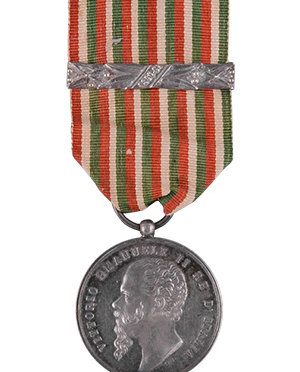
The Italian Independence Medal (or Medaglia per le guerre di Indipendenza e l’Unita d’italia) was instituted on March 4, 1865 by Royal Decree No. 2174 of King Vittorio Emmanuele II to reward the participants of the wars against Austria and the Kingdom of the 2 Sicilies.

This medal replaced all other previously granted awards, except the Crimea, St. Helena, Napoleonic campaigns of 1859 and the Expedition of Thousands medals.

The Italian Independence Medal Design

The medal is struck in silver and measures 32 millimeters in diameter.

The ribbon has green, red and white stripes.

The Italian African Campaign Medal

The Italian African Campaign Medal was awarded for campaigns and battles to colonize part of North Africa in the late 19th century.

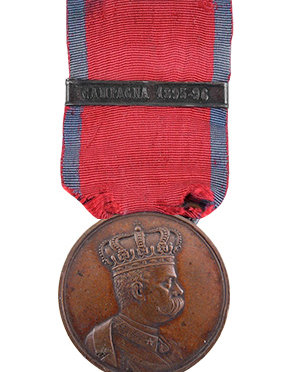
The Italian African Campaign Medal for the 1895-96 Campaign is an Italian Pre-WW1 medal awarded for the various Italian campaigns and battles to colonize part of North Africa in the late nineteenth century.

The medal was established on 3 November 1894.

The Italian African Campaign Medal Design

The medal is struck in bronze and has a diameter of 32 millimeters. It was awarded with a silver clasp reading the name of the corresponding campaign (for example, “Campagna 1895-96“).

The obverse bears the crowned bust of Umberto I facing right, crowned, and in military uniform. The reverse bears the inscription ‘CAMPAGNE D’AFRICA‘ within a laurel wreath.

The ribbon is 39 millimeters wide and red, with 6 mm blue edges. The medal is fitted with a fixed bar loop suspender and the two rectangular campaign bars slide over the ribbon.

The Italian Red Cross Medal of Merit

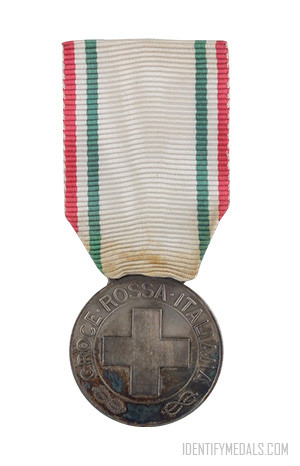
The Italian Red Cross Medal of Merit (Al merito della Croce Rossa) is an Italian award established in 1913 and awarded in three grades.

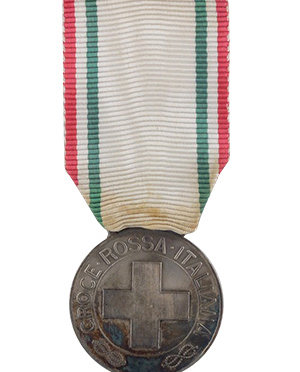
The Italian Red Cross Medal of Merit (or Medaglia al merito della Croce Rossa Italiana) is an Italian award established in 1913.

The medal was awarded in both peacetime and wartime. In peacetime, for particular merits or personal actions and for social commitment and organizational capacity. In wartime for those who have particularly distinguished themselves or worked for the Association in peace and humanitarian support operations in support of populations affected by armed conflict.

The medal was awarded in the following grades:

  • Gold Medal of Merit, awarded for services rendered in wartime in the area of ​​operations,
  • Silver Medal of Merit, awarded for services rendered in times of war in the area of ​​operations, and
  • Bronze medal of merit, awarded for services rendered in wartime in the area of ​​operations.
  • Diploma of Merit, awarded for services rendered in times of war in the area of ​​operations.

The Italian Red Cross Medal of Merit Design

The medal has a diameter of 34 millimeters and weighs about 16,67 grams. It was issued with a red case, with red fitted leatherette exterior.

The ribbon is white with narrow red, white, and green edges.

Find Red Cross Medals Online

More Red Cross Medals

The Blood Donor’s Medal

The Blood Donor’s Medal (Médaille de Donneur de Sang / Bloeddonor Medaille) is a Red Cross Belgian medal awarded for blood donations.

The Blood Donor’s Medal (Médaille de Donneur de Sang / Bloeddonor Medaille) is a Red Cross Belgian medal.

A circular bronze badge was awarded for 25 to 40 blood donations, a bronze medal for 40 to 60 donations and a silver medal for 60 to 80 donations.

Find Red Cross Medals Online

More Red Cross Medals

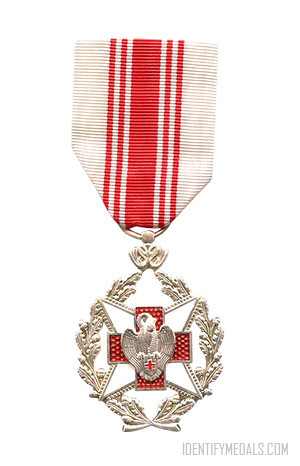
The Order of the Belgian Red Cross

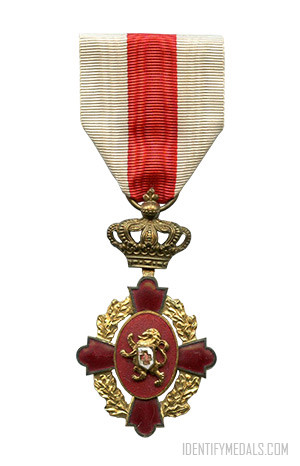
The Order of the Belgian Red Cross (Ordre de la Croix Rouge Belge / Orde van het Belgische Rode Kruis) was established in 1880.

The Order of the Belgian Red Cross (Ordre de la Croix Rouge Belge / Orde van het Belgische Rode Kruis) was established in 1880.

The award was produced in two classes: 1st class (gilt finish), and 2nd class (silver finish).

The Order of the Belgian Red Cross Design

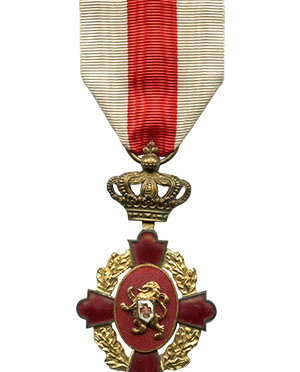
The medal is a red enamel cross patonce 37mm wide with an oak wreath set within the arms. The obverse bears a vertically elongate oval central medallion in red enamel bears the Belgian lion, with the red cross emblem on a small white shield superimposed. The reverse is similar, but with a plain central medallion in gilt or silver, suitable for engraving of the recipient’s details.

The ribbon measures 37 mm wide with a 12mm wide red central stripe for the 1st class award, or with two narrow red central stripes for the 2nd class award.

Find Red Cross Medals Online

More Red Cross Medals

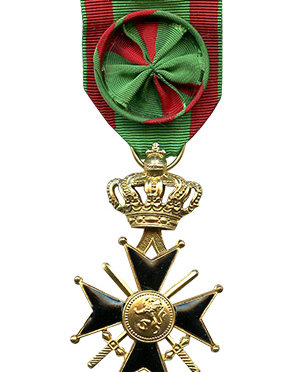
The Military Cross (Belgium)

The Military Cross (Croix Militaire / Militair Kruis) is a military long service decoration of Belgium established on 11 February 1885 by Royal Decree and awarded to commissioned officers in the Belgian Armed Forces for loyal and uninterrupted service or to Non-Belgian military officers for distinguished service in favor of the Military of Belgium.

The Military Cross, second class is awarded to Belgian military officers after 25 years of service. The Military Cross, first class is awarded to Belgian military officers after 25 years of service as a commissioned officer.

The award may be awarded to Commissioned Officers of non-Belgian armed forces for distinguished service towards the Belgian Defence. In such a case, the second class is awarded to officers below the rank of brigadier general. The first class is awarded to general officers.

The Military Cross Design

The award is a black enameled Maltese cross with a 1 mm gilt edge. The aarms end in eight 2 mm in diameter gilt spheres and gilt crossed swords pointing up are positioned between the arms of the cross.

The obverse central medallion bears the Belgian lion rampant, pre-1952, while the reverse bears the royal cipher of the reigning monarch. After 1952, the reverse is identical to the obverse.

The ribbon is green silk moiré and has two 5 mm wide red stripes set 1 mm from the ribbon’s edges. There’s a suspension ring passing through the orb of a pivot mounted crown.  The Military Cross First Class differs only from the second class award in the form of a rosette on the ribbon in the same colors as the ribbon.

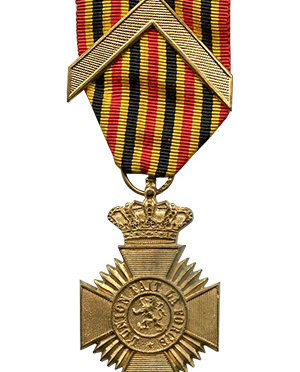
The Military Decoration for Exceptional Service

The Military Decoration (Décoration Militaire / Militaire Ereteken) is a military award of the Kingdom of Belgium established on December 23, 1873 and awarded to non-commissioned officers and other ranks of the Belgian Armed Forces for loyal and uninterrupted service.

The Decoration is awarded in two classes: Military personnel below the rank of Officer are awarded the second class after ten years of service. Five years after the award, they are awarded the first class of the medal.

The Military Decoration for Exceptional Service Design

The award is a gilt cross pattée surmounted by the royal crown of Belgium with four rays between the cross arms.

The obverse bears a circular central medallion with a Belgian lion and a circular relief inscription: “Unity makes Strength” in French (“l’union fait la force”) or Dutch (since July, 8, 1952, “eendracht maakt macht”). The reverse is identical except for the central medallion, which bears the royal monogram of the reigning monarch surrounded by the relief inscription “ARMÉE * MÉRITE * ANCIENNETÉ” (“ARMY * MERIT * SENIORITY“).

Since July, 8, 1952, only a Belgian lion is depicted, without surrounding text or reference to the reigning monarch.

The ribbon is silk moiré of seventeen alternating longitudinal stripes of red, yellow and black. The medal is suspended by a ring through the suspension loop. A gilt inverted metal chevron is affixed to the ribbon of the award first class.

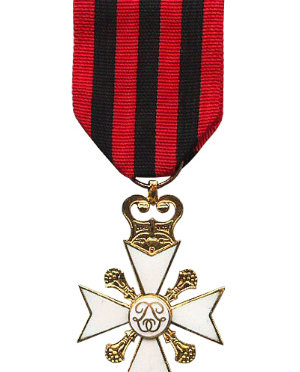
The Civic Decoration (Belgium)

The Civic Decoration (Décoration Civique / Burgerlijke Ereteken) is a civilian decoration of the Kingdom of Belgium first established on 21 July 1867 by royal decree to reward exceptional acts of bravery, devotion or humanity.

A second royal decree of 15 January 1885 extended the award to state civil servants for long service, and it was once more amended by royal decree in 1902 to include long service in the Civic Guard and firefighters.

Two wartime variants were created to reward civilians who distinguished themselves during the World Wars.

The Civic Decoration is awarded in two categories:

  • The Civic Cross (First and a Second Class),
  • The Civic Medal (First, Second and Third Class).

The Civic Decoration Design

The badge of the Civic Cross is a white enameled maltese cross with the central medallion bearing the monogram of King Leopold I or of King Albert I on the obverse and reverse. Between the arms of the Cross are:

  • Crossed swords for the Civic Cross 1914–1918.
  • Crossed flaming torches for the Civic Cross 1940–1945.
  • A Burgundy Cross for the Civic Cross for administrative services and for services as a firefighter.

The ribbons differ with the type of award:

  • For long and distinguished service in the administration: Red with three vertical black stripes.
  • For exceptional acts of bravery, devotion or humanity: Red with two vertical black stripes bordered on each side by a yellow line.
  • For long and distinguished service as a firefighter: Green with two vertical white stripes.
  • For the 1914–1918 award: Pale green with vertical black, yellow and red stripes on each edge and a central vertical gold stripe.
  • For the 1940–1945 award: Saffron with vertical black, yellow and red stripes on each edge and a central vertical black stripe.