The Württemberg Military Merit Order

The Military Merit Order (Militärverdienstorden) was a military order of the Kingdom of Württemberg, which joined the German Empire in 1871.

The Military Merit Order (or Militärverdienstorden in German) was a military order of the Kingdom of Württemberg, which joined the German Empire in 1871.

The order was one of the older military orders of the states of the German Empire. It was founded on February 11, 1759 by Karl Eugen, Duke of Württemberg as the Militär-Carls-Orden, and was renamed the Militärverdienstorden on November 11, 1806 by King Friedrich I. The order underwent several more revisions over the course of the 19th and early 20th centuries. It became obsolete with the fall of the Württemberg monarchy in the wake of Germany’s defeat in World War I.

The order came in three classes. Generally, the rank of the recipient determined which grade he would receive:

  • Grand Cross (Großkreuz)
  • Commander’s Cross (Kommandeurkreuz) and
  • Knight’s Cross (Ritterkreuz).

Between 1799 and 1919, there were an estimated 95 awards of the Grand Cross, 214 of the Commander’s Cross, and 3,128 of the Knight’s Cross, with the bulk of these awards made in World War I; the numbers may only cover native Württembergers.

The Württemberg Military Merit Order Design

The badge of the order was a white-enameled gold cross pattée with curved arms and slightly concave edges. Around the white-enameled center medallion was a blue-enameled gold ring bearing on both sides the motto “Furchtlos und trew” (“Fearless and loyal”).

On the obverse, the medallion bore a green-enameled gold laurel wreath. On the reverse, the medallion bore the monogram of the king of Württemberg at the time of award. The cross was the same size for the Grand Cross and the Commander’s Cross, and slightly smaller for the Knight’s Cross. The Grand Cross and Commander’s Cross, and from 1870 the Knight’s Cross, were topped with a crown. On September 25, 1914, the crown was removed from all grades.

The star of the order, awarded with the Grand Cross only, was a gold-rimmed silver eight-pointed star featuring the ringed medallion of the obverse of the cross.

The ribbon of the order was, until 1818 and after 1914, yellow with broad black stripes near each edge. After November 1917, when the ribbon was worn without the medal, the ribbon bore a green-enameled wreath to distinguish it from other Württemberg decorations on the same ribbon. The ribbon from 1818 to 1914 was blue.

Buy This Medal Online

Right Now on eBay 
Clicking a link to eBay may result in a referral commission being paid if a purchase is made.
Loading...

The Fidelity Medallion

The Fidelity Medallion or André Capture Medal was created in 1780 and is the oldest decoration of the United States military.

The Fidelity Medallion was created by act of the Continental Congress in 1780 and is the oldest decoration of the United States military. Also known as the “André Capture Medal“, the Fidelity Medallion was awarded to those soldiers who participated in the capture of Major John André, of the British army, who had been the contact to Benedict Arnold and had helped organize his defection.

Historical records indicate that three soldiers, all members of the militia of New York state, were awarded the Fidelity Medallion after its first issuance:

The Fidelity Medallion was never again bestowed and it quickly became regarded as a commemorative decoration. For this reason, the Badge of Military Merit is generally considered the first decoration of the U.S. military, even though it was created two years after the Fidelity Medallion, in 1782.

All three of the original Medallions were thought to be lost. Isaac Van Wart’s example was thought to be lost at the time of his death in 1828, but is actually in the hands of a descendant in Westchester County, NY. John Paulding’s and David Williams’ medallions were both donated to the New-York Historical Society in 1905 which displayed them in a locked, glass-topped case. In mid-1975, the two Medallions were stolen, along with the pocket watch originally belonging to Major John André. The Historical Society did not go public with the loss at the time, and none of the items have been recovered.

The Fidelity Medallion Design

The Fidelity Medallion measures 55mm. x 41mm. The obverse of the medallion was inscribed “Fidelity“; the reverse, with the motto, “Amor Patriæ Vincit“, which means, “The love of country conquers.”

In the two centuries since the original Fidelity Medallions were issued, replicas have occasionally been produced in metals including silver, pewter, lead and bronze and in varying degrees of historical accuracy. The American Numismatic Society has six different specimens in their collection.

The Badge of Military Merit

The Badge of Military Merit is considered the first military award of the U.S. Armed Forces. Its official successor is The Purple Heart.

The Badge of Military Merit is considered the first military award of the United States Armed Forces. The Purple Heart is its official successor decoration.

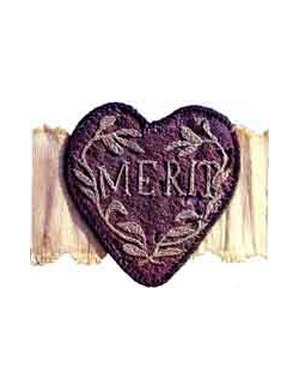
The Badge of Military Merit was first announced in General George Washington‘s general orders to the Continental Army issued on August 7, 1782 at the Headquarters in Newburgh. Designed by Washington in the form of a purple heart, it was intended as a military order for soldiers who exhibited, “not only instances of unusual gallantry in battle, but also extraordinary fidelity and essential service in any way.”

This is thought to be the first time in modern history that military awards had been presented to common soldiers. The practice in Europe was to honor high-ranking officers who had achieved victory, rather than honoring common soldiers. But in America, as General Washington said, the “road to glory in a patriot army and a free country is…open to all.”

Most historians indicate that only three people received the Badge of Military Merit during the American Revolutionary War, all of them non-commissioned officers, and the only ones who received the award from General Washington himself.

Those soldiers are:

On May 3, 1783

On June 10, 1783

Of the Badge of Military Merit, Washington said:

The General ever desirous to cherish virtuous ambition in his soldiers, as well as to foster and encourage every species of Military merit, directs that whenever any singularly meritorious action is performed, the author of it shall be permitted to wear on his facings over the left breast, the figure of a heart in purple cloth, or silk, edged with narrow lace or binding. Not only instances of unusual gallantry, but also of extraordinary fidelity and essential service in any way shall meet with a due reward. Before this favour can be conferred on any man, the particular fact, or facts, on which it is to be grounded must be set forth to the Commander in chief accompanied with certificates from the Commanding officers of the regiment and brigade to which the Candadate for reward belonged, or other incontestable proofs, and upon granting it, the name and regiment of the person with the action so certified are to be enrolled in the book of merit which will be kept at the orderly office. Men who have merited this last distinction to be suffered to pass all guards and sentinals which officers are permitted to do. The road to glory in a patriot army and a free country is thus open to all. This order is also to have retrospect to the earliest stages of the war, and to be considered as a permanent one.

The Badge of Military Merit Medal Design

The medal was designed by Washington in the form of a purple heart. The writings of General Washington indicate that three badges, two Honorary Badges of Distinction and a Badge of Military Merit, were created on August 7, 1782. 

Brown’s badge (image above) was found in a Deerfield, New Hampshire barn in the 1920s. There is disagreement in published sources about what became of Brown’s badge after that. A badge on display at the American Independence Museum in Exeter, New Hampshire on behalf of the Society of the Cincinnati, New Hampshire Branch is stated to be Brown’s. Other sources say that Brown’s badge was reported lost in 1924 while in the possession of Bishop Paul Matthews, and that the badge on display in Exeter belongs to a fourth, unknown recipient.

As of 2015, Churchill’s badge was owned by the National Temple Hill Association and on display at the New Windsor Cantonment State Historic Site. Churchill’s badge was rediscovered when H. E. Johnson, a Michigan farmer and one of Churchill’s descendants, wrote to the National Temple Hill Association about the badge.

Bissell’s badge was reportedly lost when his house burned in July 1813.

The Imperial Order of Guadalupe

The Imperial Order of Guadalupe (originally known as “National Order of Our Lady of Guadalupe”) was established by Emperor Agustín I of Mexico in the fall of 1821 – although its statutes would not be published until February 1822.

The order was originally divided into two classes: Grand Cross and Numerary Member. After the death of the Agustin I, the Order fell out of use and remained inactive for 30 years until Antonio López de Santa Anna convinced Pope Pius IX to recognize it in 1854. It fell into disuse again in August of that same year after the successful Ayutla Revolution and the ousting of Santa Anna from government.

The third and last period of the Order began on June 30, 1863, before the arrival of Maximilian I, by decree of the Provisional Imperial Government. Maximilian I modified the statutes of the Order for the last time on April 10, 1865, renaming the order “Imperial” (instead of “National”) and divided it into four ranks, each with civilian and military divisions:

  • Grand Cross, limited to 30 recipients.
  • Grand Officer, limited to 100 recipients.
  • Commander, limited to 200 recipients.
  • Knight, limited to 500 recipients.

The Order of St. Sava

The Order of St. Sava was a decoration of merits established originally to recognize civilians for meritorious achievements to the Church, to arts and sciences, the royal house and the state and awarded by the Kingdom of Serbia, the Kingdom of Serbs, Croats and Slovenes and the Kingdom of Yugoslavia from 1883 to 1945.

The Order of St Sava was then awarded by the king of Yugoslavia until the abolishment of the monarchy in 1945.

Since 1985, the Order has been awarded on the occasion of the 800th anniversary of St. Sava. This order is dedicated to ecclesiastic and secular persons, who have special merits for the Serbian Orthodox Church. According to the ordinance of the church, each person who received a medal of third grade, may receive the medal of the higher grade as well as the first grade for future merits, provided that three years have passed at least since the previous award.

The Order of St. Sava Design

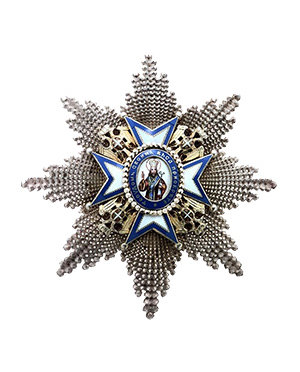
Five grades were awarded: Grand Cross, Grand Officer, Commander, Officer and Knight.

The first grade was a medal, worn with a sash over a shoulder and additionally with a breast star. The second and third grade laureates wore the Order with a neckband. The fourth grade with a triangular suspension, a rosette was attached to the ribbon above the medal. The fifth grade had a triangular suspension without a rosette. The medals of the fourth and fifth grades were worn on the breast. All white ribbons had two light blue stripes.

The order is determined in three grades: the first one is white, the second red and the third blue colored.

The Order of the White Eagle (Serbia)

Order of the White Eagle was a Royal Order in the Kingdom of Serbia (1883–1918) and the Kingdom of Yugoslavia (1918–1945) instituted by King Milan I of Serbia on 23 January 1883. In the period between 1883 and 1898 Order of the White Eagle was the highest award in the Kingdom of Serbia.

The Order had five classes and was conferred on Serbian and Yugoslav citizens for achievements in peace or war, or for special merits to the Crown, the state and nation.  In 1898 the Royal Order of Miloš the Great took precedence over the White Eagle and in 1904 the former was replaced by the Order of the Karađorđe’s Star.

After his accession to the throne in 1903, King Peter I of Serbia continued awarding the Order of the White Eagle, but the reverse of the medallion had the year of the proclamation of the Kingdom (1883) instead of the cipher of Milan I.

The Order is conferred by the Crown. Recent awards include last Grand Master of the Sovereign Order of St. John (Fr. Angelo de Mojana di Cologna), as well as posthumous conferment upon three Crown Council Members.

The Order of the White Eagle Design

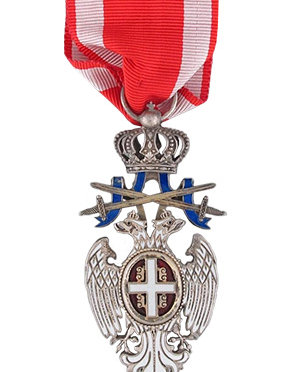
The Order of the White Eagle is made in silver gilt with red, white and blue enamels. It measures 31.8 mm (w) x 68 mm (h) inclusive of its crown suspension.

The Order had five degrees, and could be awarded with swords for the military services, with or without swords for civil merit. The classes were:

  • SRB-SHS-YUG Orden Belog Orla VKrst BAR.svg 1st Class – Grand Cross
  • SRB-SHS-YUG Orden Belog Orla VOficir BAR.svg 2nd Class – Grand Officer’s Cross
  • SRB-SHS-YUG Orden Belog Orla Komandir BAR.svg 3rd Class – Commander’s Cross
  • SRB-SHS-YUG Orden Belog Orla Oficir BAR.svg 4th Class – Officer’s Cross
  • SRB-SHS-YUG Orden Belog Orla Kavalir BAR.svg 5th Class – Knight’s Cross

The sash of the Order is worn from the left shoulder to the right hip.

The Order of Karađorđe’s Star

The Order of Karađorđe’s Star (or Orden Karađorđeve zvezde in Serbian) is Serbia’s highest civilian and military decoration and was instituted by the royal decree of King Peter I on 1 January 1904, commemorating his recent accession to the Serbian throne as well as the one-hundredth anniversary of the First Serbian Uprising.

The medal originated in the Kingdom of Serbia, and was initially awarded exclusively to Serbian citizens in return for services rendered to the Serbian monarchy, the Serb people and the Serbian state, though it is now bestowed upon Serbs and non-Serbs alike. During the Balkan Wars and World War I, the Order was mostly awarded for acts of bravery on the battlefield.

Following the breakup of Yugoslavia, Serbia ceased using many of the awards and decorations established during the communist period, though it was not until 2010 that the Serbian Government officially reinstated the Order of Karađorđe’s Star as Serbia’s highest decoration.  In February 2012, tennis player Novak Djokovic became the first person to receive the Order after it was reinstated.

The Order of Karađorđe’s Star Design

The Order comes in either gold or silver depending on class. The medals themselves were originally manufactured by foreign makers of decorations and medals, such as France’s Arthus-Bertrand and Switzerland’s Huguenin Fréres; during the interwar period (1919–39) they were produced domestically.

The obverse features a white enameled cross pattée with gilt rays protruding from each of the arms and intersected diagonally by a pair of sabers when the recipient is awarded an Order “with swords”. Orders from the royal period contain a blue medallion at the center depicting a Serbian cross with a fire-steel at each corner, with the words “For Faith and Freedom, 1804” etched into the small circle in the middle of the cross.

The reverse of the Order contains a red medallion depicting a white eagle, with the words “Peter I, 1904” written around it.

The bravery medals awarded from June 1915 forward are almost identical to the Orders awarded before that date, save for the crossed swords being present on all of them regardless of class. Such Orders also lacked the phrase etched into the obverse of the older ones and the date 1904 on the reverse, which marked the centenary of the First Serbian Uprising. Instead, they merely had King Peter’s name on the obverse beside the year when the Order was bestowed.

The Star for Naval Merit (Mexico)

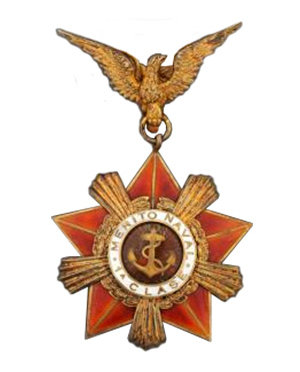
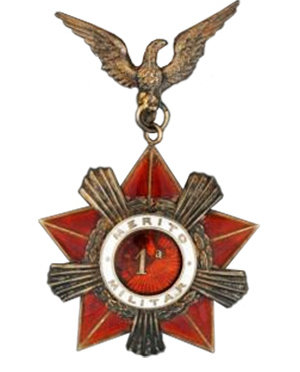
The Star for Military Merit was a medal issued during the twentieth century for the suppression of revolts and for general military service as the Mexican army put down rebellions by Mayan Indians.

In Spanish colonial times, the Yucatán (like most of New Spain) population operated under a legal caste system: peninsulares (officials born in Spain) were at the top, the criollos of Spanish descent in the next level, followed by the mestizo population (of mixed European-Amerindian descent), then descendants of the natives who had collaborated with the Spanish conquest of Yucatán, and at the bottom were the other native indios.

The Caste War of Yucatán (1847–1901) began with the revolt of native Maya people of Yucatán, Mexico against the European-descended population, called Yucatecos. The latter had long held political and economic control of the region. A lengthy war ensued between the Yucateco forces in the north-west of the Yucatán and the independent Maya in the south-east.

The war officially ended in 1901 when the Mexican army occupied the Maya capital of Chan Santa Cruz and subdued neighboring areas. Another formal end was made in 1915, when a Mexican general was sent to subdue the territory. However, skirmishes with small settlements that refused to acknowledge Mexican control continued until 1933.

The Star for Military Merit (Mexico)

The Star for Military Merit was a medal issued during the twentieth century for the suppression of revolts and for general military service as the Mexican army put down rebellions by Mayan Indians.

In Spanish colonial times, the Yucatán (like most of New Spain) population operated under a legal caste system: peninsulares (officials born in Spain) were at the top, the criollos of Spanish descent in the next level, followed by the mestizo population (of mixed European-Amerindian descent), then descendants of the natives who had collaborated with the Spanish conquest of Yucatán, and at the bottom were the other native indios.

The Caste War of Yucatán (1847–1901) began with the revolt of native Maya people of Yucatán, Mexico against the European-descended population, called Yucatecos. The latter had long held political and economic control of the region. A lengthy war ensued between the Yucateco forces in the north-west of the Yucatán and the independent Maya in the south-east.

The war officially ended in 1901 when the Mexican army occupied the Maya capital of Chan Santa Cruz and subdued neighboring areas. Another formal end was made in 1915, when a Mexican general was sent to subdue the territory. However, skirmishes with small settlements that refused to acknowledge Mexican control continued until 1933.

The Cross for the Yucatán

The Cross for the Yucatán was issued for the suppression of revolts and for general military service as the army put down rebellions. 

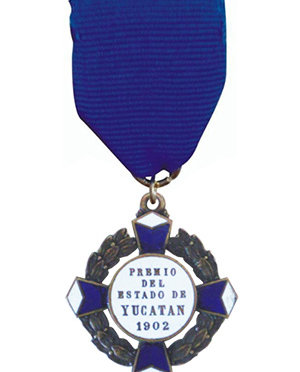
The Cross for the Yucatán was a medal issued during the twentieth century for the suppression of revolts and for general military service as the Mexican army put down rebellions by Mayan Indians.

In Spanish colonial times, the Yucatán (like most of New Spain) population operated under a legal caste system: peninsulares (officials born in Spain) were at the top, the criollos of Spanish descent in the next level, followed by the mestizo population (of mixed European-Amerindian descent), then descendants of the natives who had collaborated with the Spanish conquest of Yucatán, and at the bottom were the other native indios.

The Caste War of Yucatán (1847–1901) began with the revolt of native Maya people of Yucatán, Mexico against the European-descended population, called Yucatecos. The latter had long held political and economic control of the region. A lengthy war ensued between the Yucateco forces in the north-west of the Yucatán and the independent Maya in the south-east.

The war officially ended in 1901 when the Mexican army occupied the Maya capital of Chan Santa Cruz and subdued neighboring areas. Another formal end was made in 1915, when a Mexican general was sent to subdue the territory. However, skirmishes with small settlements that refused to acknowledge Mexican control continued until 1933.