The Medal for the Greco-Turkish War of 1912-13

  • Time Period: Pre-WW1
  • Year of Institution: 1914
  • Country: Greece

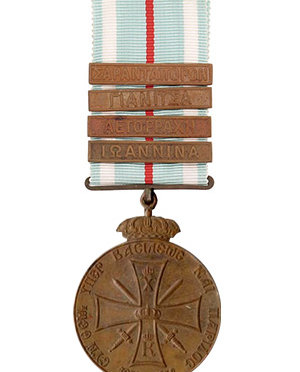
The Medal for the Greco-Turkish War of 1912-13 is a Greek medal instituted in 1914 and awarded to men of all armed forces who took part in battles or Naval battles or served in commandeering and auxiliary services on battle-sites, and also to civilians, either Greek or foreign subjects, who offered any kind of service to the Navy during the battles.

During the 1st Balkan War the alliance of Greece, Bulgaria, Montenegro and Serbia liberated the remaining Christian populations of the European territories from the Ottoman Empire. The War ended with the Treaty of London in 1913 but soon the 2nd Balkan War started, this time against Bulgaria.

The Medal for the Proclamation of the Constitution of 1843

  • Time Period: Pre-WW1
  • Year of Institution: 1843
  • Country: Greece

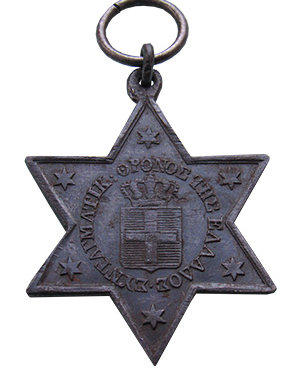
The Medal for the Proclamation of the Constitution of 1843 was created on September 3, 1843 and it also known as the Cross of the Provinces.

On 3 September 1843, the military garrison of Athens, with the help of citizens, rebelled and demanded from King Otto the concession of a Constitution. The Constitution that was proclaimed in March 1844 came from the workings of the “Third of September National Assembly of the Hellenes in Athens” and was a Constitutional Pact, in other words a contract between the monarch and the Nation. This Constitution re-established the Constitutional Monarchy and was based on the French Constitution of 1830 and the Belgian Constitution of 1831.

Its main provisions were the following: It established the principle of monarchical sovereignty, as the monarch was the decisive power of the State; the legislative power was to be exercised by the King – who also had the right to ratify the laws – by the Parliament, and by the Senate. The members of the Parliament could be no less than 80 and they were elected for a three-year term by universal suffrage. The senators were appointed for life by the King and their number was set at 27, although that number could increase should the need arise and per the monarch’s will, but it could not exceed half the number of the members of Parliament.

The ministers’ responsibility for the King’s actions is established, who also appoints and removes them. Justice stems from the King and is dispensed in his name by the judges he himself appoints.

Lastly, this Assembly voted the electoral law of 18 March 1844, which was the first European law to provide, in essence, for universal suffrage (but only for men).

Despite the fact that Otto accepted the establishment of a Constitutional regime, he was not inclined to enforce it and by breaking both the spirit and the letter of the Constitution he tried to gather as much power as he possibly could. On the night of 10 October 1862 the rising wave of discontent led the people and the military to rebel and to decide Otto’s deposition.

The Cross for the Bavarian Auxiliary Corps

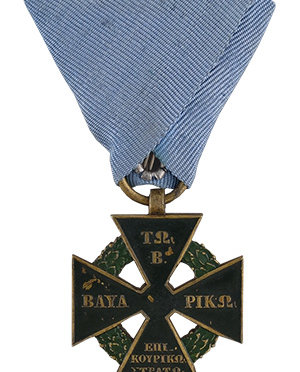
The Cross of the Bavarian Auxiliary Corps medal was created on November 22, 1833 and awarded to 3582 members of the Bavarian Auxiliary Corps who escorted King Otho I (the young Prince Otho of Bavaria) from his native Bavaria to Greece in that same year.

The Royal Bavarian Auxiliary Corps (or Β. Βαυαρικό Επικουρικό Σώμα in GreekKgl. Bayerisches Hilfskorps in German) was a Bavarian Army expeditionary force established in 1832 to accompany Prince Otto as the first king of independent Greece in 1833, to serve as a military force and enforce order until a native military could be established. It replaced the forces maintained there by the Great Powers—chiefly the French troops of the Morea Expedition—as well as the remnants of the Greek forces organized during the Greek War of Independence.

Most of the Bavarians left by 1837, but many remained behind, dominating the Greek army and the administration. This “Bavarocracy” (Βαυαροκρατία) provoked great resentment from the Greeks, and was one of the chief causes of the 3 September 1843 Revolution. Many Bavarians remained behind in Greece and became Greek citizens.

The Cross for the Bavarian Auxiliary Corps Design

The bronze and lacquer Cross features an obverse inscription that translates to “Othon King of the Hellenes,” and a reverse inscription that translates to “To the Royal Bavarian Auxiliary Corps.”

It measures 32.7mm x 37.5mm.

The Cross for the War of Independence 1821-1829

  • Time Period: Pre-WW1
  • Year of Institution: 3 September 1843
  • Country: Greece

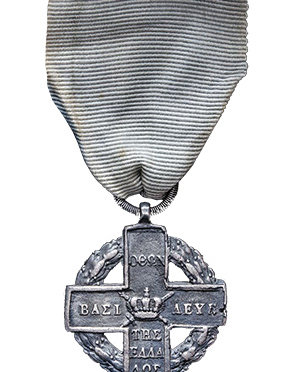
The Cross for the War of Independence 1821-1829 medal is was created in 1834 to be awarded to all those who took part in the Struggle for the Independence of Greece, or the Greek War of Independence.

Its final form and way of conferring were confirmed by the National Assembly of the 3rd of September 1843.

The Greek War of Independence, also known as the Greek Revolution (or Ελληνική ΕπανάστασηElliniki Epanastasi in Greek), was a successful war of independence waged by Greek revolutionaries against the Ottoman Empire between 1821 and 1830. The Greeks were later assisted by the Russian Empire, Great Britain, and the Kingdom of France, while the Ottomans were aided by their North African vassals, the eyalets of Egypt, Algeria, and Tripolitania, and the Beylik of Tunis.

The Cross for the War of Independence 1821-1829 Design

The medal is struck in bronze or silver and weights 11,1 grams. It measures 31 mm.

The Order of the Indian Empire

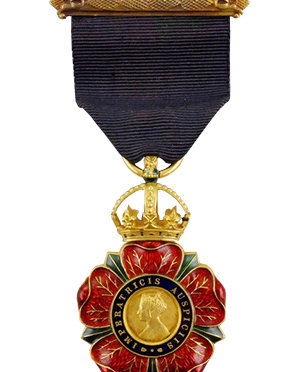
The Most Eminent Order of the Indian Empire is a British order of chivalry founded by Queen Victoria in 1878.

The Most Eminent Order of the Indian Empire is an order of chivalry founded by Queen Victoria in 1878. The motto of the Order is Imperatricis auspiciis, (Latin for “Under the auspices of the Empress“), a reference to Queen Victoria, the first Empress of India. The Order is the junior British order of chivalry associated with the British Indian Empire; the senior one is The Most Exalted Order of the Star of India.

The British founded the Order in 1878 to reward British and native officials who served in India. The Order originally had only one class (Companion), but expanded to comprise two classes in 1887. On 15 February 1887, the Order of the Indian Empire formally became “The Most Eminent Order of the Indian Empire” and was divided into two classes: Knights Commander and Companions, with the following first Knights Commander.

The British Sovereign serves as the Sovereign of the Order. The Grand Master held the next-most senior rank; the position was held, ex officio, by the Viceroy of India. Members of the first class were known as “Knights Grand Commanders” rather than “Knights Grand Cross” so as not to offend the non-Christian Indians appointed to the Order.

No appointments have been made since 1947, the year that India and Pakistan became independent from the British Raj. With the death of the last surviving knight, the Maharaja of Dhrangadhra, the order became dormant in 2010.

The Order of the Indian Empire Design

Members of the Order wore elaborate costumes on important ceremonial occasions:

  • The mantle, worn only by Knights Grand Commanders, comprised dark blue satin lined with white silk. On the left side was a representation of the star (see photo at right).
  • The collar, also worn only by Knights Grand Commanders, was made of gold. It was composed of alternating golden elephants, Indian roses and peacocks.

At less important occasions, simpler insignia were used:

  • The star, worn only by Knights Grand Commanders and Knights Commanders, had ten points, including rays of gold and silver for Knights Grand Commanders, and of plain silver for Knights Commanders. In the center was an image of Victoria surrounded by a dark blue ring with the motto and surmounted by a crown.
  • The badge was worn by Knights Grand Commanders on a dark blue riband, or sash, passing from the right shoulder to the left hip, and by Knights Commanders and Companions from a dark blue ribbon around the neck. It included a five-petaled crown-surmounted red flower, with the image of Victoria surrounded by a dark blue ring with the motto at the center.

The insignia of most other British chivalry orders incorporates a cross: the Order of the Indian Empire does not in deference to India’s non-Christian tradition.

The Royal Order of George I

  • Time Period: Pre-WW1
  • Year of Institution: 16 January 1915
  • Country: Greece

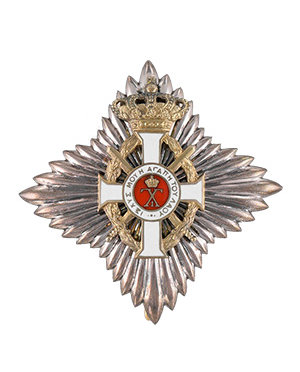
The Royal Order of George I (or Βασιλικόν Τάγμα Γεωργίου Α’) is a Greek order instituted by King Constantine I in 1915 in honor of his father, George I. Since the monarchy’s abolition in 1973, it is considered a dynastic order of the former Greek royal family.

The Order was only the second Greek order to be created after the Order of the Redeemer in 1833 and remained the second senior award of the Greek state for the duration of its existence. The order was closely associated with the Greek monarchy and was hence abolished with the establishment of the Second Hellenic Republic in 1924. The order was restored along with the monarchy in 1935, and continued to be awarded until the final abolition of the monarchy in 1973.

The Order of George I Design

The badge of the Order is a white-enameled Latin cross pattée, in silver for the Silver Cross class, in gold for the higher classes, with a wreath of laurels between the arms of the cross.

The obverse central disc was in red enamel, bearing the royal cypher of George I, two crossed gammas with a crown above and a “I” below, surrounded by a white enamel ring bearing the royal motto ΙΣΧΥΣ ΜΟΥ Η ΑΓΑΠΗ ΤΟΥ ΛΑΟΥ (“The Love of My People is My Strength”). The reverse central disc bears the years of George I’s reign, 1863-1913. The badge is topped by a crown; the military division also had crossed swords behind the badge. The Commemorative Medal’s badge is identical in design, except that the cross is not enameled.

The star of the order is a silver star with straight rays, with eight points for Grand Cross and four points for Grand Commander, and with the obverse of the badge superimposed upon it.

The ribbon of the Order is plain crimson red.

The Cross of Valor (Greece)

The Cross of Valour is the second highest military decoration of the Greek state, awarded for acts of bravery or distinguished leadership.

  • Time Period: Pre-WW1
  • Year of Institution: 13 May 1913
  • Country: Greece

The Cross of Valor (or Αριστείον ΑνδρείαςAristeion Andreias, “Gallantry/Bravery Award“) is the second highest military decoration of the Greek state, awarded for acts of bravery or distinguished leadership on the field of battle.

It has been instituted three times, first on 13 May 1913 during the Balkan Wars but not issued until 1921 during the Greco-Turkish War of 1919–1922, then on 11 November 1940 shortly after the outbreak of the Greco-Italian War and finally in 1974.

The award was liberally distributed during the campaigns of 1921–1922: from the first awards in July 1921 to the end of the war in August 1922. The Cross of Valor continued to be awarded for actions during the Greek Civil War and for the Greek participation in the Korean War, as well as for a few cases from World War II, from 1947 to 1955.

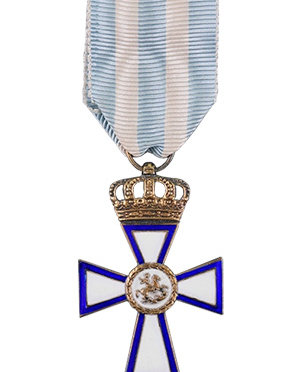
The Royal Decree of 31 March 1921 instituted the Cross of Valor in three grades: Commander’s Cross (Σταυρός Ταξιάρχη), worn as a badge on a necklet, and the Gold Cross (Χρυσούς Σταυρός) and Silver Cross (Αργυρός Σταυρός), worn as badges on chest ribbons. No limit was set on the number of awards in each grade.

The Cross of Valor Design

The design of the badge was specified as a “crowned cross, bearing in the middle of the obverse side, in a circle of narrow laurel leaves, the image of St. Demetrios, while on the middle of the reverse side in a similar circle it bears the words ΑΞΙᾼ (“for valor” in Greek)”.

The Silver Cross was to be made entirely of silver, while the Gold and Commander’s crosses were enameled in white with blue edges. The ribbon consists of five pale blue and white stripes. For each repeat award, a silver 4-millimeter star was added to the ribbon.

For World War II awards, a bar with “1940” was placed on the ribbon to distinguish it from the earlier 1913 version.

The Order of the Redeemer

The Order of the Redeemer is an order of merit of Greece and the oldest and highest decoration awarded by the modern Greek state.

  • Time Period: Pre-WW1
  • Year of Institution: 1829
  • Country: Greece

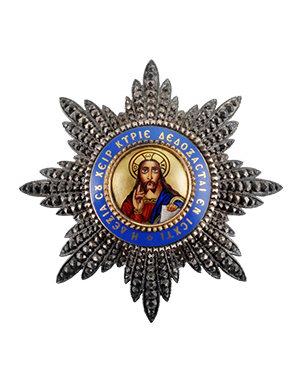
The Order of the Redeemer (or Τάγμα του Σωτήρος, Tágma tou Sotíros), also known as the Order of the Saviour, is an order of merit of Greece and the oldest and highest decoration awarded by the modern Greek state.

According to the original decree, the Order was to be awarded to those Greek citizens who partook in the War of Independence, or “who should distinguish themselves henceforth in any branch of public service, in the army and navy, in the diplomatic and judicial corps, in public administration, in the arts, science, agriculture and industry, commerce, or should distinguish themselves in any other social field through outstanding civic virtue, and through illustrious services to the Throne, for the Glory of the Hellenic name and for the welfare of the fatherland”, while foreigners were admitted either for past services to Greece, or due to their ability “to bring honour to the Order, through their outstanding personal virtues and excellence“.

The Order was established by the Fourth National Assembly at Argos in 1829, during the final year of the Greek War of Independence. The decision was not immediately implemented, however, and the relevant decree was signed on May 20, 1833. According to the decree of the establishment, the name of the Order “shall recall the, by divine assistance miraculously and fortuitously accomplished, the salvation of Greece“.

The Order of the Redeemer has five classes:

  • GRE Order Redeemer 1Class.png Grand Cross (‘Μεγαλόσταυρος’) – wears the badge of the Order on a sash on the right shoulder, and the star of the Order on the left chest;
  • GRE Order Redeemer 2Class.png Grand Commander (‘Ανώτερος Ταξιάρχης’) – wears the badge of the Order on a necklet, and the star of the Order on the left chest;
  • GRE Order Redeemer 3Class.png Commander (‘Ταξιάρχης’) – wears the badge of the Order on a necklet;
  • GRE Order Redeemer 4Class.png Gold Cross (‘Χρυσούς Σταυρός’) – wears the badge on a ribbon on the left chest;
  • GRE Order Redeemer 5Class.png Silver Cross (‘Αργυρούς Σταυρός’) – wears the badge on a ribbon on the left chest.

The Order of the Redeemer Medal Design

The form of the various insignias has been altered a number of times since the establishment of the order, the most obvious change being the removal of the crown during the periods of Republican rule.

The original decree of 1833 described the badge of the Order as consisting of a white enamelled Maltese cross (silver for the Silver Cross, gold for the higher grades), surmounted by a crown, set on a green enamelled wreath, one half of which is an oak branch and the other half a laurel branch.

The obverse featured a white cross on a blue background (the coat of arms of Greece) with Otto’s Bavarian arms in an inescutcheon in the centre, surrounded by this inscription on an outer ring: Η ΔΕΞΙΑ ΣΟΥ ΧΕΙΡ, ΚΥΡΙΕ, ΔΕΔΟΞΑΣΤΑΙ ΕΝ ΙΣΧΥΙ (“Thy right hand, O Lord, is become glorious in power”, Exodus, 15:6). The reverse featured a portrait of Otto with the circular inscription: ΟΘΩΝ, ΒΑΣΙΛΕΥΣ ΤΗΣ ΕΛΛΑΔΟΣ (“Otto, King of Greece”).

After Otto’s deposition in 1863, his portrait was removed and substituted by an icon of Jesus, the Redeemer of Orthodox Christian soteriology.

The Davis Guard Medal

The Davis Guard Medal is a military decoration bestowed by the State of Texas for the victory at the Second Battle of Sabine Pass.

The Davis Guard Medal is a military decoration bestowed by the State of Texas to the members of F Battery, 1st Texas Heavy Artillery Regiment, for the victory at the Second Battle of Sabine Pass. Some consider it to be the only medal issued by the Confederate States of America during the war.

The award was funded by a collection from Houston citizens. It was presented as a one-time award to exactly 50 men. In addition to the 49 members of the battery, the award was also presented to Jefferson Davis as the unit’s honorary commander. President Davis had his medal on him at the time of his capture in May 1865, but it was stolen by a Union soldier. A replacement was given him by three veterans in 1875.

The Davis Guard Medal Design

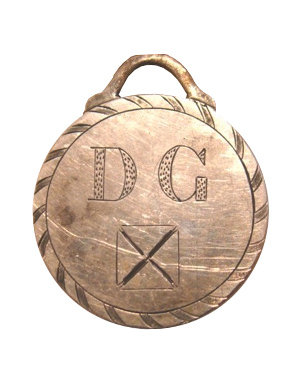
The medal consisted of a silver Mexican coin polished smooth with the letters “DG” on the front above a cross pattee. The reverse bore the inscription “Sabine Pass Sept. 23, 1864” in cursive script.

The medal hung from a green ribbon, in honor of the Irish origins of the unit’s members. The 50 recipients of the Davis Guard Medal were also listed on the Confederate Roll of Honor.

The Order of the Zähringer Lion

The Order of the Zähringer Lion was instituted on 26 December 1812 by the Grand Duke of Baden in memory of the Dukes of Zähringen.

The Order of the Zähringer Lion was instituted on 26 December 1812 by Karl, Grand Duke of Baden, in memory of the Dukes of Zähringen from whom he was descended.

It remains a very high-level award, sitting just above the Commander’s Cross (a neck order) and the Knight’s Crosses (1st and 2nd Class).

The Grand Duchy of Baden was formed in 1806 during the Napoleonic Wars. Its location on France’s southeastern border led to its devastation when it opposed the French Empire. Its two final Grand Dukes were Friedrich I (1826-1907), who reigned from 1856-1907 and his son, Friedrich II (1856-1928), who reigned from 1907 to the Empire’s end in 1918.

The Order of the Zähringer Lion was awarded in five classes:

  • Grand Cross;
  • Commander, First Class;
  • Commander, Second Class;
  • Knight, First Class; and
  • Knight, Second Class.

A total of 763 of this Order of the Zähringer Lion Grand Cross were awarded between 1815 and 1918.

The Order of the Zähringer Lion Design

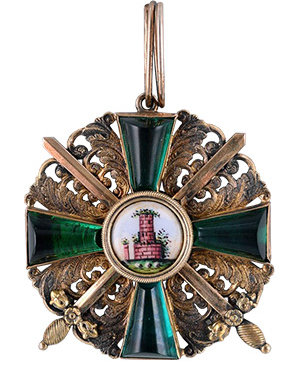
The order’s insignia measures 39.7 mm and consists of a green enameled cross with four arms of equal length, whose angles are filled out with golden clasps. The gold-edged medallion shows the tribal symbol of the Zähringers in coloured enamel. Around the circle is the order’s motto, FÜR EHRE UND WAHRHEIT (German for “FOR HONOUR AND TRUTH”). On the back, the Zähringer lion is portrayed on a red background. The order’s ribbon is green with orange-yellow stripes along the edges.

For special awards, the order was granted with oak leaves and from 1866, it could also be awarded with crossed swords for military services. The oak leaves originally carried an “L” cipher, which went out of use in 1866. Moreover, in exceptional cases, the grand cross award could also be covered in diamonds