The Civil Order of Savoy

The Civil Order of Savoy was founded as an order of knighthood in 1831 by the King of Sardinia, Charles Albert, Duke of Savoy. 

The Civil Order of Savoy was founded as an order of knighthood in 1831 by the King of Sardinia, Charles Albert, Duke of Savoy.

The intention was to reward those virtues not belonging to the existing Military Order of Savoy, founded by Vittorio Emanuele I in 1815. The order has one degree, that of Knight (Cavalieri dell’Ordine civile di Savoia), and is limited to 70 members. Admission is in the personal gift of the head of the House of Savoy.

The civil order was continued on the unification of Italy in 1861, but has been suppressed by law since the foundation of the Republic in 1946. Umberto II did not abdicate his position as fons honorum however, and the now dynastic order remains under the Grand Mastership of the head of the former Royal house. While the continued use of those decorations awarded prior to 1951 is permitted in Italy, they no longer confer any right of precedence in official ceremonies. The military order on the other hand, was revived as the Military Order of Italy and remains a national order today

The Civil Order of Savoy Design

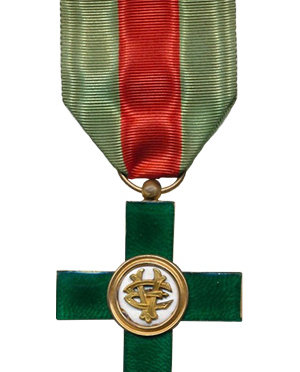
The insignia bears the inscription Al Merito Civile—1831; the letters C.A. on the reverse substituted for V.E. after the death of Charles Albert in 1849.

The Order of the Crown of Italy

The Order of the Crown of Italy was a national order founded in 1868 to commemorate the unification of Italy in 1861.

The Order of the Crown of Italy (or Ordine della Corona d’Italia) was founded as a national order in 1868 by King Vittorio Emanuele II, to commemorate the unification of Italy in 1861. It was awarded in five degrees for civilian and military merit.

Compared with the older Order of Saints Maurice and Lazarus (1572), the Order of the Crown of Italy was awarded more liberally and could be conferred on non-Catholics as well; eventually, it became a requirement for a person to have already received the Order of the Crown of Italy in at least the same degree before receiving the Order of Saints Maurice and Lazarus.

The order has been suppressed by law since the foundation of the Republic in 1946. However, Umberto II did not abdicate his position as fons honorum and it remained under his Grand Mastership as a dynastic order. While the continued use of those decorations conferred prior to 1951 is permitted in Italy, the crowns on the ribbons issued before 1946 must be substituted for as many five pointed stars on military uniforms.

The following grades exist:

  • Cavaliere di Gran Croce OCI Kingdom BAR.svg   Knight Grand Cross (Cavaliere di Gran Croce decorati del Grande Cordone)
  • Grande ufficiale OCI Kingdom BAR.svg   Grand Officer (Grande Ufficiale dell’Ordine della Corona d’Italia)
  • Commendatore OCI Kingdom BAR.svg   Commander (Commendatore dell’Ordine della Corona d’Italia)
  • Ufficiale OCI Kingdom BAR.svg   Officer (Ufficiale dell’Ordine della Corona d’Italia)
  • Cavaliere OCI BAR.svg   Knight (Cavaliere dell’Ordine della Corona d’Italia)
The Order of the Crown of Italy Design

The badge of the order was a gilt cross with curved edges, enameled in white, with the so-called Savoy knots between the arms of the cross.

The obverse central disc featured the Iron Crown of Lombardy (as appeared on the Austrian Order of the Iron Crown) on a blue enamel background. The reverse central disc had a black-enameled eagle bearing the Savoy cross on a golden background.

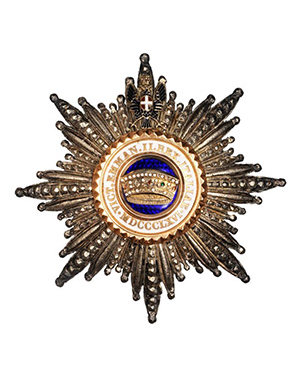
The star of the Grand Cross was an eight-pointed faceted silver star; the central disc featured the Iron Crown on a blue enameled background, surrounded by a white enamel ring bearing the inscription VICT. EMMAN. II REX ITALIAE MDCCCLXVI (Victor Emmanuel II, King of Italy, 1866). There was a black-enameled eagle bearing the Savoy cross above the star.

The star of the Grand Officer was an eight-pointed faceted silver star with ball tips at each point and with the obverse of the badge superimposed upon it.

The ribbon of the order was red-white-red.

The Order of Merit for Labor

The Order of Merit for Labor is a national order of chivalry for meritorious agriculture, industry and commerce acts.

The Order of Merit for Labour (or Ordine al Merito del Lavoro) was founded as a national order of chivalry in 1923 by King Vittorio Emanuele III of Italy and is awarded to those “who have been singularly meritorious” in agriculture, industry and commerce, crafts, lending and insurance.

It is a continuation of the earlier Ordine al Merito Agrario, Industriale e Commerciale founded in 1901. Members of the order may use the title Cavaliere del lavoro.

The origins of the order lie with King Umberto I who, in 1898, instituted “a decoration for agricultural and industrial merit and a medal of honour.” The first was the exclusive prerogative of large landowners and industrialists, the latter for their employees. This was replaced by the Chivalrous or Knightly Order of Agricultural, Industrial and Commercial Merit in 1901, which was intended by Vittorio Emanuele III to give greater dignity to the earlier award.

Awarded in the single degree of Knight, the order is open to all Italians, living at home and overseas. Every year, on 1 June, 25 new Knights of Labour are invested from a shortlist of 40 candidates. The related Star of Merit for Labour, established in 1923, confers the title of Maestro del Lavoro.

The order is bestowed by decree of the President of the Italian Republic, its head since 1952, on the recommendation of the Minister of Economic Development (successor to the Minister of Industry, Commerce and Craftsmanship). The badge bears the inscription Al merito del lavoro—1901; the V.E. monogram formerly at the centre of the Greek cross, now substituted for the national coat of arms.

The Order of the Dragon of Annam

The Imperial Order of the Dragon of Annam (Ordre impérial du Dragon d’Annam) was created in 1886 in the ancient Vietnamese city of Huế.

The Imperial Order of the Dragon of Annam (or Ordre impérial du Dragon d’Annam) was created on March 14, 1886, in the ancient Vietnamese city of Huế, by Emperor Đồng Khánh of the Imperial House of Annam, upon the “recommendation” of the President of France as a jointly awarded French colonial order.

The Order was designed as a reward for services to the state, the French colonial government, or the emperor.

When French colonial rule over Indochina ended, the Order of the Dragon of Annam was abolished and replaced by the National Order of Vietnam which was later retained and revised by the Republic of Vietnam (South Vietnam). The ribbon of the Dragon of Annam was retained for this award, but it was (belatedly) recognized that a colonial order had no place in the new regime as the order was always historically associated with the period of French rule. Even the name of “Annam” in the title of the order was a point of dishonor as the name comes from the old Chinese term for Vietnam, which means “the pacified south”.

In its classes and insignia, the Order was modeled on the French Légion d’honneur and the other French colonial orders:

  • Grand Cordon
  • Grand Officer
  • Commander
  • Officer
  • Knight

The Order of the Dragon of Annam Design

The badge was an eight-pointed star charged with a central medallion of blue bearing the legend “Hoàng đế Đồng Khánh” (‘Emperor Đồng Khánh’; in stylized Chinese characters) with four radiant suns surrounded by a red band, all suspended from an imperial crown surmounted by a green dragon.

The star for Grand Officers and Grand Cross holders was charged with a green dragon holding the same blue medallion as featured on the badge. There were two ribbons, red with gold border stripes for awards by the Emperor and green with gold border stripes for the President’s version.

The Order of Nichan El-Anouar (Order of the Light)

The Order of Nichan El-Anouar (or “Order of the Light”) was established in 1887 as a colonial order of merit of the Tajurah sultanate in French Somaliland.

The order has five degrees:

  • Grand-croix (grand cross)
  • Grand officier (grand officer)
  • Commandeur (commander)
  • Officier (officer)
  • Chevalier (knight)

The Order was deprecated on 3 December 1963 by the Ordre National du Mérite.

The Order of the Star of Anjouan

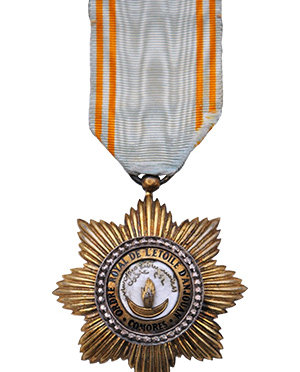
The Ordre de l’Étoile d’Anjouan (or “Order of the Star of Anjouan”) was a French colonial order of knighthood founded in 1874.

  • Time Period: Pre-WW1
  • Institution: 1 December 1889
  • Country: France

The Ordre de l’Étoile d’Anjouan (or “Order of the Star of Anjouan”) was a French colonial order of knighthood founded in 1874.

It was established in 1874 by sultan Mohamed-Saïd-Omar of the Comoros island of Anjouan, reorganized on 18 June 1892 and authorized and recognized by the French government on 12 September 1896. It was made a French Overseas Order in 1950.

In this case a local order was adopted by the French, although they reorganized and redesigned it. Another Anjouan orde, the Star of Said Ali was not adopted.

The Ordre de l’Étoile d’Anjouan has five classes:

  • Grand-croix
  • Grand-officier
  • Commandeur
  • Officier
  • Chevalier

The Order of the Black Star

The Order of the Black Star (Ordre de l’Étoile Noire) was an order of knighthood established by Toffa, future king of Dahomey, today Benin.

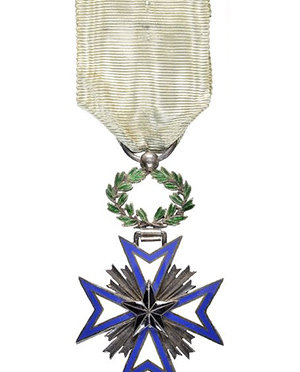
The Order of the Black Star (or “Ordre de l’Étoile Noire”) was an order of knighthood established on 1 December 1889 at Porto-Novo by Toffa, future king of Dahomey (today the Republic of Benin).

Approved and recognized by the French government on 30 July 1894, after the establishment of the new statutes of 30 August 1892, according this distinction to all those who worked to develop French influence on the west coast of Africa.

The order has five classes:

  • Grand-croix (grand cross)
  • Commandeur avec plaque (commander with plaque)
  • Commandeur (commander)
  • Officier (officer)
  • Chevalier (knight)

The order was deprecated by decree on 3 December 1963, and superseded by the Ordre National du Mérite. Extant members of the order are permitted to wear their original decorations.

The Indochinese Order of Merit

The Indochinese Order of Merit (or “Ordre du Mérite indochinois”) was a regional award of France awarded by the Governor-General of Indochina for the local population of French Indochina.

Established April 30, 1900 by Governor-General of French Indochina Paul Doumer the order was to reward the local population of Indo-China for services to agriculture, commerce, industry and art.

This award had no status as an official French colonial award but was a local only award for the population of Laos, Cambodia, Tonkin, Cochin China, and Annam.

Governed by an Order Council, it was divided into three classes with limit on the number of members for each class. The 3rd class, was limited to 500 members. The 2nd Class, was limited to 100 members. The 1st class, was limited to 15 members.

The Indochinese Order of Merit Design

The badge of the order is a ball tipped six-pointed star with concave sides. In the center of the star is a round rimmed medallion. In the center of the medallion is the inscription in Annamese ideographic writing “It is worthy to develop knowledge“.

On the rim is the inscription INDOCHINE FRANCAISE (French Indochina). Attached to the ball of the top most arm of the star are two laurel branches, which act as a ring to attach the star to its ribbon.

The ribbon of the order is yellow Moire silk. The Order was presented in the 1st degree in gold, 2nd degree silver, and third degree bronze.

The Honour Medal for Firefighters

  • Time Period: Pre-WW1
  • Institution: 16 February 1900
  • Country: France

The Honour medal for firefighters (or “Médaille d’honneur des Sapeurs Pompiers”) is a state decoration of France bestowed by the Ministry of the Interior to members of the French Fire Service.

Although possessing a two-century-old firefighting tradition, the French government proved slow in recognizing the service and courage of the men and women who face risk on a daily basis to save lives and property. Not until 1875 was a service certificate established and bestowed for thirty years of service.

The decree of 4 March 1981 saw a new design and ribbon for the Honour medal for firefighters awarded for exceptional service.

The Honour medal for firefighters is bestowed to firefighters:

  • who have always displayed devotion to duty (long service); or,
  • who have particularly distinguished themselves (exceptional service).

The Honour Medal for Firefighters Design

The Honour medal for firefighters bestowed “for long service” is a 30mm in diameter (27mm before 1935) circular medal.

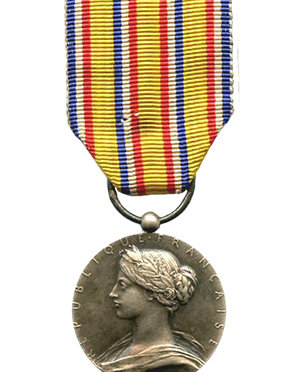
Its obverse bears the effigy of the republic in the form of the relief image of the left profile of a woman wearing a firefighter’s helmet, also visible is her uniform collar bearing the distinctive grenade insignia of the firefighting corps in France. On either side, the relief inscription along the circumference “RÉPUBLIQUE FRANÇAISE” (“FRENCH REPUBLIC”).

The medal is struck in silver, silver-gilt and gold. The silver grade award’s ribbon suspension bar is adorned with opposing fire hose nozzles. Each grade above silver is denoted by an increasingly intricate ornamentation on the ribbon suspension bar. 

The reverse of the medal bears at its center, the relief image of a fireman’s helmet partially covering a building on fire above the inscription “HONNEUR AU DEVOUEMENT” (“HONOUR TO DEVOTION”) itself above a blank area reserved for the recipient’s name and year of award. The relief image of flames at the very bottom and on either side of the fire hall. At the top along the medal circumference, the relief semi circular inscription “MINISTÈRE DE L’INTÉRIEUR” (“INTERIOR MINISTRY”).

The current, post-1981 Honour medal for firefighters bestowed “for exceptional services” is a 32mm in diameter circular medal. Its obverse bears the relief image of the left profile of a helmeted male firefighter, above his head, the relief semi circular inscription “MINISTÈRE DE L’INTÉRIEUR” “INTERIOR MINISTRY”) along the medal’s upper circumference. The ribbon suspension bar is adorned with two crossed firemen’s axes resting atop two laurel branches from which flames shoot upwards to just above opposing horizontal fire hose nozzles. The medal is struck in silver or silver-gilt variants. The reverse bears a Phrygian cap with between two axes below the initials “R.F.”.

The medal hangs from a 37mm wide silk moiré ribbon of red on the right edge watering into yellow across its width. The ribbon bears a rosette of the same colours to indicate that it is an award “for exceptional services”.

The Honour Medal of the National Police

The Honour medal of the National Police (or Médaille d’honneur de la Police nationale) is the highest award of the French National Police, which falls under the jurisdiction of the Ministry of the Interior.

Created by the Decree of 3 April 1903 at the request of Monsieur Émile Combes, Minister of the Interior, the medal was originally called the “Médaille d’honneur de la Police Municipale et Rurale” (“Honour medal of the rural and municipal police). The decree of 17 November 1936 will rename it the “Médaille d’honneur de la Police française” (“French Police honour medal). Finally, Decree No. 96-342 of 22 April 1996 will give the medal its current designation.

The award was extended in 1972, to administrative staff and senior officers of the National Police. The medal is awarded under the following conditions:

  • to police officers, for 20 years of service;
  • to members of the administrative staff, for 25 years of combined civil and military service.

The award may be bestowed posthumously regardless of time of service. It may also be awarded in exceptional cases for acts of courage or exceptional service to the police force by national or foreign police officers regardless of time of service. Under these circumstances, the medal ribbon is adorned with a five-pointed silver star.

The Honour Medal of the National Police Design

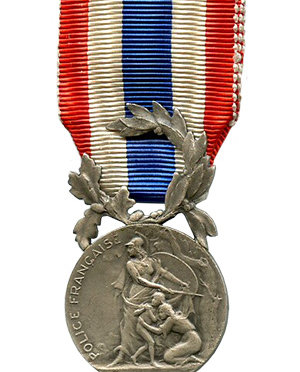
The Honour medal of the National Police, a design of engraver Marie Alexander Coudray, is a 27mm in diameter circular silver medal.

The obverse bears the relief image of the protecting Republic, in the form of a standing helmeted woman holding a sword and a shield, protecting a kneeling woman pulling a frightened child to her, behind them a tree. Along the right circumference, the semi circular relief inscription “POLICE FRANÇAISE” (“FRENCH POLICE”).

The reverse bears at its bottom a framed rectangular area destined to receive the name of the recipient and year of the award. Along the upper medal circumference, the relief inscription “RÉPUBLIQUE FRANÇAISE” (“FRENCH REPUBLIC”), at its center, the inscription “MINISTÈRE DE L’INTÉRIEUR” (“INTERIOR MINISTRY”).

The medal hangs from a 3cm wide silk moiré tricolor ribbon with an 8mm wide central blue stripe bordered by 6mm wide white stripes and 5mm red stripes at its edges. The ribbon’s suspension loop is adorned with a crown composed of an olive branch and a sprig of oak with an opening on the right.

The Honour medal of the rural and municipal police in Algeria included a clasp on the ribbon consisting of a star placed on a crescent of Islam. Today, the only ribbon device is in the form of a silver five pointed star when the medal is awarded in exceptional circumstances.