The First Madagascar Commemorative Medal

The Madagascar commemorative medal (or Médaille commémorative de Madagascar in French) is a commemorative medal issued to the participants to the First Madagascar expedition in 1883, and the Second Madagascar expedition in 1894-95.

Two different medals were issued, the first one by the law of 31 July 1886, the second one by the law of 15 January 1896. In 1883 the French bombarded and occupied Toamsina (then Tamatave), and in 1885 established a protectorate over Madagascar – which was recognized by Great Britain in 1890. In 1896, French troops under J. S. Gallieni defeated the Merina and abolished the monarchy. Queen Ranavalona III was sent into exile in Algeria in 1897, effectively ending the monarchy.

About 2,500 copies of the medal were awarded.

The First Madagascar Commemorative Medal Design

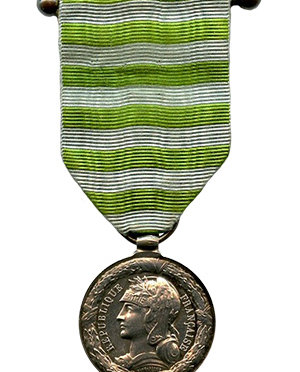
The medal was designed by Jean-Baptiste Daniel-Dupuis and has a diameter of 30 millimeters.

Within a broad wreath in the obverse is engraved the writing “République Française” arranged around the head of a symbolical helmeted and in armor-clad female figure. It is called the “armed republic” and bears the letters “PATRIE” on its ornate helmet.

The reverse bears a laurel wreath and a radiant five-pointed star, alongside the name of the island “MADAGASCAR“. Next to the star are the years 1883 and 1886 engraved. Under the rays is a trophy which depicts an anchor.

The medal was worn with light green and yellow horizontal striped ribbon on the left chest. That ribbon is a simple and rectangular silver buckle with the designation “MADAGASCAR“.
The Commemorative Medal of the 1870-1871 War

The Commemorative medal of the 1870–1871 War is a military campaign medal awarded to those who served during the Franco-Prussian War.

The Commemorative medal of the 1870–1871 War (or Médaille commémorative de la guerre 1870–1871 in French) is a military campaign medal awarded to those who served during the Franco-Prussian War.

The French Emperor, confident of the strength of his armies declared war on Prussia on 19 July 1870.  A 1866 peace agreement between Prussia and Austria greatly enlarged the forces he would face, adding the armies of Bavaria, Württemberg, Saxony, Hanover, Baden, Hesse, Schaumburg-Lippe, Saxe-Meiningen, Nassau and Reus to the already formidable Prussian Army. Soon the French armies were defeated or encircled within the walls of their cities. Over a five-month campaign, German forces defeated newly recruited French armies in a series of battles fought across northern France. Following a prolonged siege, Paris fell on 28 January 1871 and the war ended with the Treaty of Frankfurt of 10 May 1871.

Forty years would have to elapse before the government would agree to a tangible form of recognition for the surviving veterans of the conflict. The Commemorative medal of the 1870–1871 War was finally established by a law of 9 November 1911.

The Commemorative Medal of the 1870-1871 War Design

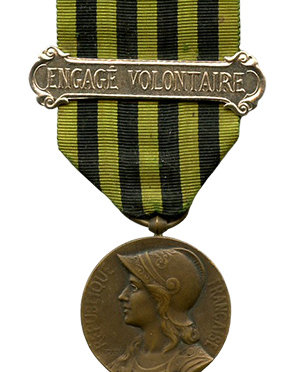
The medal measures 30-mm in diameter, is circular and struck in bronze. It was engraved by artist Georges Lemaire, his model to represent the effigy of the republic was Miss Fernande Dubois, an artist at the Opéra-Comique.

The obverse bears the relief image of the effigy of the “warrior republic” in the form of the left profile of a helmeted woman’s bust wearing armor. On either side, the relief inscription along the outer medal circumference “RÉPUBLIQUE FRANÇAISE“.

The reverse bears, at its lower center, a rectangle with the relief inscription “AUX DÉFENSEURS DE LA PATRIE” (“TO THE NATION’S DEFENDERS”), superimposed over the relief images of military weapons (sabres, lances, cannons), a naval anchor and a flowing banner, at its top, the relief years “1870 1871” bisected by the banner’s mast.

The medal hangs from a ribbon passing through a ring itself passing through a ball shaped suspension loop at the top. The 36-mm-wide green silk moiré ribbon bears four 4-mm-wide equidistant vertical black stripes, the whole forming nine alternating 4 mm stripes. The clasp “ENGAGÉ VOLONTAIRE” (“VOLUNTEER ENLISTEE”) could be worn on the ribbon.

The Commemorative Medal of the 1862 Mexico Expedition

The Commemorative medal of the Mexico Expedition is a commemorative campaign medal established by French emperor Napoleon III.

The Commemorative medal of the Mexico Expedition (or Médaille commémorative de l’expédition du Mexique in French) is a commemorative campaign medal established by decree on 29 August 1863 by French emperor Napoleon III. The medal recognizes military service during the 1862-1863 French intervention in Mexico.

On 30 April 1863, sixty two legionnaires resisted for nine hours against over two thousand Mexicans, allowing for the capture of the city of Puebla on 17 May 1863 thus paving the way to Mexico. In the capital, an assembly of notables recognized Archduke Maximilian of Habsburg as Emperor of Mexico. However, even with the support of 20,000 Mexicans who embraced the new emperor, Maximilian’s forces were harassed in their work of pacification by the troops of President Benito Juárez, who had the support of the United States. In February 1867, Emperor Napoleon III ordered the repatriation of all remaining French troops from Mexico.

No minimum time of service was mentioned in the award statute.

The Commemorative Medal of the 1862 Mexico Expedition Design

The medal measures 30 mm in diameter, is circular and struck in silver.

The obverse bears the left profile of Emperor Napoleon III crowned with a laurel wreath surrounded by the relief inscription “NAPOLEON III” “EMPEREUR“. A 4 mm wide relief laurel wreath ran along the entire circumference of both the obverse and reverse of the medal.

On the reverse and within the laurel wreath, a circular relief inscription reads “*EXPEDITION DU MEXIQUE * 1862-1863“, with two small five pointed stars separating the text from the dates. At the center, the relief inscription on five lines of the campaign’s major battles “CUMBRES” “CERRO-BORREGO” “SAN-LORENZO” “PUEBLA” “MEXICO”.

The medal hangs from a 36 mm wide white silk moiré ribbon bearing 5 mm red and green stripes arranged at a 45 degree angle forming a cross, over which was superimposed a black eagle, its wings spread and holding a green snake in its beak and talons, a design inspired by the coat of arms of Mexico.

The Commemorative Medal of the 1860 China Expedition

The Commemorative medal of the 1860 China Expedition is a military award of the Second French Empire awarded to soldiers and sailors.

  • Time Period: Pre-WW1
  • Institution: 23 January 1861
  • Country: France

The Commemorative medal of the 1860 China Expedition (or Médaille commémorative de l’expédition de Chine de 1860 in French) is a military award of the Second French Empire awarded to soldiers and sailors who had participated in the Anglo-French expedition to China during the Second Opium War.

The medal was created by imperial decree on 23 January 1861, by Napoleon IIIThe British Empire had been engaged in an ongoing conflict with the Qing Dynasty since 1856. Following the 1857 general election in the United Kingdom, the new parliament decided to seek redress from China. The French Empire, the United States, and the Russian Empire received requests from Britain to form an alliance. France joined the British action against China, prompted by the execution of a French missionary, Father August Chapdelaine. The conflict concluded with the 1858 Treaty of Tianjin in the Convention of Peking on 18 October 1860.

The medal was awarded by the Emperor to all who served in the China Expedition on propositions of the minister overseeing the service in which the potential recipient served. All recipients also received a certificate of award.

The Commemorative Medal of the 1860 China Expedition Design

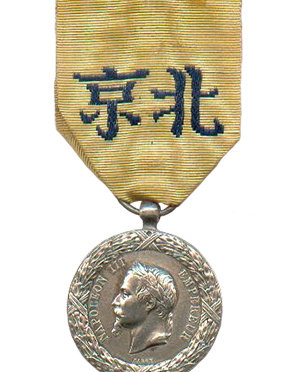
The medal measures 30 mm in diameter, is circular and struck in silver. It was designed and engraved by Albert Désiré Barre.

The obverse bears the left profile of Emperor Napoleon III crowned with a laurel wreath surrounded by the relief inscription “NAPOLEON III” “EMPEREUR”. A 4 mm wide relief laurel wreath runs along the entire circumference of both the obverse and reverse of the medal.

On the reverse, within the laurel wreath, there’s the circular relief inscription EXPÉDITION DE CHINE 1860. At the center, the relief inscription on four lines of the campaign’s major battles TA-KOU, CHANG-KIA-WAN, PA-LI-KIAO, PE-KING.

The medal is suspended from a 36 mm wide silk moiré yellow ribbon, at its center, the name of the city of Peking woven in blue Chinese characters.

The Commemorative Medal of the 1859 Italian Campaign

The Commemorative medal of the 1859 Italian Campaign is a French commemorative medal established by Napoleon III in 1859.

The Commemorative medal of the 1859 Italian Campaign (or Médaille commémorative de la campagne d’Italie de 1859 in French) is a French commemorative medal established by Napoleon III in 1859 following the French campaign in Italy during the Second Italian War of Independence.

In Europe, Italian unification was only supported by Emperor Napoleon III of France who, on 28 January 1859, based on the clauses of the Treaty of Turin, decided to bring aid and support from France. France declared war on the Austrian Empire on May 3, 1859. In spite of the lack of preparation of the French army, the soldiers and allies were to illustrate themselves in several famous battles, including that of Magenta on June 4th, which allowed Napoleon III and Victor Emmanuel II to enter triumphantly in Milan on 8 June. An armistice was signed at Villafranca on July 12.

During the three-month campaign, French losses amounted to 8,000 dead and 40,000 wounded. To reward all participants and ensure the memory of this glorious military campaign, the Medal was created by Imperial Decree on August 11, 1859.

Nearly 120,000 medals were awarded to reward all soldiers and sailors who participated in the Italian campaign of 1859. All recipients also received a certificate of award.

The Commemorative Medal of the 1859 Italian Campaign Design

The medal was designed by Albert Désiré Barre. It measures 30 mm in diameter and is circular and struck in silver.

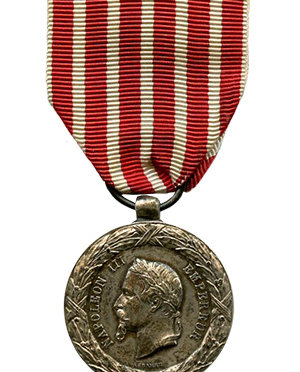
The obverse bears the left profile of Emperor Napoleon III crowned with a laurel wreath surrounded by the relief inscription “NAPOLEON III” “EMPEREUR” (English: “NAPOLEON III” “EMPEROR”). A 4 mm wide relief laurel wreath ran along the entire circumference of both the obverse and reverse of the medal.

On the reverse, within the laurel wreath, the circular relief inscription CAMPAGNE D’ITALIE 1859 (English: ITALIAN CAMPAIGN 1859). At the centre, the relief inscription on six lines of the campaign’s major battles MONTEBELLO, PALESTRO, TURBIGO, MAGENTA, MARIGNAN, SOLFERINO.

The medal hangs from a 36 mm wide silk moiré ribbon bearing six 4 mm wide red stripes and five 2 mm wide white stripes.

The Saint Helena Medal

The Saint Helena Medal (or Médaille de Sainte-Hélène in French) is the first French campaign medal, established in 1857 by a decree of emperor Napoleon III. The medal recognizes participation in the campaigns led by emperor Napoleon I, creator of the Legion of Honour and various other orders (who never instituted commemorative campaign medals for his soldiers).

In time, many veterans of these campaigns, sometimes called the “débris de la Grande Armée” (“remnants of the Great Army”), began meeting within various new veterans’ associations. Keeping alive their war memories and the myth of Napoleon in popular culture, they issued many unofficial commemorative and associative medals. It would be forty two years after the exile of the emperor to the island of Saint Helena called for the need to adequately and officially recognize the service of these combat veterans.

The Saint Helena Medal was awarded to all French and foreign soldiers, from the land armies or naval fleets, who served the Republic or the Empire between the years 1792 and 1815 inclusive. It was awarded with no condition of minimum time of service, however, it was necessary to prove one’s right with a record of service or leave record. The Saint Helena Medal could be revoked following a condemnation to a fixed prison term of one year or more for a crime committed by the recipient.

The medal was accompanied by an award certificate from the Grand Chancery of the Legion of Honour and came in a white cardboard box with intricate ornamentation on the lid in the form of an embossed imperial eagle over the inscription on seven lines “AUX COMPAGNONS DE GLOIRE DE NAPOLÉON I DÉCRET IMPÉRIAL DU 12 AOÛT 1857” (English: “TO NAPOLEON I COMPANIONS IN GLORY IMPERIAL DECREE OF 12 AUGUST 1857”).

The Saint Helena Medal Design

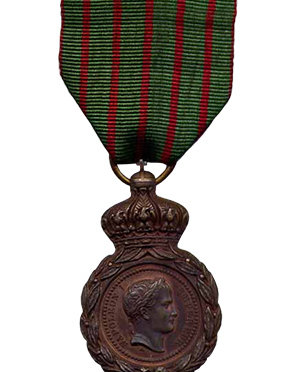
The Saint Helena Medal is of irregular (round) shape and struck in bronze. It measures 2 cm in diameter and its medallion is surrounded by a 50mm wide laurel wreath tied with a bow at the bottom.

Atop the medal there is a 2 cm wide Imperial Crown. The obverse bears the relief image of the right profile of Emperor Napoleon I surrounded by the relief inscription “NAPOLEON I EMPEREUR” (English: “NAPOLEON I EMPEROR”). A ring or small orbs separates the central medallion from the wreath. Just below the image of the emperor, a small anchor, the privy mark of the award’s designer, Désiré-Albert Barre.

The reverse is identical except for the medallion which bears the relief circular inscription within a narrow 20mm band “CAMPAGNES DE 1792 A 1815” (English: “CAMPAIGNS OF 1792 TO 1815”). In the centre, the relief inscription on nine lines “A” “SES” “COMPAGNONS” “DE GLOIRE” “SA DERNIÈRE” “PENSÉE” “STE HÉLÈNE” “5 MAI” “1821” (English: “TO HIS COMPANIONS IN GLORY HIS LAST THOUGHT ST HELENA 5 MAY 1821”).

The medal hangs from a 38mm wide green silk moiré ribbon bearing five 1,8mm wide red vertical stripes spaced 4,5mm apart and 1mm red edge stripes.

The Order of Sidonia

The Order of Sidonia was created on March 14, 1871 by King Johann the German. It’s the Kingdom of Saxony’s chivalric order for women.

The Order of Sidonia was created on March 14, 1871 by King Johann the German. It’s the Kingdom of Saxony’s chivalric order for women, granted to female members of the Saxon nobility until the fall of the monarchy in 1918. By awarding this order, King Johann aimed to reinforce the values and responsibilities associated with the Saxon nobility, encouraging other noblewomen to aspire to such standards.

Named in honor of Saint Sidonia, this order was established to recognize and reward the exemplary service and noble qualities of female members of the Saxon nobility.

The order was granted exclusively to female members of the Saxon nobility. Recipients were typically women who had shown notable service in charitable activities, cultural endeavors, or had supported the monarchy in various capacities.

The Order of Sidonia Design

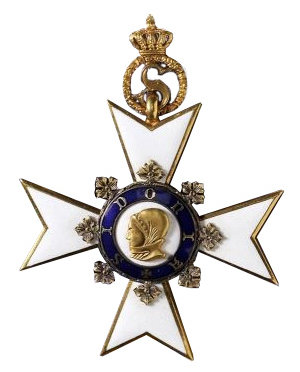
Members of the Sidonian Order wore a Maltese cross of gold and enamel, suspended from a purple bow with white and green stripes.

Members of the royal family wore a sash instead of the bow. At the apex of the Maltese cross, a medallion featured an image of a helmeted female figure, surrounded with the name “Sidonia”.

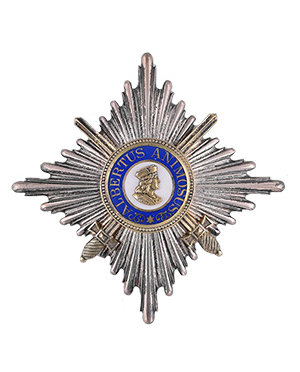
The Albert Order

The Albert Order was created in 1850 to be awarded to anyone who had served the state well, for civil virtue, science and art.

The Albert Order (or Albrechts-Orden in German) was to be awarded to anyone who had served the state well, for civil virtue, science and art, and created on 31 December 1850 by King Frederick Augustus II of Saxony to commemorate Albert III, Duke of Saxony

The grade structure of the Albert Order changed several times. At first, there were five classes: Grand Cross (Großkreuz), Commander’s Cross 1st Class (Komturkreuz I), Commander’s Cross 2nd Class (Komturkreuz II), Knight’s Cross (Ritterkreuz) and Small Cross (Kleinkreuz).

An award of Swords indicated a recipient’s bravery in wartime. If, however, a recipient was subsequently awarded a higher grade in the Order, he could lose the bravery distinction attached to the superseded grade (regulations only allowed the display of the insignia of the highest awarded grade). This anomaly was solved in 1906 by allowing the addition of Swords by replacement of insignia. A recipient, however, had to pay the cost of replacement and this appears to have inhibited the numbers of such replacements.

The Albert Order Design

The design of the insignia is a Christian cross with a bust of Albert the Bold at the centre. In 1875, however, it was discovered the bust was in fact the wrong Albert, Albert the Perennial, and the correct image was substituted and used thereafter.

The Civil Order of Saxony

The Civil Order of Saxony is a general order of merit established on 7 June 1815 by King Frederick Augustus I of Saxony.

The Civil Order of Saxony, also known as the Saxon Order of Merit, is a general order of merit established on 7 June 1815 by King Frederick Augustus I of Saxony for the royal subjects of the Kingdom of Saxony for distinguished civic service and virtue.

Upon its founding in 1815, the order was divided into seven classes of merit:

  • Knight Grand Cross
  • Commander First Class
  • Commander Second Class
  • Knight
  • Small Cross
  • Gold Civil Medal
  • Silver Civil Medal

With an amendment of 18 March 1858, the Small Cross became the Cross of Honour, eventually becoming Knight Second Class on 31 January 1876. The decree also replaced the gold and silver medals with civilian crosses of distinction, in gold and silver. The classes of the order thus became:

  • Knight Grand Cross
  • Commander First Class
  • Commander Second Class
  • Knight First Class
  • Knight Second Class
  • Golden Civil Cross
  • Silver Civil Cross

The Civil Order of Saxony Design

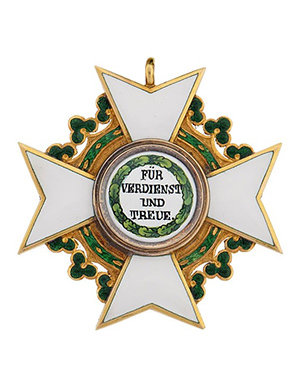
The insignia is a gold Maltese cross with white enameled arms and with green enameled fleur-de-lis between the arms of the cross. It measures 41.63 mm wide x 41.37 mm high and weighs 17.3 grams.

The obverse of the order shows a center white enameled medallion with a Saxon crowned royal monogram painted on the obverse, circumscribed “FRIED.AUG. K. V. SACHSEN. D. 7 JUN. 1815”.

The reverse hjas the inscription “Für Verdiesnt und Treue” (For Merit and Loyalty) within a laurel wreath.

The Military Order of St. Henry

The Military Order of St. Henry is a military order of the Kingdom of Saxony and the oldest military order of the German Empire.

The Military Order of St. Henry (or Militär-St. Heinrichs-Orden in German) is a military order of the Kingdom of Saxony, and the oldest military order of the states of the German Empire.

It was founded on October 7, 1736 by Augustus III, King of Poland and Elector of Saxony. The order underwent several more revisions over the course of the 19th and early 20th centuries, and became obsolete with the fall of the Saxon monarchy in the wake of Germany’s defeat in World War I.

The order came in four classes: Grand Cross (Großkreuz), Commander’s Cross 1st Class (Kommandeurkreuz I. Klasse), Commander’s Cross 2nd Class (Kommandeurkreuz II. Klasse) or sometimes just Commander, and Knight’s Cross (Ritterkreuz). Generally, the rank of the recipient determined which grade he would receive.

The Military Order of St. Henry Design

The badge of the Order of St. Henry is a gold Maltese cross with white enameled edges.

Around the center medallion in the obverse there is a blue-enameled gold ring bearing on the obverse the words “FRIDR AUG D G REX SAX INSTAURAVIT“. The reverse shows the motto “VIRTUTI IN BELLO” (“Bravery in War”). On the obverse, the medallion is yellow-enameled with a painted portrait of St. Henry, the last Saxon Holy Roman Emperor. On the reverse, the medallion bore the Saxon coat of arms (alternating horizontal black and gold stripes with a diagonal rue crown).

Between the arms of the cross were green-enameled rue crowns, a symbol of Saxony. The badge was suspended from a royal crown. 

The star of the order is a silver eight-pointed star featuring a larger version of the medallion with St. Henry of the obverse of the cross, but with the text of the ring of the reverse. 

The ribbon of the order is light blue with yellow stripes near each edge.