The Order of the Gold Lion of the House of Nassau

The Order of the Gold Lion of the House of Nassau is a chivalric order shared by the two branches of the House of Nassau.

The Order of the Gold Lion of the House of Nassau (or Huisorde van de Gouden Leeuw van Nassau in Dutch) is a chivalric order shared by the two branches of the House of Nassau (the Ottonian and Walramian lines). The order may be awarded to sovereigns, princes of sovereign houses and heads of state for meritorious service to Luxembourg and the Grand Duke.

In the context of the younger Ottonian line, this order is a house order of the Dutch Royal House of Orange-Nassau and is awarded as a personal gift by the King of the Netherlands on a person who has rendered special service to the Royal House.

The order was founded by royal grand-ducal decree on 31 March 1858 by King-Grand Duke William III. The order originally included only one grade (i.e. “Knight”), but this was increased to four by William III in 1873:

  1. Grand Cross
  2. Grand Officer
  3. Officer
  4. Knight

The further rank of Commander was introduced in 1882. Nowadays, the order is conferred only on rare occasions in the Netherlands or Luxembourg.

Princes who are sons or brothers of the heads of the two lines of the House of Nassau are born knights of the order. In 1984, Queen Beatrix and Grand Duke Jean made an agreement that princesses (daughters of the heads of the two lines of the House of Nassau) may be admitted when they reach the age of majority (18).

The Order of the Gold Lion o the House of Nassau Design

The badge of the order is a white-enameled golden Maltese Cross, with the golden monogram “N” between the arms of the cross. The obverse central disc is in blue enamel, bearing the Gold Lion of the House of Nassau. The reverse central disc is also blue enameled, with the motto Je maintiendrai (“I will maintain”) in gold.

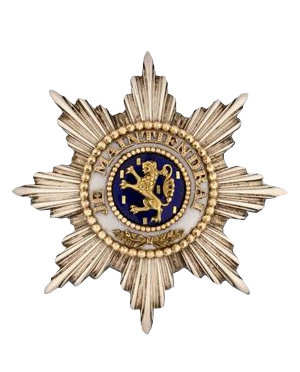
The plaque is an 8-pointed star with straight silver rays; the same obverse of the badge of the order appears at its centre, surrounded by the motto Je maintiendrai in gold letters on white enamel. The ribbon of the sash of the order is yellow-orange moiré with a small blue stripe at each edge.

A knight wears the order’s badge on a sash on the right shoulder, and the plaque (breast star) of the order on the left chest.
The Order of Orange-Nassau

The Order of Orange-Nassau is a civil and military Dutch order of chivalry founded on 4 April 1892 by the Queen regent Emma.

The Order of Orange-Nassau (or Orde van Oranje-Nassau in Dutch) is a civil and military Dutch order of chivalry founded on 4 April 1892 by the Queen regent Emma, acting on behalf of her under-age daughter Queen Wilhelmina and open to “everyone who has earned special merits for society”.

These are people who deserve appreciation and recognition from society for the special way in which they have carried out their activities. The lower grades of the order are comparable with the ranks of the Order of the British Empire in the United Kingdom, but titles, prefixes or post-nominals (other than academic ones) are not used in the Netherlands.

During World War II, the Order of Orange-Nassau was bestowed upon both members of the Netherlands military and members of foreign services who had helped liberate the Netherlands from Nazi German occupation, and those who helped liberate the former Dutch colonies in the Pacific.

In the modern age, the Orange-Nassau is still the most active civil and military decoration of the Netherlands and ranks after the Order of the Netherlands Lion. The order is typically awarded each year on the Monarch’s official birthday with around 3500 appointments to the order made public.

The order is also used to honor foreign princes, ministers, dignitaries and diplomats. The King or Queen Regnant of the Netherlands is the Grand Master of the Order of Orange-Nassau.

The Order of Orange-Nassau Design

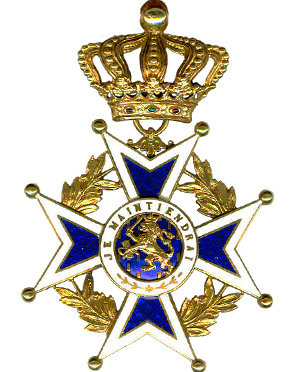
The Order of Orange-Nassau has two divisions, civil and military, the former denoted by a wreath of laurel on the badges, and the latter by crossed swords on both the badges and the stars.

The badge of the order is a blue-enameled, white enamel-bordered Maltese Cross, in gilt for the officers and above, in silver for knights and members. The obverse central disc displays the King’s coat of arms in gold and blue enamel, surrounded by a white enamel ring bearing the national motto Je Maintiendrai (I shall maintain). The reverse central disc has the crowned monogram “W” (for Queen Wilhelmina) surrounded by the motto God Zij Met Ons (God be with us). The badge hangs from a royal crown.

The star of the order is a silver star with straight rays, in 8 points for Grand Cross and in 4 points for Grand Officer; the central disc has the King’s arms in gold and blue enamel, surrounded by a white enamel ring bearing the Dutch national motto Je Maintiendrai. The military division has crossed swords.

Since 1996

In addition to the two divisions, since 1996 the Order of Orange-Nassau has been issued in six classes:

  1. Knight Grand Cross – badge may be worn on a sash on the right shoulder, plus an 8-pointed star on the left chest;
  2. Grand Officer – badge may be worn by men on a necklet, and by women worn on a ribbon tied as a bow at the left chest. Also a 4-pointed star is worn on the left chest;
  3. Commander – badge may be worn by men on a necklet, and by women worn on a ribbon tied as a bow at the left chest;
  4. Officer – wears the badge on a ribbon with a rosette on the left chest;
  5. Knight – wears the badge on a ribbon on the left chest;
  6. Member – wears a smaller badge on a ribbon on the left chest.

For the grades of Knight and Member, the badges are made of silver. For the other grades, the silver is gilded.

For the grades of Knight Grand Cross, Grand Officer and Commander, the badges have a diameter of 60 mm. For the grades of Officer and Knight, they have a diameter of 46 mm. For the grade of Member, a diameter of 35 mm.

After 1966

Until 1996, the Order of Orange-Nassau consisted of five grades. In addition, honorary medals were issued in Gold, Silver and Bronze, but these were only affiliated with the order; the bearers of the medal were not members of the order. Now no longer issued, these were replaced by the sixth grade: “Member”. Recipients wore the medal on a ribbon on the left chest.

The Order of the Netherlands Lion

The Order of the Netherlands Lion is a Dutch order of chivalry founded by King William I of the Netherlands on 29 September 1815.

The Order of the Netherlands Lion (also known as Order of the Lion of the Netherlands or De Orde van de Nederlandse Leeuw in Dutch and L’Ordre du Lion Néerlandais in French) is a Dutch order of chivalry founded by King William I of the Netherlands on 29 September 1815.

The Order of the Netherlands Lion was until recently awarded upon eminent individuals from all walks of life, including generals, ministers of the crown, mayors of large towns, professors and leading scientists, industrialists, high-ranking civil servants, presiding judges and renowned artists. Since 1980 the Order has been primarily used to recognize merit in the arts, science, sport and literature.

The Order ranks after the Military William Order, which is only awarded for military merit. The King of the Netherlands is the Grand Master of the Order.

The following classes and grades exist for the Order:

  1. Knight Grand Cross – Reserved for members of the Royal Family, foreign Heads of State and a select group of former prime ministers, princes and cardinals. Wears the badge on a sash on the right shoulder, plus the star on the left chest.
  2. Commander – Usually conferred upon Dutch Nobel Prize winners, a few distinguished artists, writers and politicians. Wears the badge on a necklet, plus an identical breast cross on the left chest.
  3. Knight – Wears the badge on a ribbon on the left chest.
  4. Brother – No longer issued; see section below. Wore the medal on a ribbon on the left chest.

The Order of the Netherlands Lion Design

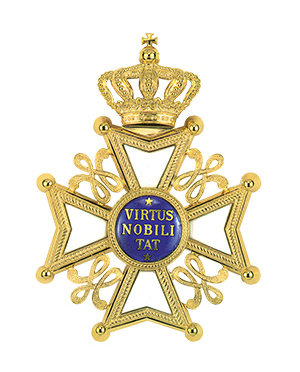
The badge of the Order is a gilt, white-enameled Maltese Cross, with the monogram “W” (for King William I) between the arms of the cross.

The obverse central disc is in blue enamel, bearing the motto Virtus Nobilitat (Virtue Ennobles). The reverse central disc is plain golden, with the lion from the Netherlands coat-of-arms. The badge hangs from a royal crown.

As with all honors awarded by the Netherlands, the insignia comprises a decoration, a miniature and optionally a breast star. The decoration and breast stars are only worn at formal occasions or while in state office. While wearing a smoking, it is allowed to wear the miniature. Decorations are not worn on any other type of clothing.

The badge of honour for Brothers was a silver medal, with the lion from the Netherlands coat of arms on the obverse, and the motto Virtus Nobilitat (English: Virtue Ennobles) on the reverse. The ribbon for Brothers was blue with a single orange central stripe.

The Military Order of William

The Military William Order (Militaire Willems-Orde in Dutch, MWO) is the oldest and highest honor of the Kingdom of the Netherlands.

The Military William Order (also known as Military Order of William or Militaire Willems-Orde in Dutch, abbreviated MWO), is the oldest and highest honour of the Kingdom of the Netherlands.

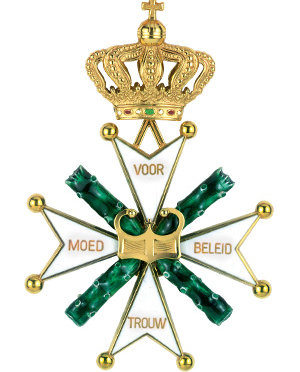
The Order’s motto is Voor Moed, Beleid en Trouw (For Bravery, Leadership and Loyalty). The chivalric order was established on 30 April 1815 by King William I and was presented for feats of excellent bravery on the battlefield and as a meritorious decoration to senior military officers. Comparable with the French Légion d’Honneur but far less often awarded, the Military William Order is a chivalry order of merit open to everyone regardless of rank and nobility, and not only to Dutch military but also foreigners. To date membership of the Order is extremely rarely awarded and only for excellent bravery in battle. Most knighthoods of the Military Order of William were awarded in 1815 and shortly afterwards to military of the Allies that fought Napoleon at the Battle of Waterloo, in total over 1,000 knighthoods were awarded at this time.

By 1945, the following classes of the Military William Order were in existence.

  • Knight Grand Cross – wears the badge on a sash on the right shoulder, plus the star on the left chest;
  • Commander – wears the badge on a necklet, plus an identical breast cross on the left chest;
  • Knight 3rd Class – wears the badge on a ribbon with rosette on the left chest;
  • Knight 4th Class – wears the badge on a ribbon on the left chest.

The oath to be taken by the accolade to the Military Order of William states: “I swear that I shall conduct myself as a faithful and valiant Knight, to stand ever ready to defend King and Country with my Life, and with all my Powers to always strive to be worthy of this Distinction, which the King has bestowed upon me. So help me God almighty.”

The Military Order of William Design

The badge of the Order is a white-enameled Maltese Cross, in silver for the 4th Class and in gilt for higher classes; a green enameled Burgundy Cross appears between the arms of the Maltese Cross.

The obverse bears a golden firesteel at the center, and the motto Voor Moed – Beleid – Trouw (For Bravery – Leadership – Loyalty) on the arms of the Maltese Cross. Both the Burgundy Cross and the firesteel were symbols of the House of Valois-Burgundy during their lordship of the Netherlands and probably are meant to recall its crucial unifying role in the history of the Netherlands. The reverse central disc bears a crowned monogram “W” (for King William I) surrounded by a laurel wreath. The badge hangs from a royal crown.

The star of the Grand Cross is a silver, 8-pointed star with straight rays; the obverse of the badge of the Order, minus the crown, appears at its centre. The breast cross of the Commander is completely identical to the obverse of the badge of the Order. The ribbon of the Order is orange (Royal House of Orange) with blue (Nassau-blue) stripes near the border.

The Morocco Commemorative Medal

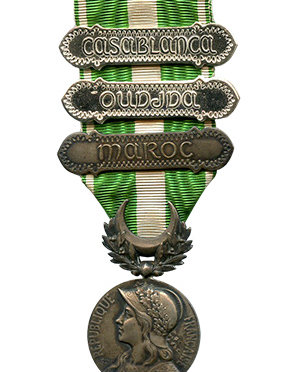
The Morocco commemorative medal (1909) (or Médaille commémorative du Maroc 1909 in French) is a military campaign medal established by the law of 22 July 1909 and awarded to soldiers participating in the Second Franco-Moroccan War under the command of general Hubert Lyautey.

Long time French colonial interests in North Africa led to tensions between European nations but particularly disturbed Germany. France pushed established international agreements to their limits bringing tensions to a high point in the Agadir Crisis. Moroccan forces took advantage of the situation to attack French positions leading to an escalation in the number of French troops in their country under the auspices of so-called pacification operations. These military operations went on until 30 March 1912, the date on which the Treaty of Fez was signed making of Morocco a French Protectorate.

Four silver clasps of oriental design could be worn on the ribbon:

  • CASABLANCA
  • OUDJDA
  • HAUT-GUIR
  • MAROC

The Morocco Commemorative Medal Design

The medal measures 30mm in diameter, is circular and struck in silver.

The obverse bears the relief image of the effigy of the “warrior republic” in the form of the left profile of a helmeted woman’s bust, the helmet being adorned by a crown of oak leaves. On either side, the relief inscription along the circumference “RÉPUBLIQUE FRANÇAISE” (English: “FRENCH REPUBLIC”).

The reverse, representing both the army and navy, bears the relief images of an infantry rifle crossed with a naval anchor below two military banners and lances surmounted by the relief inscription “MAROC” (“MOROCCO”), the banners bore the inscriptions “HONNEUR ET PATRIE” and the words “CASABLANCA”, “HAUT-GUIR”, and “OUDJDA”. In the background, sand dunes, the wall of a Kasbah and palm trees.

The medal hangs from a 36mm wide silk moiré green ribbon with a 7mm white central stripe and two 2mm wide white stripes 1mm from the ribbon edges. The medal suspension ring was adorned by a silver laurel wreath and a crescent.

The 1901 China Expedition Commemorative Medal

The 1901 China expedition commemorative medal is a military campaign medal established to recognize service in China in 1900 and 1901.

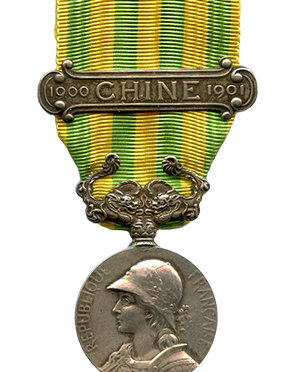
The 1901 China expedition commemorative medal (or “Médaille commémorative de l’expédition de Chine 1901” in French) is a military campaign medal established by the law of 15 April 1902 to recognize service in China in 1900 and 1901 during the Boxer rebellion.

In May 1900, an uprising throughout Northern China threatened the interests of nations with established concessions in major cities and leased territories in the empire of China (this hostility was mainly driven by a secret nationalist and xenophobic group called “the Society of Righteous and Harmonious Fists”, or “Boxers”)

Eight major powers (Germany, Austria, United States, France, Britain, Italy, Japan and Russia) decided to establish an international army of 150,000 men under the supreme command of German Field Marshal Count von Waldersee to rescue their besieged compatriots in Peking and put down the rebellion in the provinces.

The medal was awarded by the President of the French Republic to all officers, sailors and soldiers having participated in the French expedition to China during the following time periods:

  • for the personnel under the War Department, to all those who served in China between 30 June 1900 and 8 August 1901;
  • for the personnel under the Navy Department,
    • concerning members of crews, to those who were in service in theater between 30 May 1900 and 31 December 1901 who received an indemnity for service in China;
    • concerning officers, military functionaries or agents that did not figure on crew rosters, to those who received an indemnity for service in China covered in the decree of 4 August 1900 or an indemnity for expenses granted prior to 1 September 1900.

It was also awarded, on the recommendation of the Minister for External Affairs, to the French civilians who took part in the defense of the legations in Peking.

Allied troops entered Peking on 14 August 1900 but a peace treaty with China was only signed on 7 September 1901.

The 1901 China Expedition Commemorative Medal Design

The medal measures 30mm in diameter, is circular and struck in silver.

The obverse bears the relief image of the effigy of the “warrior republic” in the form of the left profile of a helmeted woman’s bust, the helmet being adorned by a crown of oak and laurel leaves. On either side, the relief inscription along the circumference “RÉPUBLIQUE FRANÇAISE” (English: “FRENCH REPUBLIC”).

The reverse displays a pagoda surrounded with military and naval articles or war. The ribbon’s suspension loop was adorned with two Chinese dragons.

The medal hangs from a 36 mm wide silk moiré yellow ribbon with four 4 mm wide equidistant green vertical stripes.

The Colonial Medal

The Colonial Medal is a decoration created by the loi de finances of 26 July 1893 to reward military services in the colonies. 

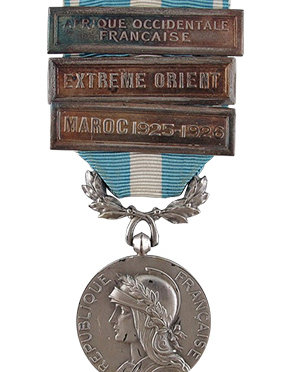
The Colonial Medal (or Médaille Coloniale in French) is a decoration created by the loi de finances of 26 July 1893 (article 75) to reward military services in the colonies. Its implementing decree dated 6 March 1894 lists the military operations carried out by France in its colonies or protectorates: Algeria – Cochin – Gold Coast – Marquesas Islands – Nossi- Bé – New Caledonia – Senegal and Sudan – Society Islands – Tunisia.

The colonial medal is closely linked to the existence of the French colonial empire.

The scope of the decree was therefore a broad retroactive effect, since the first operations considered for the award of the Medal colonial dating back to 1827, at the very beginning of the conquest of Algeria. A decree of 6 June 1962 changed the term “colonial” to “overseas”.

The Colonial Medal Design

The medal measures 30mm in diameter and is struck in silver.

On the obverse there is the helmeted effigy of the Republic with “République française” engraved above. On the reverse, a world map occupies the central field, resting on an anchor across a trophy of arms.

The ribbon is white and blue with vertical stripes. Its length can vary this from 35 to 37 mm.

The design of the medal is attributed to Capitaine de frégate Saulnier Pinellas, because the original award was for sailors. Its production had the distinction of being performed by the administration of the Paris Mint and a private company that was responsible for manufacturing the socket of the pendant ring leaves and clasps crimping indentations. The sets were to be delivered complete to the ministries of the Navy and War. The ribbon, the skewer assembly and assembly were also part of the supply.

The Second Madagascar Commemorative Medal

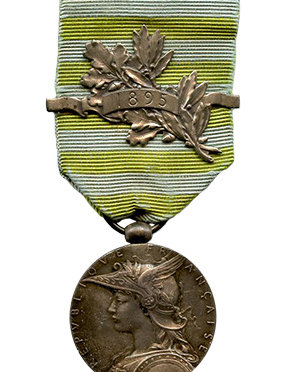
The Madagascar commemorative medal (or Médaille commémorative de Madagascar in French) is a commemorative medal issued to the participants to the First Madagascar expedition in 1883, and the Second Madagascar expedition in 1894-95.

Two different medals were issued, the first one by the law of 31 July 1886, the second one by the law of 15 January 1896. In 1883 the French bombarded and occupied Toamsina (then Tamatave), and in 1885 established a protectorate over Madagascar – which was recognized by Great Britain in 1890. In 1896, French troops under J. S. Gallieni defeated the Merina and abolished the monarchy. Queen Ranavalona III was sent into exile in Algeria in 1897, effectively ending the monarchy.

About 2,500 copies of the medal were awarded.

The First Madagascar Commemorative Medal Design

The medal was designed by Jean-Baptiste Daniel-Dupuis and has a diameter of 30 millimeters.

Within a broad wreath in the obverse is engraved the writing “République Française” arranged around the head of a symbolical helmeted and in armor-clad female figure. It is called the “armed republic” and bears the letters “PATRIE” on its ornate helmet.

The reverse bears a laurel wreath and a radiant five-pointed star, alongside the name of the island “MADAGASCAR“. Next to the star are the years 1883 and 1886 engraved. Under the rays is a trophy which depicts an anchor.

The medal was worn with light green and yellow horizontal striped ribbon on the left chest. That ribbon is a simple and rectangular silver buckle with the designation “MADAGASCAR“.

The Dahomey Expedition Commemorative Medal

  • Time Period: Pre-WW1
  • Institution: 24 November 1892
  • Country: France

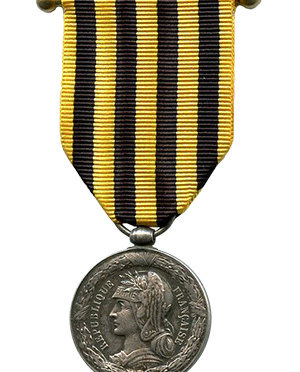
The Dahomey Expedition commemorative medal (or Médaille commémorative de l’Expédition du Dahomey in French) is a campaign medal bestowed to the participants of the First Franco-Dahomean War (1890) and the Second Franco-Dahomean War (1892–1894).

In 1892, France decided to send an expeditionary force of 1,801 Europeans and 1,769 natives under the command of Marine Infantry Colonel Alfred Dodds in response to the harassment of the kingdom of Porto-Novo under its protectorate and its trading posts on the coast of Dahomey by the troops of Behanzin, the king of Abomey. The expedition lasted five months, and the men defeated the 12,000 warrior strong army of Behanzin at Dogba. France thus reconquered the kingdom of Dahomey (now the Republic of Benin) and placed at its head, Toffa as the king of Porto-Novo. 

The Law of 24 November 1892 instituted the Commemorative Medal of the Dahomey Expedition for award to the officers, sailors and soldiers who took part in this campaign.

All recipients were to adhere to the code of conduct as set under the Grand chancellor of the Legion of honour. Posthumous awards were made to the widow or parents of the recipient.

The Dahomey Expedition Commemorative Medal Design

The medal measures 30 mm in diameter and is struck in silver. It was designed by Jean-Baptiste Daniel-Dupuis.

The obverse bears an effigy of the Republic and the words “RÉPUBLIQUE FRANÇAISE” enclosed within a laurel wreath running along the entire circumference. The Republic is represented as a helmeted young woman with the word “PATRIE” (HOMELAND) inscribed on the visor of her helmet.

The reverse of the medal features, within the same laurel wreath as on the obverse, a small five pointed star amid protruding rays, at center the relief inscription “DAHOMEY“, in the lower section, a naval sea anchor over four flags. A small relief Cornucopia trademark is just off the tip of the leftmost flag.

The medal hangs from a 36 mm wide “daffodil yellow” silk moiré ribbon bearing four equidistant 4 mm black vertical stripes.

The Tonkin Expedition Commemorative Medal

  • Time Period: Pre-WW1
  • Institution: 6 September 1885
  • Country: France

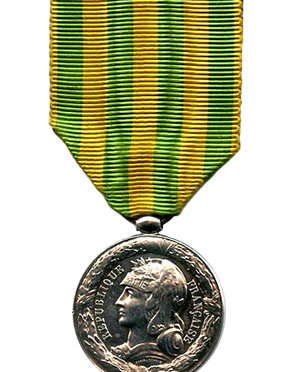
The Tonkin Expedition commemorative medal (or Médaille commémorative de l’expédition du Tonkin in French) was awarded to all the French soldiers and sailors who had taken part in the battles of the Tonkin and the Sino-French War between 1883 and 1885.

The medal, created by a law of 6 September 1885, was minted at the Monnaie de Paris and distributed shortly before the Bastille Day parade on 14 July 1886 to around 65,000 soldiers and sailors. Administrative and support staff, including cantinières and officials working in the treasury, postal and military telegraphy services, were eligible for the award of the medal. The medal was not awarded to participants whose service records were marred by serious military offences or habitual misconduct.

The medal was later awarded to participants in a number of earlier and later campaigns in Indochina, bringing the total number of recipients to 97,300.

The Tonkin Expedition Commemorative Medal Design

The obverse of the medal features an effigy of the Republic and the words République française, enclosed within a laurel wreath.The Republic is represented as a helmeted young woman with the word patrie (motherland) inscribed on the visor of her helmet.

On the reverse of the medal are a list of some of the more notable engagements of the Tonkin Campaign and the Sino-French War.

Two medal issues were made, one for the army and one for the navy and the troupes de marine. The navy issue medal includes the following names: Cau-Giaï, Sontay, Bac-Ninh, Fou-Tchéou, Formose, Tuyen-Quan, Pescadores. The army issue medal omits the name Cau-Giaï, as it was at this engagement that the French commandant supérieur in Tonkin was killed.

The medal ribbon, envisaged in the law of 6 September 1885 as half green and half yellow, was redesigned in the course of production, and the final version featured four green stripes on a yellow background. The clasp is inscribed with the word Tonkin.