The Expedition Cross

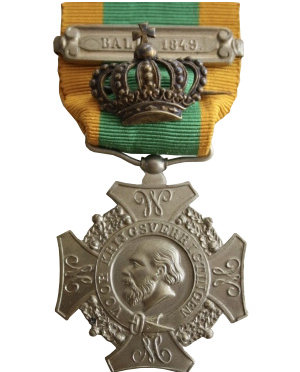
The Expedition Cross (or Expeditiekruis in Dutch) was a military decoration of Kingdom of the Netherlands created by King William III.

The Expedition Cross (or Expeditiekruis in Dutch) officially known as the Cross for Important Military Operations (Ereteken voor Belangrijke Krijgsbedrijven) was a military decoration of Kingdom of the Netherlands created by royal decree on 19 February 1869 by King William III.

The cross was awarded for participation in major military operations between 1846 and 1942.

The Expedition Cross Medal Design

The Expedition Cross is a four-armed silver metal cross measuring 39 millimeters (1.5 in) in diameter.

The obverse bears the effigy of King William III in a round center medallion, surrounded by a garter with the inscription VOOR KRIJGSVERRIGTINGEN (for military operations). Between the arms of the cross is a wreath of oak leaves. On each of the four the arms is a “W” monogram. The reverse is plain.

The ribbon is light green with yellow-orange borders.

The Cross for the Four Day Marches

The Cross for the Four Day Marches is a decoration awarded for successful participation in the International Four Days Marches Nijmegen.

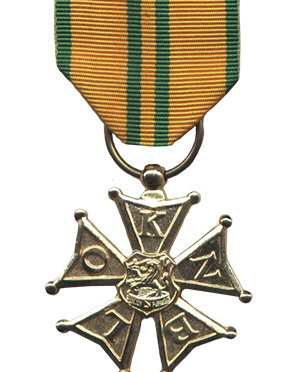
The Cross for the Four Day Marches (or Vierdaagsekruis in Dutch) is a Dutch decoration awarded for successful participation in the International Four Days Marches Nijmegen (Vierdaagse in Dutch) held annually at Nijmegen, The Netherlands.

The full title of the decoration is the Cross for Marching Proficiency (Kruis Voor Betoonde Marsvaardigheid). It is more commonly referred to as the Vierdaagse Cross or Vierdaagsekruis.

The cross was established in 1909 at the time of the first march, to award successful military participants of the Vierdaagse. Since 1910 it has been awarded to all participants who successfully complete all four days, both military and civilian.

The Cross is awarded by the Royal Dutch Walking League (KWBN or Koninklijke Wandel Bond Nederland) who organize the Nijmegen Marches. Prior to 2015 the League was known as the Royal Dutch League for Physical Education (KNBLO or Koninklijke Nederlandsche Bond Voor Lichamelijke Opvoeding) and before 1959, when it received the Royal (Koninklijke) prefix, as the NBVLO.

As well as the Vierdaagse at Nijmegen, the cross was also awarded to those who completed the four-day marches organized in various locations in the Dutch East Indies between 1935 and 1939.

Every year a walker successfully completes the march is marked either by a special cross, or a number to be attached to the ribbon of the last cross awarded. A cross is awarded in bronze for the first march, silver for the fifth and gold for the tenth, with a crown added above the cross for the year after each cross is awarded.

The Cross for the Four Day Marches Medal Design

The decoration is a five-armed cross, with each arm bearing an initial of the awarding organization. It has a width of 36 mm at its widest point and is suspended from a green-and-yellow (often orange-yellow) ribbon.

Until 1958 the initials on the five arms read: ‘NBVLO’, with ‘KNBLO’ since 1959 to reflect the Koninklijke (Royal) prefix. There have been other minor changes in design over the years. For example, in 1977 the previous silver-gilt and silver crosses were replaced by base metal versions, with other design modifications in order to reduce costs.

The reverse is plain except for the name of the manufacturer.

All medals were made by Koninklijke Begeer of the South Holland town of Voorschoten until 1976, when the contract moved to W. van Veluw of Zeist, near Utrecht.

The Carnegie Hero Fund Medal

The Carnegie Hero Fund Commission was established to recognize persons who perform extraordinary acts of heroism in civilian life.

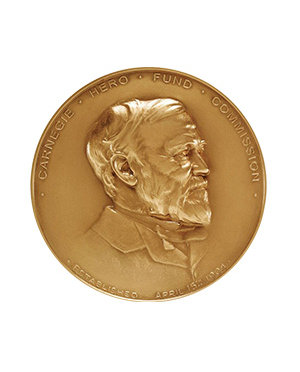
The Carnegie Hero Fund Commission (or Medaille van het Carnegie Heldenfonds in Dutch), also known as Carnegie Hero Fund, was established to recognize persons who perform extraordinary acts of heroism in civilian life in the United States and Canada, and to provide financial assistance for those disabled and the dependents of those killed saving or attempting to save others.

Those chosen for recognition receive the Carnegie Medal and become eligible for scholarship aid and other benefits. A private operating foundation, the Hero Fund was established in Pittsburgh, Pennsylvania, in 1904 with a trust fund of $5 million by Andrew Carnegie, a Scottish-American industrialist and philanthropist.

The fund was inspired by Selwyn M. Taylor and Daniel A. Lyle, who gave their lives in rescue attempts following the Harwick Mine disaster in Harwick, Pennsylvania, just outside Pittsburgh, on January 25, 1904. The disaster claimed 181, including Taylor and Lyle, who were killed during rescue attempts. Greatly touched by Taylor’s and Lyle’s sacrifice, Carnegie had medals privately minted for their families, and within two months he wrote the Hero Fund’s governing “Deed of Trust”, which was adopted by the newly created commission on April 15, 1904.

Administered by a 21-member board still based in Pittsburgh, the Hero Fund has awarded 9,893 medals as of September, 2016, and has given $38.5 million in one-time grants, scholarship aid, death benefits, and continuing assistance.

The Carnegie Hero Fund Medal Design

The three inch (7.13 cm) in diameter bronze medals which are given to awardees, are struck by Simons Brothers Co. of Philadelphia and consist of 90% copper and 10% zinc.

A verse from the New Testament of the Bible encircles the outer edge: “Greater love hath no man than this, that a man lay down his life for his friends” (John 15:13).

The first medals issued by the trust were in bronze, silver and gold. The trust soon stopped issuing gold medals. The last silver medal was issued in 1981.

The Flood Disaster Medal

The Flood disaster Medal (Watersnoodmedaille) was created by royal decree on 27 March 1855 by King William III of the Netherlands.

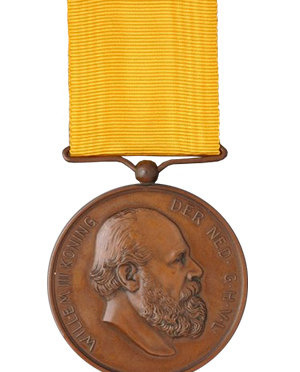
The Decoration for acknowledgment of excellent deeds performed during a flood disaster (or Onderscheidingsteken ter erkenning van uitstekende daden bij watersnood verricht in Dutch), usually called Flood disaster Medal (Watersnoodmedaille), was created by royal decree on 27 March 1855 by King William III of the Netherlands.

The medal is intended for those civilians who have shown zeal, courage, leadership, and self-sacrifice during the event of a flood disaster

The Flood Disaster Medal Design

The Flood Disaster medal is round, made of bronze and features the profile of King William III of the Netherlands. The ribbon is yellow.

The Museum Medal

The Honorary Medal for Merits toward Museum Collections (or Museum Medal) is one of the oldest civil decorations of the Netherlands.

The Honorary Medal for Merits toward Museum Collections (or Erepenning voor Verdiensten jegens Openbare Verzamelingen in Dutch), also known as the Museum Medal, is one of the oldest civil decorations of the Netherlands.

It was created by royal decree on 26 June 1817 by King William I of the Netherlands. The decree describes the following: “An honorary medal for appearance of interest in the state collection by donation shown“. The medal is awarded in gold, silver or bronze as a token of appreciation to those who “donate to the Dutch monarch any works of art, that were collected with much effort.

By royal decree, on 5 May 1877, eligibility for this award was extended by King William III of the Netherlands, with the description “to those who donated important works of art to the state museums or who showed praiseworthy acts regarding the different scientific collections or art collection of the state museums“.

Due to this description, the medal obtained its current official name. However, since the end of the 19th century, this decoration is primarily known as the “Museum Medal”.

Eligibility for this award was once again extending, by Queen Wilhelmina, on 28 October 1919 with the description “merit towards community (public) collections“. What was initially a medal for generous donors became now an official royal award for merit.

The Museum Medal Design

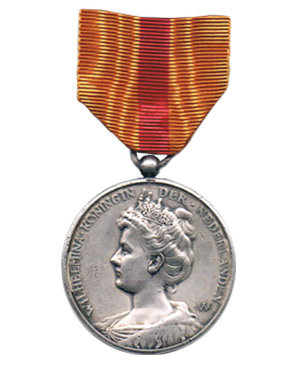
Up until 1897, the honorary medal was only a standing decoration, when Queen Wilhelmina of the Netherlands declared that the medal could be worn suspended from a ribbon. Queen Juliana of the Netherlands decided by royal decree on 26 July 1952 that the shape of the medal and ribbon should be changed.

The current ribbon is orange with two red lines descending down the middle. A ribbon bar is also given with the award, with a palm branch device in either gold or silver for recipients of the gold or silver versions of the medal, respectively. Queen Beatrix of the Netherlands later changed the composition of the medallion, and is now depicted on the obverse of the medal.

The De Ruyter Medal

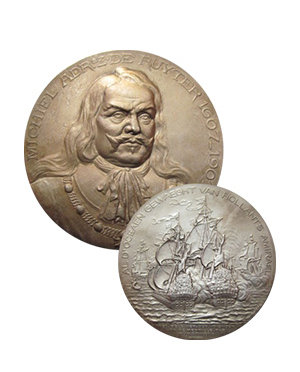
The De Ruyter Medal was created by royal decree to be awarded to those members of the Dutch Merchant fleet who distinguish themselves.

The De Ruyter Medal (or De Ruyter-medaille in Dutch) was created by royal decree no. 1 on 23 March 1907 by Queen Wilhelmina of the Netherlands, to be awarded to those members of the Dutch Merchant fleet who distinguish themselves by praiseworthy acts of duty for the Dutch Ship transport.

With the De Ruyter Medal the Kingdom of the Netherlands honors since 1907 the three-hundredth birthday of Michiel de Ruyter, one of the most famous admirals in Dutch history. The medal can be awarded in gold, silver or bronze. Awarding is on basis of nomination of the Netherlands government and by royal decree.

The Ruyter Medal Design

The Ruyter medal is a round medal with, on the front side, a picture of Michiel de Ruyter. The medal is worn with a dark orange ribbon.

The Honorary Medal for Charitable Assistance

The Honorary Medal for Charitable Assistance is one of the oldest decorations for bravery in the Kingdom of the Netherlands.

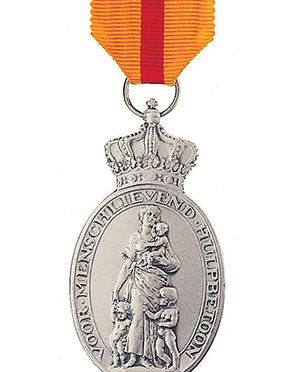
The Honorary Medal for Charitable Assistance (or Erepenning voor Menslievend Hulpbetoon in Dutch) was created at 18 June 1822 and is after the Military William Order the oldest decoration for bravery in the Kingdom of the Netherlands.

The Honorary Medal is the highest civilian decoration still being awarded for bravery, and is specifically for those who carried out a voluntary act of bravery or self-sacrifice, with an emphasis on charity.

The medal can be awarded in gold, silver or bronze. Awarding is on basis by nomination of the Netherlands government and by royal decree. The golden medal has precedence only after the Dutch Cross of Resistance (also a civilian bravery decoration, but not awarded anymore), and the silver and bronze medals have precedence after the Airman’s Cross (a military bravery award).

Lieutenant Alexander de Langle was the first person to be rewarded with this medal in 1821 for rescuing a sergeant who was stuck at the bottom of a well. Although this was considered an act of bravery, King William I did not deem it important enough to award the lieutenant the distinguished Military William Order, so inatead a new award for bravery was created: the Honorary Medal for Charitable Assistance.

The Honorary Medal for Charitable Assistance Design

In 1837 King William II decided by royal decree that the size of the golden, silver and bronze medals would be all 50 millimeter. Also his portrait was put on the medals.

Since 1849 the portrait of King William III was shown on the medals and from 1875 a portrait of the older and bold King William III.

When Emma of Waldeck and Pyrmont became the queen regent of the Netherlands she decided to put on the medal the portrait of her minor daughter Queen Wilhelmina. In 1897 a new type of medal was created, the medal did get a ribbon to wear and also did get the same shape as the French “Medal of Saint Helena”.

Since 1912 the medal has its current shape. The medal is ovally shaped with at the top a stylised royal crown. On the medal a mother with three children is portrayed. The motif is taken from the city hall in Bolsward. At the reverse side the words “De koningin aan” (English: The Queen Rewards to) and also some space is reserved for an inscription. The medal is worn with an orange ribbon that has a red band in the middle. The medallion is today still award as gold, silver or bronze.

The Cross for Courage and Fidelity

The Cross for Courage and Fidelity is a military award established by Queen Emma of the Netherlands on 7 March 1898 by Royal Decree.

The Cross for Courage and Fidelity (or Kruis voor Moed en Trouw in Dutch) is a military award established by Queen Emma of the Netherlands on 7 March 1898 by Royal Decree. The cross replaced the old Medal for Courage and Fidelity, which had limited prestige and status according to the Netherlands government.

The cross is the second-highest award of the Kingdom of the Netherlands, preceded only by the Military William Order. The cross was awarded to (and is still worn by) natives of the Netherlands East Indies that showed an exceptional display of bravery and fidelity.

The Governor-General of the Netherlands East Indies was authorized to award the cross. A total of 262 bronze and 13 silver crosses have been awarded, most of them in 1925. The last cross was awarded in 1927; after that natives and native soldiers of the Royal Dutch East Indies Army were also eligible to receive the Military William Order.

The cross, nicknamed the “Military William Order for natives”, has been regarded by many as discriminatory to the natives in the Netherlands East Indies.

The Cross for Courage and Fidelity Design

The cross has a resemblance to the Military William Order and is worn with the same ribbon as that order. The shape of the cross itself is somewhat different in the sense that the cross and crown are made of non-enameled silver.

On the cross of the Military William Order a gold spark rod is shown in the middle. However, on the cross for Courage and Fidelity, a heraldic Dutch Lion is shown. Between the arms of this cross two klewangs are added.

The text on the cross has the description “VOOR MOED EN TROUW” (English: for Courage and Fidelity) and at the back “Daden van Moed en Trouw in Nederlands-Indië door inlanders betoond” (English: Deeds of Courage and Fidelity in the Netherlands East Indies by natives awarded). Between the crown and cross is a spark rod, a distinguishing mark of the Order of the Golden Fleece or the Military William Order.

Those recipients who lost the cross during the Japanese occupation of Indonesia could receive a new cross but without an emblazoned crown.

The Order of Saint John in the Netherlands

The Order of Saint John in the Netherlands is a religious order dedicated to providing charitable and humanitarian services.

The Bailiwick of Brandenburg of the Chivalric Order of Saint John of the Hospital at Jerusalem (or Balley Brandenburg des Ritterlichen Ordens Sankt Johannis vom Spital zu Jerusalem in German), commonly known as the Order of Saint John or the Johanniter Order, is the German Protestant branch of the Knights Hospitaller, the oldest surviving chivalric order, which generally is considered to have been founded in Jerusalem in the year 1099 AD.

The medieval Dutch Bailiwick of Utrecht and Commandery of Haarlem formed parts of the German Langue (one of the “Tongues”, the major divisions of the medieval Order of Saint John) until, during the Reformation, they associated themselves with the reformed Bailiwick of Brandenburg. Both the Bailiwick of Utrecht and the Commandery of Haarlem were suppressed in 1810, during the Napoleonic occupation.

Dutch knights of the Bailiwick of Brandenburg formed their own commandery within the Johanniterorden in 1909, when the Dutch monarch afforded it royal protection; and the commandery separated from the German Johanniterorden in 1946.

The commandery became an independent order in 1958 and is known as Johanniter Orde in Nederland, now admitting noblewomen as well as noblemen. The Dutch monarch is an honorary commander. With the German and Swedish orders, the Dutch order helped found the Alliance of the Orders of St. John of Jerusalem on June 13, 1961.

The Order of Saint John in the Netherlands Design

Dutch insignia of the Johanniter Orde in Nederland replace Prussian eagles with the Dutch lion.

The Order of the House of Orange

The Order of the House of Orange is a dynastic order of the House of Orange-Nassau, the royal family of the Netherlands.

The Order of the House of Orange (or Huisorde van Oranje in Dutch) is a dynastic order of the House of Orange-Nassau, the royal family of the Netherlands. The order was instituted by Queen Wilhelmina of the Netherlands on 19 March 1905 and is not subject to ministerial responsibility or influence, but is awarded at the discretion of the Dutch monarch alone.

In 1905, Queen Wilhelmina felt the need for a House Order because the Order of the Oak Crown of the Grand Duchy of Luxembourg, used by her father and grandfather to reward Dutch subjects, was no longer available to her, as succession to the throne of Luxembourg was directed by the House treaty of the House of Nassau in a way comparable to the Salic Law within its constitution in 1890.

The Order of the House of Orange had a very complex nomenclature, with 18 different classes and medals.

More than 3200 decorations were conferred between 1905 and 1969, mostly to Court Dignitaries, the Queen’s household, and doctors and lawyers who could choose between sending a bill for their services or a decoration in the House Order.

Since the reorganization in 1969 the House Order itself has these grades:

  1. Grand Cross (Grootkruis) – badge may be worn on a sash on the right shoulder, plus an 8-pointed star on the left chest;
  2. Grand Honorary Cross (Groot erekruis) – wears the badge on a necklet;
  3. Honorary Cross (Erekruis) – wears the badge on a ribbon on the left chest.

The Order of the House of Orange Design

The insignia vary considerably amongst these awards; however they all share the same orange ribbon, symbolizing the House of Orange. The ribbon bar of the Order of the House of Orange was… well, orange.