The Honour Medal of Foreign Affairs

  • Time Period: Pre-WW1
  • Institution: Type 1 award 28 July 1816 – Type 2 award 30 August 2010
  • Country: France

The Honour medal of Foreign Affairs (or Médaille d’honneur des affaires étrangères or President’s Medal) is a state decoration bestowed by the French Republic in the form of an honour medal for work.

It was originally created by a Royal decree of 28 July 1816 as a single grade medal to reward acts of courage displayed by French nationals on foreign soil. Although still bestowed in wartime for courage, the modern award is now aimed at rewarding civil servants of the ministry for Foreign Affairs.

The Honour medal of Foreign Affairs is currently divided into three grades, bronze, silver and gold. The Honour medal of Foreign Affairs may be exceptionally awarded regardless of seniority and set quotas to reward bravery and dedication.

The wartime award with swords is bestowed as follows:

  • In bronze to privates;
  • In silver to non-commissioned officers;
  • In gold (silver-gilt prior to 2010) to officers.

The Honour Medal of Foreign Affairs Design

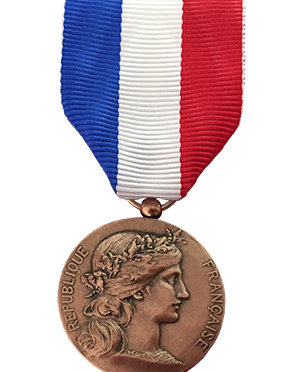
The Honour medal of Foreign Affairs, a design of engraver Daniel Dupuis, is a 27mm in diameter circular medal in bronze, silver or gold.

The obverse bears the relief effigy of the republic surrounded by the relief inscription “RÉPUBLIQUE FRANÇAISE” (“FRENCH REPUBLIC”) along the left and right circumference. The reverse bears a crown of half laurel and half oak leaves with the relief inscription “AFFAIRES ÉTRANGÈRES” (“FOREIGN AFFAIRS”) with a bare center destined to receive the recipient’s name and year of award.

The medal hangs from a silk moiré tricolour ribbon composed of three equal blue-white-red vertical stripes. The wartime award includes a wreath of oak leaves with two crossed swords on the suspension ring.

The Honour Medal for Courage and Devotion

The Honour medal for courage and devotion (or “Médaille d’honneur pour acte de courage et de dévouement”) is a French decoration that can be bestowed to individuals and whole units. It is awarded for acts of courage during a rescue.

The Honour medal for courage and devotion was created on 2 March 1820 by King Louis XVIII. It has gone through several designs during its long history. The award was given its present name by a decree of 16 November 1901.

Any person who risks his or her life to come to the rescue of one or many persons in danger, may be recognized with the medal. When the act of rescue does not warrant an award of the medal, a letter of congratulations for a successful rescue or an honorable mention for a recognized meritorious act in the form of an official certificate type scroll may be granted.

The Honour medal for courage and devotion is divided into five grades:

  • Bronze (Bronze)
  • Silver 2nd class (Argent de 2ème classe)
  • Silver 1st class (Argent de 1ère classe)
  • Silver-gilt (Vermeil)
  • Gold (Or)

The Honour Medal for Courage and Devotion Design

The design of the Honour medal for courage and devotion changed many times through the decades. It is now a 27mm in diameter circular medal struck in bronze, silver, silver-gilt or gold.

Its obverse bears the relief image of a standing woman holding palms and crowns surrounded by scenes of rescues under the relief inscription “DÉVOUEMENT” (“DEVOTION”). The reverse bears along its upper circumference, the relief inscription “RÉPUBLIQUE FRANÇAISE” (“FRENCH REPUBLIC”), at its center, the inscription “MINISTÈRE DE L’INTÉRIEUR” (“INTERIOR MINISTRY”) over a framed rectangular area destined to receive the name of the recipient and year of the award.

The medal hangs from a 3cm wide silk moiré tricolour ribbon of equal width blue, white and red vertical stripes. The 3cm wide and 22mm high ribbon suspension loop is cast as an integral part of the medal in the form of oak leaves. The leaves of the suspension loop change colour depending on the grade of the award, bronze for the bronze grade, silver for the silver grade second class, silver-gilt for the silver grade first class and silver-gilt grade, and gold for the gold grade.

Different devices may be worn on the service ribbon to denote the grade of the award when only the ribbons are worn. A plain ribbon is worn for the bronze grade, the silver grade second class is denoted by the addition of a silver five pointed star, a silver and a silver-gilt star for the silver grade first class, a silver-gilt star for the silver-gilt grade and a rosette for the gold grade.

The Order of Agricultural Merit

The Order of Agricultural Merit is an order of merit by the French Republic for outstanding contributions to agriculture.

The Order of Agricultural Merit (or Ordre du Mérite agricole) is an order of merit bestowed by the French Republic for outstanding contributions to agriculture.

When it was created in 1883, it was second in importance only to the Legion of Honour within the French order of precedence. The order was established on 7 July 1883, based on the proposition of the then Minister of Agriculture Jules Méline, in an effort to adequately reward services to agriculture in view of the maximum number of the Legion of Honour that could be awarded yearly. Labour was intensive and never-ending, devotion was commonplace but the rewards were rare.

The Order comprises approximately 340,000 recipients to date, of which approximately 23,000 are alive at any given time, including all living former ministers of agriculture. Officers number approximately 60,000 to date with approximately 5,000 living, and approximately 4800 were made commanders to date, with approximately 400 living at any given time.

Award prerequisites are as follows:

  • Knight: be at least thirty years of age with fifteen years of service/work;
  • Officer: at least five years as a Member of the order;
  • Commander: at least five years as an Officer of the order.

Conditions of age and of seniority may be lowered for candidates who have outstanding qualifications.

The Order of Agricultural Merit Design

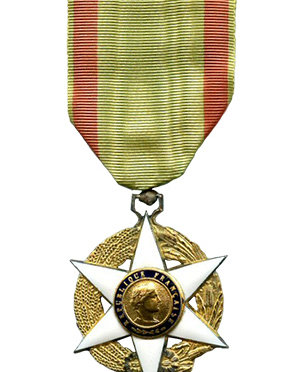
The Order of Agricultural Merit is in the form of a 40mm (35mm for pre-November 1999) wide star, 60mm for the commander’s insignia, with six white enameled arms, the arms resting on a gilt wreath of wheat on the right and of corn on the left.

On the obverse at its center, a gilt medallion bearing the effigy of the republic in the form of the relief right profile of a woman’s head, the medallion is surrounded by a narrow blue enameled band bearing the golden semi-circular inscription “RÉPUBLIQUE FRANÇAISE” (“FRENCH REPUBLIC”).

On the reverse, the gilt medallion bears the relief inscription on three lines “MÉRITE” “AGRICOLE” “1883” (“AGRICULTURAL MERIT 1883”), it is surrounded by a plain blue enameled band.

The officers’ and commanders’ badges also bear a gilt wreath, half vine and half olive branch, between the insignia and the ribbon suspension ring. The knight’s insignia is made of silver, the officer’s is made of silver-gilt, the commander’s is made of silver-gilt or gold.

The order hangs from a 37mm wide silk moiré green ribbon with 5mm amaranth vertical stripes located 1mm from the edges. The commander’s insignia is worn on a cravat around the neck.

The Order of Academic Palms

  • Time Period: Pre-WW1
  • Institution: Decoration: 1808, Order: 1955
  • Country: France

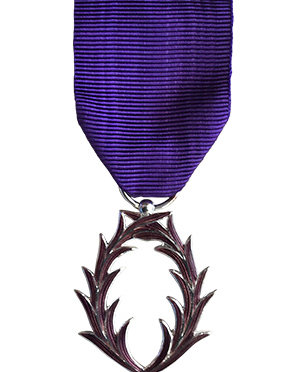
The Order of Academic Palms (“Ordre des Palmes académiques“) is a national order bestowed by the French Republic to distinguished academics and figures in the world of culture and education.

Originally established in 1808 by Emperor Napoleon as a decoration to honor eminent members of the University of Paris, it was changed into its current form as an order of merit on 4 October 1955 by President René Coty.

The early Palmes académiques was instituted on 17 March 1808 and was bestowed only upon teachers or professors. In 1850, the decoration was divided into two known classes:

  • Officier de l’Instruction Publique (Golden Palms);
  • Officier d’Académie (Silver Palms).

In 1866, the scope of the award was widened to include major contributions to French national education and culture made by anyone, including foreigners. It was also made available to any French expatriates making major contributions to the expansion of French culture throughout the rest of the world.

The Order of Academic Palms Design

Since 1955, the Ordre des Palmes académiques has comprised three grades, each grade having a fixed number of recipients:

  • Commander (Commandeur) — gold cross of 60 mm with a coronet (“couronne”) worn on necklet.
  • Officer (Officier) — gold cross of 55 mm worn on ribbon with rosette on the left breast.
  • Knight (Chevalier) — silver cross of 50 mm worn on ribbon on the left breast.

The Military Medal (France)

The Military Medal (Medaille Militaire) is a military decoration of the French Republic for meritorious service and acts of bravery.

The Military Medal (or Medaille Militaire) is a military decoration of the French Republic for other ranks for meritorious service and acts of bravery in action against an enemy force.

It is the third-highest award of the French Republic, after the Légion d’honneur, a civil and military order, and the ordre de la Libération, a second world war-only order. The Médaille militaire is therefore the most senior entirely military active French decoration.

The award was first established in 1852 by the first President of the French Republic, Louis-Napoléon Bonaparte who may have taken his inspiration from a medal established and awarded by his father, Louis Bonaparte, King of Holland.

During World War One, 230 000 médailles were awarded, when 1 400 000 French Army soldiers were killed and 3 000 000 wounded. After the First World War, the Military Medal was also temporarily awarded for wounds received in combat.

The Military Medal Award Criteria

Like many other French awards, the médaille can be awarded for different reasons. It can be awarded to foreign nationals serving with or alongside the French armed forces.

  • To members of the military other than commissioned officers;
    • As an award for valour, it is the second highest award ranking immediately after the Légion d’honneur.
    • As an in between medal for enlisted members, NCO and O(D) awarded the Légion d’honneur for “combat actions”, nowadays mostly done posthumously.
    • As a service medal, for long-serving NCOs.
  • To generals and admirals who have been commanders-in-chief, as a supreme award for leadership. These general officers must already have been awarded the grand cross of the Légion d’honneur.

The Military Medal Design

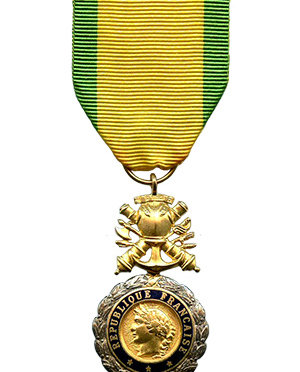
The Médaille militaire is a silver laurel wreath, 28 mm (1.1 in) in diameter, wrapped around a central gold medallion bearing the left profile of Marianne, effigy of the French Republic, the original 2nd Empire variant bore the left profile of Emperor Napoleon III.

The central gold medallion is surrounded by a blue enamelled ring bearing the gilt inscription “RÉPUBLIQUE FRANÇAISE” (FRENCH REPUBLIC) with a small gilt five-pointed star at the bottom for a 4th Republic award, three stars for a 5th Republic variant, the 3rd Republic variant bore the date 1870, the 2nd Empire variant bore the gilt inscription “LOUIS-NAPOLEON” in lieu of “RÉPUBLIQUE FRANÇAISE” and had flowers on both sides of the small star at the bottom.

The original variant was topped by a silver imperial eagle with a loop through which the suspension ring passed, all other variants were and are topped by a device composed of a breastplate superimposed over crossed cannons, a naval anchor, sabres, swords and battle axes, to which the suspension ring passes through a loop for attachment to a ribbon.

The reverse of the medallion is common to all variants since inception of the award, it bears the relief inscription on three lines “VALEUR ET DISPLINE” (“VALOUR AND DISCIPLINE”) and is surrounded by a blue enamelled ring.

The ribbon of the Médaille militaire is 37 mm (1.5 in) wide, yellow in color with 6 mm-wide (0.24 in) green stripes on each edge.

The Order of Military Merit (France)

The Order of Military Merit, initially known as the Institution of Military Merit (or Institution du Mérite militaire) was an order of the French Ancien Régime created on 10 March 1759 by King Louis XV. It was created to reward the non-Catholic officers of the French Army.

By the 18th Century there were regiments of Swedish, German, and Swiss troops in service to France, the most famous being the Swiss Guards. Since many of these regiment’s officers were Protestant there lacked a suitable reward for distinguished service. The Order of Saint Louis was intended as a reward for exceptional military officers, but could only be awarded to those of the Roman Catholic faith. King Louis XV created the Institution du Mérite militaire to be an outward sign of distinction, but not an order since French orders were limited to Catholics.

In 1792, after the proclamation of the Republic the Décoration Militaire was abolished. King Louis XVIII continued to make awards of the order while in exile. On 28 November 1814, during the restoration Louis XVIII reaffirmed the Order of Military Merit, increasing the number of Grand Crosses to four and Grand Cordons to eight. The ribbon color was also changed to match that of the Order of St. Louis. The last appointment to the order was made in 1829.

The Order of Military Merit Design

Presented in three grades the names of which were formalized as Knight, Grand Cordon, and Grand Cross in 1785, mirroring those of the Order of St. Louis. King Louis was careful to promote the prestige of the award by appointing the most talented officers. The first Grand Crosses were presented to Swiss Field Marshal Count Waldner and German Lieutenant General Prince William of Nassau-Saarbrücken.

The Order of Saint Louis

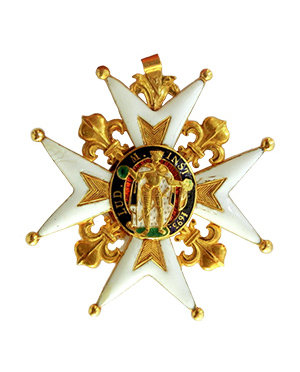
The Royal and Military Order of Saint Louis (or Ordre Royal et Militaire de Saint-Louis) is a dynastic order of chivalry founded 5 April 1693 by King Louis XIV, named after Saint Louis (King Louis IX of France).

It was intended as a reward for exceptional officers, notable as the first decoration that could be granted to non-nobles. By the authorities of the French Republic, it is considered a predecessor of the Legion of Honour, with which it shares the red ribbon (though the Legion of Honour is awarded to military personnel and civilians alike).

The King was the Grand Master of the order, and the Dauphin was automatically a member as well. The Order had three classes:

  • Grand-Croix (Grand Cross)
  • Commandeur (Commander)
  • Chevalier (Knight)

The entire order included 8 Grand Crosses, 28 Commanders and a variable number of Knights. Officers of the Order included, after the Grand Master, a Trésorier (Treasurer), a Greffier (Registrar) and a Huissier (Gentleman Usher).

Conditions for being inducted did not include nobility; however, Catholic faith was mandatory, as well as at least ten years’ service as a commissioned officer in the Army or the Navy. Members of the Order received a pension. Hereditary nobility was granted to a knight’s son and grandsons.

Although officially abolished by the government authorities of the July Revolution in 1830 following the French Revolution, its activities carried on as a dynastic order of the formerly sovereign royal family. As such, it is still recognised by the International Commission on Orders of Chivalry.

The Order of Saint Louis Design

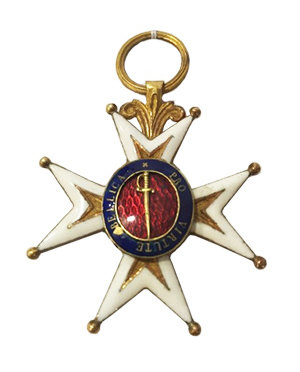
The badge of the order consisted of a portrait of Saint Louis surrounded by the motto « LUD(OVICUS) M(AGNUS) IN(STITUIT) 1693 » (“Louis the Great instituted it in 1693“).

The reverse features a sword interlaced with a laurel crown and a white sash, with the inscription « BELL(ICAE) VIRTUTIS PRAEM(IUM) » (“reward of wartime valour”). Knights wore the badge suspended from a ribbon on the breast, Commanders wore a red ribband (sash) over the right shoulder, and recipients of the Grand Cross wore the ribband as well as a star on the left breast.

The general assembly of the Order was held annually on 25 August, the feast day of Saint Louis, in the residence of the King.

The Order of Saint Michael

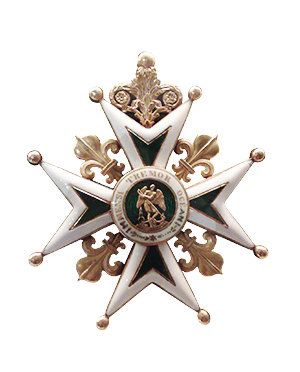
The Order of Saint Michael (or Ordre de Saint-Michel) is a French dynastic order of chivalry founded by Louis XI of France on 1 August 1469.

The Order of Saint Michael (or Ordre de Saint-Michel) is a French dynastic order of chivalry, founded by Louis XI of France on 1 August 1469, in competitive response to the Burgundian Order of the Golden Fleece founded by Philip the Good, duke of Burgundy and Louis’ chief competitor for the allegiance of the great houses of France.

As a chivalric order, its goal was to confirm the loyalty of its knights to the king. Originally, there were a limited number of knights, at first thirty-one, then increased to thirty-six including the king. An office of Provost was established in 1476. The Order of St Michael was the highest Order in France until it was superseded by the Order of the Holy Spirit.

Although officially abolished by the government authorities of the July Revolution in 1830 following the French Revolution, its activities carried on. It is still recognized by the International Commission on Orders of Chivalry.

The Order’s last member died in 1850. However, 10 nominations of knights were conferred in 1929, 1930, and in the 1970s and 1980s. As is mentioned by the French Government, it would be considered as the origin of the Ordre des Arts et des Lettres: “Saint-Michel Order (1460–1830) can be considered as the precursor of the Order of the Arts and Lettres. Originally destined to the aristocracy, from 17th to 18th Centuries it became an order of civil merit, which distinguished many artists, architects, collectors, and people of lettres…”

The motto of the order was “immensi tremor oceani” (meaning the tremor of the immense ocean) derived from the idea of Saint Michael looking out over the Atlantic from Mont Saint-Michel.

The Order of Saint Michael Design

The Order of St. Michael dedicated to the Archangel Michael conveyed to every member a gold badge of the image of the saint standing on a rock (Mont Saint-Michel) in combat with the serpent.

It was suspended from an elaborate gold collar made of scallop shells (the badge of pilgrims, especially those to Santiago de Compostela) linked with double knots. The statutes state that the badge could be hung on a simple chain, and later it was suspended from a black ribbon.

Find This Medal

Right Now on eBay 
Clicking a link to eBay may result in a referral commission being paid if a purchase is made.
Loading...

The Order of the Holy Spirit

  • Time Period: Pre-WW1
  • Institution: 31 December 1578
  • Country: France

The Order of the Holy Spirit (or Ordre du Saint-Esprit, sometimes translated into English as the Order of the Holy Ghost), is a French order of chivalry founded by Henry III of France in 1578. Today, it is a dynastic order under the House of France.

During the French Revolution, the Order of the Holy Spirit was officially abolished by the French government, along with all other chivalric orders of the Ancien Régime, although the exiled Louis XVIII continued to acknowledge it. Following the Bourbon Restoration, the order was officially revived, only to be abolished again by the Orleanist Louis-Philippe following the July Revolution in 1830. Despite the abolition of the order, both the Orléanist and Legitimist pretenders to the French throne have continued to nominate members of the order, long after the abolition of the French monarchy itself. The order is still recognised by the International Commission on Orders of Chivalry.

The King of France was the Sovereign and Grand Master (Souverain Grand Maître), and he made all appointments to the order. Members of the order can be split into three categories:

  • 8 Ecclesiastic members;
  • 4 Officers;
  • 100 Knights.

Initially, four of the ecclesiastic members had to be cardinals, whilst the other four had to be archbishops or prelates.

The Order of the Holy Spirit Design

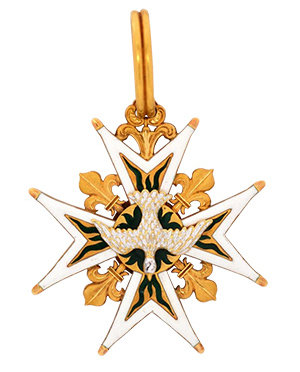
The symbol of the order is known as the Cross of the Holy Spirit (a Maltese Cross). At the periphery, the eight points of the cross are rounded, and between each pair of arms there is a fleur-de-lis. Imposed on the centre of the cross is a dove.

The eight rounded corners represent the Beatitudes, the four fleur-de-lis represent the Gospels, the twelve petals represent the Apostles, and the dove signifies the Holy Spirit. The Cross of the Holy Spirit was worn hung from a blue riband (“Le cordon bleu”).

The badge of the Order is a gold Maltese cross with white borders, each of the eight points ending in a gold ball (points boutonnées) and with a gold fleur-de-lys between each adjacent pair of its arms. At the center of the cross, was set a white dove descending (i.e., with its wings and head pointing downward) surrounded by green flames. The back of this cross worn by the knights was the same as the front except with the medallion of the Order of Saint Michael at the center rather than the dove and flames (those of ecclesiastical members were the same on the back as on the front).

During the ceremonies, the cross of officers and commanders officers was attached to a collar of links of gold fleur-de-lis alternating with links consisting of a white enameled letter H (the first initial of name of the founder) crowned with a gold French royal crown, with identical crowns on either side of it or alternately with a trophy of weapons. Each of these links was surrounded with red enamel flames forming a square around it. More generally, the cross was suspended from a large ribbon of color moirée blue sky, hence the nickname cordon bleu the knights wore.

For the ceremonies of the Order and when the knights of the Order made their Communion, the knights wore a long black velvet mantle sprinkled with embroidered gold and red flames and with a representation of the collar round its edges embroidered in gold, red and silver. The mantle was worn over a white coat (with the star of the Order embroidered on the left breast), waistcoat and puffed hose, heavily embroidered with silver. A black hat with a white plume completed the dress.

The star of the Order had the same design as the front of the badge, but embroidered in silver (later a medal star in silver was used) on both the knights’ coats and their vests.

The Lombok Cross

The Lombok Cross is a military award established to commemorate service in the Dutch intervention in Lombok and Karangasem.

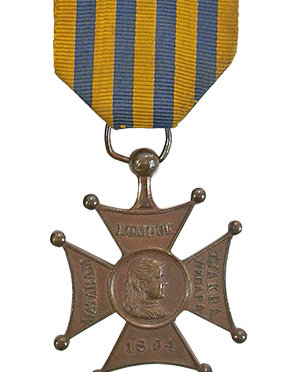
The Lombok Cross (or Lombokkruis in Dutch) is a military award of the Kingdom of the Netherlands, established to commemorate service in the Dutch intervention in Lombok and Karangasem which took place between June and December 1894.

The medal was established on 13 April 1895 by Queen Regent Emma of the Netherlands, acting for the underage Queen Wilhelmina.

The Lombok Cross Medal Design

The medal is a bronze Cross pattée with concave ends on the arms and ball finials on the points.

The obverse of the cross bears the effigy of the young queen facing right in the center of the cross. Each arm bears an inscription: On the top is LOMBOKMATARAM, on the left: TJAKRA-NEGARA on the right, and 1894 on the bottom arm.

The reverse of the cross depicts the rampant Dutch lion in a wreath. The arms are inscribed HULDE AAN at the top, LEGER on the left, EN at the bottom, and VLOOT on the right (Homage to Army and Fleet). The medal hangs from a ring suspension on a ribbon 40 mm (1.6 in) wide of nine equal stripes, five in orange-yellow and four of Nassau blue.