The Order of the Bath Medal

The Most Honorable Order of the Bath is a British order of chivalry founded by King George I in 1725 and turned into a Military Order.

The Most Honorable Order of the Bath (also knows previously as “The Most Honorable Military Order of the Bath“) is a British order of chivalry founded by King George I on 18 May 1725 and erected into a regular Military Order.

The name Order of the Bath is derived from the ancient practice of ritual purification by bathing, symbolizing spiritual cleansing and renewal. In medieval times, knights were often ceremonially bathed before being dubbed into chivalric orders, signifying their commitment to noble ideals and virtues. The knights product of this ceremony were known as “Knights of the Bath“.

The Order was re-organized in 1815 in two divisions: Military and Civil. Members can belong to either the Civil or the Military Division. Before 1815, the order had only a single class (Knight Companion), but it no longer exists.

The Order of the Bath Classes

The Order of the Bath consists of three classes, each with its own distinctive medal. These three classes of the Order of the Bath recognize different levels of achievement and service to the British Crown. 

  • Knight Grand Cross (GCB): The highest class of the Order is awarded for the most exceptional acts of service and gallantry. Recipients of this honor are entitled to wear a star and a badge. 

  • Knight Commander (KCB): The second class is awarded for distinguished service and gallantry. Recipients of this honor are entitled to wear a star and a badge suspended from a crimson ribbon worn around the neck.

  • Companion (CB): The third and lowest class is awarded for meritorious service and gallantry. Recipients are entitled to wear a badge only.

A Brief History of the Order of the Bath

The origins of the Order can be traced back to the medieval period, with its establishment formally documented in the early 18th century. The modern incarnation of the Order of the Bath was founded by King George I of Great Britain in 1725. The king established the order as a means of recognizing and rewarding military and civil merit within his realm. 

During the Napoleonic Wars of the late 18th and early 19th centuries, the Order of the Bath experienced a period of revival and expansion. It became one of the most prestigious honors bestowed by the British Crown, awarded to military officers and civil servants for distinguished service, bravery, and leadership in times of conflict.

Over the centuries, the Order of the Bath has continued to evolve, adapting to changes in British society and the nature of warfare. It remains an important institution, honoring individuals who have made significant contributions to the nation, both in times of war and peace.
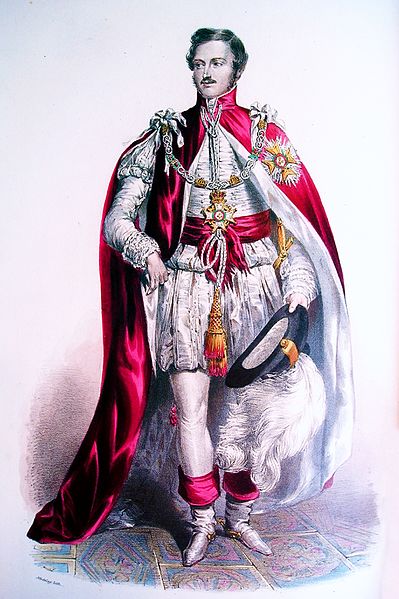
Prince Albert, the Prince Consort, Great Master 1843–1861.

The Most Honorable Order of the Bath Medal Design

Members of the Order wear elaborate costumes on important occasions (such as its quadrennial installation ceremonies and coronations), which vary by rank.

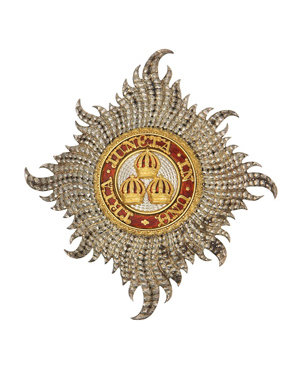
The star is a silver flaming star surmounted by a circular gold band enameled red bearing the motto around the top and laurel around the foot. It encloses three gold crowns enameled in red. The collar chain is made of gold and composed of nine crowns and eight devices (a rose, a thistle, and a shamrock), connected by gold, white-enameled knots. The collar badge is a skeletal gold badge with an oval collar and the inscription “TRIA JUNCTA IN UNO” (or “Three joined in one” in Latin) in white enameled letters. The inscription encloses a thistle, rose, and shamrock. The sash badge is similar to the collar one, but smaller and without white enamel. The ribbon is 38 millimeters and deep red.

The military badge is a gold Maltese Cross of eight points, enameled in white. Each point of the cross is decorated by a small gold ball, and each angle has a small figure of a lion. The center of the cross shows three crowns on the obverse side, and a rose, a thistle and a shamrock emanating from a scepter on the reverse. Both are surrounded by a red circular ring bearing the motto of the Order and flanked by two laurel branches, above a scroll bearing the words Ich Dien in gold letters.

The civil badge is a plain gold oval bearing three crowns on the obverse side, and a rose, a thistle, and a shamrock, emanating from a scepter on the reverse side; both emblems are surrounded by a ring bearing the motto of the Order.
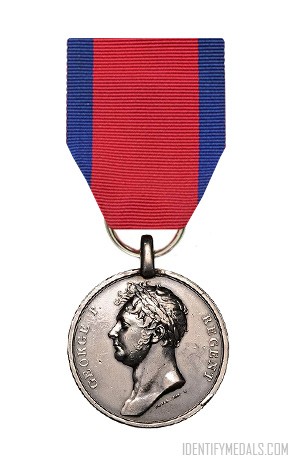
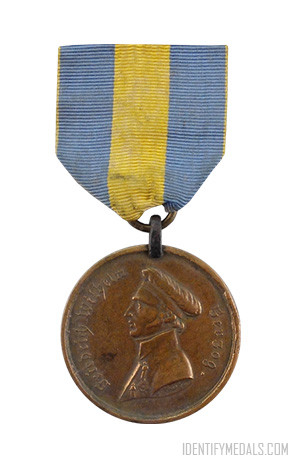
The Waterloo Medal

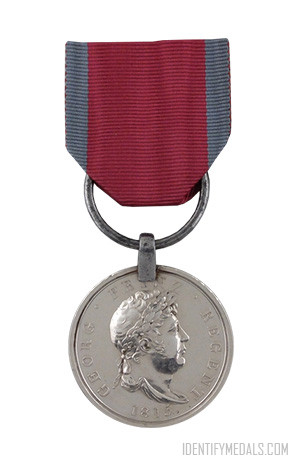
The Waterloo Medal is a British military medal established in 1816-17 and struck for all those who participated in the Waterloo campaign.

The Waterloo Medal is a British military medal established in 1816-17 by the House of Commons. The military medal was to be struck for all those who participated in the Waterloo campaign.

On 23 April 1816, it was announced in the London Gazette that the Prince Regent had been graciously pleased to confer the Waterloo Medal upon every officer, non-commissioned officer and soldier of the British Army who took part in the battles of Ligny (16 June 1815), Quatre Bras (16 June 1815) and/or Waterloo (18 June 1815). This included also members of the King’s German Legion.

The measure was supported by the Duke of Wellington, who on 28 June 1815 wrote to the Duke of York: “…the expediency of giving to the non commissioned officers and soldiers engaged in the Battle of Waterloo a medal. I am convinced it would have the best effect in the army, and if the battle should settle our concerns, they will well deserve it.

On 17 September 1815, the Duke of Wellington wrote to the Secretary of State for War recommending “that we should all have the same medal, hung to the same ribbon as that now used with the [Army Gold] Medal.

The Waterloo Medal was finally issued in 1816–1817 and given to every soldier that had been present at one or more of the battles of Ligny, Quatre Bras and Waterloo. Each and every soldier was also credited with two years extra service and pay, and were to be known as “Waterloo Men“.

Different Waterloo Medals

The Waterloo medal was the first medal issued by the British Government to all soldiers present during an action, and it was also the first campaign medal awarded to the next-of-kin of men killed in action.

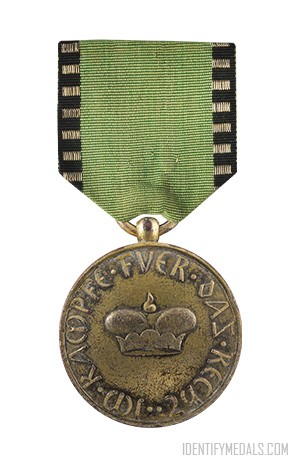
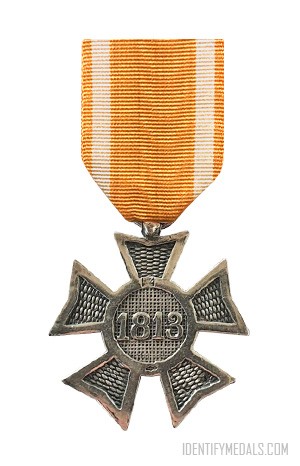
Seven nations of the Seventh Coalition struck medals for soldiers who took part in the campaign: 

British Campaign Medals: The Brunswick Waterloo Medal

The Brunswick Waterloo Medal

The Brunswick Waterloo Medal was a campaign medal awarded to those who participated in the Battles of Quatre Bras and Waterloo.

British Campaign Medals: The Hanoverian Waterloo Medal

The Hanoverian Waterloo Medal

The Hanoverian Waterloo Medal was issued to all members of the Hanoverian army who fought in the battles of Quatre Bras and Waterloo.

British Campaign Medals: The Nassau Medal for Waterloo

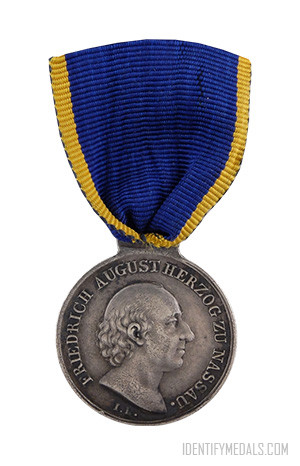
The Nassau Waterloo Medal

The Waterloo Medal is a campaign of the Duchy of Nassau established by Frederick Augustus, Duke of Nassau on 23 December 1815.

The Waterloo Medal Design

The Waterloo medal is made of silver and is 37 mm (1.5 in) in diameter. It was designed by Thomas Wyon, a recently appointed Chief Engraver to the Royal Mint. The medals were to be awarded originally in bronze, but it was decided at a late stage that they should be produced in fine silver.

The obverse of the Waterloo medal shows a left facing effigy of the Prince Regent with the inscription GEORGE P. REGENT. The reverse displays a figure of Victory seated on a plinth with the words WELLINGTON above, and WATERLOO and the date JUNE 18 1815 below.

The design of the Waterloo medal was modeled on an ancient Greek coin from Elis, that belongs today to the British Museum collection.

Find This Medal

Right Now on eBay 
Clicking a link to eBay may result in a referral commission being paid if a purchase is made.
Loading...

The Seringapatam Medal

The Seringapatam medal (Sri Ranga Pattana) is a British military medal commissioned by the East India Company in 1801 and given to soldiers.

The Seringapatam medal (or Sri Ranga Pattana) is a British military medal commissioned by the East India Company in 1801 and distributed to soldiers who had contributed to the British victory in the 1799 Battle of Seringapatam, fought against the armies of Tipu Sultan, who was the ruler of the Kingdom of Mysore

These medals were issued to all participants, but their materials were of various values; Those given to the highest-ranking commanders were made of gold, the ones given to intermediate ranks were silver, silver-gilt, or bronze, and those for lesser ranks were made of tin or pewter.

The Seringapatam Medal Design

The medal was designed by Conrad Heinrich Küchler, a German engraver who  worked as a designer of coinage and medals for the manufacturer and mint owner Matthew Boulton from 1793 until his death. Küchler was Boulton’s sole artist for designing and die-cutting, and produced the designs for various coins, medals and tokens, including the copper “cartwheel” pennies and twopences.

Many of the Seringapatam medals were manufactured at the Soho Mint in Birmingham, although a smaller version of the medal was manufactured in the Calcutta Mint.

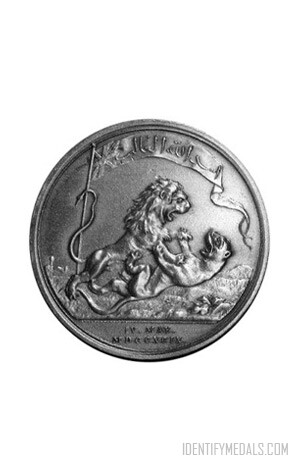
The reverse of the medal displays the storming of the fort, with the sun at its meridian. The obverse shows the British lion trampling Tipu’s emblem, the tiger, with the caption “Asad Allah al-Ghalib” (that means “Lion of God the Conqueror” in Arabic).

The Star of the Grand Cross of the Iron Cross

The Star of the Grand Cross of the Iron Cross was the highest military decoration of the Kingdom of Prussia and the German Empire. 

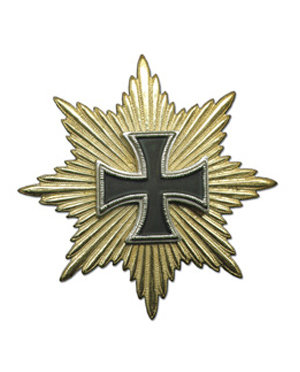
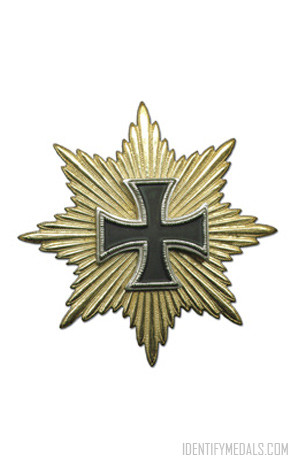
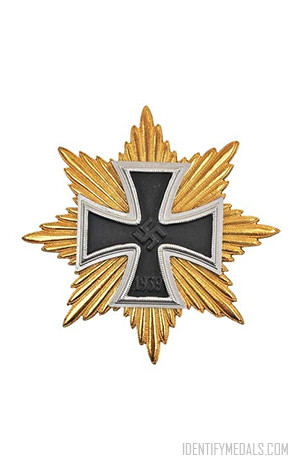
The Star of the Grand Cross of the Iron Cross (or Stern zum Großkreuz des Eisernen Kreuzes in German) was a senior decoration to the Grand Cross of the Iron Cross and the highest military decoration of the Kingdom of Prussia and the German Empire. The award is commonly known as “Blücher’s Star” (Blücherstern) after its first recipient.

This award was given to the most outstanding of generals who had performed feats of leadership that had extremely benefited the German state.

The Star of the Grand Cross of the Iron Cross was awarded only twice, a century apart. The first time it was to Field Marshal Gebhard von Blücher in 1815, to recognize his victory over Napoleon at the Battle of Waterloo. The second was awarded to Field Marshal Paul von Hindenburg in 1918 for his victory at the Battle of Tannenberg. Paul von Hindenburg received the Grand Cross of the Iron Cross (9 December 1916) to which the Golden Star added on 25 March 1918 (Star of the Grand Cross of the Iron Cross).

The Star of the Grand Cross of the Iron Cross Design

During the reign of Nazi Germany, Reichsmarschall Hermann Göring commissioned a new version of the Star of the Grand Cross of the Iron Cross medal, with the intention of awarding it to Adolf Hitler once Germany had won the Second World War. Because Germany was defeated in 1945, the award was never bestowed on him.

After the Allied victory in May 1945, the US Army seized the only known prototype of this medal, which had been securely stored in a bunker. It is now a part of the collection of the Museum of the United States Military Academy in West Point, New York.

More Variations of the Iron Cross

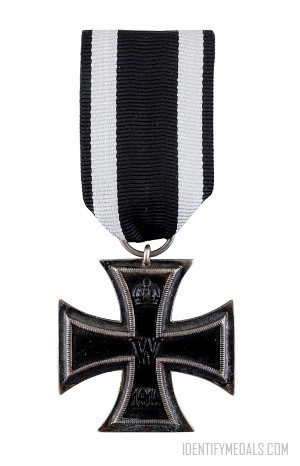
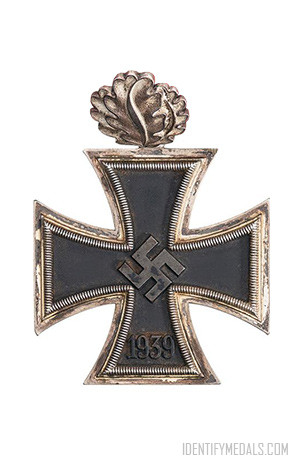
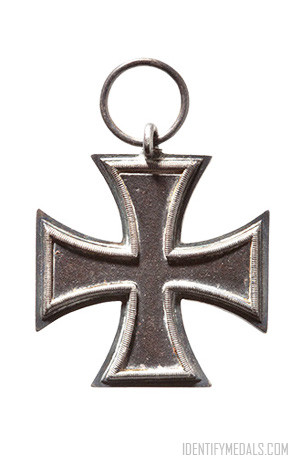
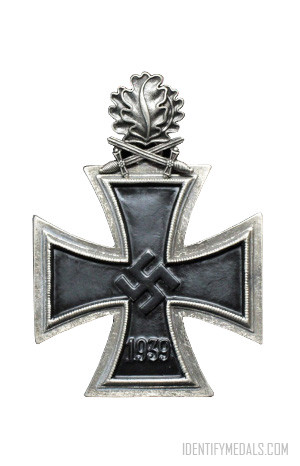
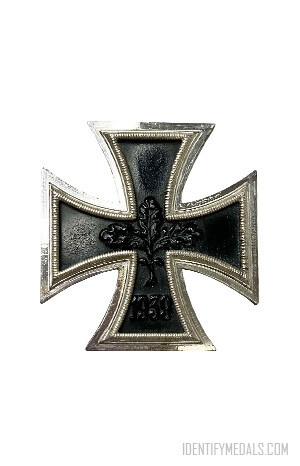
The Iron Cross, a prestigious German military decoration, has undergone several variations since its inception. For example, the Iron Cross 1813 was instituted during the Napoleonic Wars by King Frederick William III of Prussia, the Iron Cross 1914 was awarded during World War I, it was reinstated by Kaiser Wilhelm II, and the Iron Cross 1939 was revived by Adolf Hitler for World War II, with modifications including a swastika.

Find the Iron Cross Medal Online

Right Now on eBay 
Clicking a link to eBay may result in a referral commission being paid if a purchase is made.
Loading...

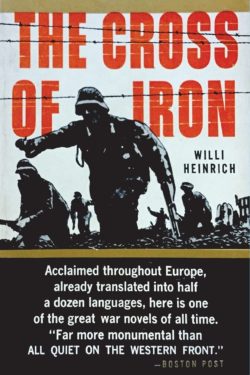
Further Reading About the Iron Cross

Discover the stories behind the Iron Cross with these compelling books and delve into the rich history and significance of this prestigious military decoration.

The Transport Medal

The Transport Medal was a campaign medal awarded by the Lord Commissioners of the Admiralty to masters and officers of merchant ships.

Time Period: Pre-WW1
Year of Institution: 8 November 1903
Country: Great Britain

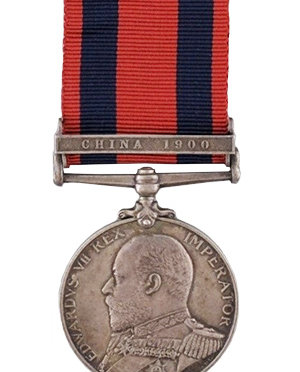
The Transport Medal was a British campaign medal awarded by the Lord Commissioners of the Admiralty to masters and officers of merchant ships employed by the Transport Service to move troops to either South Africa during the South African War or to China during the Boxer Rebellion.  The Transport Medal was created on 8 November 1903 and officers of hospital ships used in the campaigns also qualified.

It was intended that the medal would be awarded for future conflicts, but was not awarded again after the South Africa and China wars.

The Transport Medal Design

The obverse of the medal bears the head of King Edward VII in Royal Navy uniform, with the inscription EDWARDVS VII REX IMPERATOR. The reverse depicts HMS Ophir beneath a map of the world with, below, the words in Latin OB PATRIAM MILITIBUS PER MARE TRANSVECTIS ADJUTAM which translates as for services rendered in transporting troops by sea.

Two clasps were awarded: S.AFRICA 1899–1902 (for services related to the South African War) and CHINA 1900 (for services related to the Boxer Rebellion).

A total of 1,719 medals were awarded, 1,219 with the ‘S. Africa 1899-1902’ clasp, 322 with the ‘China 1900’ clasp and 178 with both clasps.

The Tibet Medal

The Tibet Medal is a British military medal awarded to members of the Tibet Mission and accompanying troops who served at or beyond Siliguri.

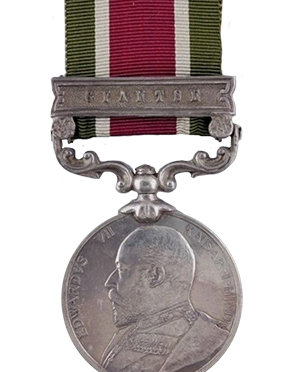
The Tibet Medal is a British military medal awarded to all members of the Tibet Mission and accompanying troops who served at or beyond Siliguri from 13 December 1903 to 23 September 1904 and authorized in February 1905.

Approximately 3,350 silver Tibet Medals were awarded, including about 600 to the first battalion the Royal Fusiliers and about 2,600 to members of the Indian Army, in addition to staff and support personnel. More than 2,500 bronze medals were awarded, mainly to those employed in transporting supplies, including to the Peshawar Camel Corps and locally recruited coolies.

The Tibet Medal Design

The obverse of the medal, designed by G. W. de Saulles, a British medallist that worked under Queen Victoria and Edward VII) shows the bust of Edward VII in Field Marshal’s uniform and the legend ‘EDWARDVS VII KAISAR-I-HIND’.
The reverse, designed by E. G. Gillick, a British sculptor, depicts the Potala (winter palace of the Dalai Lamas) in Lhasa on top of the red hill with the words ‘TIBET 1903-04’ below.

The medal was awarded in silver to combatant troops and in bronze to camp followers, with both eligible for the ‘Gyantse’ clasp. The clasp ‘GYANTSE’ was given to those present in operations between 3 May and 6 July 1904 in or near Gyantse Fortress. The suspender is of the swiveling ornate scroll type.

The India General Service Medal (1909)

The Indian General Service Medal is a British campaign medal issued to officers and men of the British and Indian armies and approved in 1909.

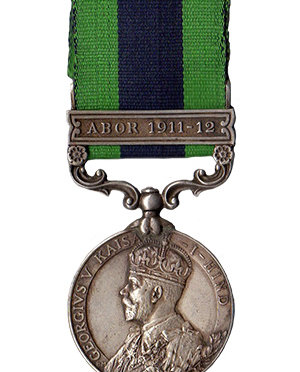
The Indian General Service Medal (also known as 1909 IGSM) is a British campaign medal issued to officers and men of the British and Indian armies and approved on 1 January 1909. From 1919 it was also awarded to officers and men of the Royal Air Force (the Waziristan 1925 clasp was awarded solely to the RAF).

The 1909 Indian General Service Medal was awarded for various minor military campaigns in India from 1908 to 1935, and each campaign is represented by a clasp, of which 12 were sanctioned.

The Indian General Service Medal Design

The medal measures 36 millimeters (1.4 in) in diameter. For early campaigns it was awarded in silver to combatants and in bronze to native bearers and servants. From 1919 on. all awards were in silver.

There are three versions of the Indian General Service Medal obverse (King Edward VII 1908-10, King George V 1911-25 and King George V 1930-35). The reverse depicts Jamrud Fort at the Khyber Pass with the word ‘India’ below between a wreath of oak and olive branches.

The Medal with the Waziristan 1925 bar was awarded to only 46 officers and 214 men of the Royal Air Force. It is by far the rarest bar given with an India General Service Medal.

From 1920, those mentioned in dispatches in a campaign for which the medal was awarded could wear a bronze oakleaf on the medal ribbon.

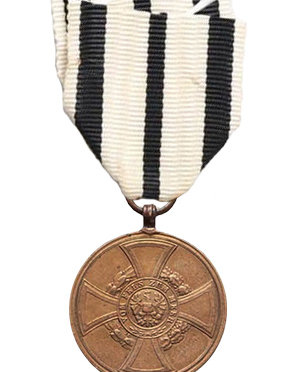
The Hohenzollern Commemorative Medal for Combatants 1848-1849

The Hohenzollern Commemorative Medal for 1848-1849 Campaign was instituted by the King of Prussia Friedrich Wilhelm IV on August 23, 1851.

The Hohenzollern Commemorative Medal for 1848-1849 Campaign was instituted by the King of Prussia Friedrich Wilhelm IV on August 23, 1851  in association with the House Order of Hohenzollern. It was awarded to those officers and soldiers who remained loyal during the rebellions of 1848 and 1849.

A Hohenzollernsche Denkmünze für 1848-1849 was also awarded to Prussian troops for battles in Denmark in 1849 during the First Schleswig War.

The Prussian army played a crucial role in suppressing not only the rebellions in Prussia but also in Baden and Saxony. Nonetheless, Prussia became a constitutional state in 1849.

The Hohenzollern Commemorative Medal Design

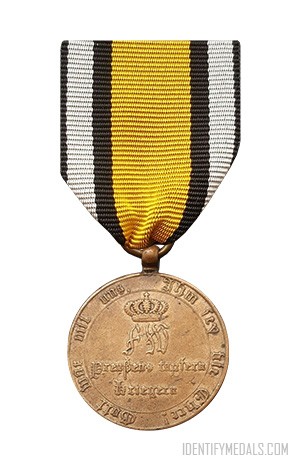
The Hohenzollern Commemorative Medal is made of circular gilt bronze with a laterally-pierced ribbed loop for ribbon suspension. The obverse shows the face with the image of the cross pattée alisée of the Royal House Order of Hohenzollern and in the reverse is inscribed ‘FRIEDRICH WILHELM IV’ with the dates ‘1848’ and ‘1849’ above and below parallel lines and a circumscribed ‘SEINEN BIS IN DEN TOD GETREUEN KRIEGERN’ (His warrior loyal unto death).

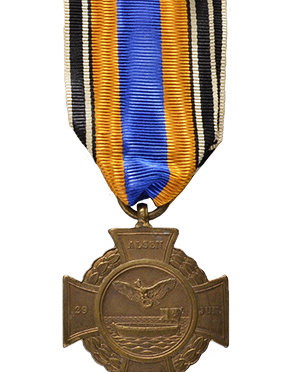
The Alsen Cross

The Alsen Cross (Alsenkreuz) is a military medal of the Kingdom of Prussia established in 1864 to commemorate the victorious Battle of Alsen.

The Alsen Cross (or Alsenkreuz, in German) is a military medal of the Kingdom of Prussia established 7 December 1864 and commemorating the Prussian victory on 29 June 1864 during the Battle of Alsen.

Alsen is an island near the German border to which Danish forces had retreated. On the night of 29 June 1864, 2,500 Prussian troops crossed the Alssund in small boats and took the Danish lines, enabling a pontoon bridge to be built to bring up reinforcements. On 1 August, the Danish king renounced his right to Schleswig-Holstein in favour of Prussia and Austria.

The medal was initially awarded with two different suspension ribbons, for combatants and noncombatants. It was subsequently extended to those troops held in reserve at the battle and members of the Johanniter Orden who participated in the battle.

The Alsen Cross Design

The Alsen Cross is made of bronze cross pattée with a laurel wreath between the arms and a loop for ribbon suspension.

The obverse shows a circular central medallion bearing the head of King Wilhelm I facing left, and the inscription ‘WILHELM KOENING VON PREUSSEN’. The reverse bears a circular central medallion with the crowned Prussian royal eagle in flight, a laurel wreath in its talons, above a small boat in the sea before a stone wall, a standard bearing the Iron Cross to the right on its stern, the upper, left, right and lower arms inscribed ‘ALSEN’, ‘29’, ‘JUN.’, ‘1864’ respectively.

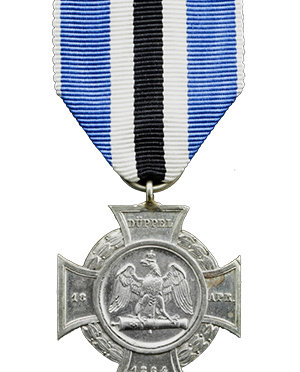
The Duppel Storm Cross

The Düppel Storm Cross was a military medal of the Kingdom of Prussia awarded to Prussian participants in the Battle of Dybbøl.

The Düppel Storm Cross (or Düppeler-Sturmkreuz in German) was a military medal of the Kingdom of Prussia awarded to Prussian participants in the Battle of Dybbøl which took place on 18 April 1864, during the Second Schleswig War.

The Düppel Storm Cross was established by Wilhelm, King of Prussia on 18 October 1864. The medal was initially awarded to combatants and noncombatants who had participated in the battle directly. In 1865, versions were created for those troops held in reserve at the battle and members of the Johanniter Orden who participated in the battle.

The Düppel Storm Cross Design

The Düppel Storm Cross was designed by Friedrich Wilhelm Kullrich, a Prussian court medalist. It was the first of three commemorative crosses awarded during the 1860s with similar designs.

The medal has the shape of a cross pattée. Between the arms of the cross is a laurel wreath and superimposed in its center is a round medallion. On the obverse, the medallion bears the left-facing effigy of King Wilhelm I and has the words WILHELM KOENIG VON PREUSSEN (William King of Prussia) written on it. The reverse of the medallion depicts a crowned Prussian eagle perched upon a Danish cannon.

The top arm of the cross has the word DÜPPEL, the left arm of the cross has 18, the right arm has APR., and the bottom arm of the cross bears the year 1864.