The Order of Saints Maurice and Lazarus

The Order of Saints Maurice and Lazarus is a Roman Catholic dynastic order of knighthood bestowed by the House of Savoy.

The Order of Saints Maurice and Lazarus (or Ordine dei Santi Maurizio e Lazzaro in Italian) is a Roman Catholic dynastic order of knighthood bestowed by the House of Savoy, founded in 1572 by Emmanuel Philibert, Duke of Savoy, through amalgamation approved by Pope Gregory XIII of the Order of Saint Maurice, founded in 1434, with the medieval Order of Saint Lazarus, founded circa 1119, considered its sole legitimate successor.

The order was formerly awarded by the Kingdom of Italy (1861–1946) with the heads of the House of Savoy as the Kings of Italy. Originally a chivalric order of noble nature, it was restricted to subjects of noble families with proofs of at least eight noble great-grandparents.

After the abolishment of the monarchy and the foundation of the Italian Republic in 1946, the legacy of the order is maintained by the pretenders of the House of Savoy and the Italian throne in exile.

The order is estimated to include about 2,000 members around the world.

The Order of Saints Maurice and Lazarus Medal Design

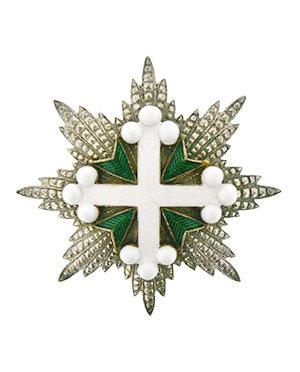
The badge of the order is in gilt, it displays a white-enameled cross bottony of the Order of Saint Maurice with a green-enameled Maltese Cross (the Cross of the Order of Saint Lazarus) placed between the arms of the cross botonny. The badge of each class except that of Knight and Dame is topped by a gilt crown.

The star of the Order is a silver faceted star, with eight points for Grand Cross and four points for Grand Officer, and with the badge (minus the crown) superimposed upon it.

The breast cross for the Commander “jus patronato” class is identical to the badge, minus the crown.

The ribbon of the Order is apple green, with slight variations for the several classes.

The Supreme Order of the Most Holy Annunciation

The Supreme Order of the Most Holy Annunciation was the pinnacle of the honors system in the Kingdom of Italy.

The Supreme Order of the Most Holy Annunciation (or Ordine Supremo della Santissima Annunziata in Italian) is a Roman Catholic order of knighthood, originating in Savoy.

It was the pinnacle of the honors system in the Kingdom of Italy, which ceased to be a national order when the kingdom became a republic in 1946.

The origins of the Supreme Order of the Most Holy Annunciation begin in 1362, when Amadeus VI, Count of Savoy (1343-1383) instituted the order’s earliest designation, under the title of Order of the Collar. Even at this time, the order was dedicated to the Blessed Virgin Mary, who is celebrated as “Our Lady of the Annunciation.” Thus, the order is a dynastic religious (or Catholic) order of chivalry. Under its first formulation, the order had fifteen knights.

Today, the order holds the following other regulations:

  • The number of knights of the Supreme Order of the most Holy Annunciation shall be, as in the past, twenty.
  • The right to appoint knights and officers of the Order appertains exclusively to the Sovereign Head. Nevertheless, when there are vacancies, the Sovereign Head meets with the Chapter of knights to hear their advice on the proposal of candidates whom he alone may select.
  • The knights shall be chosen from distinguished individuals in recognition of their eminent services in high military positions, as well as from those who have distinguished themselves in senior positions in the civil service, and from those who, as private citizens have brought distinction upon Italy as exemplary benefactors of the Nation or of Mankind, or have rendered particularly noteworthy services to the Royal House of Savoy.
  • Knights must have already been awarded the Order of Saints Maurice and Lazarus.
  • Knights must be Catholic. In rare occasions, a non-Catholic may be awarded the order. However, they may only be honorary members of the order.

The order has only one class, i.e. Knight. The full Italian title is Cavaliere dell’Ordine Supremo della Santissima Annunziata.

The Supreme Order of the Most Holy Annunciation Design

Although the order has only one class, it has two sets of insignia, the Piccola Collana and the Grande Collana. The two hold similar designs, though the Grande Collana has some different features than the Piccola Collana and is worn only on the most special of occasions.

The insignia of the order has the following regulations:

  • The large collar (Grande Collana) is worn on the first day of the year, on the feast of the Most Holy Annunciation, and on all of the principal national holidays and at important royal functions.
  • The small collar (Piccola Collana) is worn on every other occasion which necessitates the display of order insignia.
  • Knights also wear, on the left breast, a star badge bearing the image of Holy Mary of the Annunciation.

Today, the order continues as a dynastic order under the jurisdiction of the Head of the House of SavoyVittorio Emanuele, Prince of Naples, who is the order’s hereditary Sovereign and Grand Master.

The U.S. Medal of Honor

The Medal of Honor is the United States of America’s most prestigious personal military decoration, awarded for acts of valor.

The Medal of Honor is the United States of America’s highest and most prestigious personal military decoration. It may be awarded to recognize U.S. military service members who distinguished themselves by acts of valor and is normally awarded by the President of the United States in the name of the U.S. Congress. The Medal of Honor is the oldest continuously issued combat decoration of the United States armed forces.

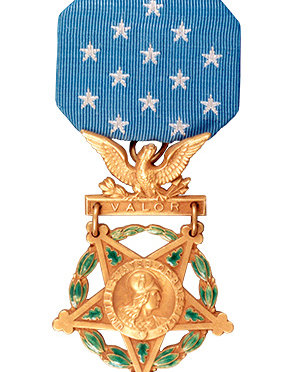
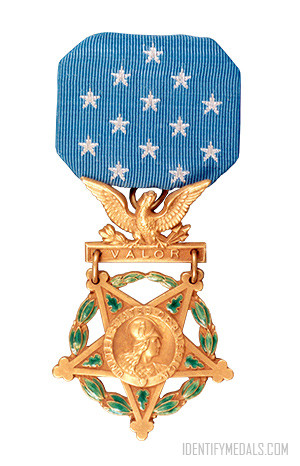
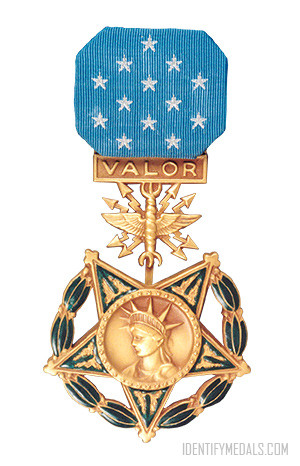
There are three versions of the Medal of Honor insignia. One for the Army, one for the Navy, and one for the Air Force. 

The History of the Medal of Honor

Signed into law by President Abraham Lincoln, a Navy Medal of Honor was first authorized on December 21, 1861 followed by an Army Medal of Honor, which was approved on July 14, 1862.

Over 40 percent of the Medals of Honor awarded to date—1,522 out of 3,464 medals—were bestowed during the Civil War. In fact, some Civil War Medals of Honor years after the end of the war, including Andrew Jackson Smith whose medal was awarded in 2001 and Alonzo Cushing in 2014. 

The first Medals of Honor were given to participants of Andrews’ Raid or the Great Locomotive Chase with Private Jacob Parrot as the first person ever to be awarded this medal of America. At least 32 Medals of Honor were awarded to African-Americans, and William Harvey Carney was the first. Born a slave in Virginia, he finally found freedom in Massachusetts. He volunteered to join the 54th Massachusetts Infantry Regiment, the first African-American unit in the northern states although it was led by white officers.

Tasked with taking Fort Wagner, a beachhead fortification that protected the southern Charleston Harbor, the 54th was chosen for the second attack. The Union flag bearer was killed as the soldiers stormed the fort, but Carney stepped in and held the flag for the remainder of the battle, never losing possession of the flag despite several injuries. Unfortunately, the 54th was forced to retreat, but, as Carney said after the battle, “the old flag never touched the ground.” Carney was awarded the Medal of Honor in 1900, thirty-five years after the end of the Civil War.

Individuals who have received two Medals of Honor are rare, and Thomas Ward Custer is a part of this elite group, receiving both medals for actions during the American Civil War

Personnel of the Marine Corps and Coast Guard receive the Navy version (it was created as a Navy version in 1861 named the “Medal of Valor”). According to the Medal of Honor Historical Society of the United States, 3,519 Medals of Honor have been awarded to the nation’s soldiers, sailors, airmen, Marines, and Coast Guardsmen since the medal’s creation. Less than half of them awarded for actions during the four years of the American Civil War.

American Medals and Awards: The Medal of Honor (Army Version)
The Medal of Honor: Army Version
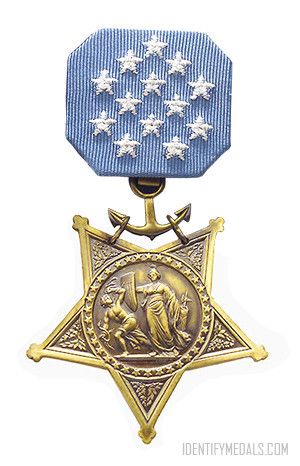
American Medals and Awards: The Medal of Honor (Navy Version)
The Medal of Honor: Navy Version
American Medals and Awards: Medal of Honor (Airforce)
The Medal of Honor: Air Force Version

The Medal of Honor During World War I and World War II

During World War I and World War II, numerous individuals received the Medal of Honor for their extraordinary valor and heroism in combat.

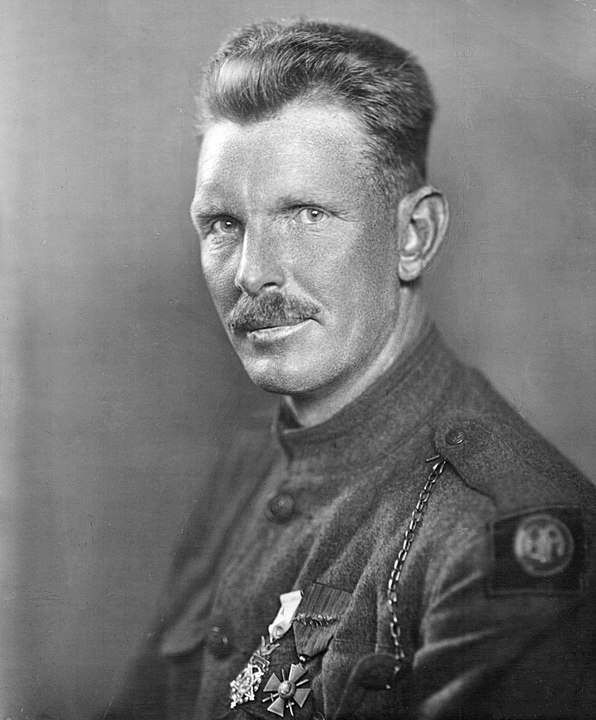
During World War I (1914-1918), the Medal of Honor was awarded for acts of bravery in various theaters of the war, including the Western Front in Europe, the Italian Front, and other areas of conflict. Recipients demonstrated exceptional courage in the face of enemy fire, often risking their lives to save their comrades or achieve critical objectives. One notable recipient during this world war was Sergeant Alvin York, who single-handedly captured 132 German soldiers during the Meuse-Argonne Offensive in 1918.

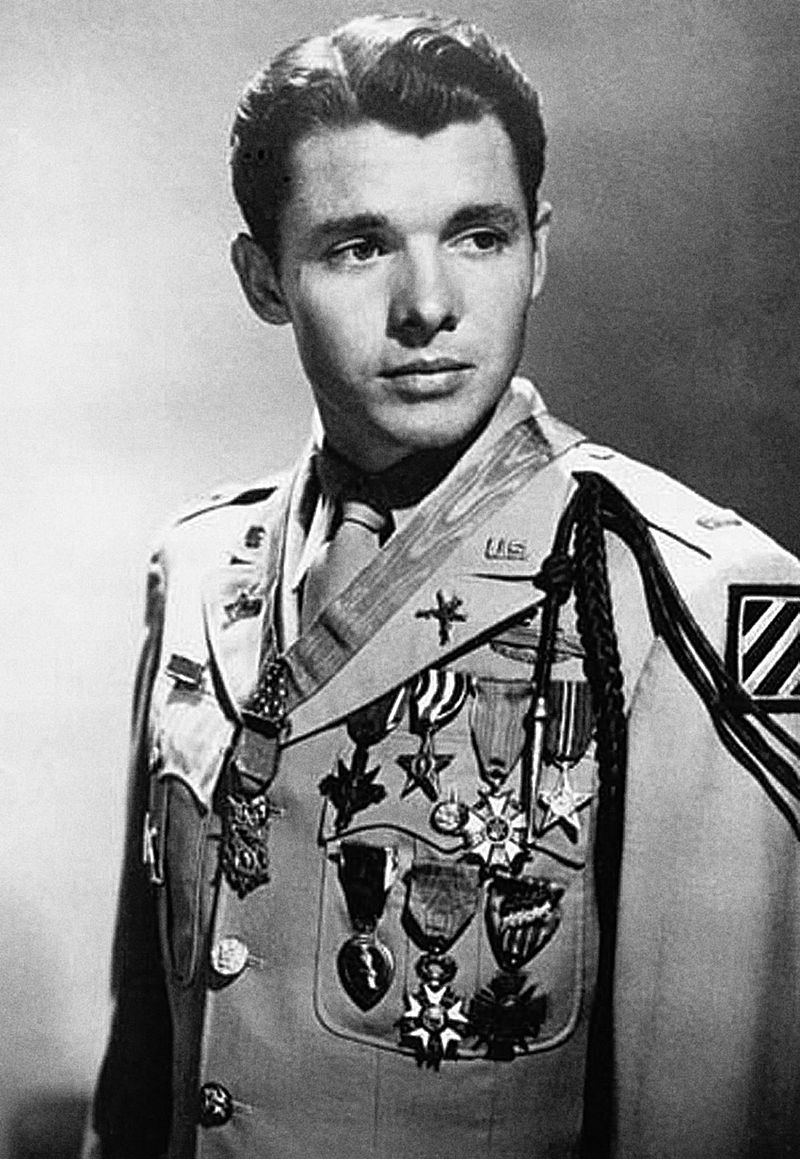
In World War II (1939-1945), the Medal of Honor continued to be awarded for acts of extraordinary heroism in combat. Recipients demonstrated exceptional bravery and selflessness in a wide range of theaters, including the Pacific, European, African, and Mediterranean theaters of war. One of the most celebrated recipients of the Medal of Honor during World War II was Sergeant Audie Murphy, who received the medal for his actions during the Battle of Holtzwihr in France, where he single-handedly repelled a German attack and called in artillery fire on enemy positions.

Alvin Cullum York (December 13, 1887 – September 2, 1964)
Alvin York in uniform, 1919, wearing the Medal of Honor and French Croix de Guerre with Palm.
Audie Murphy photographed in 1948 wearing the U.S. Army khaki "Class A" (tropical service) uniform with full-size medals. Source: Wikipedia.

The Medal of Honor Design

After World War I, the Navy decided to separate the Medal of Honor into two versions: One for combat and one for non-combat. The original upside-down star was designated as the non-combat version and a new pattern of the medal pendant, in cross form, was designed by the Tiffany Company in 1919.

It was to be presented to a sailor or marine who “in action involving actual conflict with the enemy, distinguish[es] himself conspicuously by gallantry and intrepidity at the risk of his life above and beyond the call of duty. 

Due to its prestige and status, the Medal of Honor is afforded special protection under U.S. law against any unauthorized adornment, sale, or manufacture, which includes any associated ribbon or badge.

Read more about the symbolism of the Medal of Honor:

Famous U.S. Medal of Honor Recipients

These individuals represent just a few of the many courageous recipients of the Medal of Honor who have demonstrated extraordinary bravery and selflessness in service to their country. Here are five famous recipients of the U.S. Medal of Honor:

  • Audie Murphy: Audie Murphy, a World War II veteran, is one of the most decorated American soldiers in history. He received the Medal of Honor for his actions during the Battle of Holtzwihr in France in 1945.

  • Alvin C. York: Alvin C. York was a World War I soldier and is renowned for his heroic actions during the Meuse-Argonne Offensive in 1918. He received the Medal of Honor for his bravery and leadership in capturing numerous German soldiers.

  • Desmond Doss: Desmond Doss, a conscientious objector during World War II, served as a combat medic. He was awarded the Medal of Honor for his extraordinary bravery and dedication to saving lives during the Battle of Okinawa.

  • Sal Giunta: Staff Sergeant Salvatore Giunta became the first living recipient of the Medal of Honor since the Vietnam War. He was honored for his actions during the War in Afghanistan in 2007 when he saved fellow soldiers from enemy fire.

  • Michael P. Murphy: Navy SEAL Lieutenant Michael P. Murphy was posthumously awarded the Medal of Honor for his courageous actions during Operation Red Wings in Afghanistan in 2005. He sacrificed his life while attempting to call for reinforcements to rescue his team.

The Legion of Honor

The Legion of Honor (or Ordre national de la Légion d’honneur in French) is the highest French order of merit for military and civil merits.

The Legion of Honour (National Order of the Legion of Honour; or Ordre national de la Légion d’honneur in French) is the highest French order of merit for military and civil merits. The Legion of Honour was established in 1802 by Napoleon Bonaparte and retained by all the divergent governments and regimes later holding power in France.

The Légion d’honneur is a body of men and not an order of chivalry, for Napoleon believed that France wanted a recognition of merit rather than a new system of nobility. The order’s motto is Honneur et Patrie (“Honour and Fatherland”), and its seat is the Palais de la Légion d’Honneur on the left bank of the River Seine in Paris.

Since the establishment of the Legion, the Grand Master of the order has always been the Emperor, King or President of France. 

The Legion of Honor Degrees or Classes

The order is divided into five degrees of increasing distinction: ChevalierOfficierCommandeur, Grand-officier, and Grand-croix.

  • Chevalier (Knight): The lowest rank of the Legion of Honor is awarded to individuals who have made notable contributions to French society or who have shown exceptional dedication and service to their profession. Recipients are entitled to wear the insignia badge.
  • Officier (Officer): The next rank is bestowed upon individuals who have demonstrated significant achievements or leadership in their field of expertise. Officers wear the same insignia but with a small rosette on the ribbon.
  • Commandeur (Commander): The third degree is awarded to individuals who have distinguished themselves through exceptional contributions to French society, culture, or the nation. Commanders wear the same insignia with the addition of a larger rosette on the ribbon.

  • Grand Officier (Grand Officer): This higher degree is reserved for individuals who have achieved extraordinary accomplishments or held high-ranking positions of responsibility. Recipients wear a badge with a silver star suspended from the ribbon.
  • Grand Croix (Grand Cross): The highest and most prestigious degree of the Legion of Honor, this rank is reserved for heads of state, senior government officials, and individuals who have rendered exceptional services to France or humanity. Grand Cross recipients wear a badge with a silver star and a sash over the right shoulder.

The Legion of Honor Design

The badge of the Légion is a five-armed “Maltese Asterisk” in gilt (made in silver for chevalier) enameled white, with an enameled laurel and oak wreath between the arms.

The obverse of the Legion of Honour medal central disc is in gilt, featuring the head of Marianne, surrounded by the legend République Française on a blue enamel ring. The reverse central disc is also in gilt, with a set of crossed tricolores, surrounded by the Légion’s motto Honneur et Patrie (Honour and Fatherland) and its foundation date on a blue enamel ring. The badge is suspended by an enameled laurel and oak wreath.

The star (or plaque) is worn by the Grand Cross (in gilt on the left chest) and the Grand Officer (in silver on the right chest) respectively; it is similar to the badge, but without enamel, and with the wreath replaced by a cluster of rays in between each arm. 

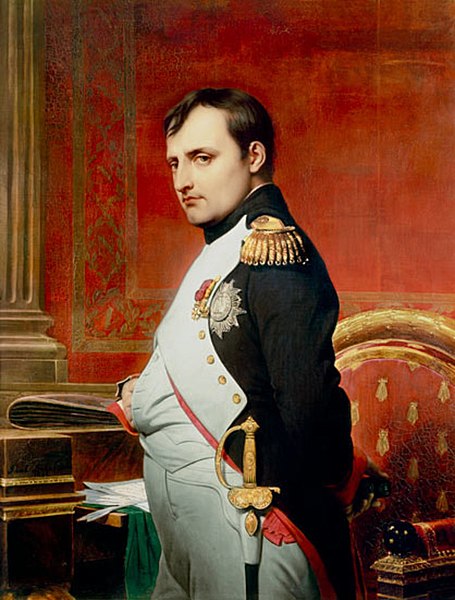
As Emperor, Napoleon always wore the Cross and Grand Eagle of the Legion of Honor.

Find This Medal

Right Now on eBay 
Clicking a link to eBay may result in a referral commission being paid if a purchase is made.
Loading...

The Silver Medal of Military Valor

Institution: 21 May 1793
Country: Italy

The Silver Medal of Military Valor (or Medaglia d’argento al valor militare in Italian) is a medal for gallantry.

Italian medals for valor were first instituted by Victor Amadeus III of Sardinia on 21 May 1793, with a gold medal, and, below it, a silver medal. These were intended for junior officers or common soldiers who had distinguished themselves in combat.

Although these medals fell into disuse during the period of Napoleonic domination, they were reinstated on 1 April 1815, by Victor Emmanuel I of Sardinia, who replaced them with the Military Order of Savoy (l’Ordine militare di Savoia), now known as the Military Order of Italy.

In 1833, Charles Albert of Sardinia re-instituted the medals for valor (gold and silver) as awards for noble acts performed by soldiers in both war and peace. During World War I, the medal was awarded to military personnel, units above the level of company and civilians for exceptional valor in the face of the enemy. During World War I, the medal was given out some 38,614 times for individual acts of heroism (compared to 368 Gold Medals and 60,244 Bronze medals). Thus, the Italian Silver Medal for Military Valor is equivalent in frequency and prestige to the British Military Cross, which was awarded some 40,253 times during World War I.

The Silver Medal of Military Valor Design

The Italian Silver Medal of Military Valor is made of silver. The medal measures 33.5 mm in diameter. On the obverse is engraved “VICARIOTTO CLAUDIO” in the centre, surrounded by the engraved inscription “COSTONE DI QUOTA 1940 – KONITZA (FRONTE GRECO) 14 NOV. 1940 XIX” on the reverse.

The Sardinian Crimea Medal 1855-1856

The Sardinian Crimean War Medal is a campaign medal issued by King Victor Emmanuel II for those who participated in the Crimean War.

The Sardinian Crimean War Medal (or Medaglia d’Argento al Valor Militare per la spedizione d’Oriente 1855-1856 in Italian) is a campaign medal issued by King Victor Emmanuel II for those who participated in the Crimean War (1854-1856) against the Russian Empire.

In addition to awards to Sardinians and other allied soldiers, the medal was awarded to 450 specially selected officers and men of the Royal Navy and British Army. Queen Victoria gave permission for the medal to be worn by British servicemen in uniform.

The Sardinian Crimean War Medal Design

The medal is made in silver with a blue watered ribbon. The obverse shows a crown with laurel and palm branch surrounding the arms of Savoy, with the inscription “Al Valore Militare“. In the reverse is inscribed “Spedizione d’Oriente 1854-1856”.

The Order of the Roman Eagle

The Fascist Order of the Roman Eagle was founded in 1942 with civil and military divisions, and abolished in Italy in 1944.

The Fascist Order of the Roman Eagle was founded in 1942 with civil and military divisions and abolished in Italy in 1944 – although it continued to be awarded by Benito Mussolini in the short-lived Italian Social Republic until 1945.

A self-styled order of the same name was founded by Romano Mussolini, fourth and youngest son of Benito Mussolini, in 1997. The separate Order of the Patron Saints of Italy (Ordine dei Santi Patroni d’Italia), St. Francis of Assisi and St. Catherine of Siena, was also conferred by the so-called Republic of Salò between February and April 1945. An organisation of this name was also founded by Romano Mussolini in 1997.

The Fascist Order of the Roman Eagle Design

The medal measures 32 mm diameter.

The Order Insignias consist of a golden Roman Eagle on purple background; the Eagle is fixed on various crosses from Knight to Grand Officer, while it is a plaque for Knights Grand Cross.

On the obverse there are three Fasces. Military medals have two crossed Roman swords behind the image on the foreground, while military crosses have two crossed Roman swords with blade pointing high and passing between the crosses arms.

For the Knight: the Cross is 35 mm and is hanging by a ribbon; it is worn on the chest, left side; Officer: the Cross is 35 mm and is hanging by a ribbon; it is worn on the chest, left side; the ribbon has a rosette; Commander: the Cross is 50 mm and is hanging by a ribbon worn around the neck; Grand Officer: the Cross is 50 mm and is suspended by the ribbon worn around the neck; the Grand Officer also has a 65 mm four-pointed plaque-star. Knight Grand Cross (Gold and Silver): the Cross is 50 mm and is hanging by a band worn over the shoulder, from right to left. Alongside the band, there is a 80 mm eight-pointed plaque-star.

The Military Order of Savoy

The Military Order of Savoy was a military honorary order of the Kingdom of Sardinia first, and of the Kingdom of Italy later.

The Military Order of Savoy was a military honorary order of the Kingdom of Sardinia first, and of the Kingdom of Italy later. Following the abolition of the Italian monarchy, the order became the Military Order of Italy.

The origin of the Military Order of Savoy can be traced back to the first honorary degrees granted by Victor Amadeus III of Sardinia to its soldiers. Later this degree went into disuse because of the Napoleonic regime in Italy and especially in Piedmont. On 1 April 1815 these honorary degrees were used by Victor Emmanuel I of Sardinia and abolished on the 14th of August of the same year.

Later, all of these honorary degrees become part of one, and became, the Military Order of Savoy. This order was to be granted to the soldiers who fought in the Italian army of Napoleon and became part of the Legion of Honor (or either obtained the honorary degree of Order of the Iron Crown) due to military merit. This honorary degree was conceded to everyone no matter what religion or rank the soldier was.

Following the foundation of the Republic, the order was renamed the Military Order of Italy in 1947; it continues to be awarded under that title today.

The Military Order of Savoy Design

The Military Order of Savoy medal is a silver Savoy cross, for the militants, and golden for all the other rankings.

The cross is covered with white and red enamel and surrounded with a laurel crown covered with green enamel. On top of the medal there is the royal crown of Sardinia.

Find This Medal

Right Now on eBay 
Clicking a link to eBay may result in a referral commission being paid if a purchase is made.
Loading...

The Military Order of Italy

The Military Order of Italy (originally of Savoy) is the highest military order of the Italian Republic and the former Kingdom of Italy.

The Military Order of Italy (or Ordine Militare d’Italia in Italian) is the highest military order of the Italian Republic and the former Kingdom of Italy.

It was founded as the Military Order of Savoy, a national order by the King of Sardinia, Vittorio Emanuele I, Duke of Savoy in 1815.

The order is awarded in five degrees for distinguished wartime conduct of units of the armed forces or individual personnel that has “proven expertise, a sense of responsibility and valour.” The order was continued on the unification of Italy in 1861 and was revived, under its new name, following the foundation of the Republic in 1946.

The Military Order of Italy Design

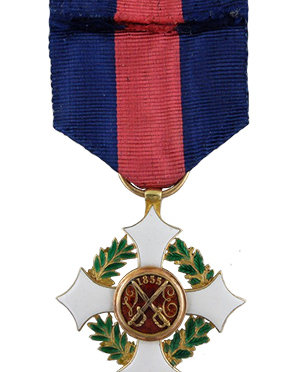
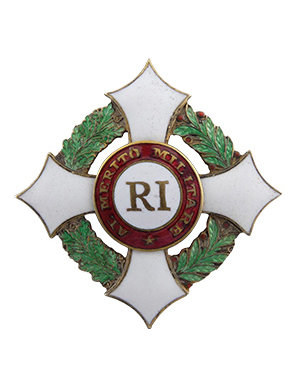
The badge is a golden matuna cross, enameled in white, with a wreath of green-enameled laurel and oak leaves between the arms of the cross.

The obverse during the monarchy was red enamel with a white enamel cross (the current version is in white enamel with the letters R.I. for Repubblica Italiana). The disc is surrounded by a red enamel ring bearing the inscription Al Merito Militare.

The reverse is in red enamel with crossed swords. During the monarchy it had the letters V.E. (for Vittorio Emanuele) on the sides of the sword and the year 1855 above it. The current version has no cypher but has the additional year 1947, the date of the promulgation of the Italian constitution, below the swords. The badge for the three higher classes are suspended by a wreath of green-enamelled laurel and oak leaves; the Officer’s badge is suspended by a golden trophy of arms instead and the Knight’s badge has neither emblems.

The Maurician Medal

The Maurician medal is an honorary degree granted to a soldier after 50 years of service in the Italian army.

The Maurician medal is an honorary degree granted to a soldier after 50 years of service in the Italian army.

The medal was established by Carlo Alberto di Savoia, on 19 July 1839 on the decree of the Regie Magistrali Patenti, with the name of “Maurician Medal to the Military Merit of Ten Lustrums”. It became official with royal decree of 21 December 1924.

The people who can receive this medal are the officers and non-commissioned officers belonging to the Carabinieri armed forces, the Italian Navy, the Italian Army, the Italian Air Force, the custom officers of Italy, and the Italian Police forces. 

The Maurician medal Design

General officers and flag officers receive a medal with a diameter of 52 millimeters (2 inches), while other recipients receive a medal with a diameter of 32 millimeters (1¼ inches).