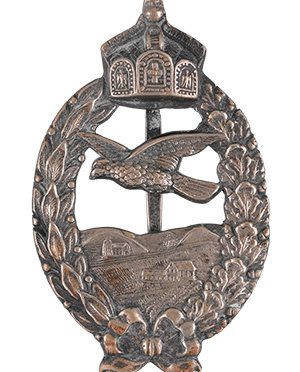
The Commemorative Flyer’s Badge (Prussia)

The Commemorative Flyer’s Badge is a badge from the Kingdom of Prussia awarded to retired German Army Air Service flight crew during WWI. 

The Commemorative Flyer’s Badge (or Flieger-Erinnerungsabzeichen in German) is a badge from the Kingdom of Prussia awarded to retired German Army Air Service flight crew during WWI.

The Commemorative Flyer’s Badge Design

The badge is made from a heavy piece of solid silver and features a dove flying over a landscape. It measures 71 mm high and 44 mm wide and weighs 24.1 grams.

The obverse bears an eagle in flight over a rural landscape, bordered by a wreath made of laurel leaves on the left and oak leaves on the right, surmounted by an imperial crown, tied with a ribbon below. The reverse presents a barrel hinge and tapering banjo-style pinback meeting a round wire catch.
The Observer’s Badge (Prussia)

The Observer’s Badge is a badge from the Kingdom of Prussia awarded to qualified Imperial German Observers during WWI.

The Observer’s Badge (or Beobachterabzeichen in German) is a badge from the Kingdom of Prussia awarded to qualified Imperial German Observers during WWI.

Silver qualification badges were approved by the German Air Service shortly before the start of the First World War. Most wartime crews wore the Prussian designs, with minor changes to the badges worn by Bavarians. There were also variations in quality, particularly between issued versions and those purchased privately.

The Observer’s Badge Design

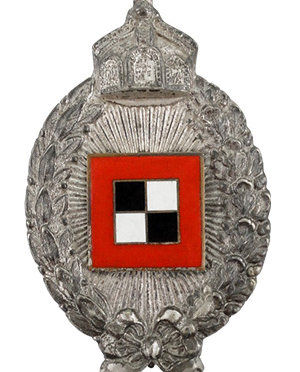
The badge measures 72.36 mm x 45.47 mm and is struck in silvered brass. In all of the Imperial German Army flight qualification badges, the outside perimeter is surrounded by a wreath. The left side has laurel leaves symbolizing victory, while the right side has oak leaves signifying strength and hardiness. The bow joining them together at the bottom signifies the joining of these two qualities.

The Observer’s badge carries an enameled flag of the German tactical symbol for an Army Corps. Issued badges were thinly stamped and silvered or silver-washed metal. Privately purchased examples can be found in hollow two-piece construction or single massive silver stampings.

The enameled square insignia consists of white, black, and red enamels mounted to the center of the badge via two hooks on the reverse. The insignia is placed within a bed of sun rays and a wreath consisting of oak and laurel leaves, and with a bow on the bottom, and a Prussian crown on the top of the wreath.

The Pilot’s Badge (Prussia)

The Pilot’s Badge is a badge from the Kingdom of Prussia instituted in 1913 by the King of Prussia and Emperor Wilhelm II.

The Pilot’s Badge (or Flugzeugführerabzeichen in German) is a badge from the Kingdom of Prussia instituted on 27 January 1913 by the King of Prussia and the Emperor of the German Empire Wilhelm II in conjunction with his birthday.

At some point during the war, and because stamped metal badges become scarce, it’s believed only certificates were issued and aircrew were required to purchase their own badges. While issued badges are thinly stamped and silvered (or silver-washed, an economical alternative) metal, privately purchased examples can be found in hollow two-piece construction or single massive silver stampings.

The Pilot's Badge Award Criteria

The badge was awarded to officers, NCOs and enlisted men upon successful graduation from the flying schools and passing two practical flight examinations. 

One of the examinations consisted of unassisted takeoff and landing. The other was a long-distance or a cross-country flight. The badges were presented by local air station commanders.

What Was Training Like for a Prussian Pilot?

Training to become a Prussian pilot during World War I was both rigorous and dangerous, reflecting the early, experimental days of military aviation. The training process involved multiple stages, beginning with ground school where recruits learned the basics of flight, navigation, and military conduct. This was followed by preliminary flight school, which included about 40-50 flight hours. Cadets had to perform a variety of maneuvers such as sideslips, loops, and simulated uncontrolled falls before graduating​ (Hartzell Propeller)​​ (MyLearning)​.

Some popular aircraft used during the time included:

  1. Fokker Eindecker (E-Series): The Fokker E.I, E.II, E.III, and E.IV were some of the first aircraft used for aerial combat. These were monoplane designs equipped with synchronized machine guns that could fire through the propeller arc, giving the Germans an initial air superiority.

  2. Albatros B Series: An early reconnaissance biplane, the Albatros B.I was unarmed and used primarily for observation and artillery spotting.

  3. Albatros D-Series (D.I to D.Va): The Albatros D.I and its subsequent models (D.II, D.III, D.V, D.Va) became the backbone of the German fighter force. Known for their speed and firepower, these aircraft were used extensively from 1916 onward.

  4. Halberstadt D.II: Another early fighter aircraft, the Halberstadt D.II was used to complement the Fokker Eindecker until more advanced aircraft became available.

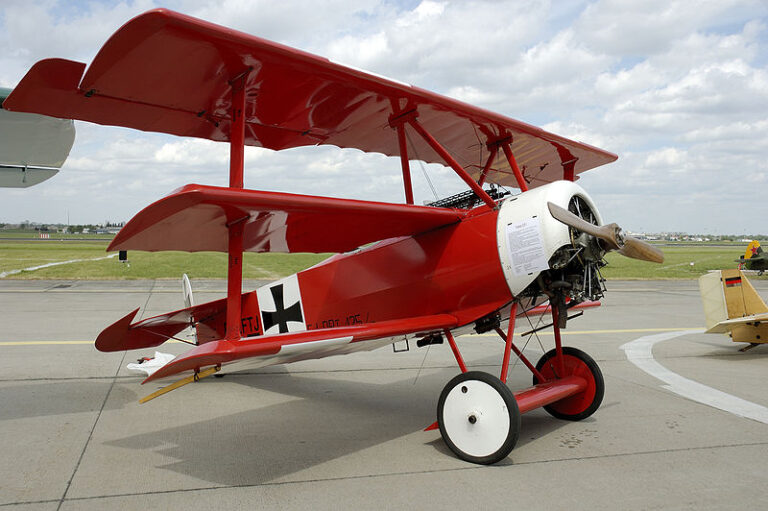
  5. Fokker Dr.I: The Fokker Dr.I triplane, made famous by Manfred von Richthofen (the Red Baron), was renowned for its maneuverability. However, it was also prone to structural failures.

  6. Fokker D.VII: Considered one of the best fighter aircraft of the war, the Fokker D.VII was introduced in early 1918. It had excellent handling, firepower, and structural integrity, making it highly effective in combat.

  7. Pfalz D.III: The Pfalz D.III and its improved version, the D.IIIa, were used by many Jastas (fighter squadrons). They were known for their durability and decent performance but were generally considered inferior to the Albatros and Fokker designs.

  8. Aviatik C.I: A versatile two-seater used for reconnaissance and light bombing missions, the Aviatik C.I was one of the many C-type aircraft that served various roles.

The Red Baron, or Manfred von Richthofen, was a legendary German fighter pilot and fighter ace during World War I.
Replica of Richthofen's Fokker Dr.I triplane, at the Berlin Air Show in 2006". Aircraft & Warplanes

The Pilot's Badge Design

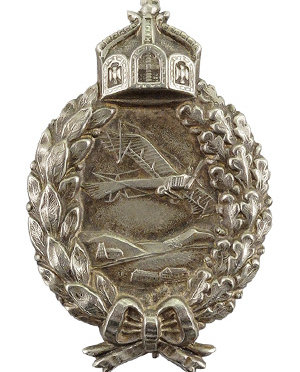
The badge measures 46.00 mm (width) by 70.60 mm (height), weighs 13.5 grams and is struck in silvered brass. In all of the Imperial German Army flight qualification badges, the outside perimeter is surrounded by a wreath. The left side has laurel leaves symbolizing victory, while the right side has oak leaves signifying strength and hardiness. The bow joining them together at the bottom signifies the joining of these two qualities.

The top of the badge mounts either a Preußen (Prussian) crown or a Bayern (Bavaria) crown. These badges were manufactured by C.E. Juncker (Berlin), Meybauer or Pollath and worn on or below the left breast pocket lower than the Prussian Iron Cross 1st Class.

The obverse bears a standard pilot’s badge motive within a wreath, with laurel leaves towards the left side of the wreath, and oak leaves towards the right side of the wreath, separated by a bow on the bottom of the wreath, ordained by the Prussian crown at the top.

The reverse is hallowed and has a vertical needle pinback with a barrel hinge and a round wire catch.

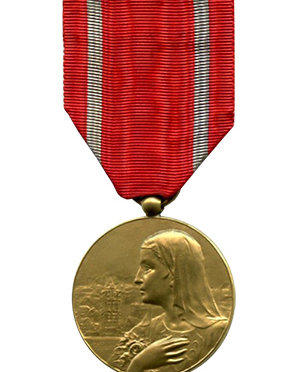
The 1914-1918 Medal for National Restoration

The 1914-1918 Medal for National Restoration was instituted on 22 May 1928 and awarded for meritorious service in organizations rebuilding Belgium after the First World War.

The 1914-1918 Medal for National Restoration Design

The medal is circular and struck in bronze gilt designed by Alfonse “Alf” Mauquoy.

The obverse depicts a woman (representing Belgium), holding flowers, against a background of a city with a tower being repaired. The reverse shows the ruins of Ypres with the dates “1914” and “1918” and in a panel underneath, embellished by two oak leaves, the inscription: “SOUVENIR DE LA RESTAURATION NATIONALE” / “AANDENKEN VAN DE NATIONALE HERSTELLING“) (“In remembrance of the national restoration”).

The ribbon is red with two light blue edge stripes.

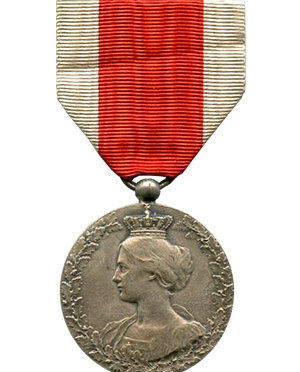
The Commemorative Medal of the National Committee for Aid and Food

The Commemorative Medal of the National Committee for Aid and Food was instituted on 31 May 1919 and awarded to those who had been active in the ‘National Committee’.

The Committee was able to direct aid and assistance to the neediest, operating under American protection and within the constraints of the occupying German forces. Much of Belgium was German-occupied from August 1914 and by the following month groups of civilian volunteers had sprung up to alleviate hunger and hardship. The Committee was also important politically and culturally in maintaining a Belgian civil identity through the period of occupation.

The Commemorative Medal of the National Committee for Aid and Food Design

The medal is circular and was engraved by Devresse. It’s divided into 4 classes, each struck in a different material:

  • 1st class: In gilded bronze and rosette ribbon.
  • 2nd class: In gilded bronze.
  • 3rd class: In silvered bronze.
  • 4th class: In bronze.

The ribbon is red with white edges.

The Queen Elisabeth Medal

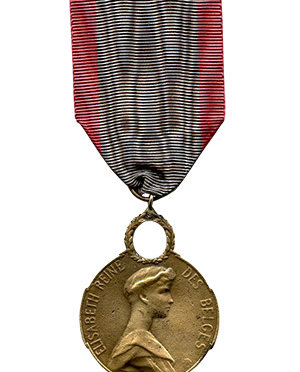
The Queen Elisabeth Medal (Médaille de la reine Élisabeth / Koningin Elisabeth Medaille) is a Belgian decoration created in October 1916 by royal decree to recognize exceptional services to Belgium in the relief of the suffering of its citizens during the First World War.

The medal was awarded to people, both Belgians and foreign nationals, who, like Queen Elisabeth herself, had worked and cared for the suffering victims of war for a year or more prior to 10 September 1919.

The award wasn’t limited to the medical care of the sick and wounded and included people working in hospitals (they received a variant with a red enameled cross within the suspension wreath). Many Belgian and foreign doctors and nurses received the medal too.

The Queen Elisabeth Medal Design

The medal measures 36 mm (1.4 in) in diameter and is circular and struck in bronze (although many recipients opted for silver or gilt silver variants). It has four sections inset by 1 mm (0.039 in) giving it the slight outline of a cross and a slightly raised edge on both sides.

The obverse bears the relief right profile bust of Queen Elisabeth with the circular relief inscription ÉLISABETH REINE DES BELGES (“ELISABETH QUEEN OF THE BELGIANS”). The reverse bears the relief image of a nurse sitting and holding an oil lamp with the circular inscription in Latin PRO PATRIA HONORE ET CARITATE (“FOR COUNTRY HONOUR AND CHARITY”). Below are the years “1914 – 1916”.

The ribbon was 38 mm (1.5 in) wide silk moiré with 6 mm (0.24 in) wide pink edge stripes. The medal was suspended by a ring through a suspension loop; a laurel wreath with a hollow center served as the base for it. Awards made for services to wounded or invalided soldiers incorporated a red enameled cross within the wreath.

The King Albert Medal

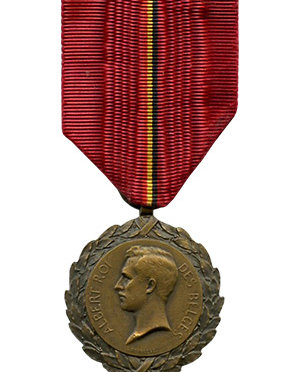
The King Albert Medal (Médaille du Roi Albert / Koning Albert Medaille) is a Belgian medal established on 7 April 1919 by royal decree and awarded to people who were exceptionally meritorious in promoting, organizing or administering humanitarian and charitable work that assisted Belgians in need during the First World War.

The medal could be awarded to both Belgians and foreigners.

The King Albert Medal Design

The medal measures 35mm in diameter and is circular and struck in bronze. Its obverse bears a central medallion bearing the left profile of King Albert I with the inscription in French or in Dutch “ALBERT KING OF THE BELGIANS” (“ALBERT ROI DES BELGES” /ALBERT KONING DER BELGEN”) surrounded by a 5mm wide laurel wreath along the entire medal circumference.

On the reverse is the relief inscription on four lines in French or in Dutch “IN TESTIMONY OF NATIONAL RECOGNITION” (EN TEMOIGNAGE DE RECONNAISSANCE NATIONALE” / “ALS BLIJK VAN’S LANDS ERKENTELIJKHEID”) with the years “1914-1918” below.

The ribbon is 38mm wide dark red silk moiré and bears a single 3mm wide longitudinal central stripe in the national colors of Belgium (1mm red, 1mm yellow and 1mm black). The ribbon bears two such stripes if the recipients distinguished themselves in the covert resupply of occupied Belgium. The medal is suspended by a ring through a suspension loop.

The Deportees’ Cross 1914-1918

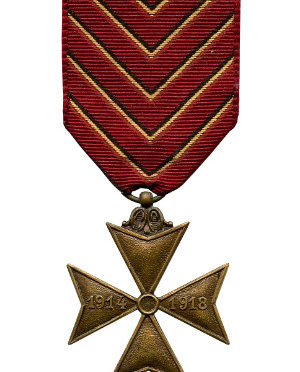
The Deportees’ Cross 1914–1918 (Croix des Déportés 1914–1918 / Weggevoerdenkruis 1914–1918) is a Belgian war medal established by royal decree on 27 November 1922 and awarded to Belgian citizens deported to Germany for forced labor during the First World War.

Deportees who died during their deportation were not awarded this cross, instead, they received the Order of Leopold II with the ribbon bearing a central longitudinal gold stripe.

The Deportees’ Cross 1914-1918 Design

The medal measures 38mm wide and is struck in bronze. It’s a cross pattée with identical plain obverse and reverse. The horizontal arms bear the relief inscription “1914” on the right arm and “1918” on the left arm.

The ribbon is 37mm wide dark red silk moiré adorned with 3mm chevrons in the national colors of Belgium. The cross is suspended by a ring through a suspension loop.

The Political Prisoner’s Medal 1914-1918

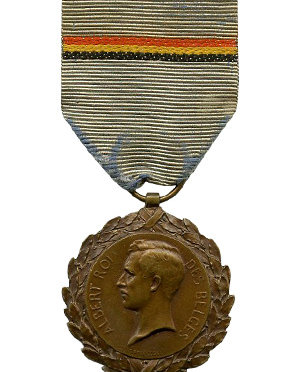
The Political Prisoner’s Medal 1914–1918 (Médaille du Prisonnier Politique 1914–1918 / Medaille van de Politieke Gevangene 1914–1918) is a Belgian medal established on 26 December 1930 by royal decree and awarded to Belgian civilians who were detained for a minimum of one month by the Germans during the First World War following an act of courage or devotion towards the Allies’ cause.

Recipients of this medal also automatically received the 1914–1918 Commemorative War Medal and the Inter-Allied Victory Medal 1914–1918.

The Political Prisoner’s Medal 1914-1918 Design

The medal measures 35 mm (1.4 in) in diameter and is circular and struck in bronze. Its obverse bears a 25 mm in diameter central medallion with the left profile of King Albert I and the inscription in French or in Dutch “ALBERT KING OF THE BELGIANS” (“ALBERT ROI DES BELGES” / “ALBERT KONING DER BELGEN”) surrounded by a 5mm wide laurel wreath along the entire medal circumference.

On the reverse of the central medallion, the relief inscription on four lines in French or in Dutch “IN TESTIMONY OF NATIONAL RECOGNITION” (“EN TEMOIGNAGE DE RECONNAISSANCE NATIONALE” / “ALS BLIJK VAN’S LANDS ERKENTELIJKHEID”) and the years “1914–1918” below.

The ribbon is 38mm wide light blue silk moiré and bears a single 4.5 mm (0.18 in) high horizontal central stripe in the national colors of Belgium (1.5 mm red, 1.5 mm yellow and 1.5 mm black). The medal is suspended by a ring through a suspension loop.

The Liège Medal

The Liège Medal is an unofficial World War I campaign medal issued by the city of Liège to its 1914 defenders against German invaders.

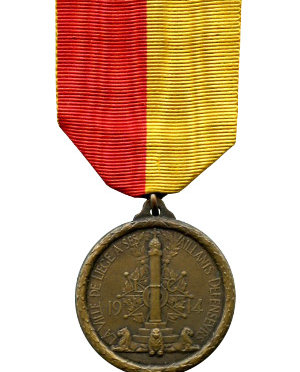
The Liège Medal (Médaille de Liège / Medaille van Luik) is an unofficial World War I campaign medal issued by the Belgian city of Liège to its 1914 defenders against the German invaders.

The medal was first issued in April 1920 during a large ceremony presided by the Duke of Brabant (later Leopold III) and Lieutenant General the Count Gérard-Mathieu Leman, military commander of the defense of Liège between 5th and 16th of August 1914. The medal was awarded to the military defenders of the city and later to residents of the city of Liège who were condemned to imprisonment by a German tribunal.

The Liège Medal Design

The medal measures 35mm in diameter and is circular and struck from bronze (although, being unofficial, some recipients had theirs gilded or silvered). It has a 2mm wide raised edge on both sides with laurel leaves along the entire circumference.

The obverse bears the relief image of the Liège Perron superimposed over a decoration akin the French Legion of Honour and bisecting the year “19” “14”. Along the circumference, a relief inscription reads “LA VILLE DE LIÈGE A SES VAILLANTS DEFENSEVRS” (“THE CITY OF LIÈGE TO ITS VALIANT DEFENDERS“). The reverse bears the relief image of a battle scene including soldiers fighting on near a partly destroyed bunker on the bank of the Meuse river.

The ribbon is a 38mm wide silk moiré half red and half yellow, the colors of the city of Liège. The medal is suspended by two interlocking rings, the lower one passing through a suspension loop on the top.