The Austrian First World War Commemorative Medal

  • Time Period: WW1
  • Institution: 21 December 1932
  • Country: Austria

The Austrian First World War Commemorative Medal (or Kreigserinnerungsmedaille in German) was awarded to those Austrians who served in the armed forces of the Austro-Hungarian Empire during the First World War 1914-1918.

The medal was officially gazetted by the Austrian government on 21 December 1932.

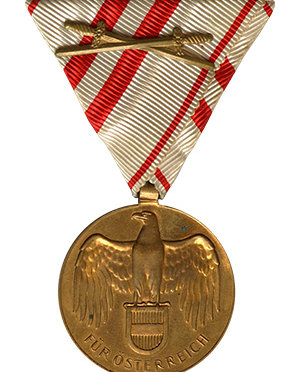
In November 1933 the government effectively created two classes for the award by announcing that all front line troops, and any other service personnel who had been wounded in action or taken prisoner, would be entitled to have a crossed swords device added to their medals to distinguish them from other recipients. The crossed swords device (in gilt) was attached to the ribbon.

The Austrian First World War Commemorative Medal Design

The medal was designed by Edwin Grienauer (1893-1964), a prominent Austrian sculptor and medalist that would later teach at the Vienna Arts Academy, who was himself a veteran of the First World War.

The obverse depicts an eagle standing on a shield displaying the medieval arms of the Duchy of Austria (which formed part of the new coat of arms of the post-war Republic of Austria) and below this is the inscription ‘FÜR ÖSTERREICH‘ (“For Austria“).

The reverse displays the dates ‘1914-1918’ and beneath them, the name of the artist, ‘GRIENAUER‘, surrounded by an oak wreath border.

The ribbon is red and white, with the stripes diagonally palced.
The Allied Subjects’ Medal

The Allied Subjects’ Medal is a decoration awarded to citizens of allied countries who gave assistance to British and Commonwealth soldiers.

The Allied Subjects’ Medal is a British decoration instituted in 1920 and distributed by the Foreign Office to citizens of allied and neutral countries who gave assistance to British and Commonwealth soldiers – especially escaped prisoners of war, behind enemy lines between 1914–1918. Most medals were awarded to Belgian and French citizens, although Danish, Dutch and other nationals also received it.

Because of delays caused by discussions within Government on the precise form and design of the award meant that it was only manufactured and distributed in 1922.

In France and Belgium, it was generally referred to as Médaille de la Reconnaissance britannique or Médaille de la Reconnaissance anglaise, after the Médaille de la Reconnaissance française.

In total, 134 silver and 574 in bronze medals were awarded, nearly half to women. In addition, 28 further foreign nationals who had rendered notable assistance received honorary appointments to the Order of the British Empire, while about one thousand others received letters of thanks for their services.

The Allied Subjects’ Medal Design

The medal was struck in silver and bronze, and measures 36 millimeters (1.4 in) in diameter. Both medals have the same design.

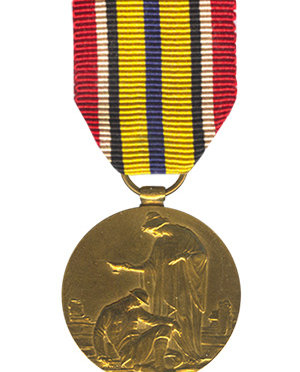
The obverse shows the left facing bareheaded effigy of King George V with the inscription “GEORGIVS V BRITT: OMN: REX ET IND: IMP:“. The reverse bears a female allegory of Humanity offering a cup to a British soldier resting on the ground, with ruined buildings in the background.

The ribbon is 25 millimeters (1.0 in) wide, and incorporates the French and Belgian national colors: It’s red with a light blue center, flanked by stripes of yellow black and white.

The medal was awarded unnamed.

The medal has a ring suspension.

The Distinguished Flying Cross and Medal (UK)

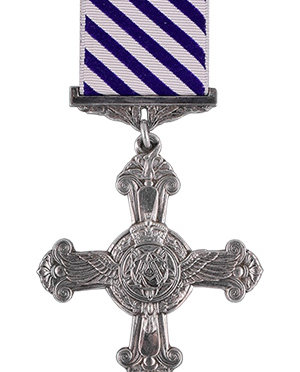
The Distinguished Flying Cross (DFC) was established in June 1918 for officers and warrant officers of the RAF for acts of valor and courage.

The Distinguished Flying Cross (or DFC) was established in June 1918, shortly after the formation of the Royal Air Force (RAF), for officers and warrant officers of the RAF for “an act or acts of valor, courage, or devotion to duty whilst flying in active operations against the enemy“.

The DFC now serves as the third-level award for all ranks of the British Armed Forces for exemplary gallantry in active operations against the enemy in the air, not to the standard required to receive the Victoria Cross or the Conspicuous Gallantry Cross. All awards of the DFC are announced in the London Gazette.

In March 1941 eligibility for the DFC was extended to Naval Officers of the Fleet Air Arm, and in November 1942 to Army officers, including Royal Artillery officers serving on attachment to the RAF as pilots-cum-artillery observers. Posthumous awards were permitted from 1979. The DFC had also been awarded by Commonwealth countries but by the 1990s most had established their own honors systems and no longer recommended British honors.

Recipients are entitled to use the post-nominal letters “DFC”.

The Distinguished Flying Cross and Medal Design

The Cross

The decoration is a cross flory, 2.125 inches (54.0 mm) wide and was designed by Edward Carter Preston. The horizontal and bottom bars are terminated with bumps, the upper bar with a rose.

Its obverse features airplane propellers, superimposed on the vertical arms of the cross, and wings on the horizontal arms. In the center is a laurel wreath around the RAF monogram, surmounted by a heraldic Imperial Crown. The reverse is plain, except for a central roundel bearing the reigning monarch’s cipher and the date ‘1918’. 

The ribbon is 1.25-inch (32 mm) wide. Originally white with deep purple broad horizontal stripes, it was changed in 1919 to the current white with purple broad diagonal stripes. The ribbon bar is silver, with the Royal Air Force eagle in its center. The suspender is straight and decorated with laurel wreaths.

Originally unnamed, the WW2 crosses usually have the year of issue engraved on the reverse of the lower limb.

The Medal

The Distinguished Flying Medal is an oval struck in silver and measures 42 mm tall and 34 mm wide.

The obverse features the sovereign’s effigy, while the reverse shows Athena Nike seated on an aeroplane, with a hawk rising from her hand. The medal was originally undated, but the date 1918 was added to the reverse with the advent of George VI obverse.

The medal is suspended by a pair of wings from a straight bar. The ribbon was originally purple and white with horizontal stripes, but since July 1919 it changed to thirteen diagonal stripes alternating white and purple.

Find This Medal

Right Now on eBay 
Clicking a link to eBay may result in a referral commission being paid if a purchase is made.
Loading...

The Italian Red Cross Medal of Merit

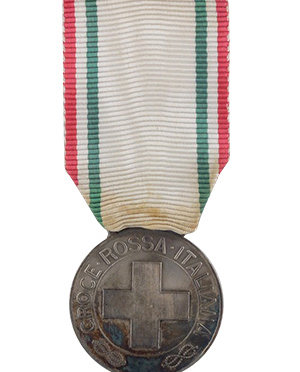
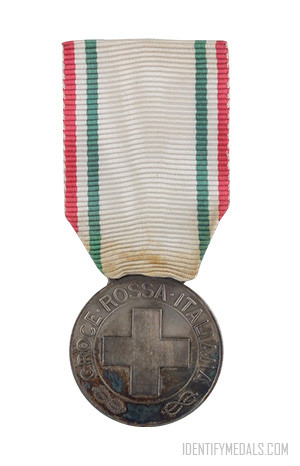
The Italian Red Cross Medal of Merit (Al merito della Croce Rossa) is an Italian award established in 1913 and awarded in three grades.

The Italian Red Cross Medal of Merit (or Medaglia al merito della Croce Rossa Italiana) is an Italian award established in 1913.

The medal was awarded in both peacetime and wartime. In peacetime, for particular merits or personal actions and for social commitment and organizational capacity. In wartime for those who have particularly distinguished themselves or worked for the Association in peace and humanitarian support operations in support of populations affected by armed conflict.

The medal was awarded in the following grades:

  • Gold Medal of Merit, awarded for services rendered in wartime in the area of ​​operations,
  • Silver Medal of Merit, awarded for services rendered in times of war in the area of ​​operations, and
  • Bronze medal of merit, awarded for services rendered in wartime in the area of ​​operations.
  • Diploma of Merit, awarded for services rendered in times of war in the area of ​​operations.

The Italian Red Cross Medal of Merit Design

The medal has a diameter of 34 millimeters and weighs about 16,67 grams. It was issued with a red case, with red fitted leatherette exterior.

The ribbon is white with narrow red, white, and green edges.

Find Red Cross Medals Online

More Red Cross Medals

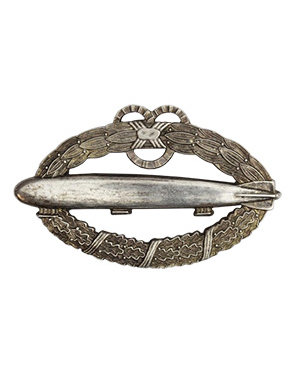
The Zeppelin Commemorative Badge

The Zeppelin Commemorative Badge is a badge established in 1920 by the Weimar Republic as a “Badge for Airshipmen.”

Institution: 1 August 1920
Country: Germany

The Zeppelin Commemorative Badge is a badge established on 1 August 1920 by Reichswehrminister Otto Karl Geßler of the Weimar Republic as a “Commemorative Badge for Airshipmen”. The badge was awarded to navy personnel regardless of rank who served on naval airships for at least one year. This condition was waived in case of outstanding merits during the Great War as well as for ex-POWs and crews of naval airships destroyed by enemy fire.

The total true aircrew personnel of the Army Airships numbered around 500 during the War, however during it no badges were issued to them (although the plan existed early on, it was canceled). Instead, the badges were manufactured and issued in the Summer of 1920, as ” Commemorative Badge for Airshipmen”.

The Zepplin badge was a post-war badge, its production was begun in 1920.

The Zeppelin Commemorative Badge Design

The badge measures 67.88mm by 38.77mm and was designed by P. Meybauer in Berlin. It’s struck in silver-plated brass.

The badge has a horizontal oval shape with an airship facing left superimposed on a green enameled wreath. The wreath is made of laurel leaves on its upper part and oak leaves on the lower one. The laurel part of the wreath is tied crosswise on its top by a ribbon that forms three semicircular arcs, two facing above and one beneath. The oak portion in its turn is tied with three ribbons.

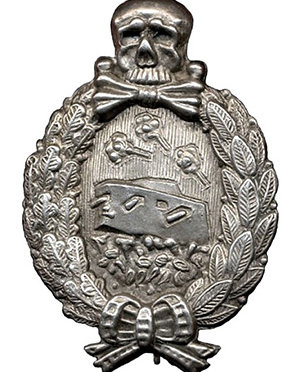
The Tank Battle Badge

The Tank Battle Badge (or Kampfwagenab-zeichen in German) is a badge established on 13 July 1921 by Dr. Otto Geller in Germany.

The Tank Battle Badge (or Kampfwagenab-zeichen in German) is a badge established on 13 July 1921 by Dr. Otto Geller in Germany. It wasn’t a wartime insignia, but rather an immediate post-war offering.

The medal was created “In order to keep awake among the German people the memory of the battle vehicle units“. The German tanks made their initial combat appearance at San Quenten, on March 21, 1918, at the start of the Michael Offensive known as “the Great Battle in France”. The First Detachment fielded five German-built A7V tanks and the Second Detachment operated five captured British tanks.

To qualify for the badge, a tanker had to have participated in three assaults against the enemy, but this requirement could be waived if the tanker was wounded. Only about 100 of these badges were awarded.

The Tank Battle Badge Design

The badge is a 2 piece silver hollow-core badge made of metal with a dull silver finish. It measures approximately 75mm by 45mm and is oval shaped, with a skull and crossed bones atop an oval wreath of oak leaves on one side and laurel leaves on the other, enclosing a scene of an A7V tank crossing a battlefield with shells bursting above it. The enclosing wreath is tied at the bottom with a bow.

A total of 99 badges were issued. The Berlin firm of C.E. Junker was the first company authorized to produce it. These badges continued to be produced in the 1930s.

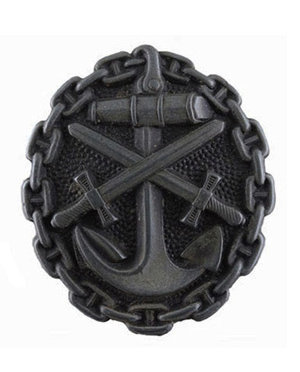
The Naval Wound Badge

The Naval Wound Badge is a badge from Imperial Germany established on 24 June 1918 by Emperor Wilhelm II for three or four wounds.

The Naval Wound Badge (or Verwundetenabzeichen für Angehörige der Marine in German) is a badge from IMperial Germany established on 24 June 1918 by Emperor Wilhelm II in the same classes and under the same regulations as the Army badge.

The Wound Badge in Silver was awarded for three or four wounds to members of the Imperial Navy, which were wounded at a sea-fight. Although it was introduced at the closing stage of the Great War, since 1936 all the veterans who were wounded but never received a badge were eligible for that award upon presentation of a documented proof. Another step forward was made on April 20, 1939, when the Ministry of Interior Affairs applied the same procedure to the former military personnel wounded in action during the Great War who were permanent residents of Austria, Sudetenland and Memel, annexed by that time. Thus Army and Naval Wound Badges (model 1918) were presented to veterans until late 1941.

The Naval Wound Badge Design

The badge has the shape of a vertical oval, but unlike the Army Wound Badge it was formed by an anchor chain.

The obverse bears an anchor with two superimposed crossed swords pointing upwards and situated in the middle of the badge. Issued pieces were seamless with a pebbled surface, while privately purchased badges in most cases had elegant cut-out design.

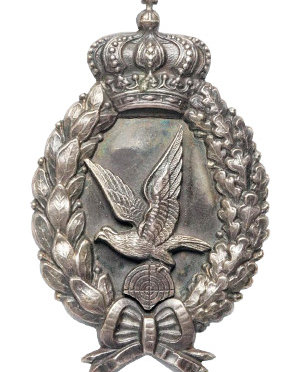
The Bavarian Air Gunner’s Badge

The Bavarian Air Gunner’s Badge is a badge from the Kingdom of Bavaria was introduced in 27 January 1918 by King Ludwig III.

The Bavarian Air Gunner’s Badge is a badge from the Kingdom of Bavaria was introduced in 27 January 1918 by King Ludwig III immediately after Wilhelm II, King of Prussia and Emperor of Germany, instituted similar badges.

The Bavarian Air Gunner’s Badge Design

The badge measures 46.2mm by 70.93mm and is struck in Silver. Of hollow construction, it has four went holes and weighs 26.3 grams.

In the obverse, the eagle has its wings raised, atop target sight, radiant within wreath, and crown above. The maker’s name is stamped in the reverse, which has a vertical pinback and breather hole below the catch.

The Naval Observer’s Badge (Prussia)

The Naval Observer’s Badge is a badge from the Kingdom of Prussia introduced in 1915  by the King and Emperor of the German Empire Wilhelm II.

The Naval Observer’s Badge (Beobachter der Fliegertruppe der Marine) is a badge from the Kingdom of Prussia introduced in 1915  by the King of Prussia and the Emperor of the German Empire Wilhelm II.

The badge was awarded to naval observers who successfully passed series of theoretical and practical examinations upon completion of the special training. Operational requirements for naval observers were by far more strict than those for army personnel.

The Naval Observer’s Badge Design

The badge measures approximately 48mm wide and 74mm high and is made of guilded medal. It weighs 58.2 grams.

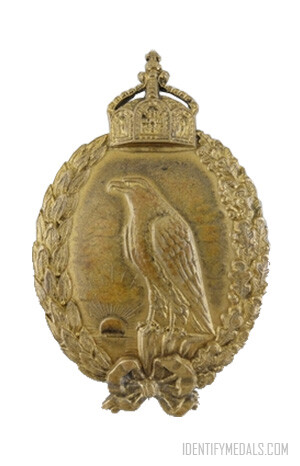
It has a shape of a vertical oval with an outside perimeter surrounded by a wide wreath. Its left side has laurel leaves symbolizing victory and its right side had oak leaves standing for strength and hardiness. Both were joined together with a ribbon bow at the bottom thus signifying a combination of those two qualities. Imperial crown topped the badge.

The obverse of the badge carries an image of an eagle with lowered wings sitting on a rock and facing left. The background shows a sea with rising or descending sun and clouds above. The reverse is either plain or carries an image of multiple straight rays radiating from the center.

Depending on the manufacturer, the badge differs in certain details (for example, some had crown inserts and lower ribbon fragments cut out). The manufacturers’ hallmarks and silver standards were often found on the reverse or the pin.

The Naval Sea Service Pilot’s Badge (Prussia)

The Naval Sea Service Pilot’s Badge is a badge from the Kingdom of Prussia awarded to qualified NCO pilots during WWI.

The Naval Sea Service Pilot’s Badge is a badge from the Kingdom of Prussia awarded to qualified NCO pilots during WWI.

The Imperial Air Service Korps eventually consisted of 88 Jastas (squadrons). Prussia formed 67 Jastas, Bavaria formed 10 Jastas, Saxony formed 7 Jastas, and Wurttemberg formed 4 Jastas. All used the Imperial badge with the Prussian crown except for Bavaria.

Naval Sea Service Pilot’s Badge Design

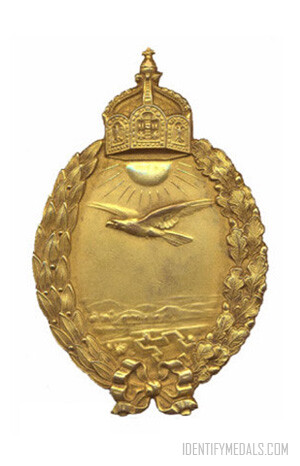
The badge is struck in guilded solid bronze.

Its obverse shows a sea eagle flying over the sea and Helgoland rock.