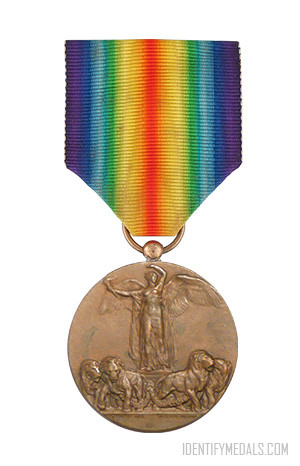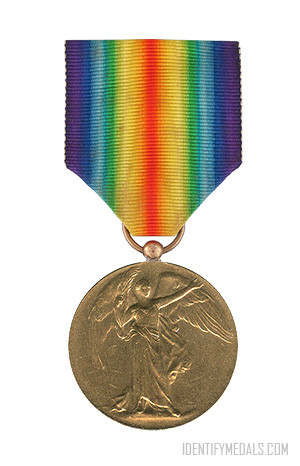
The 1914-20 First World War Medal

The 1914-20 First World War Medal is a Japanese medal established in 1915 to commemorate Japanese participation in World War I.

  • Time Period: WW1
  • Institution: 1915
  • Country: Medals from Japan Japan

The 1914-20 First World War Medal is a Japanese medal established on November 6, 1915 by Imperial Edict No. 203 to commemorate Japanese participation in World War I.

The medal was issued to naval personnel who served in the Japanese fleet in the Mediterranean during the Great War and to the military participating in the Japanese expedition to Siberia from 1918 to 1922 aimed at the Soviet Bolsheviks during the Russian Civil War that followed the October 1917 revolution.

The 1914-20 First World War Medal Design

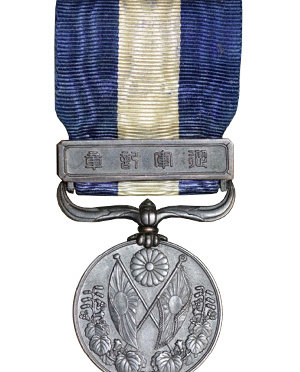
The award is a blackened bronze circular medal with ornate swivel suspension with bar inscribed ‘ju-gun-ki-sho’ (War Medal).

The obverse bears with crossed Imperial army and navy flags, a chrysanthemum crest above, sprays of pauwlona below. The reverse shows ten characters in three columns ‘tai-sho-san-nen-nai-shi-kyu-nen-sen-eki’ (Taisho 3rd Year to 9th Year War’ – Taisho 3 to 9 = AD1914 to 1920).

The ribbon has a hook and eye fittings. The medal was issued in a fitted wooden case with pale cream felt lining, the lid embossed in gilt characters ‘tai-sho-san-nen-nai-shi-kyu-nen-sen-eki-ju-gun-ki-sho’ (Taisho 3-9 War Military Service Medal).
The Medal for Participation in the European War 1915-1918

The Medal for Participation in the European War 1915–1918 is a Bulgarian military decoration awarded to individuals who served in WW1.

The Medal for Participation in the European War 1915-1918 (or За Участие В Европейската Война) was instituted on 9 December 1933 and awarded to Bulgarian and Bulgarian allied force participants of the “1915–1918” war (The Great War). It was issued to all WWI veterans including military personnel, non-combatants (such as medics, war journalists, and civilians) and relatives of KIAs. Also eligible were NCOs, former officers, and soldiers from Central Powers armies.

The medal was awarded until December 31, 1939. About 249,000 medals were issued (about 50,000 to Bulgarians and about 199,000 to allied forces) in three classes.

The Medal for Participation in the European War 1915-1918 Design

The medal is circular and measures 32,1 mm in diameter. It was made of gilt bronze. They were manufactured by the Lüdenscheid-based company “Gebrüder Gloerfeld” (the first lot of 30,000), the Swiss company “Huguenin Gebr.&Co.” (59,000), the Sofia-based manufacturer Бердж Керестеджиев and “Otto Shiсkle”(60,000 medals in 1939).

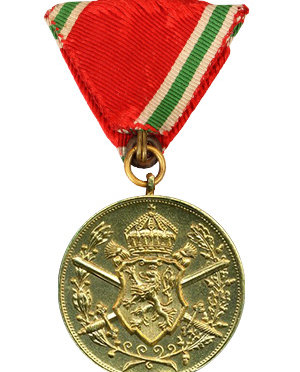
The obverse of the medal shows a crowned Bulgarian coat of arms imposed on crossed swords and flanked by laurel and oak branches. The reverse shows the dates of the Bulgarian participation in the Great War (“1915-1918”) inscribed in two lines in the centre, encircled by a wreath of wheat, laurel, oak and roses that symbolized Macedonia, Thrace and Moesia.

The ribbon was made of 39 mm wide silk and followed colors of the Bulgarian flag. The medal was awarded to people who did not participate directly in war activities with a central white stripe in the ribbon. Medals for next of kin had a central black stripe.

The Inter Allied Victory Medal (Greece)

The Greek Victory Medal was instituted to commemorate the Allied victory in the First World War. It was designed by Henry-Eugène Nocq.

The Allied Victory Medal was recommended by an inter-allied committee in March 1919. Fourteen victorious countries finally awarded the medal after World War I, and each allied nation would design a ‘Victory Medal’ for award to their own nationals. Certain features were to be shared: a winged figure of Victory on the obverse and the same ribbon.

For most of the war, Greece was officially neutral. Finally in 1918 Greece sided with the allies, sending 230,000 troops to fight in Macedonia. The Greek Victory medal followed the proposal made by French Marshal Ferdinand Foch, who was the supreme commander of the Allied Forces during the war. It was instituted on 22nd September 1920 and was awarded to military personnel who had served at least 3 months active service or had been wounded in action, died of wounds or had been killed in action and to sailors with service of at least a year between 14th June 1917 and 25th November 1918. Approximately 200,000 medals were issued.

The Greece Inter Allied Victory Medal Design

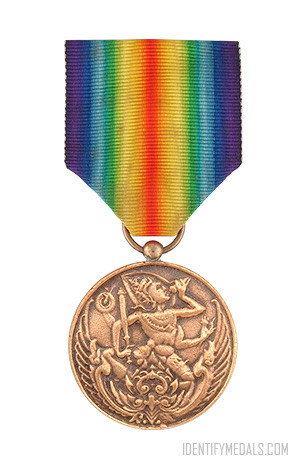
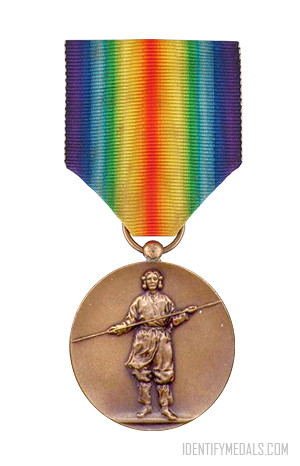
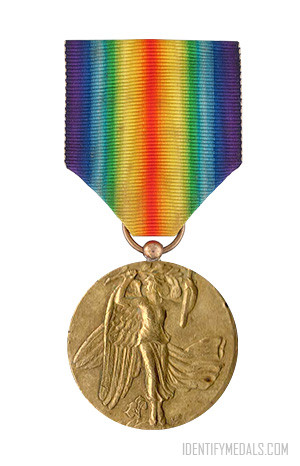
The Victory Medal measures 36 millimetres (1.4 in) in diameter and was designed by William McMillan. The design and ribbon was also adopted by Belgium, Brazil, Cuba, Czechoslovakia, France, Greece, Italy, Japan, Portugal, Romania, Siam, Union of South Africa and the USA. Each allied nation would design a ‘Victory Medal’ for award to their own nationals, all issues having certain common features, including a winged figure of victory on the obverse and the same ribbon.

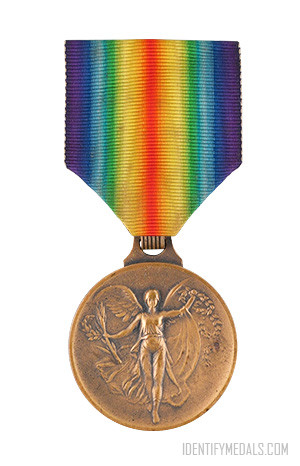
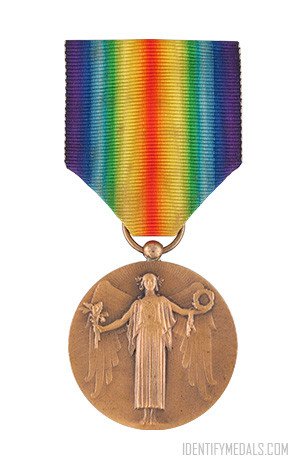
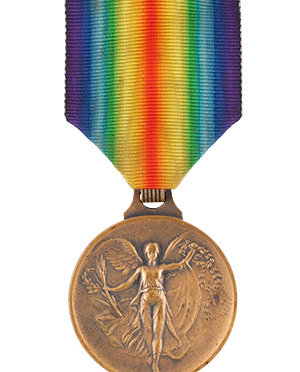
The obverse of the medal bears the winged, full-length figure of Victory designed by Henry-Eugène Nocq (1868–1944), a recognized French sculptor and medalist who lived in Paris, where the medal was also struck. The image of Victory was modeled after the 5th Century BCE statue of Nike by Paionios. The reverse bears “The Great War for Civilization” in Greek, and an infant Hercules wrestling with two snakes. The tablet in the center reads “Allies and Comrades” and lists the allied nations.

The 39 millimeters (1.5 in) wide watered ribbon has an iridescent color scheme, with the violet moving through to a central red stripe where both schemes meet. It attaches to the medal through a ring suspender. The recipient’s name, rank, service number and unit were impressed on the edge of the medal. The name of the regiment or corps was omitted on medals awarded to Army officers.

All the Inter-Allied Victory Medal Variations

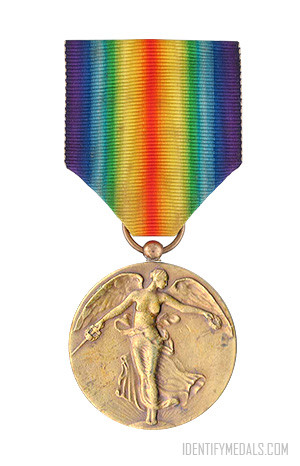
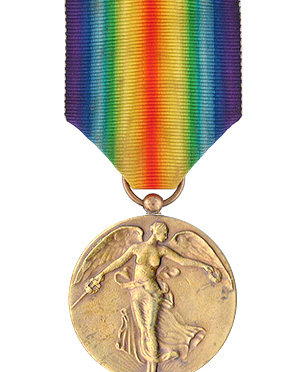
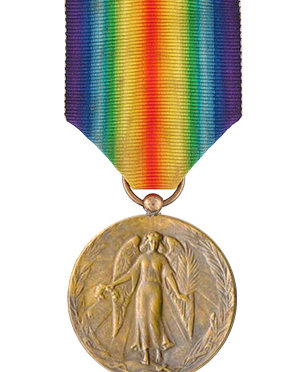
Although each country designed its own version of the Inter-Allied Victory Medal, all of them shared some common elements, such as a winged victory figure on the obverse and a similar ribbon with rainbow colors symbolizing unity among the Allies. Here are the versions for all countries:

Find an Inter-Allied Victory Medal Online

Right Now on eBay 
Clicking a link to eBay may result in a referral commission being paid if a purchase is made.
Loading...

The Inter Allied Victory Medal (Belgium)

The Belgian Victory Medal was established by royal decree on 15 July 1919 and awarded to all members of the Belgian Armed Forces.

The Allied Victory Medal was recommended by an inter-allied committee in March 1919. Fourteen victorious countries finally awarded the medal after World War I, and each allied nation would design a ‘Victory Medal’ for award to their own nationals. Certain features were to be shared: a winged figure of Victory on the obverse and the same ribbon.

The Belgian Victory Medal was established by royal decree on 15 July 1919 and awarded to all members of the Belgian Armed Forces.

The Belgium Inter Allied Victory Medal Design

The Victory Medal measures 36 millimetres (1.4 in) in diameter and was designed by William McMillan. The design and ribbon was also adopted by Belgium, Brazil, Cuba, Czechoslovakia, France, Greece, Italy, Japan, Portugal, Romania, Siam, Union of South Africa and the USA. Each allied nation would design a ‘Victory Medal’ for award to their own nationals, all issues having certain common features, including a winged figure of victory on the obverse and the same ribbon.

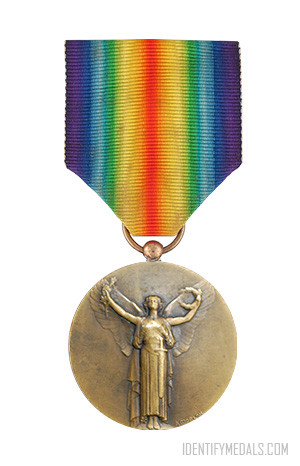
The obverse of the medal was designed by Belgian sculptor Paul Du Bois.

The reverse shows the words ‘THE GREAT / WAR FOR / CIVILISATION / 1914-1919’ surrounded by a laurel wreath.

The 39 millimeters (1.5 in) wide watered ribbon has an iridescent color scheme, with the violet moving through to a central red stripe where both schemes meet. It attaches to the medal through a ring suspender. The recipient’s name, rank, service number and unit were impressed on the edge of the medal. The name of the regiment or corps was omitted on medals awarded to Army officers.

All the Inter-Allied Victory Medal Variations

Although each country designed its own version of the Inter-Allied Victory Medal, all of them shared some common elements, such as a winged victory figure on the obverse and a similar ribbon with rainbow colors symbolizing unity among the Allies. Here are the versions for all countries:

Find an Inter-Allied Victory Medal Online

Right Now on eBay 
Clicking a link to eBay may result in a referral commission being paid if a purchase is made.
Loading...

The Inter Allied Victory Medal (Brazil)

The Brazilian Victory Medal was established in January 24, 1919 and awarded to all military personnel or civilians employed in war service.

The Allied Victory Medal was recommended by an inter-allied committee in March 1919. Fourteen victorious countries finally awarded the medal after World War I, and each allied nation would design a ‘Victory Medal’ for award to their own nationals. Certain features were to be shared: a winged figure of Victory on the obverse and the same ribbon.

The President of the United States of Brazil, adopted the proposal of Marshal Foch in January 24, 1919 so that all the fighters of the Great War received a commemorative medal. Brazil had a sizable merchant fleet and had lost a number of ships to German submarines when it joined the allies in October 1917, contributing with two cruisers and two destroyers and their crews placed under command of the British Admiralty.

Brazilians also sent a medical mission to Europe and a number of soldiers to set up several field medical stations and a 300-bed hospital near Paris. Approximately 2,500 medals were produced for these sailors, soldiers and medical personnel.

The Brazil Inter Allied Victory Medal Design

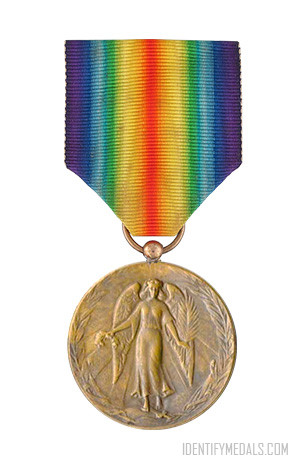
The Victory Medal measures 36 millimetres (1.4 in) in diameter and was designed by William McMillan. The design and ribbon was also adopted by Belgium, Brazil, Cuba, Czechoslovakia, France, Greece, Italy, Japan, Portugal, Romania, Siam, Union of South Africa and the USA. Each allied nation would design a ‘Victory Medal’ for award to their own nationals, all issues having certain common features, including a winged figure of victory on the obverse and the same ribbon.

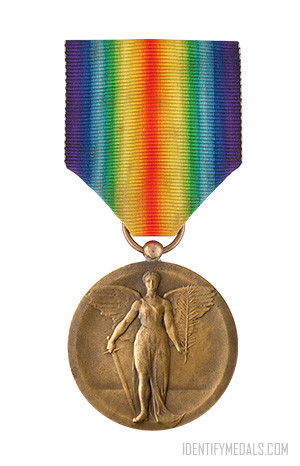
The obverse of the Brazilian Victory Medal featured a symbolic figure of Victoria fringed with two palms on a plain background.

The reverse shows the words ‘THE GREAT / WAR FOR / CIVILISATION / 1914-1919’ surrounded by a laurel wreath.

The 39 millimeters (1.5 in) wide watered ribbon has an iridescent color scheme, with the violet moving through to a central red stripe where both schemes meet. It attaches to the medal through a ring suspender. The recipient’s name, rank, service number and unit were impressed on the edge of the medal. The name of the regiment or corps was omitted on medals awarded to Army officers.

All the Inter-Allied Victory Medal Variations

Although each country designed its own version of the Inter-Allied Victory Medal, all of them shared some common elements, such as a winged victory figure on the obverse and a similar ribbon with rainbow colors symbolizing unity among the Allies. Here are the versions for all countries:

Find an Inter-Allied Victory Medal Online

Right Now on eBay 
Clicking a link to eBay may result in a referral commission being paid if a purchase is made.
Loading...

The Inter Allied Victory Medal (South Africa)

The South African Victory Medal was awarded to all those South Africans who were awarded the 1914–15 Star or the British War Medal.

The Allied Victory Medal was recommended by an inter-allied committee in March 1919. Fourteen victorious countries finally awarded the medal after World War I, and each allied nation would design a ‘Victory Medal’ for award to their own nationals. Certain features were to be shared: a winged figure of Victory on the obverse and the same ribbon.

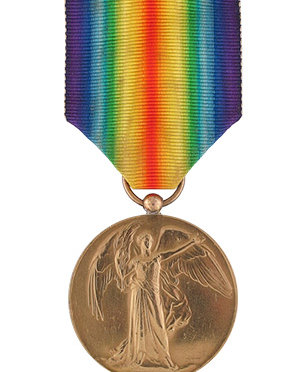
The South-African Victory medal was awarded to all those South Africans who were awarded the 1914–15 Star or the British War Medal. The Union of South Africa awarded its own version of the Victory Medal, identical to the British version on the obverse, but with the inscription on the reverse in English and Dutch, the two official languages of South Africa at the time. Recipients had to have entered a theatre of the war between 5 August 1914.

The South Africa Inter Allied Victory Medal Design

The Victory Medal measures 36 millimetres (1.4 in) in diameter and was designed by William McMillan. The design and ribbon was also adopted by Belgium, Brazil, Cuba, Czechoslovakia, France, Greece, Italy, Japan, Portugal, Romania, Siam, Union of South Africa and the USA. Each allied nation would design a ‘Victory Medal’ for award to their own nationals, all issues having certain common features, including a winged figure of victory on the obverse and the same ribbon.

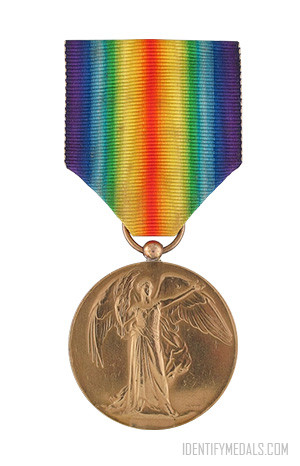
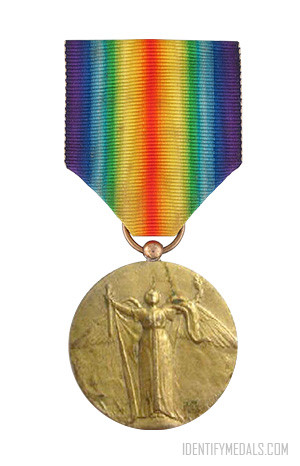
The obverse of the medal bears the winged, full-length and full-front figure of Victoria, with her left arm extended and holding a palm branch in her right hand. The reverse reads “THE GREAT WAR FOR CIVILISATION” in three lines above and “DE GROTE OORLOG VOOR DE BESCHAVING” in three lines below, with the two inscriptions separated by “•••••” and with the years “1914-1919”, all surrounded by a laurel wreath.

The 39 millimeters (1.5 in) wide watered ribbon has an iridescent color scheme, with the violet moving through to a central red stripe where both schemes meet. It attaches to the medal through a ring suspender. The recipient’s name, rank, service number and unit were impressed on the edge of the medal. The name of the regiment or corps was omitted on medals awarded to Army officers.

All the Inter-Allied Victory Medal Variations

Although each country designed its own version of the Inter-Allied Victory Medal, all of them shared some common elements, such as a winged victory figure on the obverse and a similar ribbon with rainbow colors symbolizing unity among the Allies. Here are the versions for all countries:

Find an Inter-Allied Victory Medal Online

Right Now on eBay 
Clicking a link to eBay may result in a referral commission being paid if a purchase is made.
Loading...

The Inter Allied Victory Medal (Portugal)

The Portuguese Victory Medal was designed by Joao da Silva. Portugal had to defend against German attacks on her colonies.

The Allied Victory Medal was recommended by an inter-allied committee in March 1919. Fourteen victorious countries finally awarded the medal after World War I, and each allied nation would design a ‘Victory Medal’ for award to their own nationals. Certain features were to be shared: a winged figure of Victory on the obverse and the same ribbon.

Portugal had to defend against German attacks on her colonies, Angola and Mozambique, after it seized 72 German merchant ships that were in Portuguese harbors and Germany declared war on it.

The Portugal Inter Allied Victory Medal Design

The Victory Medal measures 36 millimeters (1.4 in) in diameter and was designed by William McMillan. The design and ribbon was also adopted by Belgium, Brazil, Cuba, Czechoslovakia, France, Greece, Italy, Japan, Portugal, Romania, Siam, Union of South Africa and the USA. Each allied nation would design a ‘Victory Medal’ for award to their own nationals, all issues having certain common features, including a winged figure of victory on the obverse and the same ribbon.

The obverse of the medal was designed by Joao da Silva, a renowned Portuguese sculptor of the time. The reverse reads “MEDALHA DA VITORIA” or “Victory Medal” (instead of the usual “The Great War for Civilization”) and omits the names of the allied nations.

The 39 millimeters (1.5 in) wide watered ribbon has an iridescent color scheme, with the violet moving through to a central red stripe where both schemes meet. It attaches to the medal through a ring suspender. The recipient’s name, rank, service number and unit were impressed on the edge of the medal. The name of the regiment or corps was omitted on medals awarded to Army officers.

All the Inter-Allied Victory Medal Variations

Although each country designed its own version of the Inter-Allied Victory Medal, all of them shared some common elements, such as a winged victory figure on the obverse and a similar ribbon with rainbow colors symbolizing unity among the Allies. Here are the versions for all countries:

Find an Inter-Allied Victory Medal Online

Right Now on eBay 
Clicking a link to eBay may result in a referral commission being paid if a purchase is made.
Loading...

The Inter Allied Victory Medal (United States)

The American Victory Medal was designed by James Earle Fraser and awarded to military personnel for service between 1917 and 1918.

The Allied Victory Medal was recommended by an inter-allied committee in March 1919. Fourteen victorius countries finally awarded the medal after World War I, and each allied nation would design a ‘Victory Medal’ for award to their own nationals. Certain features were to be shared: a winged figure of Victory on the obverse and the same ribbon.

The American Victory Medal was awarded to military personnel for service between April 6, 1917, and November 11, 1918 with the American Expeditionary Forces in European Russia (November 12, 1918 to August 5, 1919) or the American Expeditionary Forces Siberia (November 23, 1918 to April 1, 1920).

Although originally intended to be established by an act of Congress, the bill authorizing the medal never passed and it had to be established by the military departments through general orders. The War Department published orders in April 1919, and the Navy on June 1919.

The Victory Medal was authorized with a large variety of devices to denote specific accomplishments, such as the Citation Star, Navy Commendation Star and several Battle Clasps.

The U.S. Inter-Allied Victory Medal Design

The Victory Medal measures 36 millimetres (1.4 in) in diameter and was designed by William McMillan. The design and ribbon was also adopted by Belgium, Brazil, Cuba, Czechoslovakia, France, Greece, Italy, Japan, Portugal, Romania, Siam, Union of South Africa and the USA. Each allied nation would design a ‘Victory Medal’ for award to their own nationals, all issues having certain common features, including a winged figure of victory on the obverse and the same ribbon.

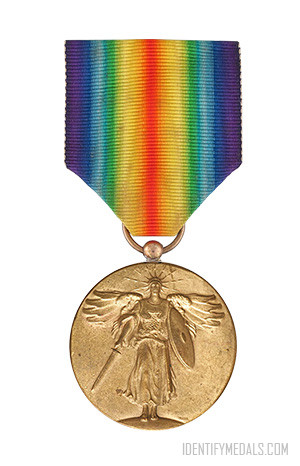
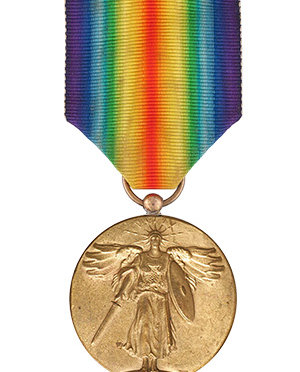
The obverse of the medal features a winged Victory holding a shield and sword on the front. The reverse bears “The Great War For Civilization” in capital letters curved along the top of the medal. Along the bottom of the back are six stars, three on either side of the center column of seven staffs wrapped in a cord. On left side of the staff it lists one World War I Allied country per line: France, Italy, Serbia, Japan, Montenegro, Russia, and Greece. On the right side of the staff the Allied country names read Great Britain, Belgium, Brazil, Portugal, Rumania(spelled with a U), andChina.

The 39 millimeters (1.5 in) wide watered ribbon has an iridescent color scheme, with the violet moving through to a central red stripe where both schemes meet. It attaches to the medal through a ring suspender. The recipient’s name, rank, service number and unit were impressed on the edge of the medal. The name of the regiment or corps was omitted on medals awarded to Army officers.

All the Inter-Allied Victory Medal Variations

Although each country designed its own version of the Inter-Allied Victory Medal, all of them shared some common elements, such as a winged victory figure on the obverse and a similar ribbon with rainbow colors symbolizing unity among the Allies. Here are the versions for all countries:

Find an Inter-Allied Victory Medal Online

Right Now on eBay 
Clicking a link to eBay may result in a referral commission being paid if a purchase is made.
Loading...

The Battle of Verdun Medal

The Medal of Verdun was issued for those serving on the Argonne and St Mihiel sectors between 1914 and 1918 during the Battle of Verdun.

Created in late 1916 and even before the end of the battle, the Medal of Verdun was made for soldiers who, for several months under intense pressure from infantry attacks and heavy artillery pounding, held their ground during the WW1 Battle of Verdun.

Around 70% of all the French soldiers that were engaged in World War I participated to the battle of Verdun. Six or seven different designs were put forward for the medal but none were approved by the French Government and all remained unofficial awards that could not be worn on military uniform.

Originally intended to be “awarded to those who served on the Verdun front between 21 February 1916 and 2 November 1916″, the medal was, in fact, awarded to those who served anywhere on the Argonne and St Mihiel sectors between 31 July 1914 and 11 November 1918.

The Battle of Verdun Medal Design

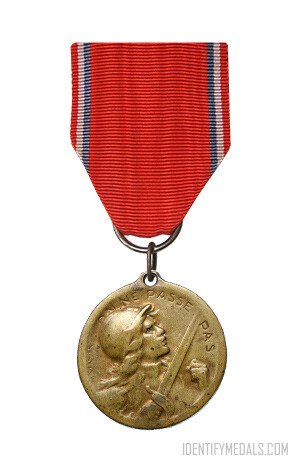
The obverse shows the head of the Republic (a symbol of the Third French Republic) and the famous sentence pronounced by Robert Nivelle: “Ils ne passeront pas”, translated as: “They will not break through”. The reverse bears a French soldier and the inscription “EN AVANT S. QU AU BOUT” (“Forward, always forward” or “Forward until the end.”) The “S” stands for “sans,” which means “without,” so it could be interpreted as “Forward, without stopping, until the end.” Another reverse shows a twin castle gate with the inscriptions “VERDUN” and “21 FEVRIER 1916”.

The medal is fitted with a loose ring suspender and a piece of 37 mm red ribbon that has blue-white-red edges.

The original, and most commonly found, version was by Vernier but since supplies of this medal were inadequate, others created Verdun medals and at least seven versions of varying rarity are known. It is relatively common medal to find but it was an immense measure of respect in the civil life. It was carried with pride to show that these soldiers participated in the biggest attack France had to suffer in its history.

The Inter Allied Victory Medal (Czechoslovakia)

The Czechoslovakian Victory Medal was awarded to all military personnel or civilians who participated in WW1 and has an Art Deco style.

  • Time Period: World War I
  • Institution: 1919
  • Country: Czechoslovakia

The Allied Victory Medal was recommended by an inter-allied committee in March 1919. Fourteen victorious countries finally awarded the medal after World War I, and each allied nation would design a ‘Victory Medal’ for award to their own nationals. Certain features were to be shared: a winged figure of Victory on the obverse and the same ribbon.

During the war, Czechs and Slovaks living in France were given the choice of military service or internment as enemy aliens. The Inter-Allied Victory medal was awarded to soldiers who served in the various Czech legions under the French, Italian and Russian Armies, to those who fought in the army of any allied nation, and to those who joined the French Foreign Legion.

The Czechoslovakia Inter-Allied Victory Medal Design

The Victory Medal measures 36 millimetres (1.4 in) in diameter and was designed by William McMillan. The design and ribbon was also adopted by Belgium, Brazil, Cuba, Czechoslovakia, France, Greece, Italy, Japan, Portugal, Romania, Siam, Union of South Africa and the USA. Each allied nation would design a ‘Victory Medal’ for award to their own nationals, all issues having certain common features, including a winged figure of victory on the obverse and the same ribbon.

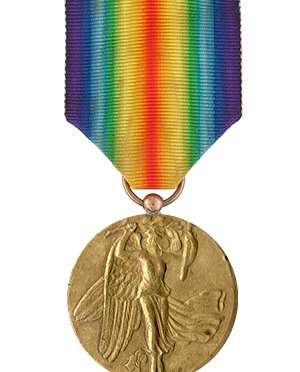
The obverse of the Czechoslovakian Victory Medal featured an Art Deco style winged Victory. The linden tree, symbol of the Czech nation, sprouts near Victory’s feet. The back has a shield with the lion of Bohemia with the arms of Silesia on its chest, surrounded by linden leaves.

The reverse shows the words ‘THE GREAT / WAR FOR / CIVILISATION / 1914-1919’ surrounded by a laurel wreath.

The 39 millimeters (1.5 in) wide watered ribbon has an iridescent color scheme, with the violet moving through to a central red stripe where both schemes meet. It attaches to the medal through a ring suspender. The recipient’s name, rank, service number and unit were impressed on the edge of the medal. The name of the regiment or corps was omitted on medals awarded to Army officers.

All the Inter-Allied Victory Medal Variations

Although each country designed its own version of the Inter-Allied Victory Medal, all of them shared some common elements, such as a winged victory figure on the obverse and a similar ribbon with rainbow colors symbolizing unity among the Allies. Here are the versions for all countries:

Find an Inter-Allied Victory Medal Online

Right Now on eBay 
Clicking a link to eBay may result in a referral commission being paid if a purchase is made.
Loading...