The Distinguished Service Medal (Navy & Marines)

The Navy Distinguished Service Medal is a military decoration created in 1919 for the United States Navy and United States Marine Corps.

  • Time PeriodThe Great War
  • Institution: 4 February 1919
  • Country: United States

The Navy Distinguished Service Medal is a military decoration, first created in 1919, of the United States Navy and United States Marine Corps. It recognizes distinguished and exceptionally meritorious service to the country while serving in a duty or position of great responsibility.

At the start of World War I, the Navy had the Medal of Honor as the only decoration with which to recognize heroism. At a level below, the Navy Distinguished Service Medal and the Navy Cross were created by Public Law 253 on 4 February 1919. The Navy Distinguished Service Medal remained senior to the Navy Cross until August 1942, when the precedence of the two decorations was reversed. 

To justify this decoration, exceptional performance of duty must be clearly above that normally expected, and contributes to the success of a major command or project. The decoration is normally only bestowed to senior Navy flag officers and Marine Corps general officers, or extremely senior enlisted positions. In rare instances, it has also been awarded to Navy captains and Marine Corps colonels.

The Navy Distinguished Service Medal Design

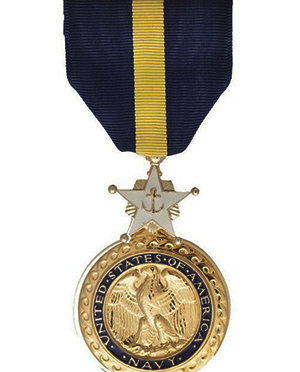
The Navy Distinguished Service Medal is a gilt bronze medallion measuring 1.25 inches (32 mm) in diameter.

The obverse features an American bald eagle in the center displaying its wings (the eagle holds an olive branch in its right talon and arrows in its left talons and is surrounded by a blue enameled ring with the words “UNITED  STATES OF AMERICA” at the top and “NAVY” at the bottom).

Surrounding the blue enamel ring is a gold border of scroll waves depicted moving in a clockwise direction. The medal is surmounted by a white five-pointed star, point up, the points of the star being tipped with gold balls. In the center of the star is a blue anchor, while gold rays radiate between the arms of the star.

The reverse depicts a trident surrounded by a laurel wreath, and surrounded itselft by a blue enamel ring containing the inscription “FOR DISTINGUISHED SERVICE”

The medal’s suspension and service ribbon is navy blue with a single central stripe of yellow. Additional awards of the Navy Distinguished Service Medal are denoted by gold and silver 5/16 inch stars worn on the medal’s suspension and service ribbon.

Find This Medal Online

Right Now on eBay 
Clicking a link to eBay may result in a referral commission being paid if a purchase is made.
Loading...

The Medal of Military Merit (Greece)

The Medal of Military Merit (Μετάλλιο Στρατιωτικής Αξίας) is a military decoration of Greece created in 1916 for wartime meritorious service.

  • Time Period: WW1
  • Year of Institution: 28 February 1917
  • Country: Greece

The Medal of Military Merit (or Μετάλλιο Στρατιωτικής Αξίας in Greek) is a military decoration of Greece, originally created in 1916 for wartime meritorious service. After World War II the medal became a peace-time medal reserved for officers. After the abolition of the Greek monarchy in 1974, its design was slightly altered.

The medal was created as the Military Medal (Στρατιωτικόν Μετάλλιον) by the National Defence Government on 28 October 1916, during the National Schism, and was adopted as the Medal of Military Merit nationwide by Royal Decree on 30 June 1917.

The Medal of Military Merit Design

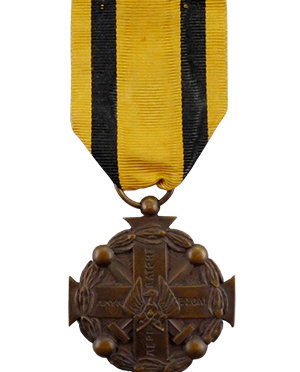
The medal was designed by the French sculptor André Rivaud (who also designed the 1916 War Cross) and is similar to its current version, a copper cross pattée concave with the arms filled, enclosed in a laurel wreath and with two crossed short swords superimposed.

The cross’s arms bear the legend ΑΜΥΝΕΣΘΑΙ ΠΕΡΙ ΠΑΤΡΗΣ (“Defending the fatherland”, a quote of Hector from the Iliad). The 1916 version had a phoenix rising from its ashes in the center, while the post-1974 version substitutes the national emblem of Greece. The 1916 version bore the legend ΕΛΛΑΣ 1916–1917 (“Greece 1916–1917”) on the reverse (although some medals omit the date or the inscription altogether), while the current version bears the legend ΓΙΑ ΣΤΡΑΤΙΩΤΙΚΗ ΑΞΙΑ (“For Military Merit”).

The 1916 version was suspended by a yellow ribbon with two black stripes, while the current version’s ribbon has three equal blue-white-blue stripes, edged with yellow. When worn as a ribbon bar, the circular wreaths were substituted by branches.

Originally the medal had four classes, with the third, second and first classes distinguished respectively by a bronze, silver and gilded laurel wreath on the ribbon, while the fourth class was plain.

The War Cross (Greece)

The War Cross (or Πολεμικός Σταυρός) is a military decoration of Greece, awarded for heroism in wartime to both Greeks and foreign allies.

  • Time Period: WW1
  • Year of Institution: 28 February 1917
  • Country: Greece

The War Cross (or Πολεμικός Σταυρός in Greek) is a military decoration of Greece, awarded for heroism in wartime to both Greeks and foreign allies.

There have been three versions of the cross, the 1917 version covering World War I (established by the Venizelist “National Defence” Government on 28 February 1917, and confirmed by Royal Decree on 31 October), the 1940 version covering the Second World War and the Greek Civil War, and the 1974 version covering peacekeeping missions in the subsequent years.

Its creation was inspired by the French Croix de guerre, and it was awarded to military personnel of all branches for acts of valor in the Macedonian Front (1916–1918), the Allied Expedition to the Ukraine (1919) and the Greco-Turkish War of 1919–1922 (rarely after 1920 due to its Venizelist connotations). In addition, from 1919, the first class could be awarded to the war flags of distinguished regiments.

When Greece found itself at war again in October 1940 after the Italian invasion, the staunchly royalist dictatorial government chose an entirely different design instead of simply re-establishing the old version. The new medal was instituted by Royal Decree on 11 November 1940 and continued to be awarded throughout the Second World War. It was re-authorised on 19 April 1947 for the Greek Civil War (1946–1949) and extended until 1953, covering the Greek participation in the Korean War.

In 1974, during the last months of the Greek military junta and following the abolition of the monarchy in June 1973, the junta issued Law 376/74 on military medals, which revised the until then current regulations. It specified that the War Cross would have three classes, with the 1st class was reserved for senior officers and war flags, the 2nd class for mid-level officers and the 3rd class for junior and warrant officers, NCOs and privates.

The War Cross Design

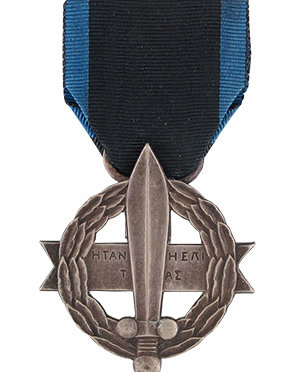
The War Cross medal was designed by the French sculptor André Rivaud and struck in silver.

1917 Version

The obverse features a vertical sword on a circular wreath, with a horizontal plaque, bearing the ancient Spartan motto “Η ΤΑΝ Η ΕΠΙ ΤΑΣ” (“[return home] either with your shield, or upon it”) underneath. The reverse bears the inscription “ΕΛΛΑΣ” (“Greece”) and underneath the dates “1916–1917”.

The ribbon was black, edged with blue, and 35–37 mm wide. The cross was awarded in three classes, distinguished by the devices born on the ribbon: the 3rd class being plain, the 2nd class bearing a bronze five-pointed star, and the 1st class a bronze palm leaf. Subsequent awards were designated by the addition of silver five-pointed stars on the ribbon.
1940 Version

The medal’s design is also a modification of the French Croix de guerre, featuring in the obverse a bronze cross pattée with the royal monogram (two crossed gammas and a crown) of King George II, atop two crossed swords, and topped by a royal crown. The reverse bears the date “1940”.

The ribbon features three equal alternating bands of red, blue and red. The cross was awarded in three classes, distinguished by the colour of the crown: bronze for the 3rd class, silver for the 2nd, and gold for the 1st class. Several variations exist because many manufacturers were used, some in Greece and others in the United Kingdom, with minor variations in the style of the crown and the cross, as well as design of the obverse side (in some versions, the date lies within a circle).

1974 Version

The medal was not officially redesigned at the time. In 1985, a provisional version was cut. It retained the same basic design as the 1940 version, but without the royal cypher, which was replaced by an oak wreath, and the crowns, which were replaced by bronze, silver and gold versions of the national emblem of Greece for the 3rd, 2nd and 1st classes respectively. The reverse bore the legend “ΕΛΛΗΝΙΚΗ ΔΗΜΟΚΡΑΤΙΑ” (“Hellenic Republic”). Four medals of the 1st class were issued to war flags of units participating in UN peacekeeping missions.

The design was finalized in Presidential Decree 159 of 17 March 2003. It retains the basic design of the 1940 and 1985 crosses, but the national emblem has been moved to the center of the cross, in bronze, silver and gold versions for the 3rd, 2nd and 1st classes respectively.

The Air Force Cross and Medal (United Kingdom)

The Air Force Cross is a British military decoration awarded to officers for “acts of exemplary gallantry while flying against the enemy”

Time Period: WW1 The Great War
Year of Institution: 3 June 1918
Country: Great Britain

The Air Force Cross (or AFC) is a military decoration awarded to officers for “an act or acts of exemplary gallantry while flying, though not in active operations against the enemy“. Since 1993 it’s also given to other ranks, of the United Kingdom Armed Forces, and formerly also to officers of the other Commonwealth countries.

The award was established on 3 June 1918, shortly after the formation of the Royal Air Force (RAF). It was originally awarded to RAF commissioned officers and Warrant Officers, but was later expanded to include Royal Navy and army aviation officers. Recipients of the Air Force Cross are entitled to use the post-nominal letters “AFC”.

Between 1919 and 1932 the AFC was also awarded to civilians, on the same basis as for RAF personnel. The AFC had also been awarded by Commonwealth countries but by 1990’s most, including Canada, Australia, and New Zealand, had established their own honors systems and no longer recommended British honors.

The Air Force Cross and Medal Design

The Cross

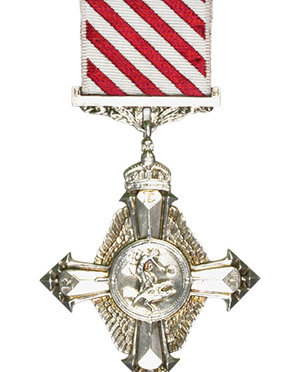
The Air Force Cross is a silver cross measuring 60 millimeters (2.4 in) in height and 54 millimeters (2.1 in) in width, representing aircraft propeller blades, with wings between the arms. It was design by Edward Carter Preston.

The obverse depicts Hermes, riding on the wings of a hawk holding a laurel wreath. At the top of the upper arm is the royal crown, while the other three arms bear the royal cipher of the reigning monarch at the time of issue. The reverse is plain, except for a central roundel bearing the reigning monarch’s cipher and the date ‘1918’. Originally awarded unnamed, from 1939 the year of issue was engraved on the reverse lower limb of cross, and since 1984 it has been awarded named to the recipient.

The suspender is straight and decorated with laurel wreaths. The ribbon bar denoting a further award is silver, with the Royal Air Force eagle in its centre. Bars awarded during World War II have the year of award engraved on the reverse. The 32 mm (1.25 inch) ribbon was originally white with red broad horizontal stripes, but changed in July 1919 to the current white with red broad diagonal stripes at a 45-degree angle.

The Medal

The Air Force Medal is an oval struck in silver and measures 42 mm tall and 32 mm wide. It has a laurel border and features, on the obverse, the sovereign’s effigy. The reverse Hermes mounted on a hawk bestowing a laurel wreath.

The medal is suspended by a pair of wings from a straight bar. The ribbon, originally with horizontal narrow stripes or white and crimson, changed in 1919 to diagonal ones of the same colors.

The Scottish Territorial Red Cross Brigade Badge

The Scottish Territorial Red Cross Brigade Badge is a WW1 cap badge made in brass-metal with a red felt backing to the central Geneva Cross.

The Scottish Territorial Red Cross Brigade Badge is a WW1 die-stamped cap badge to the Scottish Territorial Red Cross Brigade in brass metal with a red felt backing to the central Geneva Cross.

This organization was originally founded in 1908. The badge was approved by the War Office as the Scottish Branch of the British Red Cross Society and was intended as a formation of voluntary aid detachments for service in the event of war. It was only issued to registered members of detachments and had to be purchased by the member.

The Scottish Territorial Brigade was mobilized immediately after the proclamation of War in 1914. Sadly, there are no mentions of the Brigade after that – whether it changed name/structure – is not known. The Royal Scots (The Royal Regiment), once known as the Royal Regiment of Foot, was the oldest and most senior infantry regiment of the line of the British Army, having been raised in 1633 during the reign of Charles I of Scotland.

The Scottish Territorial Red Cross Brigade Badge Design

The Badge is made of brass with loops (lugs) and pin measuring 56mm in diameter. The back is red.

Find Red Cross Medals Online

More Red Cross Medals

The Florence Nightingale Medal

The Florence Nightingale Medal was instituted in 1912 by the Red Cross as the highest distinction a nurse can achieve.

The Florence Nightingale Medal was instituted in 1912 by the International Committee of the Red Cross. It is the highest international distinction a nurse can achieve and is awarded to nurses or nursing aides for “exceptional courage and devotion to the wounded, sick or disabled or to civilian victims of a conflict or disaster” or “exemplary services or a creative and pioneering spirit in the areas of public health or nursing education“.

The assembled delegates of the Eighth International Conference of Red Cross Societies in London in 1907 decided to create a commemorative International Nightingale Medal to be awarded to those distinguished in the nursing field. It was initially set up to be awarded to six nurses annually, although the first 42 awards were only made in 1920 due to the disruption of the First World War. Among the first recipients were six American nurses: Florence Merriam JohnsonHelen Scott HayLinda K. MeirsMartha M. RussellMary E. Gladwin, and Alma E. Foerster.

The medal was restricted to female nurses until regulation changes in 1991. Under the new regulations, it is open to both women and men and is awarded every two years to a maximum number of fifty recipients worldwide. 

In 2007, the 41st set of medals were awarded to 35 recipients from 18 countries. In 2009, the 42nd set of medals were awarded to 28 recipients from 15 countries, including one for the first time to a nurse in Afghanistan. In 2011, the 43rd set of medals were awarded to 39 recipients from 19 countries, (including for the first time to two Kenyan nurses). In 2013, the 44th set of medals were awarded to 32 recipients from 16 countries, including one posthumously to a delegate from the British Red Cross. In 2015, the 45th set of medals were awarded to 36 recipients from 18 countries, including one posthumously to a Sierra Leonian nurse who had worked in an Ebola treatment center.

In 2017, the 46th set of medals were awarded to 39 recipients from 22 countries, including one to Rear Admiral Sylvia Trent-Adams, the Acting Surgeon General of the United States.

The medal and a diploma are usually presented by the Head of State at a ceremony in their own country, which is required to have “a formal character, in keeping with the founders’ wishes“.

The Florence Nightingale Medal Design

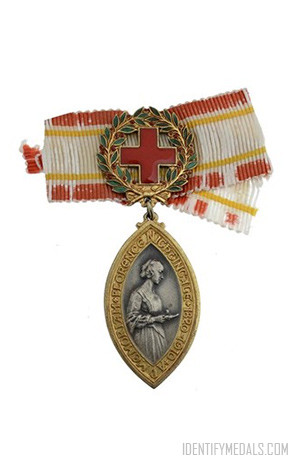
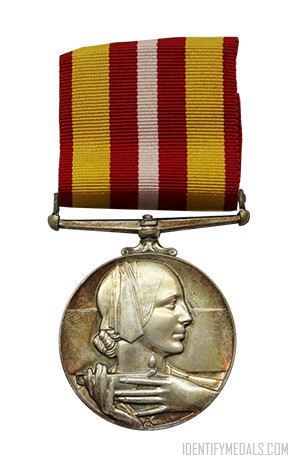
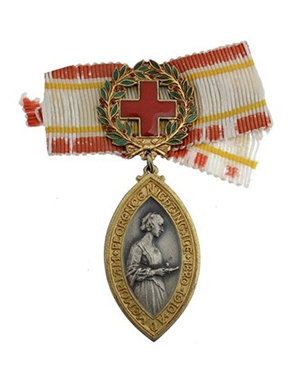
The vesica piscis-shaped medal is composed of gold and silver-gilt and bears, on the obverse, a portrait of Florence Nightingale surrounded by the words ‘Ad memoriam Florence Nightingale 1820-1910‘.

On the reverse, the name of the recipient and the date of the award are engraved, surrounded by the inscription ‘Pro vera misericordia et cara humanitate perennis décor universalis‘ (‘true and loving humanitarianism – a lasting general propriety‘).

The medal is attached to a white and red ribbon by a clasp featuring a red enamel cross encircled by a green laurel crown.

Recipients are also presented with a parchment diploma of the award and, from 1927, a miniature version of the medal that could be more easily worn. 

Find Red Cross Medals Online

More Red Cross Medals

The Inter Allied Victory Medal (Romania)

The Romanian Victory Medal was awarded to those who had taken part in a battle between 28 August 1916 and 31 March 1921 or served as a medic.

  • Time Period: World War I
  • Institution: 1919
  • Country: Romania

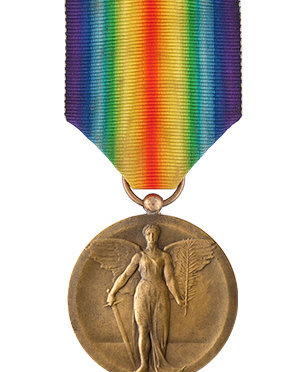
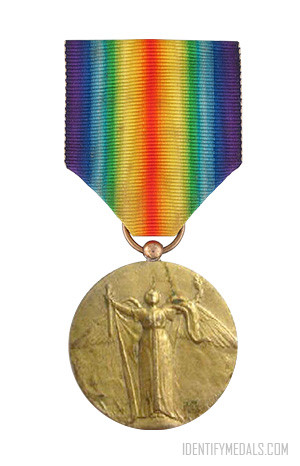
The Allied Victory Medal was recommended by an inter-allied committee in March 1919. Fourteen victorious countries finally awarded the medal after World War I, and each allied nation would design a ‘Victory Medal’ for award to their own nationals. Certain features were to be shared: a winged figure of Victory on the obverse and the same ribbon.
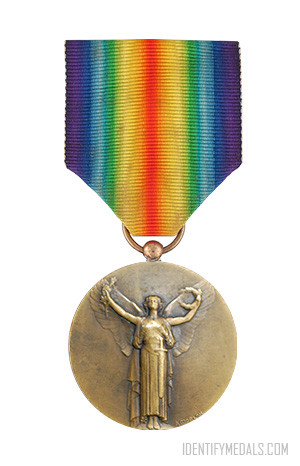
To qualify for the Romanian Victory Medal, recipients of any rank had to be mobilized for war service and to have taken part in a battle between 28 August 1916 and 31 March 1921, or to have served as an army medic. Also included were the combatants from the Hungarian–Romanian War.

The Romania Inter-Allied Victory Medal Design

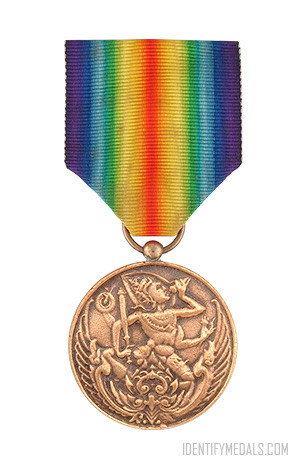
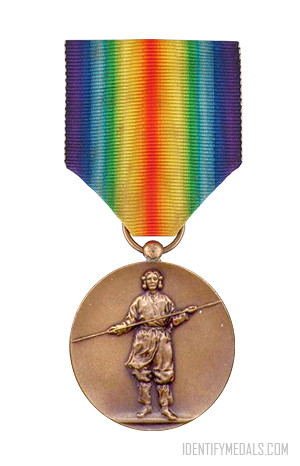
The Victory Medal measures 36 millimetres (1.4 in) in diameter and was designed by William McMillan. The design and ribbon was also adopted by Belgium, Brazil, Cuba, Czechoslovakia, France, Greece, Italy, Japan, Portugal, Romania, Siam, Union of South Africa and the USA. Each allied nation would design a ‘Victory Medal’ for award to their own nationals, all issues having certain common features, including a winged figure of victory on the obverse and the same ribbon.
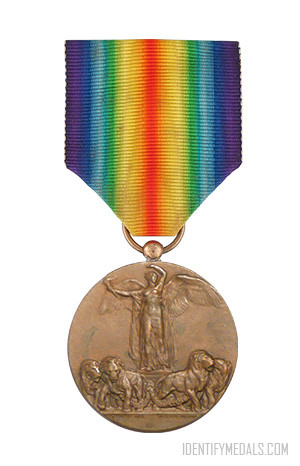
The obverse of the Romanian medal was selected from a set of proposals submitted to an international jury. The jury selected the design of Lt. Col. Constantin Kristescu, who was also put in charge of its sculpting. The medal was manufactured in Paris, where Kristescu used to work with La Maison Arthus-Bertrand.

The reverse shows the words ‘THE GREAT / WAR FOR / CIVILISATION / 1914-1919’ surrounded by a laurel wreath.

The 39 millimeters (1.5 in) wide watered ribbon has an iridescent color scheme, with the violet moving through to a central red stripe where both schemes meet. It attaches to the medal through a ring suspender. The recipient’s name, rank, service number and unit were impressed on the edge of the medal. The name of the regiment or corps was omitted on medals awarded to Army officers.

All the Inter-Allied Victory Medal Variations

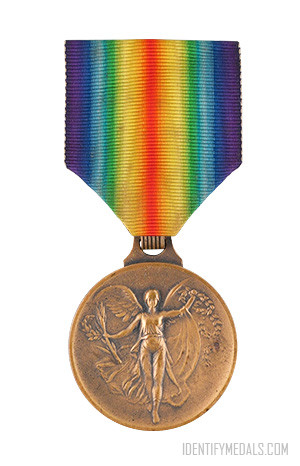
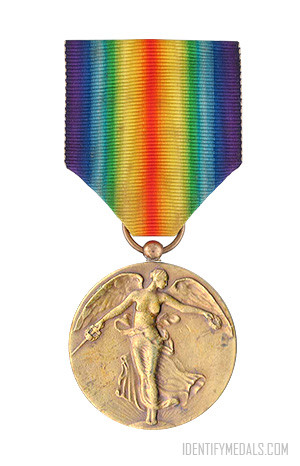
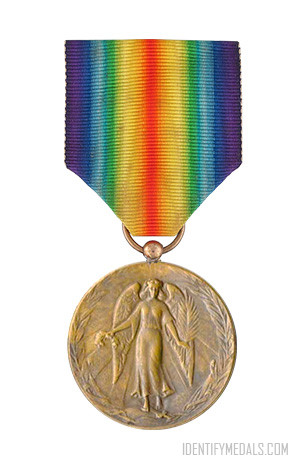
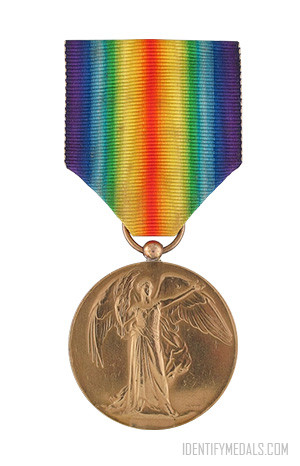
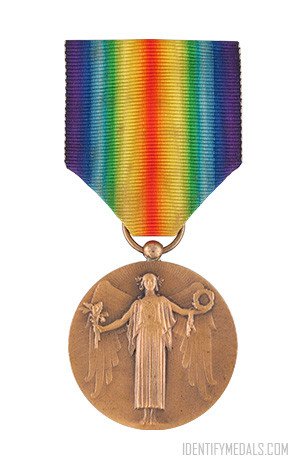
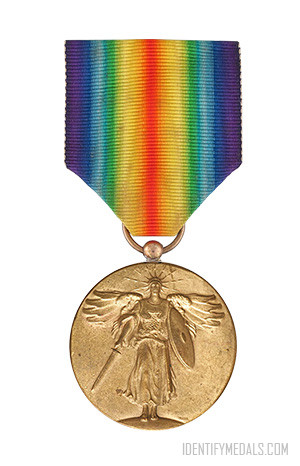
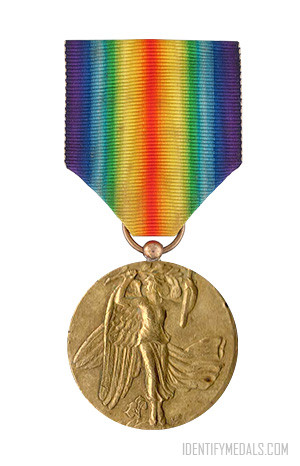
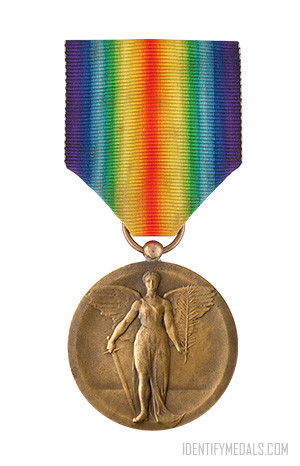
Although each country designed its own version of the Inter-Allied Victory Medal, all of them shared some common elements, such as a winged victory figure on the obverse and a similar ribbon with rainbow colors symbolizing unity among the Allies. Here are the versions for all countries:

Find an Inter-Allied Victory Medal Online

Right Now on eBay 
Clicking a link to eBay may result in a referral commission being paid if a purchase is made.
Loading...

The Inter Allied Victory Medal (Cuba)

The Cuban Victory Medal was awarded to all military personnel or civilians who have been employed in war service between 1917 and 1919.

The Allied Victory Medal was recommended by an inter-allied committee in March 1919. Fourteen victorious countries finally awarded the medal after World War I, and each allied nation would design a ‘Victory Medal’ for award to their own nationals. Certain features were to be shared: a winged figure of Victory on the obverse and the same ribbon.
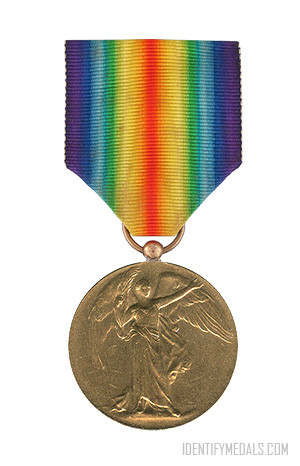
The President of the United States of Brazil, adopted the proposal of Marshal Foch in January 24, 1919 so that all the fighters of the Great War received a commemorative medal.

The Cuba Inter-Allied Victory Medal Design

The Victory Medal measures 36 millimetres (1.4 in) in diameter and was designed by William McMillan. The design and ribbon was also adopted by Belgium, Brazil, Cuba, Czechoslovakia, France, Greece, Italy, Japan, Portugal, Romania, Siam, Union of South Africa and the USA. Each allied nation would design a ‘Victory Medal’ for award to their own nationals, all issues having certain common features, including a winged figure of victory on the obverse and the same ribbon.
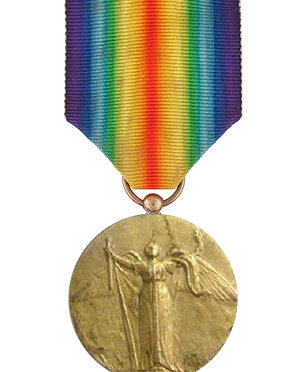
The obverse of the Cuban Victory Medal featured a symbolic figure of Victoria with her hands up on a plain background.

The reverse shows the words ‘THE GREAT / WAR FOR / CIVILISATION / 1914-1919’ surrounded by a laurel wreath.

The 39 millimeters (1.5 in) wide watered ribbon has an iridescent color scheme, with the violet moving through to a central red stripe where both schemes meet. It attaches to the medal through a ring suspender. The recipient’s name, rank, service number and unit were impressed on the edge of the medal. The name of the regiment or corps was omitted on medals awarded to Army officers.

All the Inter-Allied Victory Medal Variations

Although each country designed its own version of the Inter-Allied Victory Medal, all of them shared some common elements, such as a winged victory figure on the obverse and a similar ribbon with rainbow colors symbolizing unity among the Allies. Here are the versions for all countries:

Find an Inter-Allied Victory Medal Online

Right Now on eBay 
Clicking a link to eBay may result in a referral commission being paid if a purchase is made.
Loading...

The Cross of Charity or Mercy

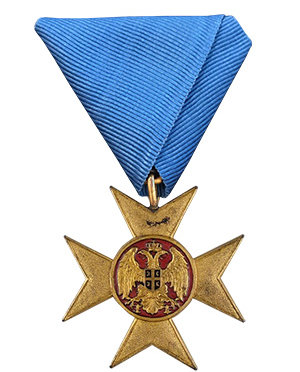
The Cross of Charity or Mercy is a decoration established in the Kingdom of Yugoslavia by King Peter I of Serbia on 7 (19) June 1913. Peter I was the king of Serbia during a period of great Serbian military success, he was remembered by the Serbian people as King Peter the Liberator, and also known as Old King.

The medal was to be awarded to men or women in or out of the military who aided victims of the 1912-13 First Balkan War (which lasted from October 8, 1912 to May 30, 1913), the sick and wounded. It could be awarded to Serbians and non-Serbians alike, to military and civilians, and to Red Cross volunteers. 

During the Balcan War, foreign awards could be granted for service in a red cross or medical capacity. Many women who served with the French or the Serbs were awarded decorations, although there is no gazette entry for them.

The Cross of Charity or Mercy Design

The Cross was manufactured by Arthus Bertrand of Paris and Huguenin Frères of Le Locle, Switzerland. It is made in bronze gilt maltese cross with a loop for ribbon suspension and red and black enamels and measures 39.7 mm.

The obverse bears a central circular red enamel medallion with the inscription in gilt letters ‘For Mercy‘ and circumscribed “For Tending the Wounded and the Sick 1912″.

The reverse shows the Serbian royal arms and the eagle with a fleur de lis beneath its claws.

Men and women versions of this medal are differentiated only by the suspension; a classical light-blue triangular one for men, and a ribbon in a bow shape of the same color for women (although this was not always the case).

The Cross for Loyalty to the Assassinated President Venustiano Carranza

The Cross for Loyalty to Carranza is a medal issued during 1910 and 1920 when control of Mexico’s government was attempted by several parties. 

The Cross for Loyalty to the Assassinated President Venustiano Carranza is a medal issued during the early years of the twentieth century, between 1910 and 1920 when control of Mexico’s government was attempted by several parties.

The United States involvement in the Mexican Revolution was varied and seemingly contradictory, first supporting and then repudiating Mexican regimes during the period 1910-1920. For both economic and political reasons, the U.S. government generally supported those who occupied the seats of power, whether they held that power legitimately or not.

When Francisco I. Madero was elected president in October 1911, the U.S. president was a lame duck. The U.S. Ambassador to Mexico, Henry Lane Wilson was initially sympathetic to the new regime, but quickly came into conflict with it. Ambassador Wilson conspired with General Victoriano Huerta to oust Madero.

The United States government under newly inaugurated president Woodrow Wilson refused to recognize Huerta’s government and sent troops to occupy Veracruz. President Wilson’s government recognized the government of Venustiano Carranza in 1915.

The Cross for Loyalty to the Assassinated President Venustiano Carranza Design

The Cross for Loyalty is typically designed in the shape of a cross, which is a common motif for many military medals and decorations. At the center of the cross, there is usually a circular medallion. This medallion features a depiction of President Venustiano Carranza. The image of Carranza may vary in detail but typically includes his profile or bust.

Around the outer edge of the central medallion, there may be an inscription. This inscription may include Carranza’s name, title, and dates of birth and death, as well as the words “Por la Lealtad” (For Loyalty) or similar phrases. The cross often has arms that radiate outward from the central medallion, creating a cross-like shape. These arms are usually plain but may sometimes feature decorative elements or symbols.

The medal is typically suspended from a ribbon that allows it to be worn around the neck or pinned to a uniform. The ribbon’s color and design may vary but often incorporate the national colors of Mexico, which are green, white, and red.