The Cross for the Defenders of Veracruz

The Cross for the Defenders of Veracruz is a medal issued 1910-1920 when control of Mexico’s government was attempted by several parties. 

The Cross for the Defenders of Veracruz is a medal issued during the early years of the twentieth century, between 1910 and 1920 when control of Mexico’s government was attempted by several parties.

The United States involvement in the Mexican Revolution was varied and seemingly contradictory, first supporting and then repudiating Mexican regimes during the period 1910-1920. For both economic and political reasons, the U.S. government generally supported those who occupied the seats of power, whether they held that power legitimately or not.

When Francisco I. Madero was elected president in October 1911, the U.S. president was a lame duck. The U.S. Ambassador to Mexico, Henry Lane Wilson was initially sympathetic to the new regime, but quickly came into conflict with it. Ambassador Wilson conspired with General Victoriano Huerta to oust Madero.

The United States government under newly inaugurated president Woodrow Wilson refused to recognize Huerta’s government and sent troops to occupy Veracruz. President Wilson’s government recognized the government of Venustiano Carranza in 1915.

The Cross for the Defenders of Veracruz Design

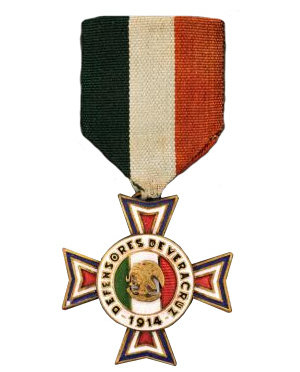
Like many Mexican military decorations, the Cross for the Defenders of Veracruz is typically designed in the shape of a cross. The cross shape is a common motif for such awards. At the center of the cross, there is usually a circular medallion. This medallion often features the image of a Mexican soldier or a patriotic symbol associated with the defense of Veracruz. The image may vary in detail but generally represents the valor and dedication of those who defended the city.

Around the outer edge of the central medallion, there may be an inscription. This inscription typically includes the words “Defensores de Veracruz” (Defenders of Veracruz) or similar phrases, highlighting the purpose and significance of the decoration. The cross often has arms that radiate outward from the central medallion, creating a cross-like shape. These arms are usually plain but may sometimes feature decorative elements or symbols.

The medal is typically suspended from a ribbon that allows it to be worn around the neck or pinned to a uniform. The ribbon’s color and design may vary but often incorporate patriotic colors, such as green, white, and red, which are the national colors of Mexico. At the top of the medal, there is a small ring or loop through which a ribbon or chain is threaded to allow for wearing or display.

The Cross for Revolutionary Merit 1913-14

The Cross of Revolutionary Merit is a medal issued during 1910 and 1920 when control of Mexico’s government was attempted by several parties. 

The Cross of Revolutionary Merit is a medal issued during the early years of the twentieth century, between 1910 and 1920 when control of Mexico’s government was attempted by several parties.

The United States involvement in the Mexican Revolution was varied and seemingly contradictory, first supporting and then repudiating Mexican regimes during the period 1910-1920. For both economic and political reasons, the U.S. government generally supported those who occupied the seats of power, whether they held that power legitimately or not.

When Francisco I. Madero was elected president in October 1911, the U.S. president was a lame duck. The U.S. Ambassador to Mexico, Henry Lane Wilson was initially sympathetic to the new regime, but quickly came into conflict with it. Ambassador Wilson conspired with General Victoriano Huerta to oust Madero.

The United States government under newly inaugurated president Woodrow Wilson refused to recognize Huerta’s government and sent troops to occupy Veracruz. President Wilson’s government recognized the government of Venustiano Carranza in 1915.

The Cross for Revolutionary Merit 1910-11

The Cross of Revolutionary Merit is a medal issued during 1910 and 1920 when control of Mexico’s government was attempted by several parties. 

The Cross of Revolutionary Merit is a medal issued during the early years of the twentieth century, between 1910 and 1920 when control of Mexico’s government was attempted by several parties.

The United States involvement in the Mexican Revolution was varied and seemingly contradictory, first supporting and then repudiating Mexican regimes during the period 1910-1920. For both economic and political reasons, the U.S. government generally supported those who occupied the seats of power, whether they held that power legitimately or not.

When Francisco I. Madero was elected president in October 1911, the U.S. president was a lame duck. The U.S. Ambassador to Mexico, Henry Lane Wilson was initially sympathetic to the new regime, but quickly came into conflict with it. Ambassador Wilson conspired with General Victoriano Huerta to oust Madero.

The United States government under newly inaugurated president Woodrow Wilson refused to recognize Huerta’s government and sent troops to occupy Veracruz. President Wilson’s government recognized the government of Venustiano Carranza in 1915.

The Congressional Gold Medal

The Congressional Gold Medal is an award bestowed by the Congress and one of the three highest civilian awards in the United States. 

Institution: 1776
Country: United States
 

The Congressional Gold Medal is an award bestowed by the United States Congress and one of the three highest civilian awards in the United States. Alongside the Presidential Medal of Freedom, it’s the oldest and highest American civilian award.

The medal is awarded to persons “who have performed an achievement that has an impact on American history and culture that is likely to be recognized as a major achievement in the recipient’s field long after the achievement.”

The tradition within the U.S. Congress of awarding gold medals as a form of recognition originated during the American Revolution, initially bestowed upon military personnel. Over time, this practice expanded to include individuals from various professions and, in the late 20th century, even groups. 

At the time of writing this, there have been 184 Congressional Gold Medals awarded.

How the Congressional Gold Medal is Awarded

There are no permanent statutory provisions for the creation of Congressional Gold Medals. When one has been deemed appropriate, Congress has, by legislative action, provided for the creation of a medal on an ad hoc basis.

Since the American Revolution, Congress has commissioned gold medals as its highest expression of national appreciation for distinguished achievements and contributions. The medal was first awarded in 1776 by the Second Continental Congress to General George Washington.

Although the first recipients were military figures who participated in the American Revolution, the War of 1812 and the Mexican–American War, Congress broadened the scope of the medal to include actors, authors, entertainers, musicians, pioneers in aeronautics and space, explorers, lifesavers, notables in science and medicine, athletes, humanitarians, public servants, and foreign recipients.

The medal is normally awarded to persons, but in 1979 the American Red Cross became the first organization to be honored with a gold medal. U.S. citizenship is not a requirement.

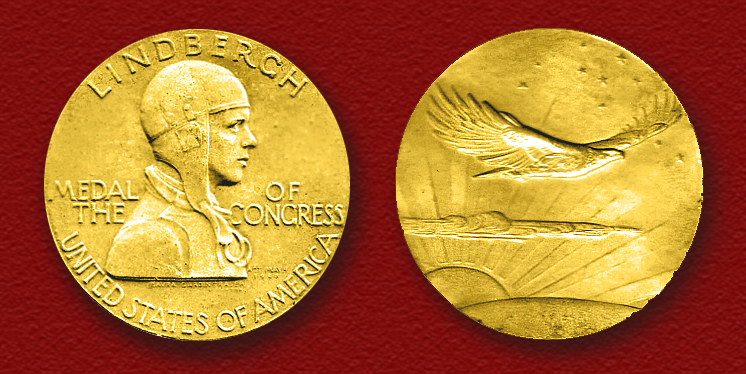
Medal awarded to Charles A. Lindbergh in 1930
Medal awarded to Charles A. Lindbergh in 1930. Image courtesy of Wikipedia.

The Congressional Gold Medal Design

A Congressional Gold Medal is designed by the United States Mint to commemorate the person and achievement for which the medal is awarded specifically. Medals are therefore different in appearance, and there is no standard design.

Congressional Gold Medals are considered non-portable, meaning that they are not meant to be worn on a uniform or other clothing but rather displayed. In rare instances, miniature versions have been made or converted for wear on clothing suspended from a ribbon.

Often, bronze versions of the medals are struck for sale by the U.S. Mint, and may be available in both larger and smaller sizes.

Find This Medal Online

Right Now on eBay 
Clicking a link to eBay may result in a referral commission being paid if a purchase is made.
Loading...

The Military Medal (Spain)

The Military Medal (or Medalla Militar) is a high military award of Spain to recognize battlefield bravery.

The medal was established in 1918 by Alfonso XIII of Spain. Since then it is awarded to members of the Spanish military service independent of rank.

Among notable recipients are:

  • Emilio Mola
  • Adolf Galland (Condor Legion)
  • Mohamed Meziane
  • Werner Mölders (Condor Legion)
  • Walter Oesau (Condor Legion)
  • Wilhelm Ritter von Thoma (Condor Legion)
  • Wolfram Freiherr von Richthofen (Condor Legion)
  • Philippe Pétain (Commander-in-Chief of French Forces)

The Military Medal Design

The order is worn, in all uniforms, in normal size and highlighted above all other decorations, except the Laureate Cross. Additional awards are denoted by golden clasps with relevant inscription.

The medal is struck in silvered bronze andmeasures 42mm.

The Insignia for Wounded Civilians

The Insignia for wounded civilians (Insigne des blessés civils) is a French distinction for civilians injured or maimed as a result of war.

The Insignia for wounded civilians (or Insigne des blessés civils) is a French distinction for civilians, irrespective of age or sex, who have been injured or maimed as a result of war.

It was Maurice Barres, defender of the National Federation of the Disabled and President of the League of Patriots, to whom the idea of the creation of the Badge Wounded. In 1915, he launched a first call in the columns of the newspaper “L’Echo de Paris” on 28 March and another in the issue of June 10, for the creation of this distinctive insignia to designate the eyes of all “un homme dont les blessures, l’infirmité, la maladie proviennent d’un fait de guerre” (“a man whose injury, disability, illness comes from an act of war”).

On July 18, 1918, a decree made at the initiative of Minister of the Interior, which instituted a lapel pin for civilian victims of war. This award is presented:

  • for World War I 1914-1918, by order of the Minister of Interior after consulting a board meeting at Head of the department of residence of the candidate.
  • for World War II 1939-1945, by the Minister of Veterans and War Victims, the candidate must be a pensioner or civilian casualties of war.

La Grande Chancellerie de la Légion d’honneur does not recognize this medal, or the military version, as an official decoration, therefore it is not mentioned on any order of precedence list. However, in view of the importance it can have many of its owners, it is widely worn.

The Insignia or Wounded Civilians Design

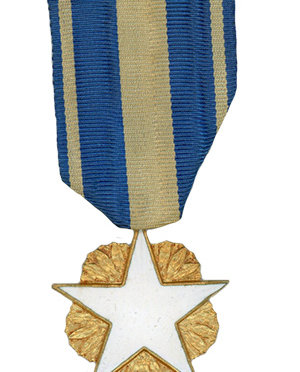
Currently, the most commonly worn medal is uniface of gilt bronze, 30 mm in diameter and consists of a white enamel star encircled by a wreath of oak and laurel leaves.

The medal hangs from a ribbon of blue and yellow. When the ribbon bar is worn alone it containts a white star clasp.

The Combatant’s Cross

The Combatant’s Cross (or “Croix du combattant”) is a French decoration that recognizes those who fought in combat for France.

The Combatant’s Cross (or “Croix du combattant”) is a French decoration that recognizes, as its name implies, those who fought in combat for France.

The Poilus (French combat soldiers) of World War I worked toward recognition by the government, of special status to those who had participated in the bitter fighting of 1914-1918 (as opposed to those who served behind the lines). The law of 19 December 1926 created la “carte du combatant”, or combatant’s card, for veterans of 1914-1918, as well as for the veterans of 1870-1871 and colonial wars before the First World War. The decoration was created only three years later by the law of 28 June 1930.

A decree of January 29, 1948 states that the provisions of the 1930 Act relating to the allocation of the combatant’s card and the Combatant’s Cross were applicable to participants of the 1939-1945 war. The law of 18 July 1952 extended the benefit of the award of the Croix du combattant for Indochina and Korea and the law of December 9, 1974 extended the award of the Combatant’s Cross to operations in North Africa between 1 January 1952 and July 2, 1962.

The Cross is awarded in different cases:

– for service with a unit asserted as combattant unit (front-line service) by the Ministry of Defense: ninety days of service or a wound or illness received or contracted during service, or ninety days of detention by the enemy.

– for service with any unit: mention in dispatches for valor, or direct participation in five fire engagements, or a wound in action, or detention by the enemy without application of the Geneva Convention.

The Combatant’s Cross Design

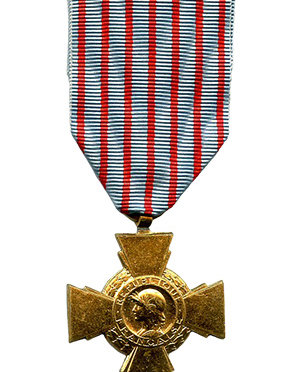
The medal is a 36 mm wide bronze cross pattée with a laurel wreath between the arms 36 mm across.

On the obverse at center, the effigy of the Republic wearing an Adrian’s helmet crowned with laurel leaves surrounded by the relief inscription REPUBLIQUE FRANCAISE (FRENCH REPUBLIC).

On the reverse the relief inscription CROIX DU COMBATTANT (COMBATTANT’S CROSS) along the lower circumference framing a vertical sword pointing down, rays protruding horizontally and up from the hilt in a 180° arc.

The Volunteer Combatant’s Cross 1914-1918

The Volunteer combatant’s cross 1914–1918 is a French decoration for those who have volunteered to serve in a unit during World War I.

The Volunteer combatant’s cross 1914–1918 (or “Croix du Combattant Volontaire 1914–1918”) is a French decoration that recognizes those who have volunteered to serve on the front in a combat unit during World War I.

When the 1914–1918 Commemorative war medal (France) was established, it was anticipated that a clasp bearing “ENGAGÉ VOLONTAIRE” (“VOLUNTEER ENLISTEE”) would be worn on its ribbon for those who had freely and voluntarily enlisted in the French Armed Forces for combat service. This clasp was produced, however it was short-lived due to parliament demanding the establishment of a special insignia to distinguish the special merit of the voluntary combatant.

The Act of 4 July 1935 created the Croix du Combattant Volontaire, designated for those who volunteered to serve on the front in a combat unit during the Great War.

The qualifications of the candidates have been reviewed by a panel from 1951, twelve members as follows:

  • Minister of National Defence: Chairman;
  • Secretary of State for War: two members;
  • Secretary of State for the Navy: two members;
  • Secretary of State for Air: two members;
  • Office national des mutilés et combattants: two members;
  • Association d’engagés et de combattants volontaires: three members.

The decree of 10 April 1936 extended the award to the few surviving volunteer firefighters from the War of 1870–1871.

The Volunteer Combatant’s Cross 1914-1918 Design

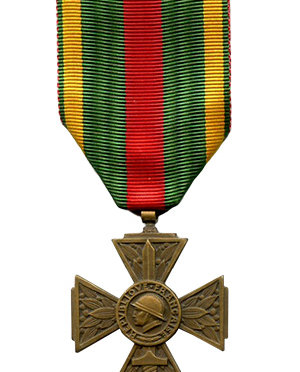
The cross has four arms in bronze and measures 36 mm wide. It is engraved by Frédéric de Vernon.

On the obverse is a round central medallion with the legend surrounding REPUBLIQUE FRANCAISE. Effigy of a helmeted Poilu (World War I infantryman), on a sword drawn vertically on the branches, or of the cross being charged with bay leaves and oak leaves in relief.

On the reverse, inside the central medallion, is a branch of laurel is surrounded by the inscription: COMBATTANT VOLONTAIRE 1914–1918. The cross arms are covered with leaves of laurel and oak forming relief.

A special version was made for the volunteer fighters from the war of 1870–1871 with the dates 1870–1871 on the back replacing those of 1914–1918.

The Escapees’ Medal

The Escapees’ Medal is a military award bestowed to prisoners of war and who successfully escaped internment or died in their attempt.

The Escapees’ Medal (or Médaille des Évadés) is a military award bestowed by the government of France to individuals who were prisoners of war and who successfully escaped internment or died as a result of their escape attempt.

The “Escapees’ Medal” was established by a 1926 law, intended to honor combatants not only of the First World War, but also of the Franco-Prussian War of 1870. Its statute was later amended to include combatants of the Second World War and later conflicts.

The award criteria for the Franco-Prussian War was established by law on 2 October 1926 and read as follows:

  • To French soldiers serving during the Franco-Prussian War, who successfully escaped their internment in Germany.

The award criteria for the First World War were established by decree on 7 April 1927 and read as follows:

  • To French soldiers serving during the First World War, who were taken prisoner during combat either in Europe or in an external theatre of operations, and who successfully escaped, regardless of the length of their internment;
  • To citizens of Alsace-Lorraine, who, between 2 August 1914 and 1 November 1918, deserted from the German army.
  • To civilians interned in Germany, or living in territories occupied by the enemy, who crossed enemy lines with the intent of making themselves available to the French military authority.

The award criteria for the Second World War were long in coming. A decree of 7 February 1959 allowed for award of the medal, followed by an Order on 20 May 1959 and detailed instructions on 10 July 1959. The medal was bestowed to persons able to prove a successful escape:

  • From a prisoner of war camp;
  • From a place of internment where they were being held for acts related to the resistance;
  • From enemy-held or controlled territory, an escape including the clandestine crossing of a front line or customs checkpoint.

The medal can be awarded to both French citizens and foreign nationals serving in the ranks of the French armed forces. Civilians and members of the military killed, or who have died as a result of wounds received during an escape attempt, are automatically awarded the medal.

The Escapee’s Medal Design

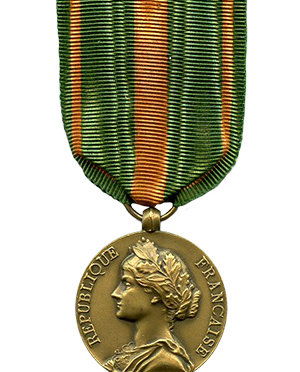
The Escapees’ Medal is a 30 mm in diameter circular medal struck from bronze. Its design is from the French engraver A. Dubois.

Its obverse bears the relief left profile bust of Marianne (representing the French Republic) crowned with branches of oak, along the outer circumference, the relief inscription (REPUBLIQUE FRANCAISE) “FRENCH REPUBLIC”.

On its reverse, at center, the relief inscription on three rows (MÉDAILLE DES ÉVADÉS) (ESCAPEES’ MEDAL) surrounded by a wreath of oak branches.

The medal is suspended by a ring through the suspension loop to a 36 mm wide green silk moiré ribbon with a 7 mm wide central orange stripe and 2 mm wide longitudinal orange stripes located 2 mm from the ribbon’s outer edges.

The War Cross 1914-1918

The War Cross 1914-1918 (Croix de guerre) is a French military decoration for French and allied soldiers for valorous service during WW1.

The War Cross 1914-1918 (or Croix de guerre 1914–1918) is a French military decoration created to recognize French and allied soldiers who were cited for valorous service during World War I, similar to the British mentioned in dispatches but with multiple degrees equivalent to other nations’ decorations for courage.

Soon after the outbreak of World War I, French military officials felt that a new military award had to be created. At that time, the Citation du jour (“Daily Citation”) already existed to acknowledge soldiers, but it was just a sheet of paper. At the end of 1914, General Boëlle, Commandant in Chief of the French 4th Army Corps, tried to convince the French administration to create a formal military award. Maurice Barrès, the noted writer and parliamentarian for Paris, gave Boëlle support in his efforts.

Every Croix de guerre awarded carries at least one citation for gallantry or courage to a member of any rank of the French military or of an allied army. Ribbon devices indicate the importance or degree of the soldier’s role during the action cited.

The Croix de guerre 1914-1918 was attributed to:

  • French and allied soldiers individually cited for a wartime act of gallantry;
  • Civilians and militarized personnel individually cited for a wartime act of gallantry;
  • Automatically to soldiers and civilians not specifically cited for a Croix de guerre but awarded the Légion d’honneur or Médaille militaire for the highest acts of wartime valour and gazetted in the Official Journal of the French Republic;
  • Collectively, to army units, ships or air squadrons;
  • To cities and villages, martyrs of war, destroyed, ravaged or bombed by the enemy (2952 towns received the Croix de guerre 1914-1918, in this case, always awarded with palm).

The War Cross 1914-1018 Design

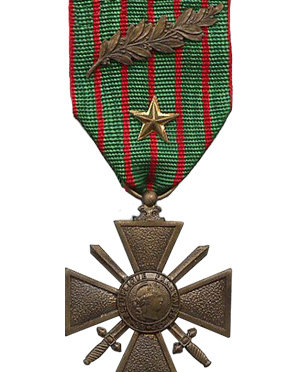
The cross was designed by the sculptor Paul-Albert Bartholomé. It is 37 mm wide, Florentine bronze cross pattée, with two crossed swords pointing up between the arms.

The obverse center medallion bears the relief image of the French Republic in the form of the bust of a young woman wearing a Phrygian cap surrounded by the circular relief inscription RÉPUBLIQUE FRANCAISE (FRENCH REPUBLIC). Not knowing how long the war would last, the reverse centre medallion bears the dates 1914–1915, 1914–1916, 1914–1917 and finally 1914–1918.

The cross is suspended by a ring through a suspension loop cast atop the upper cross arm. It hangs from a 37 mm wide green silk moiré ribbon with seven narrow 1,5 mm wide vertical red stripes evenly spaced and two 1 mm red edge stripes.

Find this Medal Online

Right Now on eBay 
Clicking a link to eBay may result in a referral commission being paid if a purchase is made.
Loading...