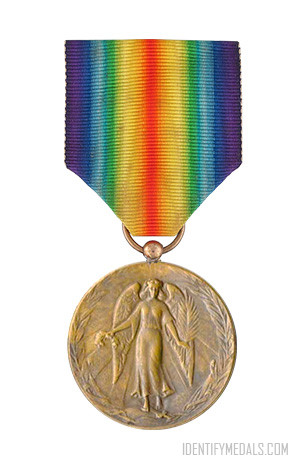
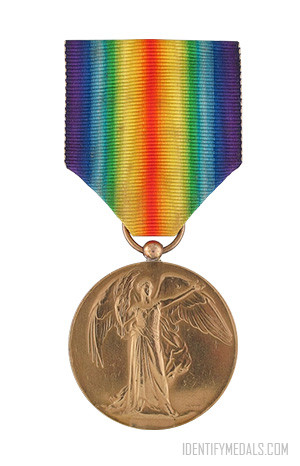
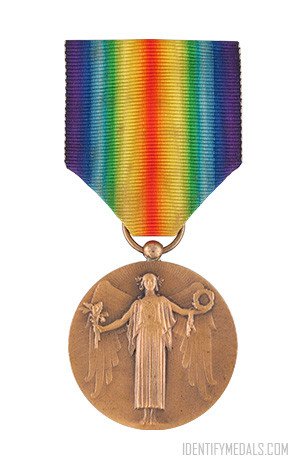
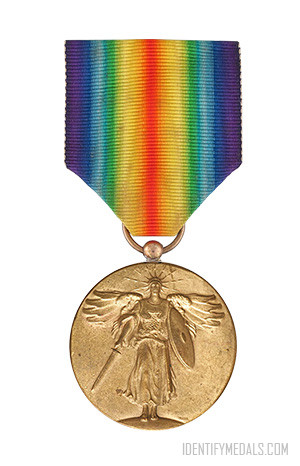
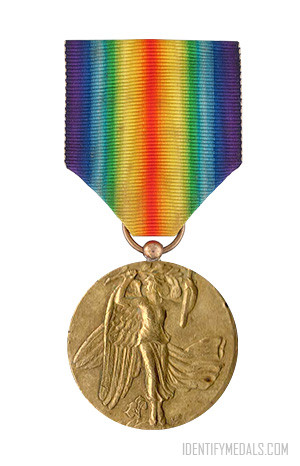
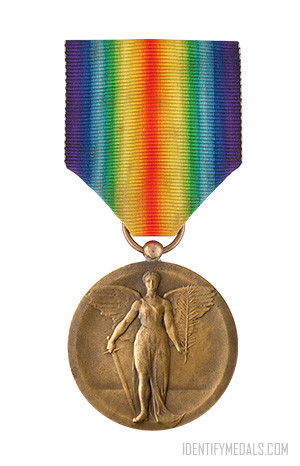
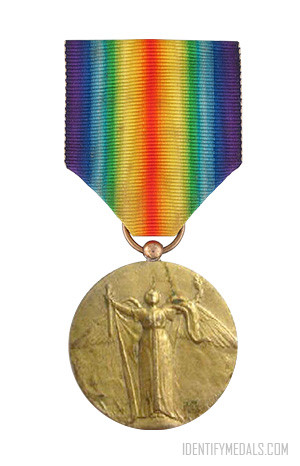
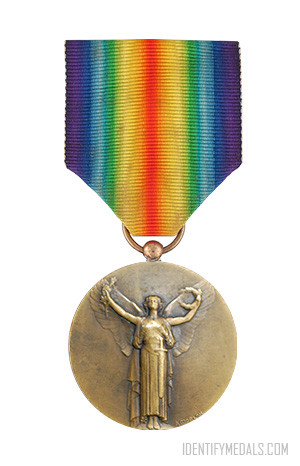
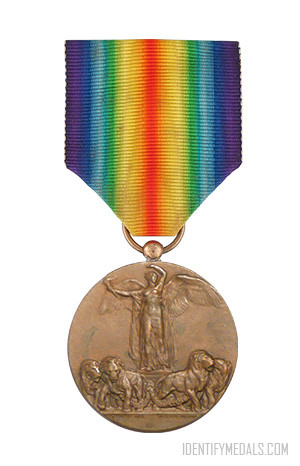
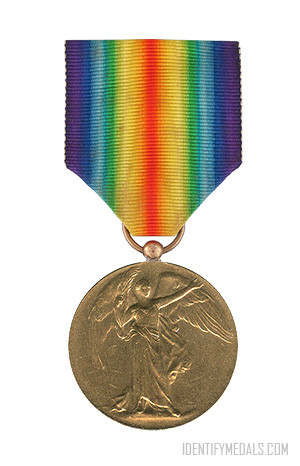

The Inter Allied Victory Medal (France)

The French Victory Medal was established on 20 July 1922 and awarded to all soldiers who served three months between 1914 and 1918.

The Allied Victory Medal was recommended by an inter-allied committee in March 1919. Fourteen victorious countries were finally awarded the medal after World War I, and each allied nation would design a ‘Victory Medal’ for award to their own nationals. Certain features were to be shared: a winged figure of Victory on the obverse and the same ribbon.

The French Victory Medal was established on 20 July 1922 and awarded to all soldiers who served three months between 2 August 1914 and 11 November 1918, as well as to civilian nurses, aliens who served directly under French command, Marshals and generals who had a command for at least three months, and prisoners of war from Alsace and Lorraine who then served in the French forces.

The France Inter-Allied Victory Medal Design

The Victory Medal measures 36 millimetres (1.4 in) in diameter and was designed by William McMillan. The design and ribbon was also adopted by Belgium, Brazil, Cuba, Czechoslovakia, France, Greece, Italy, Japan, Portugal, Romania, Siam, Union of South Africa and the USA. Each allied nation would design a ‘Victory Medal’ for award to their own nationals, all issues having certain common features, including a winged figure of victory on the obverse and the same ribbon.

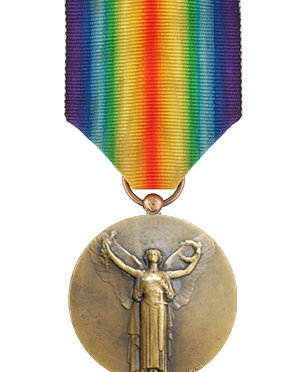
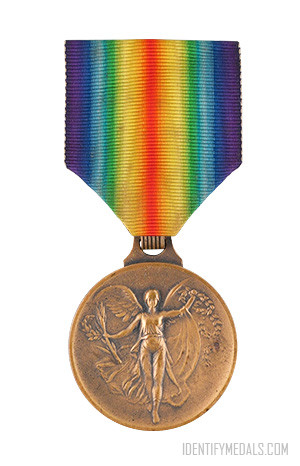
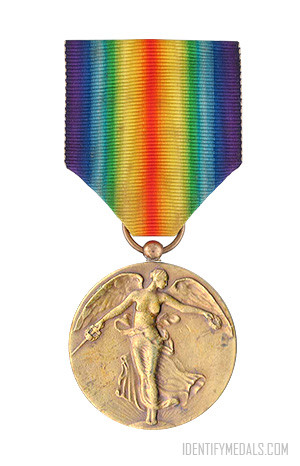
The obverse of the medal bears the winged, full-length and full-front figure of Victoria and the designer’s signature “A. Morlon”. The reverse reads “LA GRANDE GVERRE POUR CIVILISATION 1914-1919” and a Phrygian cap between the letters R. F.

The 39 millimeters (1.5 in) wide watered ribbon has an iridescent color scheme, with the violet moving through to a central red stripe where both schemes meet. It attaches to the medal through a ring suspender. The recipient’s name, rank, service number and unit were impressed on the edge of the medal. The name of the regiment or corps was omitted on medals awarded to Army officers.

All the Inter-Allied Victory Medal Variations

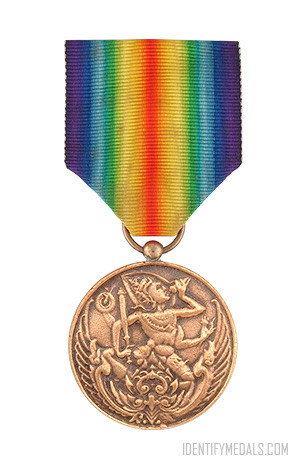
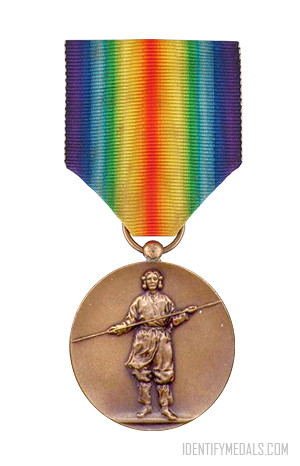
Although each country designed its own version of the Inter-Allied Victory Medal, all of them shared some common elements, such as a winged victory figure on the obverse and a similar ribbon with rainbow colors symbolizing unity among the Allies. Here are the versions for all countries:

Find an Inter-Allied Victory Medal Online

Right Now on eBay 
Clicking a link to eBay may result in a referral commission being paid if a purchase is made.
Loading...

The U-boat War Badge (WW1)

The U-boat War Badge was a German war badge that was awarded to U-boat (submarine) crew members during World War I and World War II.
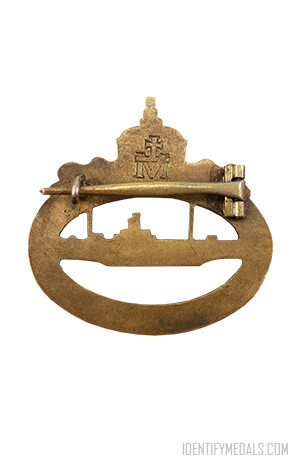
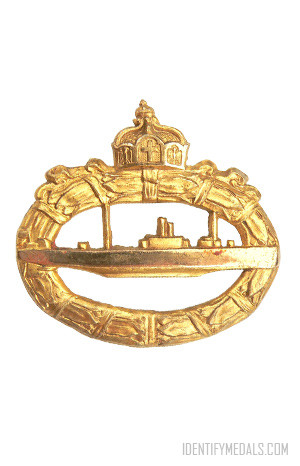
The U-boat War Badge (or U-Boot-Kriegsabzeichen in German) was a German war badge that was awarded to U-boat (submarine) crew members during World War I and also World War II. It was originally instituted during WW1 on February 1, 1918, to recognize U-boat crews who had completed three war patrols. 

The U-Boat War Badge Design

The badge was worn on the lower left side of the uniform and was oval shaped resembling a wreath of laurel leaves. On the obverse is a submarine laying across the center. The German State Crown is inlaid at the top center of the wreath.

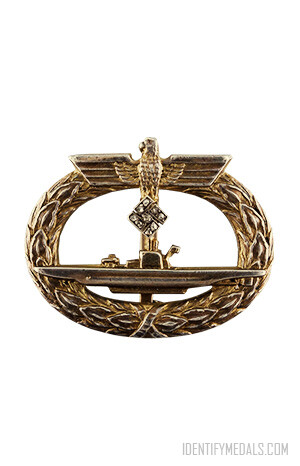
The 1939 version was very similar to the original badge with the exception of the imperial crown being replaced with a German Eagle above a swastika, and a more modernized submarine now facing towards the left was used.

The new version was first made of bronze metal, with later ones made of zinc with a “gold wash”.

More Variants of the U-Boat Badge

Imperial U-Boat Badge, reverse.
Imperial U-Boat Badge, reverse. The "M" is an original maker mark but the manufacturer is unknown.
The U-boat War Badge - German WW1 Medals & Badges
The WW1 U-boat War Badge - Obverse.
U-Boat Badge with diamonds, reverse.
German WW2 U-Boat Badge with diamonds. 1939 version, obverse.

Find an U-Boat War Badge

Right Now on eBay 
Clicking a link to eBay may result in a referral commission being paid if a purchase is made.
Loading...

The Order of the British Empire

The Most Excellent Order of the British Empire is a British order of chivalry that rewards charitable works and public service.

The Most Excellent Order of the British Empire is a British order of chivalry that rewards work with charitable and welfare organizations, contributions to the arts and sciences and public service outside the Civil service.

The Most Excellent Order of the British Empire was established on 4 June 1917 by King George V, and comprises five classes across both civil and military divisions. The most senior two of them make the recipient either a knight (male) or Dame (female).

The five classes of appointment to the Order are, in descending order of precedence:

  1. Knight Grand Cross or Dame Grand Cross of the Most Excellent Order of the British Empire (GBE)
  2. Knight Commander or Dame Commander of the Most Excellent Order of the British Empire (KBE or DBE)
  3. Commander of the Most Excellent Order of the British Empire (CBE)
  4. Officer of the Most Excellent Order of the British Empire (OBE)
  5. Member of the Most Excellent Order of the British Empire (MBE)

The senior two ranks of Knight or Dame Grand Cross, and Knight or Dame Commander, entitle their members to use the title of Sir for men and Dame for women before their forename.

The Order of the British Empire Medal Design

Members of the Order wear elaborate vestments on important occasions, which vary by rank: The mantle was originally made of yellow satin lined with blue silk but is now rose pink satin lined with pearl-grey silk. It’s worn only by Knights and Dames Grand Cross. The collar is made of gold and consists of six medallions depicting the Royal Arms, alternating with six medallions depicting the Royal and Imperial Cypher of George V (GRI, which stands for “Georgius Rex Imperator“) and is also worn by only Knights and Dames Grand Cross.

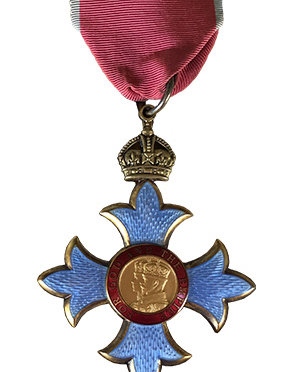
The star is an eight-pointed silver star worn pinned to the left breast and bearing a crimson ring with the motto of the Order inscribed. Within the ring, before 1937 a figure of Britannia was originally shown. Since then, the effigies of George V and Mary of Teck are shown instead.

The badge was, until 1937, suspended on a purple ribbon with a red central stripe for the military division. After 1937 the ribbon became rose-pink with pearl-grey edges, with the addition of a pearl-grey central stripe for the military division. The badge is in the form of a cross patonce, the obverse of which bears the same field as the star; the reverse bears George V’s Royal and Imperial Cypher. Both are within a ring bearing the motto of the Order. The size of the badges varies according to rank.

Find This Medal

Right Now on eBay 
Clicking a link to eBay may result in a referral commission being paid if a purchase is made.
Loading...

The Order of Vittorio Veneto

The military Order of Vittorio Veneto was founded as national order by Giuseppe Saragat in 1968 to express the gratitude of the nation.

The military Order of Vittorio Veneto was founded as a national order by the fifth President of the Italian Republic, Giuseppe Saragat, in 1968, “to express the gratitude of the nation” to those decorated with the Medal and Cross of War for Military Valour who had fought for at least six months in World War I and earlier conflicts.

Awarded in the single degree of Knight, a small annuity was granted in favor of those recipients who did not enjoy an income above their tax allowance, payable to the widow or minor children on death. The allowance was also granted to those that fought in the former Austro-Hungarian armed forces who became Italian citizens after annexation.

The order was bestowed by decree of the President of the Republic, its head, on the recommendation of the Minister of Defence. A Lieutenant General chaired the council, which screened applications made by eligible parties to the municipality of residence. With the death of the last surviving Knights of Vittorio Veneto in 2008, the order fell into abeyance and in 2010, it was formally wound up by repeal of the original legislation.

The Order of Vittorio Veneto Medal Design

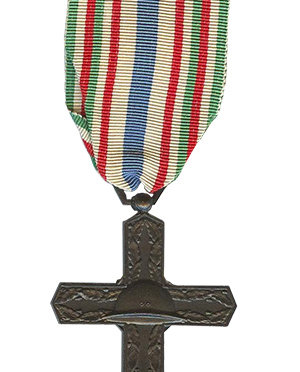
The Order of Vittorio Veneto Medal is made of bronze and shaped like a Greek cross with pointed ends to the arms.

The obverse shows a circular central medallion bearing the five-pointed star of the Italian Republic circumscribed ‘ORDINE VITTORIO VENETO’, the arms decorated with oak leaves.

The reverse is a circular central medallion bearing an Adrian helmet, the arms decorated with laurel leaves; on original ribbon.

Find This Medal

Right Now on eBay 
Clicking a link to eBay may result in a referral commission being paid if a purchase is made.
Loading...

The Silver Medal of Military Valor

Institution: 21 May 1793
Country: Italy

The Silver Medal of Military Valor (or Medaglia d’argento al valor militare in Italian) is a medal for gallantry.

Italian medals for valor were first instituted by Victor Amadeus III of Sardinia on 21 May 1793, with a gold medal, and, below it, a silver medal. These were intended for junior officers or common soldiers who had distinguished themselves in combat.

Although these medals fell into disuse during the period of Napoleonic domination, they were reinstated on 1 April 1815, by Victor Emmanuel I of Sardinia, who replaced them with the Military Order of Savoy (l’Ordine militare di Savoia), now known as the Military Order of Italy.

In 1833, Charles Albert of Sardinia re-instituted the medals for valor (gold and silver) as awards for noble acts performed by soldiers in both war and peace. During World War I, the medal was awarded to military personnel, units above the level of company and civilians for exceptional valor in the face of the enemy. During World War I, the medal was given out some 38,614 times for individual acts of heroism (compared to 368 Gold Medals and 60,244 Bronze medals). Thus, the Italian Silver Medal for Military Valor is equivalent in frequency and prestige to the British Military Cross, which was awarded some 40,253 times during World War I.

The Silver Medal of Military Valor Design

The Italian Silver Medal of Military Valor is made of silver. The medal measures 33.5 mm in diameter. On the obverse is engraved “VICARIOTTO CLAUDIO” in the centre, surrounded by the engraved inscription “COSTONE DI QUOTA 1940 – KONITZA (FRONTE GRECO) 14 NOV. 1940 XIX” on the reverse.

The Colonial Order of the Star of Italy

The Colonial Order of the Star of Italy was founded as a colonial order of knighthood on 18 June 1914 by King Victor Emmanuel III.

The Colonial Order of the Star of Italy (or Ordine coloniale della Stella d’Italia in Italian) was founded as a colonial order of knighthood on 18 June 1914 by King Victor Emmanuel III.

It was awarded to soldiers deployed to the colony of Libya. The order had fallen into abeyance by 1943, when Allied forces conquered the colonies of Italian North Africa. This marked the end of Italy’s colonial ambitions and the order’s active issuance.

The Colonial Order of the Star of Italy Medal Design

The Colonial Order of the Star of Italy medal is shaped like a star, with white, green and red enamel. The obverse shows the initial EV and the year 1911.

The Bronze Medal of Military Valor

Time Period: Pre World War I, World War I

Institution: 26 March 1833
Country: Italy

The Bronze Medal of Military Valor (or Medaglia di bronzo al valor militare in Italian) is a medal given for gallantry.

It was established by Charles Albert of Sardinia on 26 March 1833, along with the higher ranking Gold and Silver Medals for Military valor. Their purpose is defined as “To distinguish and publicly honor the authors of heroic military acts, even ones performed in time of peace, provided that the exploit is closely connected with the purposes for which the Armed Forces are constituted, whatever may be the condition or quality of the author.”

These medals, as well as the “Croce di Guerra al Valor Militare” (War Cross of Military Valor – which can only be awarded in time of war) are established by the Royal Decree of 4 November 1932.

During the First World War, the medal was given out some 60,244 times for individual acts of heroism (compared to 38,614 Silver medals and 368 Gold Medals).

The Bronze Medal of Military Valor Design

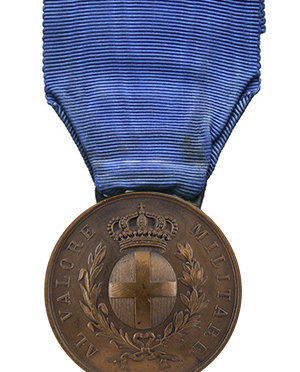
The Bronze Medal of Military Valor is shaped like an oval, with a blue ribbon. The medal is made of bronze.

The War Merit Cross

The Italian War Merit Cross (Croce al Merito di Guerra) was instituted by King Victor Emanuel III in 1918 and awarded to the armed forces.

The Italian War Merit Cross (Croce al Merito di Guerra) was instituted by the King Victor Emanuel III in 1918, and was awarded to members of the armed forces with a minimum of one year’s service who had been in contact with the enemy, or to those who, when mentioned for war merit, received a promotion.

If an act of valour was deemed insufficient for the Medal of Military Valour, the War Merit Cross could be awarded instead.

From its institution until 30 May 1927, 1,034,924 Crosses were issued.

The Italian War Merit Cross Design

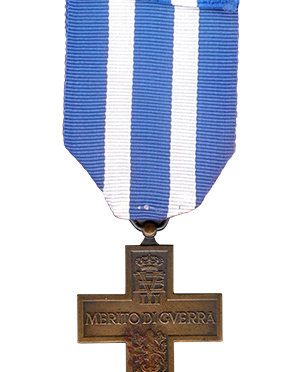
The War Merit Cross is made in bronze, it measures 38mm wide (1-1/2 inches) and has a blue ribbon. A second award was indicated by a bronze star on the ribbon. The reverse side of the medal bears a 5-pointed star on a background of rays, and the obverse shows the royal cypher (“VE III” under a crown) in the upper arm, with the words “MERITO DI GVERRA” (War Merit) on the horizontal arms and a Roman sword point upwards, on oak leaves, in the lower arm.

The Allied Victory Medal (Italy)

The Allied Victory Medal (Medaglia interalleata della vittoria) was the Italian variant of the Victory Medal of other nations.

The Allied Victory Medal (or Medaglia interalleata della vittoria, or Medaglia della vittoria commemorativa della grande guerra per la civiltà in Italian) was the Italian variant of the Victory Medal of other nations.

The Allied Victory Medal was established by royal decree number 1918 on 16 December 1920, and was awarded to all who had been given the “fatiche di guerra” distinction before, on 21 May 1916. It was also given to those who had served for four months in an area under the jurisdiction of the armed forces and who had been mobilized and directly worked with the operational army.

The Italy Inter-Allied Victory Medal Design

The Victory Medal measures 36 millimeters (1.4 in) in diameter and its obverse was designed by William McMillan. The design and ribbon was adopted by Great Britain, Belgium, Brazil, Cuba, Czechoslovakia, France, Greece, Italy, Japan, Portugal, Romania, Siam, Union of South Africa and the USA.

Each allied nation would design a ‘Victory Medal’ for award to their own nationals, all issues having certain common features, including a winged figure of victory on the obverse and the same ribbon.

The Italian medal’s design was done via public competition, which was won by Gaetano Orsolini. His design features the ‘Victory on a triumphal chariot, with the torch of liberty, drawn by four yoked lions’.

The obverse of the medal shows the winged, full-length, full-front, figure of ‘Victory‘ with her left arm extended and holding a palm branch in her right hand.

The 39 millimeters (1.5 in) wide watered ribbon has an iridescent color scheme, with the violet moving through to a central red stripe where both schemes meet. It attaches to the medal through a ring suspender. The recipient’s name, rank, service number and unit were impressed on the edge of the medal. The name of the regiment or corps was omitted on medals awarded to Army officers.

All the Inter-Allied Victory Medal Variations

Although each country designed its own version of the Inter-Allied Victory Medal, all of them shared some common elements, such as a winged victory figure on the obverse and a similar ribbon with rainbow colors symbolizing unity among the Allies. Here are the versions for all countries:

Find an Inter-Allied Victory Medal Online

Right Now on eBay 
Clicking a link to eBay may result in a referral commission being paid if a purchase is made.
Loading...

The Distinguished Service Cross

The Distinguished Service Cross is the second-highest United States Army military award and is given for extreme gallantry and risk of life.
The Distinguished Service Cross (or DSC) is the second-highest United States Army military award. It is given for extreme gallantry and risk of life in actual combat with an armed enemy force. This award was established by President Woodrow Wilson on January 2, 1918, during World War I.

The act or acts of heroism required for the Distinguished Service Cross must have been so notable and have involved risk of life so extraordinary as to set the individual apart from his or her comrades. These are of such degree that are above those required for all other U.S. combat decorations except the Medal of Honor.

While the Distinguished Service Medal is awarded to persons in recognition of service to the government, the Cross is only awarded for actions in combat.

The History of the Distinguished Service Cross

The award was first given during World War I, although a number of them were made for actions before WW1 to soldiers who had received a Certificate of Merit for gallantry. Others were belated recognition of actions in the Philippines during the Boxer Rebellion and on the Mexican Border.

During World War II, just over 5,000 awards were made. Only three men received the medal three times: Lieutenant Colonel John C. Meyer, Major General James A. Van Fleet, and Master Sergeant Llewellyn Chilson. A little over fifty soldiers and one sailor received two Distinguished Service Crosses in WW2.

Over 800 awards, over 300 posthumous, were given in the Korean War, and over 1,000 in the Vietnam War (almost 400 of which were posthumous).

The Distinguished Service Cross Design

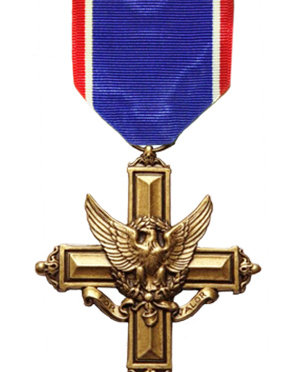
The Distinguished Service Cross award is a cross made of bronze and measures 2 inches in height and ​1 1316 inches in width.

The obverse shows an eagle in the center and a scroll below the eagle bearing the inscription “FOR VALOR.” On the reverse, the center of the cross is circled by a wreath with a space for engraving the name of the recipient. The Distinguished Service Cross was originally designed by J. Andre Smith, an artist employed by the United States Army during World War I.

During World War I, 6,309 awards of the Distinguished Service Cross were made to 6,185 recipients. In the aftermath of The Great War, 62 awards were made for actions in North Russia and Siberia during the Russian Civil War and approximately 132 retroactive awards were made for actions in previous conflicts. During World War II, just over 5,000 awards were made.

American Soldiers That Earned a
Distinguished Service Cross

Here are five individuals who earned the Distinguished Service Cross. They represent just a few examples of the many brave soldiers who have earned this award for their exceptional courage and selflessness in the face of danger.

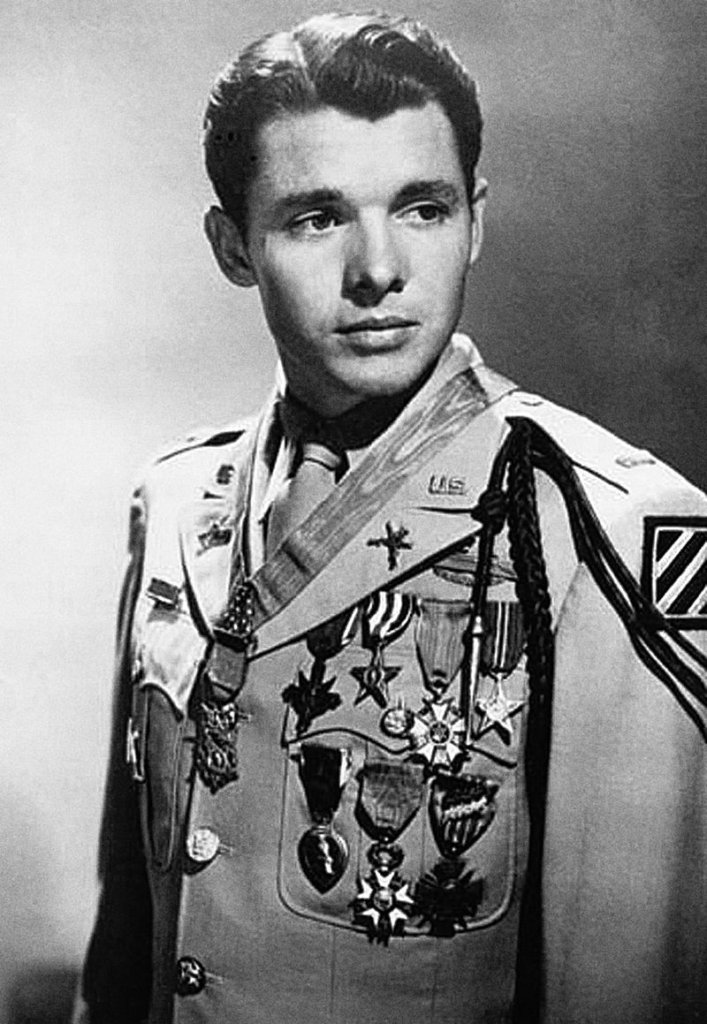
Audie Murphy

Audie Murphy, a highly decorated American soldier and actor, earned the Distinguished Service Cross for his actions during World War II. He received the medal for his heroic leadership and valor in combat, including single-handedly holding off a German attack.

Alvin C. York

Alvin C. York, a World War I soldier, was awarded the Distinguished Service Cross for his extraordinary actions during the Meuse-Argonne Offensive in 1918. He led an attack on a German machine gun nest, capturing 132 enemy soldiers and helping to secure the success of his unit.

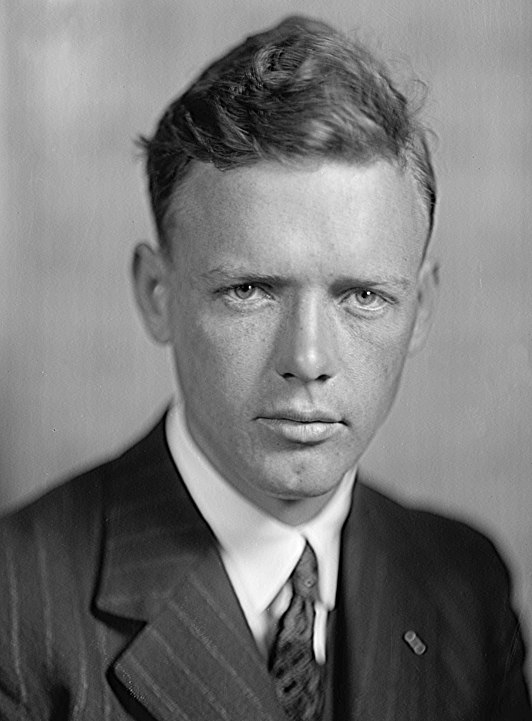
Charles Lindbergh 

Charles Lindbergh, the renowned aviator, received the Distinguished Service Cross for his pioneering transatlantic flight in 1927. The award recognized his significant contribution to aviation and the advancement of airmail services.

Theodore Roosevelt Jr.

Theodore Roosevelt Jr., the son of President Theodore Roosevelt, was posthumously awarded the Distinguished Service Cross for his actions during the D-Day invasion of Normandy in World War II. Despite being suffering from arthritis and heart problems, he landed with the first wave of troops and provided invaluable leadership during the assault.

Roy Benavidez

Roy Benavidez, a member of the U.S. Army Special Forces, earned the Distinguished Service Cross for his heroic actions during the Vietnam War. He saved the lives of numerous fellow soldiers during a six-hour battle, despite being severely wounded himself.

Audie Murphy photographed in 1948 wearing the U.S. Army khaki "Class A" (tropical service) uniform with full-size medals. Source: Wikipedia.
Col. Charles Lindbergh. Photo by Harris & Ewing, c. 1927.

Buy This Medal Online

Right Now on eBay 
Clicking a link to eBay may result in a referral commission being paid if a purchase is made.
Loading...