The Army Medal for War 1939-45

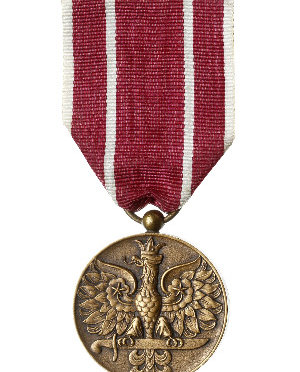
The Army Medal for War 1939-45 was created in 1945 to reward members of the Polish ground forces for service during World War II.

The Army Medal for War 1939-45 (or Medal Wojska za Wojne 1939-45 in Polish) was created in 1945 by the Polish government in Exile (in London) to reward members of the Polish ground forces for service during World War II.

The eligibility criteria for the medal were:

  • Six months of operational service during World War II, or
  • 12 months in a non-operational role.

The medal could be conferred up to four times, although for a subsequent award the period of service was doubled.

The Army Medal for War 1939-45 Design

The medal measures 35 mm in diameter.

The ribbon is crimson, with four thin stripes of white (including two edges).

The Cross of Merit with Swords (Poland)

The Cross of Merit with Swords is a military award of Poland established October 19, 1942, by the Polish Government in Exile.

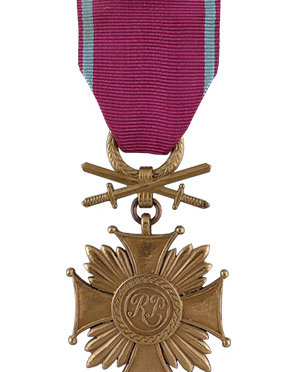
The Cross of Merit with Swords (or Krzyż Zasługi z Mieczami in Polish) is a military award of Poland established October 19, 1942, by the Polish Government in Exile.

The Cross of Merit with Swords is awarded for deeds of bravery and valor during time of war not connected with direct combat, and for merit demonstrated in perilous circumstances.

The Order has three grades:

1. Gold Cross of Merit with Swords
2. Silver Cross of Merit with Swords
3. Bronze Cross of Merit with Swords

The cross may be awarded twice in each grade to the same person.

The Cross of Merit with Swords Design

The medal is struck in silver or bronze (the first class with red and white enamels), measures 40.5 mm (w) x 40.5 mm (h) ad weighs approximately 24 grams. The shape is a cross with sunlight rays between the arms.

In the center medallion, in the obverse, are the initials RP (“Rzeczpospolita Polska” or Republic of Poland). The ribbon is red with white edges. The suspension has crossed sowrds.

The medal was awarded with a molded box and a certificate.

The Medal for the Restoration of the Black Metallurgy Enterprises of the South

The Medal for the Restoration of the Black Metallurgy Enterprises was awarded to Soviet workers of outstanding performance in restorations.

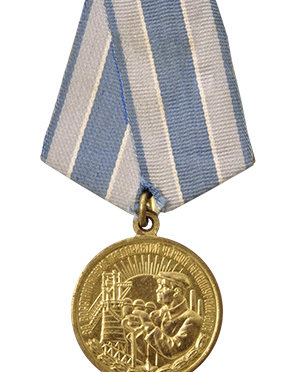
The Medal for the Restoration of the Black Metallurgy Enterprises of the South (or Медаль «За восстановление предприятий чёрной металлургии юга», Medal «Za vosstanovlenie predprijatij chernoj metallurgii yuga» in Russian) was established on 18 May 1948 by decree of the Presidium of the Supreme Soviet of the USSR and awarded to Soviet workers of outstanding performance in restoring the Black Metallurgic Enterprises of the Soviet Union which were destroyed during the Great Patriotic War.

Thirteen blast furnaces, forty-nine open-hearth furnaces, twenty-nine finishing mills, and sixty-eight coke-oven batteries were restored to effective or outstanding production rates.

Lists of potential recipients were reviewed on behalf of the Presidium of the Supreme Soviet of the USSR by the Ministry of Metallurgy of the USSR and the Ministry of Construction of Heavy Industry of the USSR. The medal was to be worn with honor, to serve as an example of high awareness and observance of labor discipline and integrity in the performance of public duties.

The medal’s statute was amended on July 18, 1980 by decree of the Presidium of the Supreme Soviet of the USSR № 2523-X.

The Medal for the Restoration of the Black Metallurgy Enterprises Design

The medal was 32mm in diameter, circular, and made of brass, with a raised rim on both sides. It was worn on the left side of the chest.

On the obverse on the left side, the relief image of a rebuilt blast furnace, at right, a worker with a tool for punching tapholes, in the background at center, the rising Sun with rays going up. Along the medal side and upper circumference, the relief inscription «За восстановление предприятий чёрной металлургии юга» (“For the restoration of the black metallurgy enterprises of the South”), at the bottom, the relief image of a five-pointed star over a laurel wreath.

On the reverse, the relief image of the hammer and sickle over the inscription on two lines in prominent letters «ТРУД В СССР — ДЕЛО ЧЕСТИ» (“LABOUR IN THE USSR – A MATTER OF HONOUR”).

The medal was secured by a ring through the medal suspension loop to a standard Soviet pentagonal mount covered by an overlapping 24 mm silk moiré ribbon. The ribbon had an 8 mm wide central blue stripe bordered by 1 mm wide white stripes themselves bordered by 5 mm wide light blue stripes, 2 mm wide blue edge stripes completed it.

The Medal for the Restoration of the Donbass Coal Mines

The Medal for the Restoration of the Donbass Coal Mines was awarded to workers, clerks, engineering and professionals for outstanding work.

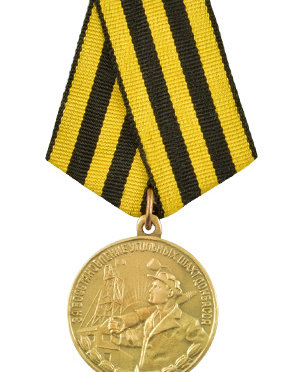
The Medal for the Restoration of the Donbass Coal Mines (or Медаль «За восстановление угольных шахт Донбасса», Medal «Za vosstanovlenie ugl’nyh shaht Donbassa» in Russian) was established on 10 September 1947 by decree of the Presidium of the Supreme Soviet of the USSR and awarded to workers, clerks, engineering and business professionals, for outstanding work, high production performance and achievements in the recovery of the Donbass coal mines.

Lists of potential recipients were reviewed on behalf of the Presidium of the Supreme Soviet of the USSR by the Ministry of the Coal Industry of the USSR, the Ministry of Construction of the USSR or the Ministry of Chemical and Petroleum Industries of the western areas.

The medal’s statute was amended on July 18, 1980 by decree of the Presidium of the Supreme Soviet of the USSR № 2523-X.

The Medal for the Restoration of the Donbass Coal Mines Design

The medal was 32mm in diameter, circular, and made of brass, with a raised rim on both sides. It was worn on the left side of the chest.

On its obverse, in the left half, the relief image of a restored mine, a flag-waving atop the tower; on the right side, the relief image of a helmeted miner facing left carrying a jackhammer on his right shoulder; in the background at center, the Sun with rays going all the way to the top of the medal; along the upper circumference, the relief inscription «За восстановление угольных шахт Донбасса» (“For the Restoration of the Donbass Coal Mines”); along the lower circumference, the relief image of a five-pointed star over a laurel wreath.

On the reverse, the relief image of the hammer and sickle over the inscription on two lines in prominent letters «ТРУД В СССР — ДЕЛО ЧЕСТИ» (“LABOUR IN THE USSR – A MATTER OF HONOUR”).

The medal was secured by a ring through the medal suspension loop to a standard Soviet pentagonal mount covered by an overlapping 24 mm silk moiré ribbon with 0,5 mm black edge stripes and three 5 mm wide gold stripes separated by two 4 mm wide black stripes.

The Medal for Valiant Labor in the Great Patriotic War 1941–1945

The Medal for Valiant Labor in the Great Patriotic War 1941–194 was awarded to Soviet industrial workers for long labor during the war.

The Medal for Valiant Labor in the Great Patriotic War 1941–1945 (or Медаль «За доблестный труд в Великой Отечественной войне 1941—1945 гг.», Medal «Za doblestnyj trud v Velikoj Otechestvennoj vojne 1941-1945 gg.» in Russian) was established on 6 June 1945 by decree of the Presidium of the Supreme Soviet of the USSR and awarded to all Soviet industrial workers for a term of one year or longer of labor during The Great Patriotic War (6 months for disabled military veterans/professional school graduates/the retired who returned to work to aid.)

The medal was awarded for wartime labor of one year or six months in the case of disabled veterans, to:

  • workers, technical personnel and employees of industry and transport;
  • farmers and agricultural specialists;
  • workers in science, technology, the arts, and literature;
  • employees of the Soviet, party, trade union, and other civic organizations.

Presentation of the award of the Medal “For Valiant Labor in the Great Patriotic War of 1941–1945” was made by the executive committees of city and district Soviets on the basis of documents issued by the heads of enterprises, institutions, party, government, trade unions, and other civic organizations.

Its statute was later amended by decree of the Presidium of the Supreme Soviet of the USSR on July 18, 1980.

The Medal for Valiant Labor in the Great Patriotic War 1941–1945 Design

The medal was 32mm in diameter, circular, and made of copper, with a raised rim on both sides. It was worn on the left side of the chest.

On the obverse, the left profile bust of Joseph Stalin wearing the uniform of a Marshal of the Soviet Union, along the upper circumference of the medal, the relief inscription “НАШЕ ДЕЛО ПРАВОЕ” (“OUR CAUSE IS JUST”), along the lower circumference of the medal, the relief inscription “МЫ ПОБЕДИЛИ” (“WE HAVE WON”).

On the reverse along the upper circumference of the medal, the relief inscription «ЗА ДОБЛЕСТНЫЙ ТРУД» (“FOR VALIANT LABOUR”), in the center, under a relief hammer and sickle, the inscription on four lines «В ВЕЛИКОЙ ОТЕЧЕСТВЕННОЙ ВОЙНЕ 1941–1945 ГГ.» (“THE GREAT PATRIOTIC WAR 1941–1945”), at the bottom, a small relief five-pointed star.

The Medal “For Valiant Labour in the Great Patriotic War 1941–1945” was secured by a ring through the medal suspension loop to a standard Soviet pentagonal mount covered by a 24mm wide red silk moiré ribbon with 2mm wide yellow edge stripes and a 7mm wide green central stripe.

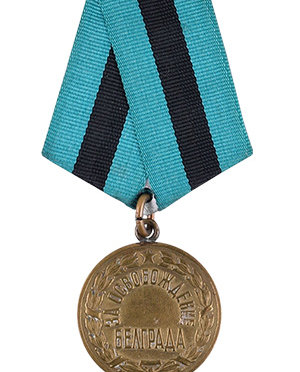
The Medal for the Liberation of Belgrade

The Medal for the Liberation of Belgrade was awarded to Soviet service personnel who took part in the liberation of Belgrade in 1944.

The Medal for the Liberation of Belgrade (or Медаль «За освобождение Белграда», Medal «Za osvobozhdenie Belgrada» in Russian) was established on 9 June 1945 by decree of the Presidium of the Supreme Soviet of the USSR and awarded to Soviet service personnel who took part in the liberation of Belgrade between 29 September and 22 October 1944.

The medal was awarded to soldiers of the Red Army, Navy, and troops of the NKVD, direct participants of the heroic assault and liberation of the city of Belgrade as well as to the organizers and leaders of combat operations in the capture of this city. Serving military personnel received the medal from their unit commander, retirees from military service received the medal from a regional, municipal, or district military commissioner in the recipient’s community.

The Medal for the Liberation of Belgrade Design

The medal was 32mm in diameter, circular, and made of brass, with a raised rim on the obverse. It was worn on the left side of the chest.

On its obverse along the entire medal circumference, a laurel wreath split only at the top by a small five-pointed star, within the wreath, along its upper inner circumference, the relief inscription ЗА ОСВОБОЖДЕНИЕ» (“FOR THE LIBERATION”), at lower center just above the wreath, the horizontal relief inscription «БЕЛГРАДА» (“OF BELGRADE”). On the reverse at the top, a relief plain five-pointed star over the relief date in three rows «20 ОКТЯБРЯ 1944» (“20 OCTOBER 1944”).

The Medal “For the Liberation of Belgrade” was secured by a ring through the medal suspension loop to a standard Soviet pentagonal mount covered by a 24mm wide green silk moiré ribbon with 8mm wide black central stripe.

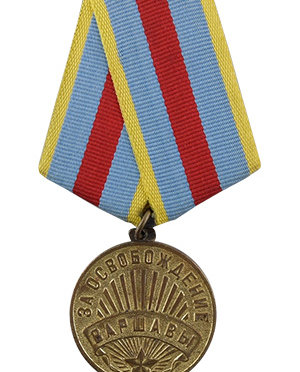
The Medal for the Liberation of Warsaw

The Medal for the Liberation of Warsaw was awarded to Soviet service personnel who took part in the liberation of Warsaw between in 1945.

The Medal for the Liberation of Warsaw (or Медаль «За освобождение Варшавы», Medal «Za osvobozhdenie Warshavy» in Russian) was established on 9 June 1945 by decree of the Presidium of the Supreme Soviet of the USSR and awarded to Soviet service personnel who took part in the liberation of Warsaw between the 14 and 17 January 1945.

The medal was awarded to soldiers of the Red Army, Navy, and troops of the NKVD, direct participants of the heroic assault and liberation of the city of Warsaw as well as to the organizers and leaders of combat operations in the capture of this city. Serving military personnel received the medal from their unit commander, retirees from military service received the medal from a regional, municipal, or district military commissioner in the recipient’s community.

The Medal for the Liberation of Warsaw Design

The medal was 32mm in diameter, circular, and made of brass, with a raised rim on the obverse. It was worn on the left side of the chest.

On its obverse along the upper half of the medal’s circumference, the relief inscription «ЗА ОСВОБОЖДЕНИЕ» (“FOR THE LIBERATION OF”), at the bottom, a relief five-pointed star radiating divergent rays upwards, superimposed over the rays, a ribbon bearing the relief inscription «ВАРШАВЫ» (“WARSAW”). On the reverse at the top, a relief plain five-pointed star over the relief date in three rows «17 ЯНВАРЯ 1945» (“17 JANUARY 1945”).

The Medal “For the Liberation of Warsaw” was secured by a ring through the medal suspension loop to a standard Soviet pentagonal mount covered by a 24mm wide blue silk moiré ribbon with 2mm yellow edge stripes and a 6mm wide central red stripe.

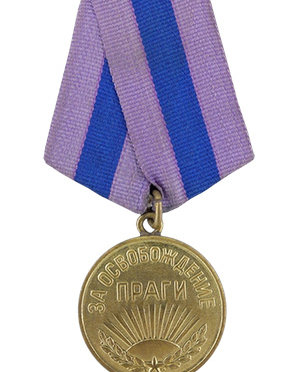
The Medal for the Liberation of Prague

The Medal for the Liberation of Prague was awarded to Soviet service personnel who took part in the liberation of Prague in 1945.

The Medal for the Liberation of Prague (or Медаль «За освобождение Праги», Medal «Za osvobozhdenie Pragi» in Russian) was established on 9 June 1945 by decree of the Presidium of the Supreme Soviet of the USSR and awarded to Soviet service personnel who took part in the liberation of Prague from the armed forces of Nazi Germany between the 3 and 9 May 1945.

The medal was awarded to soldiers of the Red Army, Navy, and troops of the NKVD, direct participants of the heroic assault and liberation of the city of Prague as well as to the organizers and leaders of combat operations in the capture of this city. Serving military personnel received the medal from their unit commander, retirees from military service received the medal from a regional, municipal, or district military commissioner in the recipient’s community.

The Medal for the Liberation of Prague Design

The medal was 32mm in diameter, circular, and made of brass, with a raised rim on the obverse. It was worn on the left side of the chest.

On its obverse along the upper half of the medal’s circumference, the relief inscription «ЗА ОСВОБОЖДЕНИЕ» (“FOR THE LIBERATION OF”), beneath the inscription, in prominent letters, the relief inscription «ПРАГИ» (“PRAGUE”). At the bottom, a small relief five-pointed star over a laurel wreath, over the wreath, a rising sun casting divergent rays upwards. On the reverse the relief date in three rows «9 МАЯ 1945» (“9 MAY 1945”) over a relief plain five-pointed star.

The Medal “For the Liberation of Prague” was secured by a ring through the medal suspension loop to a standard Soviet pentagonal mount covered by a 24mm wide purple silk moiré ribbon with an 8mm wide blue central stripe.

The Medal for the Capture of Vienna

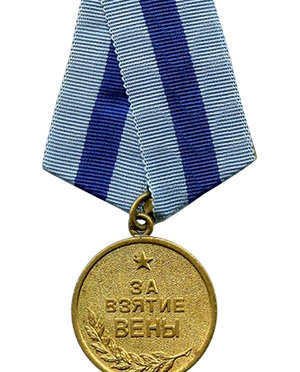
The Medal for the Capture of Vienna was awarded to Soviet service personnel who took part in the capture of Vienna in 1945.

The Medal for the Capture of Vienna (or Медаль «За взятие Вены», Medal «Za vzjatie Veny» in Russian) was established on 9 June 1945 by decree of the Presidium of the Supreme Soviet of the USSR and awarded to Soviet service personnel who took part in the capture of Vienna from the armed forces of Nazi Germany between 16 March and 13 April 1945.

The medal was awarded to soldiers of the Red Army, Navy, and troops of the NKVD, direct participants of the heroic assault and capture of Vienna as well as to the organizers and leaders of combat operations in the capture of this city. Serving military personnel received the medal from their unit commander, retirees from military service received the medal from a regional, municipal, or district military commissioner in the recipient’s community.

The medal’s statute was amended on July 18, 1980, by decree of the Presidium of the Supreme Soviet of the USSR № 2523-X.

The Medal for the Capture of Vienna Design

The medal was 32mm in diameter, circular, and made of brass, with a raised rim on the obverse. It was worn on the left side of the chest.

On its pebbled obverse at the top, a relief five-pointed star. Below the star, the relief inscription in bold letters on three rows «ЗА ВЗЯТИЕ ВЕНЫ» (“FOR THE CAPTURE OF VIENNA”). At the bottom, the relief image of a laurel branch going up the left circumference of the medal up to the second row of the inscription. On the reverse at the top, a relief plain five-pointed star, below the star, the relief date in three rows «13 АПРЕЛЯ 1945» (“13 APRIL 1945”).

The medal was secured by a ring through the medal suspension loop to a standard Soviet pentagonal mount covered by a 24mm wide silk moiré light blue ribbon with an 8mm wide central dark blue stripe.

The Medal for the Capture of Königsberg

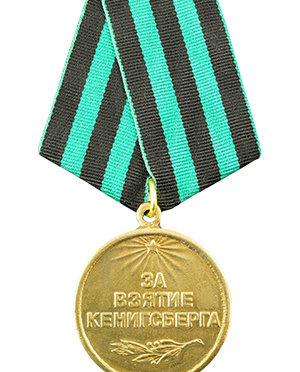
The Medal for the Capture of Königsberg was awarded to Soviet service personnel who took part in the capture of Königsberg in 1945.

The Medal for the Capture of Königsberg (or Медаль «За взятие Кенигсберга», Medal «Za vzjatie Kenigsberga» in Russian) was established on 9 June 1945 by decree of the Presidium of the Supreme Soviet of the USSR and awarded to Soviet service personnel who took part in the capture of Königsberg from the armed forces of Nazi Germany between 23 January and 10 April 1945.

The medal was awarded to soldiers of the Red Army, Navy, and troops of the NKVD, direct participants of the assault and capture of Königsberg as well as to the organizers and leaders of combat operations in the capture of this city. Serving military personnel received the medal from their unit commander, retirees from military service received the medal from a regional, municipal, or district military commissioner in the recipient’s community.

The medal’s statute was amended on July 18, 1980 by decree of the Presidium of the Supreme Soviet of the USSR № 2523-X.

The Medal for the Capture of Königsberg Design

The medal was 32mm in diameter, circular, and made of brass, with a raised rim on the obverse. It was worn on the left side of the chest.

The obverse has a raised rim and shows a small relief five-pointed star with divergent rays at the top. Below this is a relief inscription in bold letters on three rows «ЗА ВЗЯТИЕ КЕНИГСБЕРГА» (“FOR THE CAPTURE OF KÖNIGSBERG”), with a relief image of a horizontal laurel branch below. The reverse bears the relief date in three rows «10 АПРЕЛЯ 1945» (“10 APRIL 1945”) below a relief plain five pointed star.

The medal is secured by a ring through the medal suspension loop to a standard Soviet pentagonal mount covered by a 24mm wide silk moiré ribbon with 2 mm green edge stripes and five 4 mm wide alternating stripes, three black and two green.