The Order of Loyalty and Valor

The Order of Loyalty and Valor s a military award created on 23 September 1944 and awarded for outstanding command in battle.

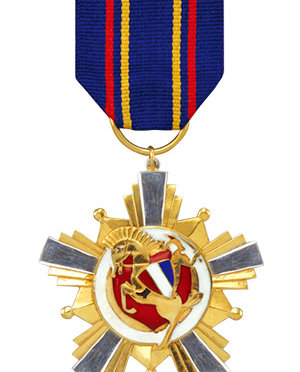
The Order of Loyalty and Valor (忠勇勳章 in Chinese) is a military award from the Republic of China created on 23 September 1944 and awarded for outstanding command in battle.

The Order is awarded by the President to soldiers who have killed the enemy bravely, for being wounded and not treating, or for commanding battle in danger. It can also be given tho those that defend the people, are loyal to duties, or perform heroic acts beyond the ordinary during a peace period.

The Order only has one grade.

The Order of Loyalty and Valor Design

The ribbon is dark blue with narrow red and yellow edge stripes.

The Medal for the War of Liberation

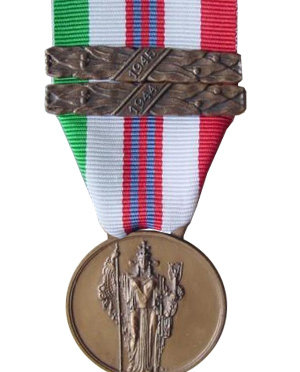
The Medal for the War of Liberation is an Italian medal established in 1945 and awarded for minimum 3 months service after September 1943.

The Medal for the War of Liberation was instituted on 21 April 1945 and awarded to personnel of the Italian armed forces, frontier guards, Red Cross, and certain categories of civilians, for a minimum 3 months service after 9 September 1943, excluding service in the “Social Italian Republic”.

The medal was awarded to Italian forces who served in operations against the German occupational army in Italy, post the capitulation and collapse of the Mussolini Fascist regime.

The award was first instituted as a ribbon and from 6 May 1959 as a medal.

The Medal for the War of Liberation Design

The ribbon can carry bars for each year of service: 1943, 1944, 1945, and possibly 1946. The latter year would refer to services in defusing bombs, mine clearance, etc. but seems never to have been effectively awarded or manufactured.

The Medal for Volunteers of the War 1940-45

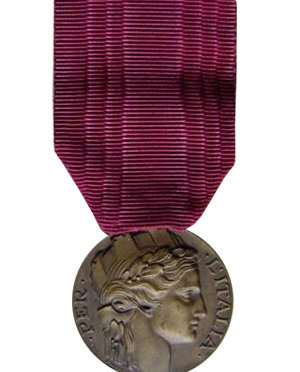
The Medal for Volunteers of the War 1940-45 was instituted on 21 April 1948 and awarded to those that volunteered for the Second World War.

The Medal for Volunteers of the War 1940-45 (or Volontario di Guerra 1940-45 in Italian) was instituted on 21 April 1948.

This medal, with a different ribbon and referred to as The Merit Medal for Crossing Enemy Lines after 8 September 1943, was also awarded to those that crossed enemy lines into Allied liberated territory before 8 September 1943 and put themselves at the disposal of the Italian National Government.

The Medal for Volunteers of the War 1940-45 Design

The official medal’s reverse has the inscription “VOLONTARIO DI GVERRA MCMXL-MCMXLV“. A type with the years in Arabic figures has also been reported to exist.

This medal can be found on different ribbons. The original decree stipulates the claret ribbon as for the WW1 Volunteer’s Medal but two other ribbons are known to exist (although they are considered unofficial). Both are purple, one with a center of four green and three red stripes, the other with three green and two red stripes in the middle. They both incorporate the War Commemorative Medal’s color scheme.

The Gold Medal of Military Valor

Institution: 21 May 1793
Country: Italy

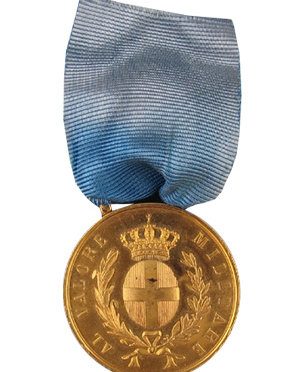
The Gold Medal of Military Valour (or Medaglia d’oro al valor militare in Italian) is a medal established on 21 May 1793 by King Victor Amadeus III of Sardinia for deeds of outstanding gallantry in war by junior officers and soldiers.

On 14 August 1815, Victor Emmanuel I of Sardinia replaced it with the Military Order of Savoy. On 26 March 1833, Charles Albert of Sardinia revived it and added to it the Silver and Bronze medals.

With the proclamation of the Republic on 2 June 1946, the coat of arms of the House of Savoy was replaced with the emblem of the Italian Republic. 

For actions performed by individuals during World War I, the Gold Medal was awarded some 368 times, as well as 37 times to military units, and once to the Unknown Soldier. Only four of the individual awards went to foreigners, one of these being Czar Nicholas II of Russia. The other three were for acts of gallantry in which the recipient was killed in action or died from his injuries (the Frenchmen John O’Byrne and Roland Morillot, and the American Coleman deWitt). 

During World War II the medal was awarded to soldiers of the Royal Italian Army; after these forces were reorganized following the Armistice with Italy in 1943, it was awarded to members of the Allies-supporting Italian Co-Belligerent forces. The Axis-affiliated Italian Social Republic created another design of the medal, with a Gladius replacing the arms of Savoy, for members of the Esercito Nazionale Repubblicano from 1943 to 1945. This version of the award was not given recognition by the postwar Italian government.

The Gold Medal for Military Valor is still awarded by the Italian state, and it, along with Silver and Bronze medals for Military Valor as well as the War Cross of Military Valor (which can only be awarded in time of war) was established by the Royal Decree of 4 November 1932.

The Gold Medal of Military Valor Design

The obverse of the medal displays the coat of arms of Savoy with laurel branches, the royal crown, and the words “For Military Valor“. On the reverse are two laurel branches enclosing the name of the decorated soldier, and the place and date of the action.

The Medal for Mothers and Widows of the Fallen

Time Period: The Great War, Second World War

Institution: 24 May 1919
Country: Italy

The Medal for Mothers and Widows of the Fallen (or Medaglia di Madri e Vedove Dei Caduti in Italian) is an Italian medal instituted on 24 May 1919 (with Royal decree no. 800 of 1919) as a token of national gratitude to Italian mothers who had lost one or more children during the First World War.

Both legitimate and natural mothers who had recognized the fallen son were entitled to the badge, but only if it was indubitable that the soldier had fallen in combat or as a result of injuries sustained in combat. It was granted by the Ministry of War or the Navy, depending on whether the fallen soldier was part of the land or sea army.

The medal was established by the Kingdom of Italy and reconfirmed by the Italian Republic for the Second World War. A similar recognition was established in 1887 for the mothers of the fallen of the Battle of Dogali. The recognition was also extended to the African Campaign, the Spanish Campaign, thje Expedition to Albania, The 1940/43 War, and WW2.

The Medal for Mothers and Widows of the Fallen Design

The medal is circular and could be cast in bronze of the guns taken from the enemy. It was designed by G. Prini and measures 32 mm in diameter.

The obverse shows an allegorical design of a woman offering a laurel wreath to a dying soldier while another woman stands in the background. The reverse is bears the inscription “IL FIGLI / CHE TI NACQVE / DAL DOLORE / TI RINASCE “O BEATA” / NELLA GLORIA / E IL VIVO EROE / “PIENA DI GRAZIA ” / E TECO” (“The son which was born out of you in pain, is reborn to you, o blessed one, full of glory and he lives as a hero. With gratitude“).

There are several variants produced by private industries. Some of these show, under the left arm of the fallen, the name of the model maker “G. PRINI – MOD.” and the name of the manufacturer: Sacchini, S. Johnson or Lorioli and Castelli.

The ribbon is dark grey, with thin green, white, and red stripes in the center and measures 37 mm wide. A ministerial circular dated March 23, 1921 established that each fallen child was represented by an equivalent number of bronze crowns on the ribbon.

The Medal of Victory and Freedom 1945

The Medal of Victory and Freedom 1945 was a military decoration awarded to persons who fought during World War II against Nazi Germany.

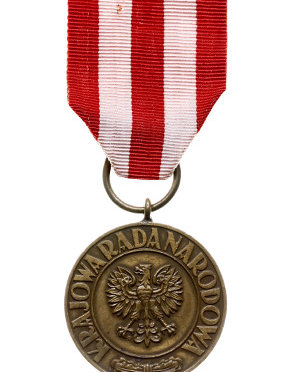
The Medal of Victory and Freedom 1945 (or Medal Zwycięstwa i Wolności 1945 in Polish) was a military decoration from Poland awarded to persons who fought during World War II against Nazi Germany.

The medal was introduced by a decree of the Council of Ministers and approved by the State National Council (Krajowa Rada Narodowa) on October 26, 1945. According to the decree, it was instituted “to commemorate the victory of the Polish Nation and its allies over the barbarism of hitlerism, a triumph of the idea of democratic freedom, and to award persons who helped in this victory”.

It was awarded to:

  • soldiers of the Polish People’s Army (Ludowe Wojsko Polskie) in the USSR.
  • soldiers fighting in the invasion of Poland in 1939.
  • soldiers of the Polish Armed Forces in the West, provided that they come back to Poland after the war.
  • Poles who fought against Germans in allied armies.
  • Polish partisans fighting in the country or abroad.
  • members of the Soviet, Yugoslav or French partisan units.
  • armed forces members who served at least three months by May 9, 1945, in auxiliary units, helping in the victory.

The medal was awarded by the Prime Minister, and from 1958 by the Council of State. It ceased to be awarded in 1992. About 670,000 Medals were awarded by 1985.

The Medal of Victory and Freedom 1945 Design

The medal in the first version was a bronze disc with a diameter of 33 mm.

On the obverse was the state eagle, surrounded by oak leaves, with the inscription KRN in the upper part, but this version was not introduced.

The final version, sanctioned by the regulations in 1946, is a disc 33 mm in diameter, patinated in brown, with the State Eagle on the obverse and the inscription around the medal: KRAJOWA RADA NARODOWA. At the bottom of the medal there are two tied oak leaves. On the reverse there are four lines separated by horizontal lines: RP VICTORY – AND FREEDOM – 9.V.1945.

In 1945, a ribbon was established, which was half red and white in a vertical line. From 1946, the ribbon of the medal was 35 mm wide and consisted of 3 red and 2 white stripes 7 mm wide, arranged alternately. Since 1960, the width of the ribbon has been defined as 33 mm.

The Silesian Uprising Cross

The Silesian Uprising Cross is a Polish military decoration awarded to veterans of the Silesian Uprisings those active in Silesia in WW2.

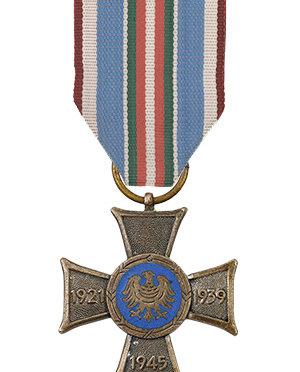
The Silesian Uprising Cross (or Śląski Krzyż Powstańczy in Polish) is a military decoration established in 1946 and awarded to veterans of the Silesian Uprisings (1919-1921) and members of Polish resistance in World War II active in Silesia.

The Silesian Uprisings were a series of three uprisings from August 1919 to July 1921 in Upper Silesia, which was part of the Weimar Republic at the time. Ethnic Polish separatists, seeking to have the area transferred to the newly founded Polish Republic, fought German police and paramilitary forces, as the former sought to keep the area part of the new German state founded after World War I. Following the conflict, the area was divided between the two countries. The rebellions have subsequently been commemorated in modern Poland as an example of Polish nationalism.

The order ceased to be given out in 1999.

The Silesian Uprising Cross Design

The medal is struck in silvered bronze with blue enamels and measures 36.2 mm in diameter.

The obverse bears the years 1921 on the left arm, 1939 on the right arm, and 1945 on the lower arm. The central disc is light blue enamel and shows the silver Silesian eagle encircled by a stylized wreath. The reverse is not enameled.

The ribbon is light blue with white (inner) and dark red (outer) edges. In the centre there is a wide stripe of green, red, white, red, green, flanked by white pinstripes.

The Partisan Cross (Poland)

The Partisan Cross was a Polish military decoration introduced by the Council of Ministers in 1945 and awarded to World War II partisans.

The Partisan Cross (or Krzyż Partyzancki in Polish) was a military decoration awarded to World War II partisans (part of resistance movement fighting in the countryside). It was introduced by the Council of Ministers on October 26, 1945.

The cross was awarded to organizers, commanders and members of partisan units who fought against Germans on a Polish territory, or to Poles who fought in partisan units in the USSR, Yugoslavia and France, or to foreigners, who fought in partisan units on Polish territory. It could be given also to cities or villages, that distinguished themselves in supporting the partisan movement.

About 55,000 Partisan Crosses were awarded. The Partisan Cross ceased to be awarded in 1999.

The Partisan Cross Design

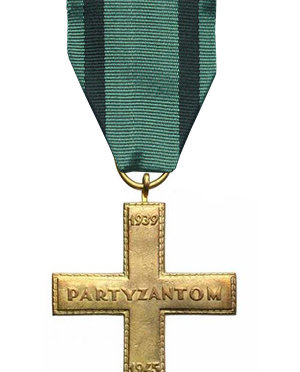
The Cross is a gold-plated Greek cross with thin arms, 38 x 38 mm.

The obverse shows the eagle in the centre (the Polish coat-of-arms) and an inscription: “ZA – POLSKĘ – WOLNOŚĆ – i LUD” (“For Poland, Liberty and People”) on arms. The reverse bears the horizontal inscription “PARTYZANTOM” (“To partisans”), and the date “1939” on an upper vertical arm and “1945” on a lower arm.

The ribbon is dark green, 35 mm wide, with black strips 7 mm wide, near both edges.

The Order of the Cross of Grunwald

The Order of the Cross of Grunwald is a military decoration created in Poland in November 1943 and conferred for merit in combat.

The Order of the Cross of Grunwald (or Order Krzyża Grunwaldu in Polish) was a military decoration created in Poland in November 1943 by the High Command of Gwardia Ludowa, a World War II Polish resistance movement organized by the Polish Workers Party.

The medal was conferred to Polish or the allied military for valor or merit in combat with Nazi Germany. After the end of the Second World War it continued to be awarded for outstanding merit in commanding or outstanding contribution to the development of the Polish Armed Forces.

On 20 February 1944 it was confirmed by the State National Council and on 22 December by the Polish Committee of National Liberation and further confirmed on 17 February 1960 by the government of the People’s Republic of Poland. It was disestablished by the President of Poland via Parliament in 1992.

The Order of the Cross of Grunwald Design

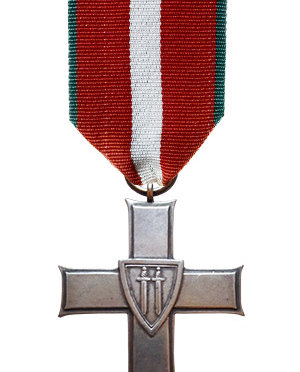
The medal is a cross with 4 equilateral arms with gold edges and pointed ends. It’s struck in silver and measures 45 by 45 mm in diameter. Overall arm length with finials is 16.5 mm and without finials 15 mm. Thickness is 2.5 mm.

The center of the obverse shows a shield within which are two swords facing downwards. In the center of the reverse is also a sword, in which is the transcription 1410 KG 1944 below one another.

The ribbon has a central grey stripe flanked by red with green edges.

The Monte Cassino Commemorative Cross

The Monte Cassino Commemorative Cross was awarded to all soldiers of the Polish II Corps who fought in the battle of Monte Cassino.

The Monte Cassino Commemorative Cross (or Krzyż Pamiątkowy Monte Cassino in Polish) is a commemorative medal awarded to all soldiers of the Polish II Corps who fought in the battle of Monte Cassino and the battles for Piedimonte and Passo Corno.

The Battle of Monte Cassino (also known as the Battle for Rome and the Battle for Cassino) was a costly series of four assaults by the Allies against the Winter Line in Italy held by Axis forces during the Italian Campaign of World War II. The intention was a breakthrough to Rome.

After the capture of Monte Cassino in May 1944, the Polish government-in-exile (in London) created a campaign cross to commemorate the role of the Polish II Corps (often known as Anders Army) in capturing this strategic point, which had long blocked the Allied advance up the Italian peninsula. A consignment of 50,000 crosses was ordered from a manufacturer in Tel Aviv, then part of British-ruled Palestine, where the Polish forces had spent part of 1942 and almost all of 1943 in training.

A total of 48,498 crosses were awarded with accompanying award documents issued in the field to each soldier who took part in the battle. The lists of named cross recipients are held at the Polish Institute and Sikorski Museum.

The Monte Cassino Commemorative Cross Design

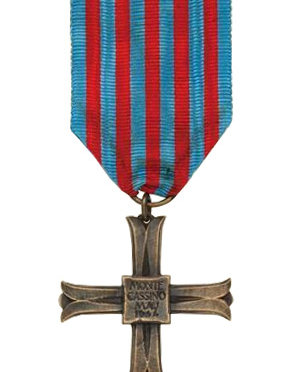
The medal is a cross with 4 equilateral arms, incised grooves and outward curving, radiant tips. It is struck in silver or bronze and measures 40 mm in diameter. The design of the cross echoes that used by the order of St. Benedict, who founded the Monte Cassino Abbey in 529.

The obverse (top left) bears the inscription “MONTE CASSINO MAJ 1944“. The reverse (top right) has the serial number of the medal.

The grosgrain ribbon has alternating vertical stripes of equal width: 6 blue, 5 orange. The ribbon is inserted through a suspension ring attached to a ring suspension attached to a loop in the cross point.