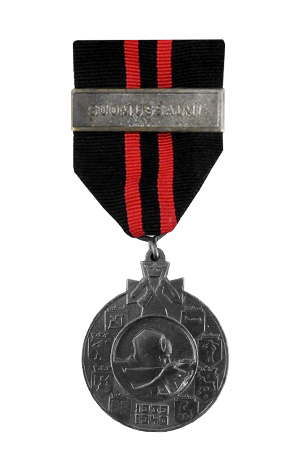
The Winter War 1939-1940 Medal

The Winter War 1939-1940 Medal was established on 2 August 1940 and awarded to soldiers and civilians for serving the Nation’s best interests. In particular, to honour those who had helped to keep Finland’s independence.

The 1939-1940 War Service Medal was created through Number 418 Finnish Code of Regulations 1940 by President Kyösti Kallio and the Minister of Defense Rudolf Walden. The first medals were presented in September of the same year.

The criteria was as follows: The medal was ‘established to commemorate the war of 1939–1940 and the unanimous will to defend it and the deeds done for the benefit of the motherland.’ The medal was generally very liberally granted to those engaged in some form of war work. This could range from those who cooked and baked in canteens to soldiers and young boys and girls who helped pass messages and washed uniforms.

Over 700,000 of all versions of the 1939-1940 War Service Medal were awarded.

The Winter War 1939-1940 Medal Design

The medal was designed by Major Aarno Karimo, who had helped found the Voimaliitto (Power League) in 1906. He was a well-known and respected poet and artist who had spent the Winter War designing propaganda posters.

The medal is made from blackened iron and measures 35 mm wide. The obverse is divided in two: An 18mm diameter circular centerpiece and a 17mm wide border. The centerpiece displays a silhouette of a snow-covered rifleman surrounded by eight provincial coats of arms of Finland. At the bottom is a stylized text reading 1939–1940. The reverse has an embossed conifer wreath around the border and the inscription ‘KUNNIA ISÄNMAA’ meaning ‘Honour Fatherland’. 
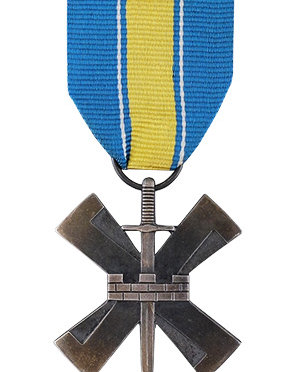
The 1941-1944 Finish Eastern Isthmus Campaign Cross

The 1941-1944 Finish Eastern Isthmus Campaign Cross is a military medal from Finland. The Finnish reconquest of the Karelian Isthmus (1941) refers to a military campaign carried out by Finland in 1941, which was part of what is commonly referred to as the Continuation War.

The 1941-1944 Finish Eastern Isthmus Campaign Cross Design

The medal is struck in silver and measures 34.2 mm by 39 mm.

The Finish Continuation War Commemorative Medal 1941-1945

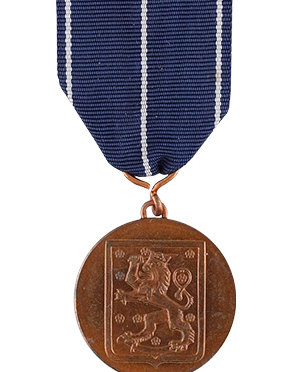
The Finish Continuation War Commemorative Medal 1941-1945 is a Finnish medal awarded to participants in the Continuation War (1941-1945). It was established on 24 May 1957, 12 years after the end of the war.

The Continuation War supported the view that it was a continuation of the Winter War of 1939-1940  in which Soviet forces invaded Finland. It was an attempt by Finland to regain territory lost at the end of the Winter War and to occupy Russian territory, taking advantage of the German invasion of Russia and acting as a defensive buffer against future incursions.

The Finish Continuation War Commemorative Medal 1941-1945 Design

The medal is a one-piece construction and measures 31 mm wide. The ribbon is dark blue with three thin white strips on the sides and middle.

The Finnish Air Force Cross 1941-1945

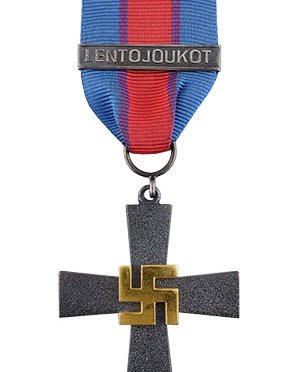
The Finnish Air Force Cross 1941-1945 (or Commemorative Cross of the Finnish Air Force) is a Finnish medal awarded to participants in the Continuation War (1941-1945).

The Finnish Air Force Cross 1941-1945 Design

The medal is a two-piece construction with a brass swastika overlaying a blackened bronze cross. It measures 39.5 mm wide.

The 1939-1940 Finish Summa Cross

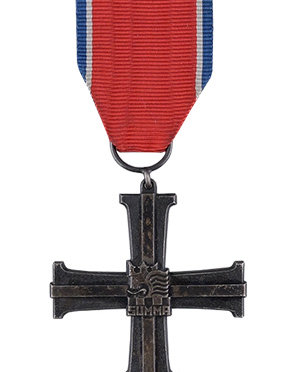
The 1939-1940 Finish Summa Cross was instituted on the 27th of October 1940 and awarded to participants of the Battle of Summa.

The 1939-1940 Finish Summa Cross (or Summan Risti in Finnish) was instituted on the 27th of October 1940 and awarded to participants of the Battle of Summa during the Winter War (the defense against the Soviet invasion 1939-1940).

Summa was a key Finnish defence position in the Mannerheim Line. The village of Summa was a gateway to the city of Viipuri. The Finns had built 41 reinforced concrete bunkers in the area, making the defense line stronger than elsewhere in the Karelian Isthmus. However, mistakes in planning were made, resulting in a kilometer wide gap in the line, nearby the Munasuo swamp.

The 1939-1940 Finish Summa Cross Design

The medal is struck in silvered white metal and measures 45.5 mm wide.

The 1939-1940 Finnish Middle-Isthmus Battle Cross

The 1939-1940 Finnish Middle-Isthmus Battle Cross was instituted in 1940 and awarded to participants of the defence of the Karelian Isthmus.

The 1939-1940 Finnish Middle-Isthmus Battle Cross (or Keski-Kannaksen Risti in Finnish) was instituted in 1940 and awarded to participants of the defence of the Karelian Isthmus.

The Karelian Isthmus (Karjalankannas in Finnish) is the approximately 45–110-kilometre-wide (30–70 mi) stretch of land that is situated between the Gulf of Finland and Lake Ladoga in northwestern Russia, to the north of the River Neva. The Vyborg–Petrozavodsk offensive or Karelian offensive was a strategic operation by the Soviet Leningrad and Karelian Fronts against Finland on the Karelian Isthmus and East Karelia fronts of the Continuation War, on the Eastern Front of World War II.

The 1939-1940 Finnish Middle-Isthmus Battle Cross Design

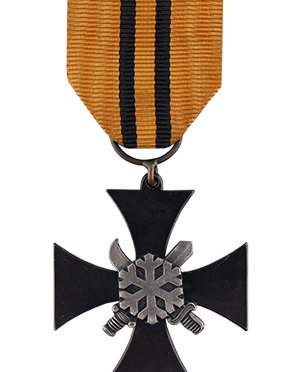
The medal is a two-piece construction in blackened bronze with a silvered centrepiece and measures 39 mm wide.

The Cross of the Central Karelian Isthmus Battle has an eyelet and a loop for ribbon suspension, as well as silvered crossed swords on the obverse. On top is a central snowflake. The reverse is plain.

The ribbon is orange with two black stripes in the middle.

The Order of the Lion of Finland

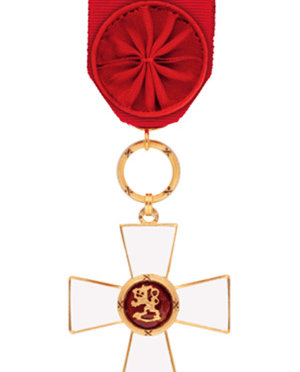
The Order of the Lion of Finland (Suomen Leijonan ritarikunta) is one of three official Orders in Finland, established on September 11, 1942.

The Order of the Lion of Finland (or Suomen Leijonan ritarikunta in Finnish) is one of three official orders in Finland, along with the Order of the Cross of Liberty and the Order of the White Rose of Finland. It was established on September 11, 1942.

The Order of the Lion of Finland was established to allow the continuation of decorating foreigners with high ranks in Finnish orders, although it can also be awarded to Finnish nationals. This was because the existing Finnish orders could not keep up with the decorations and their highest grades were in danger to become inflated due to too many holders. 

The President of the country is the Grand Master of all three orders, which are administered by boards consisting of a chancellor, a vice-chancellor and at least four members. The orders of the White Rose of Finland and the Lion of Finland have a joint board. The President of Finland wears the Star of the Order of the Lion of Finland.

The classes of the Order of the Lion of Finland are:

  • FIN Order of the Lion of Finland 1Class BAR.png Commander Grand Cross of the Order of the Lion of Finland
  • FIN Order of the Lion of Finland 2Class BAR.png Commander, First Class, of the Order of the Lion of Finland
  • FIN Order of the Lion of Finland 3Class BAR.png Commander of the Order of the Lion of Finland
  • FIN Order of the Lion of Finland Pro-Finlandia BAR.png Pro Finlandia Medal of the Order of the Lion of Finland (awarded to artists and writers)
  • FIN Order of the Lion of Finland 4Class BAR.png Knight, First Class, of the Order of the Lion of Finland
  • FIN Order of the Lion of Finland 5Class BAR.png Knight of the Order of the Lion of Finland
  • FIN Order of the Lion of Finland 5Class BAR.png Cross of Merit of the Order of the Lion of Finland

The Order of the Lion of Finland Design

The ribbon for all classes of insignia is dark red. The cross size and ribbon width are at their greatest for the Grand Cross and are reduced for the Commander First Class and Commander. The ribbon width for Knights is narrower still, but remains at this width for all decorations down to Medals.

The Commemorative Badge for the Foundation of the Manchukuo Empire

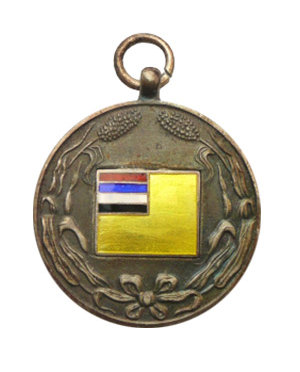
The Commemorative Badge for the Foundation of the Manchukuo Empire is a commemorative item made to celebrate its founding.

  • Time Period: WW2
  • Institution: 1930s?
  • Country: Medals from Japan Japan

The Commemorative Badge for the Foundation of the Manchukuo Empire is one of many commemorative items that were made on the occasion of the founding of the Manchukuo Empire. Similar items were also produced on subsequent anniversaries.

Although these badges had a suspension ring, they were probably never actually worn. Their function was more decorative, with most of them probably bought as a gift for others.

The Commemorative Badge for the Foundation of the Manchukuo Empire Design

The obverse shows two branches around an enameled national flag. These are sorghum branches and buds, a plant used often on Manchukuo items. Although the official imperial crest is the orchid, the sorghum was used as a symbol of the nation, just as the cherry blossom is used as a symbol of Japan.

The reverse shows the inscription ‘Manchukuo Empire, Daidou 2 [1933] March 1st, National Foundation 1-Year Anniversary Commemorative.’

The badge was kept in a paulownia wood box with an inscription reading ‘Manchukuo Empire, National Foundation 1-Year Anniversary Commemorative.’

The Imperial Japanese Army Koga Regiment Badge

Time Period: WW2

Institution: 1930s?
Country: Medals from Japan Japan

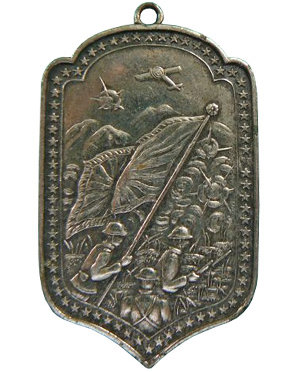
The Imperial Japanese Army Koga Regiment Badge is an example of a small, portable, and inexpensive regiment badge. These awards were usually given to troops by regiment commanders.

The Imperial Japanese Army Koga Regiment Badge Design

These regimental badges usually had the unit name and number inscribed in the obverse, and could also be personalized. However, they rarely had the name of the individual soldier unless they were hand-carved.

The Koga regiment badge has a border covered with Army stars. The obverse shows, it the center, Japanese soldiers battling at the front. One of them is carrying the regiment standard. In the background are clouds of smoke with stylized explosions and some hills. Above is a fighter plane and another explosion. The inscription in the reverse reads ‘Koga Regiment, Blood-Stained Regiment Standard.’

The Japanese Military Wounded Soldier Badge

Time Period: WW2
Institution: From 1938
Country: Medals from Japan Japan

The Japanese Military Wounded Soldier Badge was issued to both army and navy personnel from about 1938. Also translated as the War Wound Badge, this medal was produced in two varieties.

The gilt senshou badge was awarded for a wound sustained in combat. The silver koushou badge was awarded for a wound sustained in the public service (or in a non-combat situation). It was also often given to a soldier when they contracted a disease like malaria or were poisoned, injured in an equipment accident, etc. 

The Japanese Military Wounded Soldier Badge Design

The badge measures approximately 31 mm high. The outer edges on the reverse side read Gunjin Shoui Kishou (Soldier Wound Badge).

The badge was awarded in a red pressed cardboard or wooden box with gold or silver lettering and with an accompanying registration card.