The Medal for the Defense of Leningrad

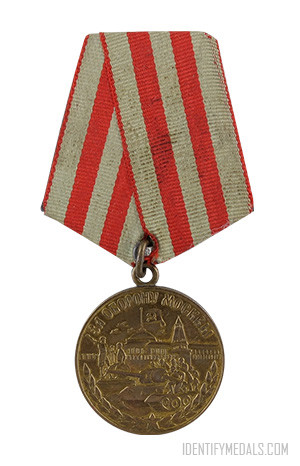
The Medal for the Defense of Leningrad was awarded to all Soviet military and civilians who participated in the defense of Leningrad in 1944.

The Medal for the Defense of Leningrad (or Медаль «За оборону Ленинграда», Medal «Za oboronu Leningrada» in Russian) was established on 22 December 1942 by decree of the Presidium of the Supreme Soviet of the USSR and awarded to all Soviet military and civilians who participated in the defense of Leningrad between 8 September 1941 and 27 January 1944.

The medal recognizes the valor and hard work of the Soviet civilian and military defenders of Leningrad (soldiers of the Red Army, Navy, and troops of the NKVD, as well as persons from the civilian population) during the 872-day siege of the city by the German armed forces between September 8, 1941, and January 27, 1944.

Award of the medal was made on behalf of the Presidium of the Supreme Soviet of the USSR on the basis of documents attesting to actual participation in the defense of Leningrad issued by the unit commander, the chief of the military medical establishment, or by a relevant provincial or municipal authority.

The Medal for the Defense of Leningrad Design

The medal measures 32mm in diameter and is circular and struck in brass. It has a raised rim.

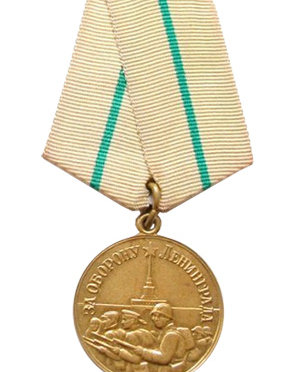
The obverse features, in the lower half, the relief images of a helmeted Red Army soldier (nearest), a sailor (middle), and a worker (farthest), all three with rifles at the ready. In the background is the relief outline of the Leningrad Admiralty building. Along the upper circumference of the medal, an inscription in prominent letters reads  «ЗА ОБОРОНУ ЛЕНИНГРАДА» (“FOR DEFENCE OF LENINGRAD”).

On the reverse near the top, the relief image of the hammer and sickle, below the image, the relief inscription in three rows «ЗА НАШУ СОВЕТСКУЮ РОДИНУ» (“FOR OUR SOVIET MOTHERLAND”).

The medal was secured by a ring through the suspension loop to a standard Soviet pentagonal mount covered by a 24mm wide olive green silk moiré ribbon with a 2mm central green stripe.

Other Soviet Defense Medals from WW2

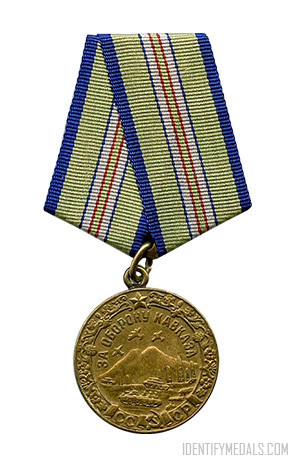
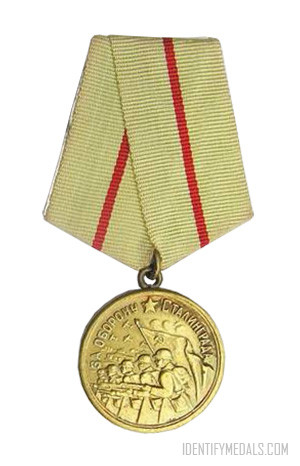
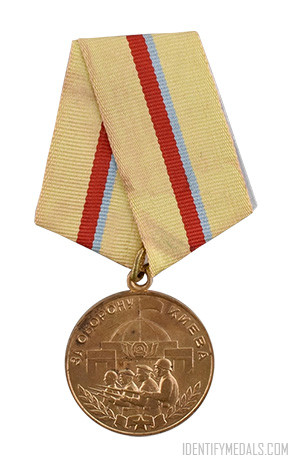
The medals awarded for the defense of various places during World War II belong to a specific group of Soviet campaign medals. These medals were instituted by the Soviet Union to recognize and honor the efforts and sacrifices of those who participated in the defense of key cities and regions against Axis forces. 

Find This Medal

Right Now on eBay 
Clicking a link to eBay may result in a referral commission being paid if a purchase is made.
Loading...

The Soviet 40th Anniversary Medal

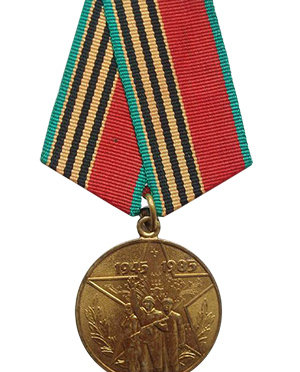
The Soviet 40th Anniversary Medal was established on 12th April 1985 and awarded to British and Canadian forces who served mainly in RN or MN ships on Arctic Convoys. The medal was approved in 1994 by Her Majesty the Queen and first awarded by the Soviet Government to selected ex-Servicemen – in particular surviving veterans of the Arctic Convoys of World War II.

Similar medals were issues for the 50th and subsequent five year anniversaries as well. However, those for the 55th anniversary and above have not been authorized for wear.

The Soviet 40th Anniversary Medal Design

The medal is circular, struck in bronze, and measures 32 mm in diameter.

The obverse features a group of servicemen and women in front of a five-pointed star and flanked by oak leaves and the dates 1945-1985 above. The reverse has the inscription “40th Anniversary of the Victory in the Great Patriotic War 1941-1945” in Russian.

The ribbon is one-half red and the other orange with three black stripes, edged with pale blue. Later issues of the medal have no blue edges.

The medal is worn in the Russian style.

The Newfoundland Volunteer War Service Medal

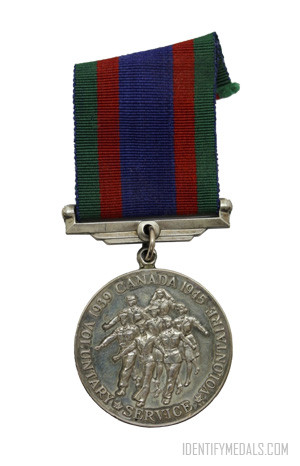
The Newfoundland Volunteer War Service Medal was created to honor those from Newfoundland & Labrador who served in British Forces.

The Newfoundland Volunteer War Service Medal is a British campaign medal established 6 November 1981, to honour those from Newfoundland & Labrador who served in British Forces outside of the province.

The medal was issued to those who did not receive a volunteer war service medal from another country, including Canada, and who had volunteered and served in units or organizations contributed by the Dominion of Newfoundland to the allied war effort. The period of qualifying service was from September 3, 1939 through September 2, 1945.

During the Second World War, Newfoundland was a separate Dominion of the British Empire, only joining the Canadian Confederation in 1949. Accordingly, Newfoundland servicemen who volunteered to serve with British Imperial Forces, including Newfoundland units, did not qualify for the Canadian Volunteer Service Medal

A total of 7,500 medals were awarded, including those issued to next-of-kin, who could claim on behalf of those who died both in or since the war.

The Newfoundland Volunteer War Service Medal Design

The medal is circular, struck in bronze and measures 37 millimeters in diameter. It was designed by Ian H Stewart CM, the Senior Designer in Residence at Memorial University St John’s Nfld.

The obverse shows the Crown and cipher of King George VI surmounted by a baying Newfoundland stag caribou. Around the edge is the inscription “NEWFOUNDLAND VOLUNTEER SERVICE MEDAL 1939-1945″. The reverse bears a depiction of Britannia standing on a scallop shell, with a spear in her right hand and the sun’s rays behind her. Two lions encircle each side with their heads towards the bottom of the medal.

The ribbon is deep claret with edges of red, white, and blue. The medal is mounted on a single claw with a single-curl mount and the rim is uniquely numbered to each recipient.

Find This Campaign Medal

Right Now on eBay 
Clicking a link to eBay may result in a referral commission being paid if a purchase is made.
Loading...

More WW2 British Campaign Medals

During World War II (1939–1945) British campaign medals were awarded to members of the British Armed Forces and civilians for active service in specific military campaigns or operations. These included:

WW2 Medals and Awards: The Arctic Star

The Arctic Star

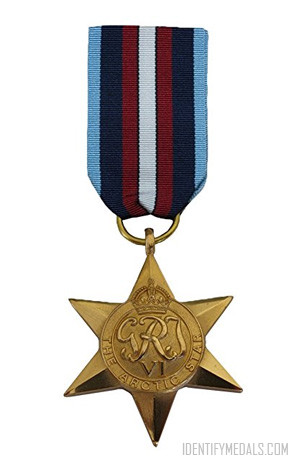
The Arctic Star is a military campaign medal which was instituted for service on the Arctic Convoys north of the Arctic Circle in WW2. 

Read More »
WW2 Medals and Awards: The Africa Star

The Africa Star

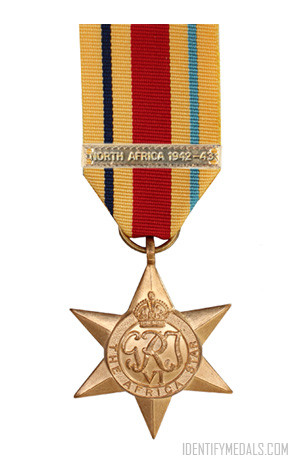
The Africa Star is a military campaign medal awarded to those who served in the Second World War specifically in North Africa. 

Read More »
The War Medal 1939-1945 Obverse

The War Medal 1939-1945

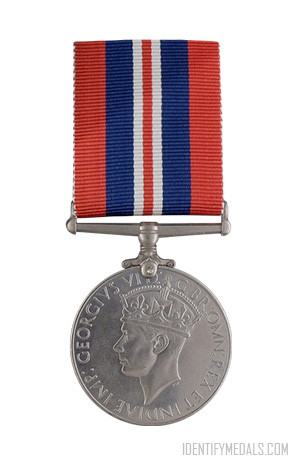
The War Medal 1939–1945 is a British campaign medal instituted by the United Kingdom on 16 August 1945. The medal was awarded to subjects of the British Commonwealth who had served full-time.

Read More »

The Southern Rhodesia Service Medal

The Southern Rhodesia Service Medal 1939-1945 is a campaign medal awarded to members of the Southern Rhodesia Defence Forces for home service.

The Southern Rhodesia Service Medal 1939-1945 is a campaign medal of the British Commonwealth awarded to members of the Southern Rhodesia Defence Forces who had at least six months full or part-time service between 3 September 1939 and 2 September 1945 and were not eligible for any other British World War II campaign medal.

The Southern Rhodesia Service Medal was authorized in 1948 and distributed from 1949. A total of 3,908 medals were awarded, mainly to those who had served part-time:

  • Southern Rhodesia Territorial Force: 3,140
  • British South Africa Police Reservists: 497
  • Those who served with both bodies: 271

There are no clasps for this medal.

The Southern Rhodesia Service Medal Design

The medal is circular, struck in cupro-nickel and measures 36 millimeters (1.4 in) in diameter.

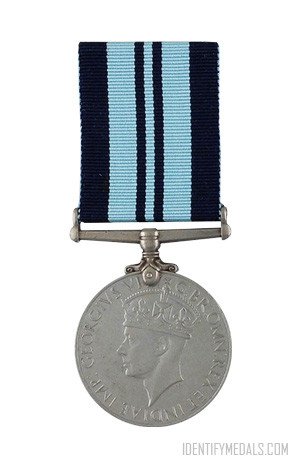
The obverse shows the crowned effigy of King George VI facing left, with the legend “GEORGIVS VI D:G:BR:OMN:REX ET INDIAE IMP.” (George VI by the grace of God King of Great Britain and Emperor of India).

The reverse was designed by Humphrey Paget and shows the coat of arms of Southern Rhodesia, surrounded by the words “+ FOR SERVICE IN SOUTHERN RHODESIA + 1939-1945”.

The ribbon measures 31.7 millimeters (1.25 in) wide and is beetle green with red and black stripes at each edge, the colors of the Rhodesia Regiment.

Find This Campaign Medal

Right Now on eBay 
Clicking a link to eBay may result in a referral commission being paid if a purchase is made.
Loading...

More WW2 British Campaign Medals

During World War II (1939–1945) British campaign medals were awarded to members of the British Armed Forces and civilians for active service in specific military campaigns or operations. These included:

WW2 Medals and Awards: The Pacific Star

The Pacific Star

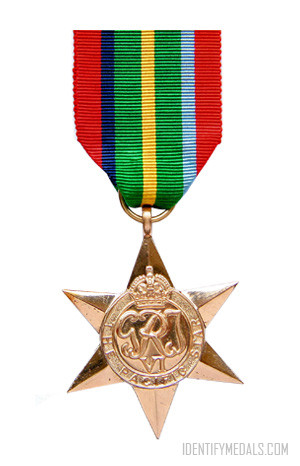
The Pacific Star is a British military campaign medal instituted by the United Kingdom in 1945 for those who served in the Pacific Campaign.

Read More »
The War Medal 1939-1945 Obverse

The War Medal 1939-1945

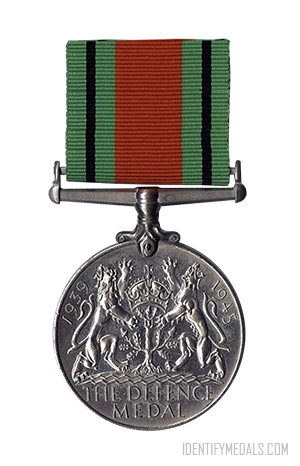
The War Medal 1939–1945 is a British campaign medal instituted by the United Kingdom on 16 August 1945. The medal was awarded to subjects of the British Commonwealth who had served full-time.

Read More »

The South African Medal for War Services

The South African Medal for War Services is a service medal for voluntary unpaid service in support of the war effort during WW2.

The South African Medal for War Services is a South African service medal for voluntary unpaid service in support of the war effort during the Second World War (between 6 September 1939 and 15 February 1946). The South African Medal for War Services was instituted by a Royal Warrant dated 29 December 1945, countersigned and sealed at Cape Town on 6 February 1946.

Altogether 17,500 medals were awarded to people of both sexes, irrespective of whether or not they were British subjects. The requirement was a minimum of two years service, of which at least one year was continuous, rendered voluntarily and without pay within or outside the borders of the Union of South Africa, in one or more of the officially recognized voluntary non-military organizations, such as the Red Cross and the Governor-General’s War Fund, with the proviso that five or more hours were worked every week.

The South African Medal for War Services Design

The medal is circular, struck in silver and measures 36 millimeters in diameter and 3 millimeters thick at the raised rim.

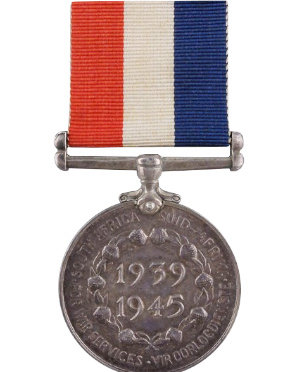
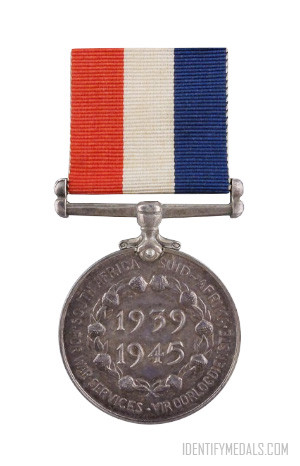
The obverse shows the years “1939” over “1945”, encircled by a wreath of protea flowers, all of which are surrounded by the name of the medal in English and Afrikaans, “SOUTH AFRICA” and “SUID-AFRIKA” above and “FOR WAR SERVICES • VIR OORLOGDIENSTE” below. The reverse bears the Coat of Arms of the Union of South Africa, with the medal number impressed at the bottom on the rim.

The ribbon has three equal stripes of red, white and blue (the national South African colors). The medal is affixed to the suspender by means of claws and a pin through the upper edge of the medal.

More Union of South Africa Medals

The New Zealand Memorial Cross

The New Zealand Memorial Cross is awarded to the next of kin of New Zealand service personnel killed on active service or who died of wounds.

The New Zealand Memorial Cross is a campaign medal awarded to the next of kin of New Zealand service personnel who, since September 1939, have been killed on active service or later died of their wounds. Up to two crosses could be awarded to the family of each individual, and was intended primarily for widows and mothers.

The cross was formally instituted, and full regulations published, in September 1947. Eligibility included both those serving with New Zealand forces and New Zealanders serving with other British Commonwealth forces, including the merchant navy.

In September 1960, further regulations were published extending eligibility to conflicts since the Second World War. Awards have since been made relating to service in Korea, Malaya, Vietnam, East Timor and Afghanistan. In September 1995 relatives of those killed during peacekeeping operations became eligible.

The New Zealand Memorial Cross Design

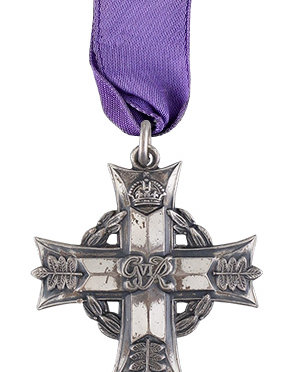
The medal is a cross patoncé struck in dull silver and measures 32 millimeters (1.3 inches) in diameter.

The obverse shows a laurel wreath between the arms of the cross. At the top of the vertical arm is a St. Edward’s Crown, with a fern leaf at the end of each of the other arms. At the center is the reigning monarch’s Royal Cypher.
The reverse is plain, with most crosses engraved with the name, rank and service number of the person commemorated.

The ribbon measures 12 millimeters wide and is royal purple.

The King’s Badge

The King’s Badge is a lapel badge issued to servicemen who, as a result of their injuries, had been discharged from active service.

The King’s Badge is a lapel badge authorized by the Ministry of Pensions in the early part of the Second World War and initially issued to servicemen who, as a result of their injuries, had been discharged from active service.

Its basic purpose was to show that the wearer was a veteran. As well as members of the armed services, merchant navy and fishing fleets qualifying, by late 1944, it was also awarded to the coastguards, police, members of the Civil Defence Services, and the Home Guard. The badge was to be worn only on civilian clothing and by the end of 1941 over 8,000 had been awarded.

Three versions of the badge were produced.

The King’s Badge Design

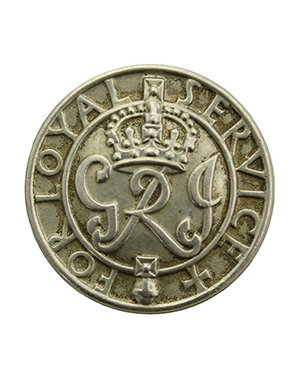
The badge is struck in silver and measures 26 millimeters in diameter.

The obverse shows the initials “GRI” for Georgius Rex Imperator, in this case referring to King George VI. The earlier badge was in the name of his father, George V. The wording around the initials read “For King and Empire Services Rendered to For Loyal Service”.

The reverse is plain and the badges are not numbered or named.

The King’s Medal for Service in the Cause of Freedom

The King’s Medal for Service in the Cause of Freedom was awarded to foreign civilian nationals who had given meritorious service to the Allied cause.

The King’s Medal for Service in the Cause of Freedom is a British medal instituted on 23 August 1945 by King George VI and awarded to foreign civilian nationals, mainly of allied countries, who had given meritorious service to further the interests of the British Commonwealth or the Allied cause during World War II.

Among those activities recognized by the decoration are fundraising for British war relief, scientific research that aided the war effort, and organizing ambulance services. Those who helped British military personnel to escape the enemy, return from occupied areas or for other dangerous work for the British or Allied cause during the war were eligible for the King’s Medal for Courage in the Cause of Freedom.

The medal was awarded 2,539 times.

The King’s Medal for Service in the Cause of Freedom Design

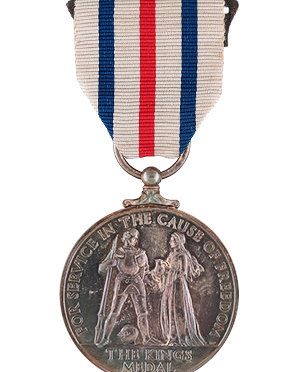
The medal is struck in silver and measures 36 millimeters (1.4 in) in diameter.

The obverse shows the left facing crowned effigy of King George VI with the inscription ‘GEORGIVS VI D:G:BR:OMN:REX ET INDIAE IMP‘.

The reverse bears a medieval warrior in armor carrying a broken lance, being offered sustenance by a woman. The upper circumference is inscribed ‘FOR SERVICE IN THE CAUSE OF FREEDOM‘, with ‘THE KINGS MEDAL‘ below.

The ribbon measures 32 millimeters (1.3 in) wide and is white with a central red stripe, flanked by blue stripes. The medal has a ring suspension and was awarded unnamed.

The Medal of Belgian Gratitude 1940-1945

The Medal of Belgian Gratitude 1940-1945 (Médaille de la Reconnaissance Belge 1940–1945 / Erkentelijkheidsmedaille 1940–1945) is a Belgian medal instituted on 1 August 1945 by the Prince-Regent Karel, in three classes: gold, silver and bronze.

The medal was awarded to civilians, Belgian or foreign alike, who during the war had shown their patriotism in the humanitarian field by acts of courage. A good example of an award to non-Belgians is the gold medal to the Dutch village of Vught, given in recognition of the inhabitant’s attitude towards the Belgian prisoners held in the German concentration camp there.

The Medal of Belgian Gratitude 1940-1945 Design

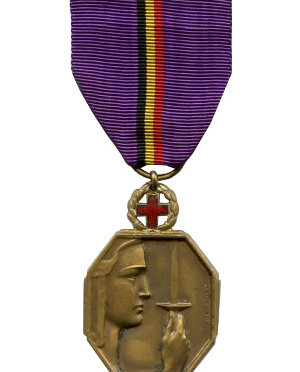
The medal measures 34 mm in diameter and is octagonal and struck in silver.

The obverse depicts a veiled woman (representing Belgium) facing to the right, with a rapier in her right hand, raised in salute. The reverse bears the inscription “PATRIA GRATA 1940 1945” with a decorative pattern on either side of the inscription. Above the medal is a laurel wreath.

The ribbon has central stripes of black, yellow, and pink flanked by purple.
Red Cross members who qualified were awarded a medal with a red enamel cross in the open laurel wreath of the medal’s suspension.

The Commemorative Medal of the War 1940-1945

The Commemorative Medal of the 1940–45 War (Médaille Commémorative de la Guerre 1940–45 / De Herinneringsmedaille van de Oorlog 1940–1945) is a military decoration of Belgium established on 16 February 1945 by royal decree of the Prince Regent to recognize Belgian servicemen and women who served during the Second World War.

The medal was also awarded to members of the Belgian Resistance and members of Belgium’s Merchant Navy on the side of the Allies. Later decrees allowed for its award to foreign recipients of the Belgian Croix de Guerre.

The Commemorative Medal of the War 1940-1945 Design

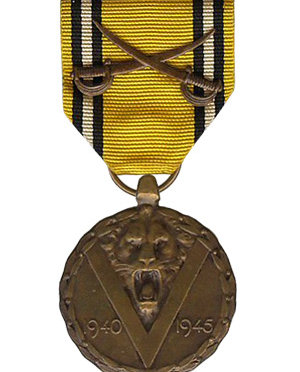
The medal measures 38mm in diameter and is circular and struck in bronze.

The obverse bears a large V for Victory sign with a relief roaring lion in the V, at the lower left was the relief year “1940”, at the lower right the relief year “1945”. A 3mm wide laurel wreath encircled the entire medal on both the obverse and reverse. On the reverse, within a 5mm wide raised circle, the relief inscriptions “MEDAILLE COMMEMORATIVE” within the upper half and “HERINNERINGSMEDAILLE” in the lower half. In the center of the circle, two 3mm high raised horizontal bars positioned 8mm apart bear the relief inscriptions “DE LA GUERRE” / “VAN DER OORLOG“, at the center, between the two horizontal bars, the relief years “1940–1945”.

The ribbon is 37mm wide yellow silk moiré with 8mm wide edge stripes composed of 2mm wide stripes of yellow, black, white and black, the yellow being closest to the edges. The medal is suspended by a ring through a lateral suspension loop.