The Medal of the Recruiting Centers 1940

The Medal of the Recruiting Centers 1940 (Médaille des Centres de Recrutement 1940 / Medaille van de Recruteringscentra van het Belgisch Leger 1940) is a decoration of the Kingdom of Belgium created by royal decree on

 granted to any man between the ages of sixteen and thirty-five who responded to the order, given in  by the Government, to join the recruiting centers of the Belgian army in France from  and whose period of absence from their home must count at least 10 days and have taken place before .

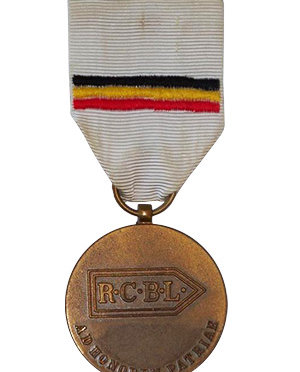
The medal exists in three versions according to the linguistic affiliation of the beneficiary: With the inscription in relief “CRAB” for French speakers, “RCBL” for Dutch speakers and “RZBH” for German speakers.

The Medal of the Recruiting Centers 1940 Design

The medal measures 37 millimeters in diameter and is struck in patinated bronze.

The obverse bears the inscription “CRAB” and “AD HONOREM PATRIAE” in relief and the reverse the year “1940” in relief. The medal is suspended by a ring passing laterally in a suspension barrel at the top of the medal, to a white silk ribbon with a width of 38 mm, in its center horizontally 3 bands of 2 mm, red, yellow and black symbolizing the Belgian flag.
The Medal for Resistance against Nazism in the Annexed Territories

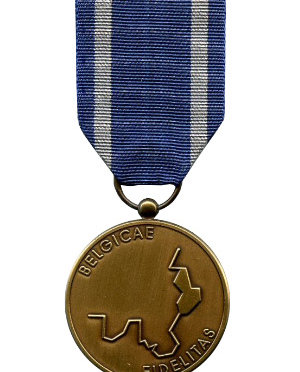
The Medal for Resistance against Nazism in the Annexed Territories (Médaille du Résistant contre le Nazisme dans les Territoires Annexées / Medaille voor Weerstand tegen het Nazisme in de Geannexeerde Gebieden) was established very late, on April 16, 1985.

It was intended for the inhabitants of the German region in Belgium (annexed after the 1st World War) who had actively resisted Nazism during the Second World War: political prisoners, prisoners of war, members of the resistance, saboteurs, and members of the underground press, those who, between May 10, 1940 and January 1, 1943, had – for patriotic reasons – left the region or been expelled from it, those who had forced to enter service with the German army or the labor force in Germany and who had deserted their post before June 6, 1944, etc.

The Medal for Resistance against Nazism in the Annexed Territories Design

The medal is circular and struck in bronze. The obverse bears the inscription “BELGICAE FIDELITAS” and the reverse “1940-1945”.

There are three different ribbons to indicate the category to which the decorated person belonged: to the deserters of the German service the medal with the blue ribbon with yellow bands, with those which had left the region or were expelled with the ribbon with red bands, with the others that with the ribbon white stripes was awarded.

The Escapees’ Cross 1940-1945

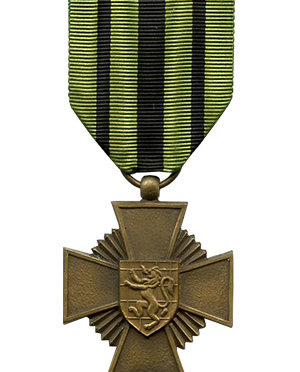
The Escapees’ Cross 1940–1945 (Croix des Évadés 1940–1945 / Kruis der Ontsnapten 1940–1945) is a Belgian war service medal established by the Belgian government in exile in London on 25 February 1944.

The medal was awarded to all Belgian citizens who, during the Second World War escaped from occupied Belgium (or from another occupied land or Germany) and that, following it, had proven their patriotism by joining and serving with a resistance group. It was also awarded for being imprisoned for a minimum of three months following an act of patriotism, or for having traveled clandestinely to participate in a Belgian action aimed at promoting the war against the enemy. 

The medal’s statute was later amended to include those who had escaped also from non-occupied territories and made their way to the United Kingdom in order to continue fighting the enemy (such as those that left the beaches of Dunkirk, non-occupied France or French North Africa).

The Escapees’ Cross 1940-1945 Design

The medal is a cross pattée measuring 39mm wide, with four 7mm long rays radiating outwards between its arms.

The obverse bears a 14mm wide by 18mm high shield bearing a lion rampant superimposed over prison bars. The medal is a single face, and the reverse is bare.

The ribbon is 37mm wide green silk moiré, with a longitudinal 6mm wide central black stripe and narrow 3mm black stripes 6mm from the ribbon edges. The award was suspended by a ring through a suspension loop.

The Prisoner of War Medal 1940-1945

The Prisoner of War Medal 1940–1945 (Médaille du Prisonnier de Guerre 1940-1945 / Krijgsgevangenenmedaille 1940-1945) is a Belgian war service medal established on 20 October 1947 by royal decree.

The medal was awarded to all members of the Belgian Armed Forces imprisoned by Axis Forces during the Second World War.

The Prisoner of War Medal 1940-1945 Design

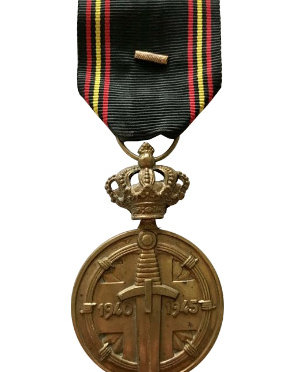
The medal measures 38 mm in diameter and is circular and struck in bronze. It’s surmounted by a three-dimensional 25 mm high royal crown mounted on a pin giving the entire assembly (medal and crown) a height of 64 mm.

The obverse bears a broadsword pointing down superimposed over a Greek cross with slightly flared ends and the years “1940” and “1945” inscribed in relief on the lateral cross arms. Two triangular laurel leaves protrude from between the cross arms fanning out and a ring of barbed wire encircles the cross along the circumference and 3mm from the medal’s edge. The reverse bears a guard tower and prison camp fence surrounded by a chain along the circumference and 3mm from the medal’s edge.

The ribbon is 37 mm wide black silk moiré with narrow longitudinal 1 mm red/black/yellow/black/red stripes 2 mm from the edges. The medal was suspended by a ring through the crown’s orb. The years of imprisonment were denoted on the ribbon by small striated metal bars.

The Political Prisoner’s Cross 1940-1945

The Political Prisoner’s Cross 1940–1945 (Croix du Prisonnier Politique 1940–1945, / Politieke Gevangenkruis 1940–1945) is a Belgian war medal established on 13 November 1947 by royal decree of the Regent and awarded to Belgian citizens arrested and interned by the Germans as political prisoners during the Second World War.

The award’s statute also included provisions for posthumous award should the intended recipient not survive detention, and the right of the widow (the father or the mother of the deceased) to wear the cross.

The Political Prisoner’s Cross 1940-1945 Design

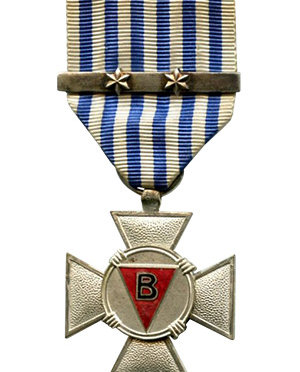
The medal is a cross pattée measuring 37mm wide and is struck in silver.

Its obverse bears a 2 cm in diameter central medallion surrounded by barbed wire with an inverted red enameled triangle with a black capital “B” at its center, representing the insignia internees had to wear on their prisoners’ uniforms that identified them as Belgian political prisoners. The reverse also bears a central medallion but enameled in black and bearing the years “1940 1945” in silver numerals.

The ribbon is 38mm wide white silk moiré with six 3mm wide longitudinal blue stripes 3mm apart from each other, the colors representing the striped prisoners’ uniforms. The cross was suspended by a ring through a suspension loop.

Silver bars with up to four small five or six-pointed stars on them could be worn on the ribbon, each one denoting a period of six months of internment. Many veterans opted instead for small individual silver stars directly affixed to the ribbon. In the case of a posthumous award, a black enameled bar was worn on the ribbon above the others.

The Civilian Disobedience Medal

The Civilian Disobedience Medal (Médaille du Réfractaire / Werkweigeraarsmedaille) is a war service medal of the Kingdom of Belgium established on 12 February 1951 by royal decree and awarded to Belgian citizens refusing to support the German war effort during the Second World War.

The Civilian Disobedience Medal Design

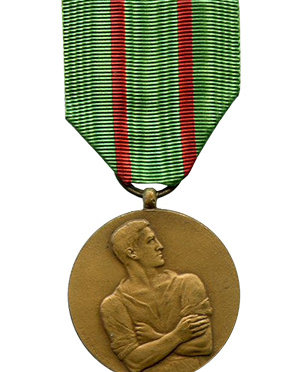
The medal measures 37mm in diameter, and is circular and struck in bronze.

The obverse bears the relief torso of a civilian male with his arms crossed and his face turned away to the right in defiance. The reverse bears the relief inscription on two lines in Latin “FORSAN VICTI NUNQUAM SERVI” roughly translating into “MAYBE DEFEATED BUT NEVER SLAVES“. The years “1940-1945” are inscribed along the reverse’s upper circumference.

The ribbon measures 38mm wide and is silk moiré green, with two 3mm wide longitudinal stripes located 1cm from the edges, the stripes came in three different colors depending on the reason for bestowal:

  • yellow stripes indicated a refusal to serve in the German armed forces;
  • white stripes indicated a refusal to work for the Germans;
  • red stripes indicated a refusal to return to Germany by a forced laborer following leave at home in Belgium.

The medal is suspended by a ring through a suspension loop.

The Civilian Resistance Medal

The Civilian Resistance Medal was established in 1951 and awarded to all members of the Belgian civilian resistance during World War II.

The Civilian Resistance Medal (Médaille du résistant civil / Burgerlijke Weerstandsmedaille) is a war service medal of the Kingdom of Belgium established on 21 March 1951 by royal decree and awarded to all members of the Belgian civilian resistance during the Second World War who were recognized as such by the law of 24 September 1946.

The Civilian Resistance Medal Design

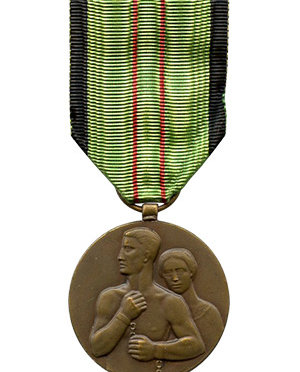
The medal measures 39mm in diameter and is circular and struck in bronze. The obverse bears the relief image of the torso of a man breaking free of chains around his wrists, a woman stands behind him and slightly to his left. The reverse bears the relief inscription in Latin “RESTITERUNT” meaning “THEY RESISTED” with the years “1940” above and “1945” below. The reverse has a slightly raised border.

The ribbon masures 37 mm wide and is light green silk moiré, with two central 1 mm wide red stripes 5 mm apart and 4 mm black edge stripes. The colors of the ribbon are symbolic, the black denoting the dark days of the German occupation and/or the clandestine nature of the resistance, the green stands for the hope of liberation and the red for the spilled blood of the resistance members. The medal is suspended by a ring through a suspension loop.

The Medal of the Armed Resistance 1940-1945

The Resistance Medal 1940–1945 (Médaille de la Résistance 1940–1945 / Medaille van de Weerstand 1940–1945) is a Belgian war medal established on 16 February 1946 by royal decree of the Regent and awarded to all members of the Belgian armed resistance during the Second World War.

The medal was also awarded to members of the intelligence service who operated in occupied territories and participated in combat actions aimed at the liberation of Belgium.

The Medal of the Armed Resistance 1940-1945 Design

The medal measures 39mm in diameter and is circular and struck in bronze.

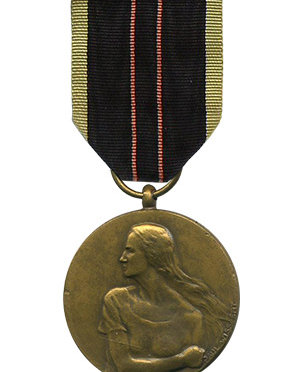
The obverse bears the upper body of a young woman facing left in defiance with her right fist clenched. The reverse bears the relief inscription in Latin on three lines “1940 RESISTERE 1945” superimposed over a laurel wreath.

The ribbon measures 37 mm wide and is black silk moiré, with two central 1 mm wide red stripes 5 mm apart and 4 mm light green edge stripes. The colors of the ribbon are symbolic, the black denoting the dark days of the German occupation and/or the clandestine nature of the resistance, the green stood the hope of liberation and the red for the spilled blood of the resistance members. The medal is suspended by a ring through a suspension loop.

The Commemorative Medal of the Ethiopian Campaign

The Commemorative Medal of the Ethiopian Campaign (Médaille Commémorative de la Campagne d’Ethiopie / Herinneringsmedaille van de Ethiopische Veldtocht) was established by royal decree in January 1947 and awarded for participation in the campaign in Abyssinia for at least one year between 6 March and 3 July 1941.

On 11 March 1941, Belgian forces, together with elements of the British King’s African Rifles attacked Asosa, defeating the occupying Italians before moving on to Gambela and Saio. The Belgian forces besides defending the Belgian Colonies of Congo or Ruanda/Urundi served also in Madagascar, Ethiopia, Nigeria, Libya, Egypt, Sudan and Palestine.

This medal is very rare, as the Belgian forces that participated in the campaign were less than 3000 men. There were possibly fewer than 500 medals actually awarded.

The Commemorative Medal of the Ethiopian Campaign Design

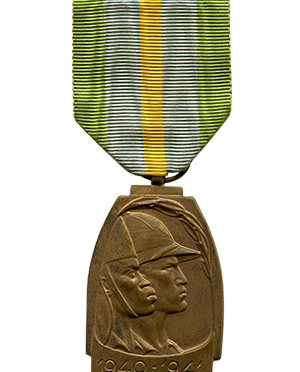
The medal was designed by the sculptor Arthur Dupagne. Struck patinated bronze, of trapezoidal form, it measures 45mm high by 31mm wide and has two curved sides.

The obverse depicts the overlapping right-facing profiles of the head of a European and an African soldier with the date “1940-1941” at the base. The reverse bears the names of the three major actions of the campaign: SAIO, GAMBELA, and ASOSA, with a star above and below.

The ribbon is light blue with green edges and a yellow central stripe.

The claspNigeria” was awarded to the expeditionary force of 13.000 men of the Force Public (Gendarmery and Military force of Belgian Congo consisted of native Congolese troops under the command of Belgian officers and NCOs) who served under British command from 1942 to 1943 in Nigeria – 9.000 of these troops served in Egypt and Palestine and received also the “Middle East” clasp.

The 1940-1945 Colonial War Effort Medal

The 1940–1945 Colonial War Effort Medal (Médaille de l’Effort de Guerre Colonial 1940-1945 / Medaille voor de Koloniale Oorlogsinspanning 1940-1945) is a Belgian war service medal established on 30 January 1947 by royal decree of the Regent and awarded to government civil servants, magistrates, volunteer members of the female auxiliary service, missionaries, civilian agents of the different departments and civilians who served honorably for at least one year in the Belgian Congo or Ruanda-Urundi colonies of the Kingdom of Belgium in Africa between 10 May 1940 and 7 May 1945.

Those eligible for the award of both the 1940–1945 Colonial War Effort Medal and the 1940–1945 African War Medal could only receive one of the two, usually the one earned for the longest service.

The 1940-1945 Colonial War Effort Medal Design

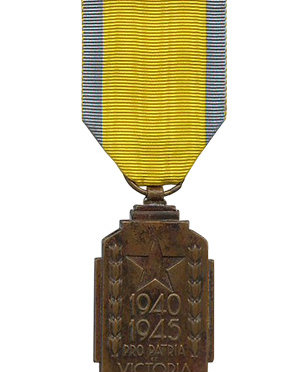
The medal measures 31mm wide by 52mm high, and is struck bronze. It’s rectangular with sloping upper corners.

The obverse bears, at its upper center, an embossed five-pointed star above the relief inscription on five rows “1940” “1945” “PRO PATRIA” “ET” “VICTORIA” between vertical laurel leaves. The reverse is plain.

The ribbon is 37mm wide yellow silk moiré with 5mm wide light blue edge stripes. The medal is suspended by a ring through a lateral suspension hole.