The 1940-1945 African War Medal

The 1940–1945 African War Medal (Médaille de la Guerre Africaine 1940-1945 / Afrikaanse Oorlogsmedaille 1940-1945) is a Belgian war service medal established on 30 January 1947 by royal decree of the Regent and awarded to officers and soldiers for at least one year’s service in the Force Publique between 10 May 1940 and 7 May 1945.

Those eligible for the award of both the 1940–1945 Colonial War Effort Medal and the 1940–1945 African War Medal could only receive one of the two, usually the one earned for the longest service.

The service was not limited to the Belgian colonies of the Congo and Ruanda-Urundi. The following four clasps were issued for wear on the ribbon inscribed in French:

  • NIGERIE (for six months service in Nigeria)
  • MOYEN-ORIENT (for six months service in the Middle East)
  • MADAGASCAR (for six months service in Madagascar)
  • BIRMANIE (for six months service in Burma)

The 1940-1945 African War Medal Design

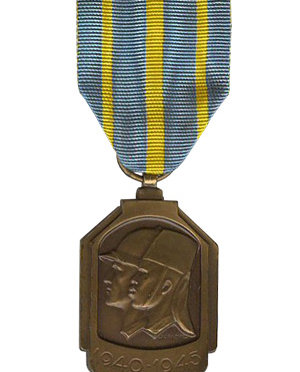
The medal measures 52mm high (including the suspension) by 33mm wide and is rectangular and struck from bronze. It has sloped upper shoulders and rounded lower corners.

The obverse bears the relief images of the left profiles of a native African soldier wearing a fez and of a pith-helmeted Belgian soldier, both within a recessed central area. Under the recess, the embossed years “1940 – 1945”. The reverse is plain.

The Volunteer’s Medal 1940-1945

The Volunteer’s Medal 1940–1945 (Médaille du Volontaire 1940–1945 / Medaille van de Oorlogsvrijwilliger 1940–1945) is a Belgian war medal established on 16 February 1945 by royal decree of the Regent and awarded to Belgian and foreign civilians who voluntarily enlisted in the Belgian Armed Forces during the Second World War.

The medal could also be awarded to volunteers serving in the Belgian units of the Royal Air Force, Royal Navy or British merchant navy.

The Volunteer’s Medal 1940-1945 Design

The medal measures 38 mm in diameter and is circular and struck in bronze.

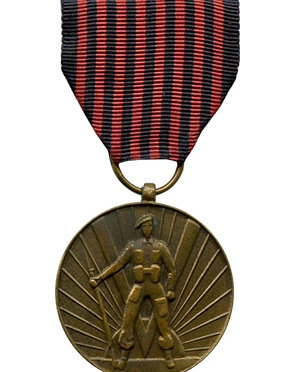
The obverse bears the relief image of a soldier standing at ease holding a rifle with a bayonet, with the soldier is superimposed over a large capital letter V in front of a rising sun. The reverse bears the relief image of the Flemish lion rampant below the inscription in Latin “VOLONTARIIS“, and the inscription of the dates “1940” and “1945“.

The medal was suspended by a ring through the suspension loop from a 38 mm wide silk moiré ribbon composed of fifteen 2 mm wide alternating red and blue stripes and two 4 mm wide blue edge stripes.

The 1940-1945 Military Combatant’s Medal

The 1940–1945 Military Combatant’s Medal (Médaille du Combattant Militaire de la Guerre 1940–1945 / Medaille van de Militaire Strijder 1940–1945) is a Belgian war medal established on 19 December 1967 by royal decree and awarded to all members of the Belgian Armed Forces who fought from England during the Second World War.

The 1940-1945 Military Combatant’s Medal Design

The medal measures 38mm wide is Greek cross struck in bronze, with semi-circular protrusions filling the gaps between the arms up to 3mm from the cross arms’ ends.

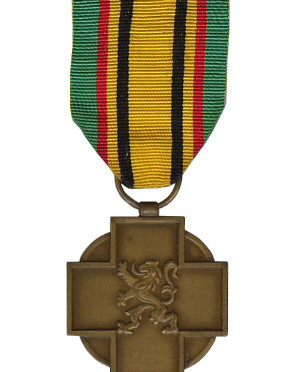
The obverse bears the relief image of a lion rampant at the center of the cross. The reverse bears a vertical broadsword bisecting the years “1940” and “1945” inscribed in relief.

The ribbon is 36mm wide silk moiré with the colors divided as follows from the left to the right edge: 6mm green, 2mm red, 3mm yellow, 2mm black, 1 cm yellow, 2mm black, 3mm yellow, 2mm red, 6mm green. The medal is suspended by a ring through a suspension loop.

The Maritime Medal 1940-1945

The Maritime Medal 1940–1945 (Médaille Maritime 1940–1945 / Maritieme Medaille 1940–1945) is a Belgian bravery award of World War II, established on 17 July 1941 by Royal Decree and awarded to members of the Belgian Navy, merchant navy or fishing fleet (later also all naval personnel for service of two years onboard an allied warship and those shipwrecked twice due to combat action) for acts of heroism in the saving of ships or lives during action against the enemy.

The Maritime Medal 1940-1945 Design

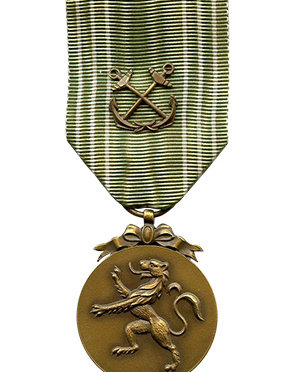
The medal measures 38mm in diameter and is circular and struck in bronze. Its obverse bears the relief image of a lion rampant. The reverse bears the royal cipher of King Leopold III

The ribbon is 38mm wide ocean green silk moiré. There are six 1mm wide white stripes, three at left and three at right separated by 3mm each starting 3mm from the ribbon’s edges. The medal is suspended by a ring through the suspension loop. Miniature crossed bronze sea anchors are affixed to the ribbon, sizes vary greatly depending on the maker.

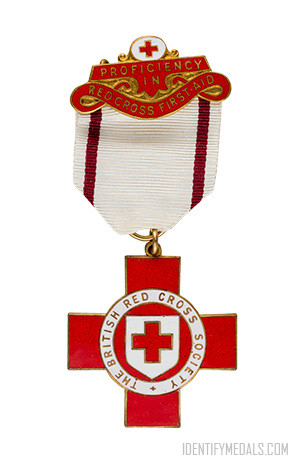
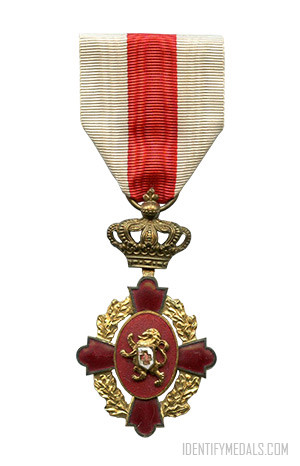
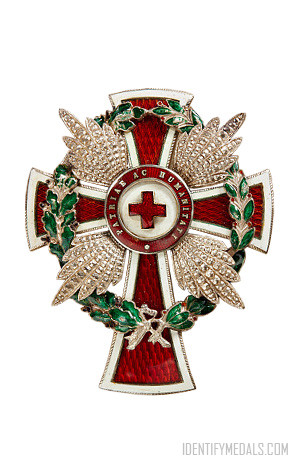
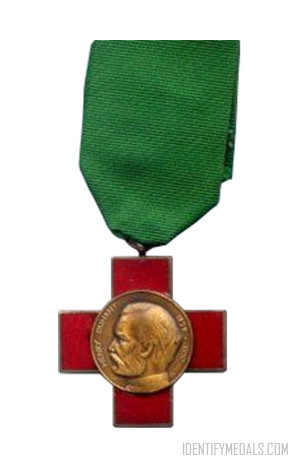
The 1940-1945 Belgian Red Cross Decoration

The 1940-1945 Belgian Red Cross Decoration (Décoration de la Croix Rouge Belge 1940–1945 / Ereteken van het Belgische Rode Kruis 1940–1945).

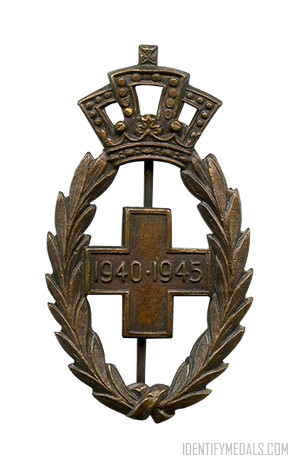
The 1940-1945 Belgian Red Cross Decoration (Décoration de la Croix Rouge Belge 1940–1945 / Ereteken van het Belgische Rode Kruis 1940–1945) is a Belgian Red Cross decoration.

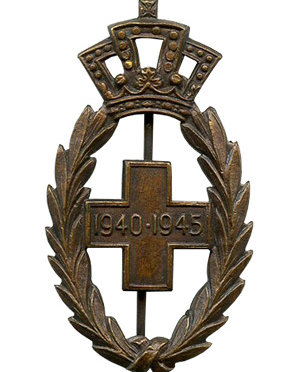
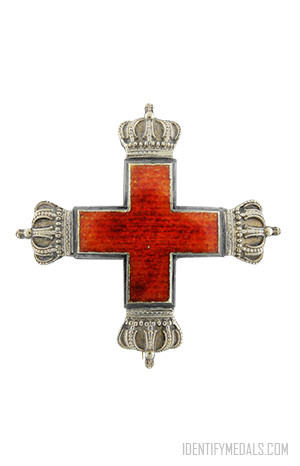
It consists of a gilding metal pin-back badge of 60mm max height in the form of an openwork crowned pair of vertically elongate palms. The palms support the Greek Red Cross symbol in the center, which bears the dates ‘1940 -1945’ across the horizontal arms.

Find Red Cross Medals Online

More Red Cross Medals

The War Cross (Belgium)

[vc_row][vc_column width=”1/4″][vc_single_image image=”6490″ img_size=”full”][/vc_column][vc_column width=”3/4″][vc_column_text]

The War Cross (Belgium)

[/vc_column_text][vc_column_text]

Institution: 25 October 1915
Country: Belgium

[/vc_column_text][vc_separator css=”.vc_custom_1526473075957{padding-top: 16px !important;padding-bottom: 16px !important;}”][vc_column_text]The War Cross (Croix de guerre / Oorlogskruis) is a military decoration of the Kingdom of Belgium established on 25 October 1915 by royal decree and primarily awarded for bravery or other military virtue on the battlefield, or for three years or more of service on the front line, or good conduct on the battlefield. It was only awarded to individuals.

The award was reestablished on 20 July 1940 by the Belgian government in exile for recognition of bravery and military virtue during World War II. The decoration was again reestablished by royal decree on 3 April 1954 for award during future conflicts.

The War Cross was also awarded to volunteers after a minimum of 18 months of service, to escaped prisoners of war rejoining the armed forces, and to military personnel who were placed on inactive duty because of injury.[/vc_column_text][vc_column_text css=”.vc_custom_1590656067244{padding-top: 24px !important;}”]

The War Cross (1915) Design

WW1

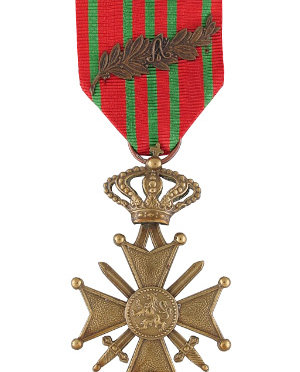
The War Cross from WW1 is a 40mm wide and 65mm high bronze Maltese cross with 3mm balls at its eight points.

On its obverse, it has a 14mm central medallion bearing the relief image of a lion rampant. On its reverse is the royal cypher of King Albert I. Two 37mm long crossed swords point upwards between its arms. A 14mm high “inverted V” between the two points of the top cross arm is secured to the inside of a high royal crown, and the ribbon’s suspension ring passes through the top orb of the crown.

The ribbon of the WW1 War Cross is red and measures 38 mm (1.5 in) wide, with five 2 mm (0.079 in) wide light green longitudinal stripes, three at the center separated by 3 mm (0.12 in) and one on each side 3 mm from the edges.

When the person being awarded was mentioned in despatches, the distinction was denoted by a device worn on the ribbon, either a small lion or a palm adorned with the monogram “A”.

WW2

The WW2 War Cross shows slight changes to the reverse of the central medallion (the royal cypher was that of King Leopold III) and the ribbon. Because the award was now also authorized as a unit award, those presented to a unit were denoted by a ribbon of the war cross being affixed to the unit colors.

The new ribbon was still red with light green stripes but there were now six, 1mm wide, and positioned three on each side 2mm apart beginning 2mm from the edge of the ribbon.[/vc_column_text][vc_raw_html css=”.vc_custom_1590656126997{padding-top: 40px !important;}”]JTNDaW5zJTIwY2xhc3MlM0QlMjJlcG4tcGxhY2VtZW50JTIyJTIwZGF0YS1jb25maWctaWQlM0QlMjI1ZWNmN2M3OGM2NWQ2MDQ3MmIxYTYzY2MlMjIlM0UlM0MlMkZpbnMlM0U=[/vc_raw_html][/vc_column][/vc_row][vc_row][vc_column][vc_column_text css=”.vc_custom_1590504426327{padding-bottom: 24px !important;}”]

Explore More Belgian Medals – See All >

[/vc_column_text][vc_basic_grid post_type=”post” max_items=”18″ style=”pagination” items_per_page=”6″ element_width=”2″ gap=”20″ arrows_design=”vc_arrow-icon-arrow_06_left” arrows_position=”outside” paging_design=”none” item=”masonryGrid_Default” grid_id=”vc_gid:1590655230493-00ce8aa7-b6aa-3″ taxonomies=”127″ el_class=”relatedMedals”][/vc_column][/vc_row][vc_row][vc_column][vc_column_text css=”.vc_custom_1590656143680{padding-bottom: 24px !important;}”]

Explore More Medals from WW1 – See All >

[/vc_column_text][vc_basic_grid post_type=”post” max_items=”18″ style=”pagination” items_per_page=”6″ element_width=”2″ gap=”20″ orderby=”rand” arrows_design=”vc_arrow-icon-arrow_06_left” arrows_position=”outside” paging_design=”none” item=”masonryGrid_Default” grid_id=”vc_gid:1590655230496-c0ab4813-3062-9″ taxonomies=”4″ el_class=”relatedMedals”][/vc_column][/vc_row][vc_row][vc_column][vc_column_text css=”.vc_custom_1590656240664{padding-bottom: 24px !important;}”]

Explore More Medals from WW2 – See All >

[/vc_column_text][vc_basic_grid post_type=”post” max_items=”18″ style=”pagination” items_per_page=”6″ element_width=”2″ gap=”20″ orderby=”rand” arrows_design=”vc_arrow-icon-arrow_06_left” arrows_position=”outside” paging_design=”none” item=”masonryGrid_Default” grid_id=”vc_gid:1590656226877-e32a1611-d274-6″ taxonomies=”8″ el_class=”relatedMedals”][/vc_column][/vc_row]

The 1941-45 Great East Asia War Medal

The 1941-45 Great East Asia War Medal (Daitōa sensō jūgun kishō) is a Japanese medal established on June 21, 1944 by Imperial Edict No. 417.

  • Time Period: WW2
  • Institution: 7 December 1944
  • Country: Medals from Japan Japan

The 1941-45 Great East Asia War Medal (or 大東亜戦争従軍記章Daitōa sensō jūgun kishō in Japanese) was a Japanese medal established on June 21, 1944 by Imperial Edict No. 417.

It’s not clear to whom this medal would have been awarded, but it was likely designed to become a common medal
like the China Incident War Medal. After the war ended in defeat, the circa 10,000 struck medals were destroyed by the American occupying forces.

To commemorate the 35th Anniversary of the end of the war, a new series of medals were struck by the Nihon Gouyuu Renmei, which may be translated as Federation of Japan Nationalists. The new medal bears the inscription ‘Great East Asia War, Showa 16 [1941] December 8th to Showa 20 [1945] August 15th.’

The 1941-45 Great East Asia War Medal Design

The medal was designed by the famous sculptor and designer Hinago Jitsuzou (1892-1945). It’s a a tin alloy on jointed suspension bar. The attached bar reads ‘War Medal.’

The obverse has a central Imperial Mum crest imposed on two crossed Japanese swords and, a rayed star and a ring of blossoms on the rim. The reverse a map of East Asia, inscribed with characters meaning ‘Great East Asia War Medal’.

Several post-war replicas made for veterans in the 1960s.

The 1937-45 China Incident War Medal

The China Incident Medal was established in 1939 and awarded for service at any time from the 12th to the 20th years of the Shōwa period.

  • Time Period: WW2
  • Institution: 7 December 1939
  • Country: Medals from Japan Japan

The China Incident Medal (or 支那事変従軍記章Sina jihen jūgun kishō) was established by Imperial Edit No. 496 on July 27, 1939 and awarded for service in China at any time from the 12th through the 20th years of the Shōwa period (1937–1945).

An amendment was promulgated by Imperial Edict No. 418 in 1944, and the decoration was abolished in 1946 by government ordinance No. 177. Although the Japanese government still uses “China Incident” in formal documents, media in Japan often paraphrase it with other expressions like Japan-China Incident (日華事変Nikka jihen) or (日支事変Nisshi jihen). 

This medal is one of the most commonly found Japanese awards. Millions were made for those who served.

The China Incident Medal Design

The medal is struck in bronze and has a swivel grip.

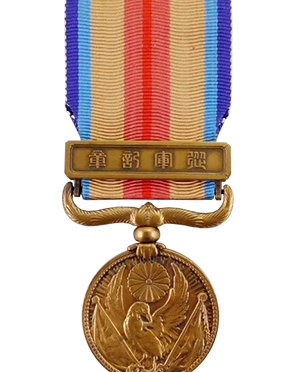
The obverse shows crossed flags, the imperial mum crest, and a crow. The reverse shows mountains, clouds, and waves, as well as the inscription ‘China Incident.’ The ribbon is 37mm wide, watered, of 3 mm blue (the
sea and the Navy), 7.5 mm tan (the soil of China, for the Army), 3.5 mm dark pink (the bloodstained soil of China), and 2 mm bright red (blood and loyalty).

The Royal Bulgarian Observer’s Badge

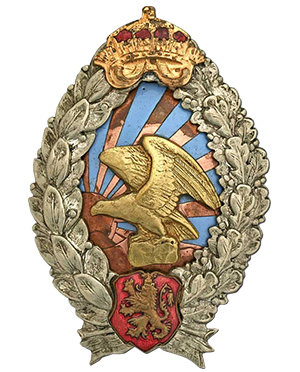
The Royal Bulgarian Observer’s Badge was instituted in 1935 and worn by Bulgarian observers during WWII as well as awarded to German Luftwaffe observers serving with Bulgarian airmen.

The badge is made in silvered bronze, white metal, and enamels. It measures 36 millimeters by 52 millimeters and is made of multiple pieces with a backing plate and fastening screw on the reverse. It was manufactured by Bulgarian and German manufacturers.

The Royal Bulgarian Observer’s Badge was discontinued in 1944.

The Royal Bulgarian Pilot’s Badge

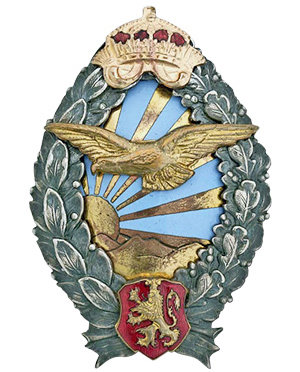
The Royal Bulgarian Pilot’s Badge was instituted in 1936 and often awarded to German pilots serving on the Balkans alongside Bulgarian airmen.

The badge is made in silvered bronze, white metal, and enamels. It measures 36 millimeters by 52 millimeters and is made of multiple pieces with a backing plate and fastening screw on the reverse. It was manufactured by Bulgarian and German manufacturers.

The Royal Bulgarian Pilot’s Badge was discontinued in 1944.