The Order of Suvorov

The Order of Suvorov (or Орден Суворова) is a military decoration established in 1942 and named in honor of Count Alexander Suvorov.

The Order of Suvorov (or Орден Суворова in Russian) is a military decoration established on July 29, 1942 and named in honor of Russian Field Marshal Count Alexander Suvorov (1729–1800). The Order was originally a Soviet award, created to reward senior army personnel for exceptional leadership in combat operations.

The Order was divided into three different classes: 1st class, 2nd class, and 3rd class. The Order 1st class was awarded to army commanders for exceptional leadership of combat operations. The Order 2nd class was awarded to corps, division, and brigade commanders for a decisive victory over a numerically superior enemy. The Order 3rd class was awarded to regimental commanders, their chiefs of staff, and battalion and company commanders for outstanding leadership leading to a combat victory. 

Following the 1991 dissolution of the USSR, the Order of Suvorov was retained unchanged but it was not awarded in this form. The Presidential Decree 1099 of September 7, 2010 modernized and reorganized the entire Russian awards system away from its Soviet past changed the statute of the Order to a single-class medal. 

The Order of Suvorov Design

The Order of Suvorov measures 40 mm wide and is a gold plated cross pattée with silver rays protruding from the center outwards between the arms of the cross to form a square.

The obverse center has a circular convex medallion bearing the gilded bust of Alexander Suvorov in profile and facing left. Below, on the medallion lower edge, are crossed branches of oak and laurel. At the upper part and following its circumference is the inscription in red enameled embossed letters “ALEXANDER SUVOROV” (АЛЕКСАНДР СУВОРОВ). The reverse is bare except for the award serial number.

The Order is suspended by a ring through a suspension loop to a standard Russian pentagonal mount covered by a 24mm wide green silk moiré ribbon with a 5mm wide orange central stripe. The Order of Suvorov is to be worn on the left side of the chest and immediately after the Order of Alexander Nevsky.

The Order of Alexander Nevsky

The Order of Alexander Nevsky is an order of merit bestowed to civil servants for twenty years + of highly meritorious service.

The Order of Alexander Nevsky (or орден Александра Невского in Russian) is an order of merit of the Russian Federation bestowed to civil servants for twenty years or more of highly meritorious service and named in honor of saint Alexander Nevsky (1220–1263). It was awarded to Red Army commanders who displayed personal bravery in fighting for their country in World War II, for courage, bravery and skillful leadership that ensured success.

It was originally established by the Soviet Union as a military honor during World War II on July 7, 1942. Its statute was amended by Decree of the Presidium of the Supreme Soviet of the USSR of February 26, 1947.

The Order of Alexander Nevsky was reinstated by the Soviet Union for award to officers of the army for personal courage and resolute leadership. The Order was retained by the new Russian Federation following the dissolution of the USSR but was never awarded. The September 7, 2010 Decree №1099 amended the statute of the Order making it a purely civilian award.

The Order of Alexander Nevsky Design

The Order of Alexander Nevsky (in its Soviet and early Russian Federation version) is made of silver, measures 50 mm wide and is a high ruby-red enameled, five-pointed convex star superimposed on a decagon composed of polished diverging rays. The star had gold-plated rims and edges.

In the center of the star, a central medallion bearing the left profile relief image of a helmeted Alexander Nevsky and the inscription along the left and right circumference in prominent letters “ALEXANDER NEVSKY” («АЛЕКСАНДР НЕВСКИЙ»). The central medallion is surrounded by a gilt laurel wreath bisected at its base by a silver shield bearing the hammer and sickle, the shield is superimposed over gilded sword, spear, bow and quiver of arrows. Two gilt pollaxes cross behind the central medallion, their outward facing blades protruding on either side of the five pointed star’s top arm and extending slightly past the decagon’s outer edge, their base visible just inside of the star’s two lower arms.

The original Order was suspended by a ring through a suspension loop, which was changed in 1943 to a threaded stud and nut attachment on the reverse. The design of the early Russian Federation variant of the Order differed from the Soviet variant only in the abrogation of the hammer and sickle from the silver shield on the obverse.

The Order of the Patriotic War (USSR)

The Order of the Patriotic War (Орден Отечественной войны) is a  Soviet military decoration established in 1942 and awarded for heroic deeds.

The Order of the Patriotic War (or Орден Отечественной войны in Russian) is a  Soviet military decoration established on 20 May 1942 and awarded for heroic deeds during WW2 or the German-Soviet War to all soldiers in the Soviet armed forces, security troops, as well as to partisans.

This was the first Soviet order established during the war, and the first Soviet order divided into classes. Deeds are awarded with the order (shooting down three aircraft as a fighter pilot, destroying two heavy or three medium or four light tanks, capturing a warship, repairing an aircraft under fire after landing on a hostile territory, etc) were awarded with the first class.

The medal was also given to some allied troops and commanders, including western allies. Altogether, over 324,903 of the 1st class and 951,652 of the 2nd class were issued during the war. 

The Order of the Patriotic War Classes

The Order of the Patriotic War had two classes:

  1. First Class: Awarded for acts of bravery and courage displayed in combat against the enemy. It was typically bestowed upon soldiers, sailors, and airmen who demonstrated exceptional valor or leadership on the battlefield. Recipients of the First Class were often recognized for their direct involvement in significant military operations, such as leading successful assaults, repelling enemy attacks, or capturing strategic objectives.

  2. Second Class: Awarded for various contributions to the war effort, including acts of bravery, distinguished service, or significant achievements in support of the Soviet war machine. While the criteria for the Second Class were less stringent than those for the First Class, recipients were still required to demonstrate commendable conduct and dedication to the defense of the Soviet Union. This class of the order was often bestowed upon individuals who displayed courage under fire, rendered valuable assistance to their comrades, or made significant sacrifices for the cause of victory.

The Order of the Patriotic War Medal Design

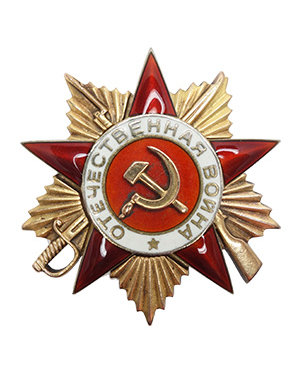
The Order of the Patriotic War medal features a red enamel five-pointed star, made of silver, with straight rays in the background, and crossed sabre and a Mosin rifle. The rays in the background are golden for the First Class and silver for the Second Class.

The central disc has a golden hammer and sickle on a red enamel background, surrounded by a white enamel ring with the words ОТЕЧЕСТВЕННАЯ ВОЙНА (“Patriotic War”). Anniversary orders of 1985 were made cheaper, as a single silver piece, gold-plated in the 1st class.

The ribbon varies slightly depending on the class:

  • Order of the Patriotic War – First Class Ribbon
  • Order of the Patriotic War – Second Class Ribbon
The Order of the Patriotic War - MEDIA

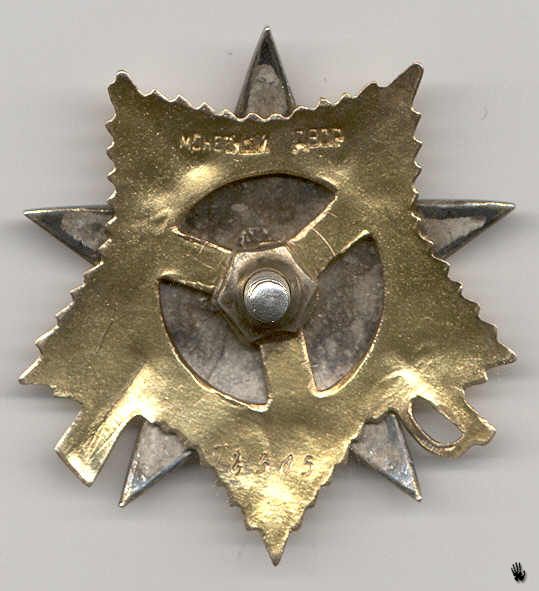
The Order of the Patriotic War, 1st class, reverse.
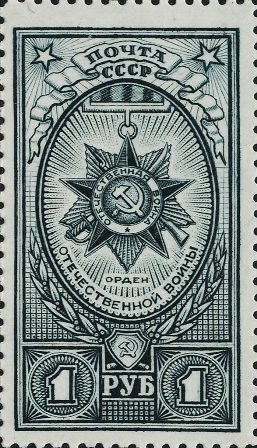
Order of the Patriotic War depicted on a 1943 postage stamp.
The Order of the Patriotic War depicted on a 1943 postage stamp. Wikipedia.

The British Red Cross Medal for Proficiency

Members of the Red Cross had to have three successive certificates in appropriate subjects (nursing, first aid, hygiene and sanitation).

Members of the Red Cross had to have three successive certificates in appropriate subjects (nursing, first aid, hygiene and sanitation) with an interval of at least 12 months between the dates of each certificate gained.

A proficiency badge was awarded after the third successful examination, and after the 4th and subsequent examinations the Red Cross members would be given proficiency bars. Each proficiency badge had the relevant subject on the ornamental brooch and a different ribbon for each subject.

The British Red Cross Society and the Order of St John formed the Joint War Organisation, offering extensive services for the sick and wounded, for prisoners of war, and for civilians needing relief as a result of enemy action, at home and abroad. The joint organization created ambulance departments for the transportation of the wounded, established convalescent homes and auxiliary hospitals, sometimes in private properties across the UK.

The British Red Cross Medal for Proficiency Badge Design

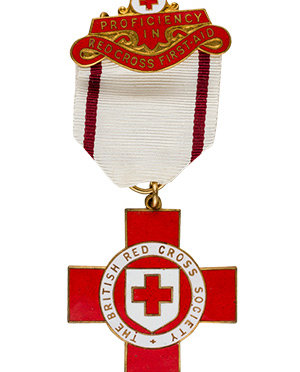
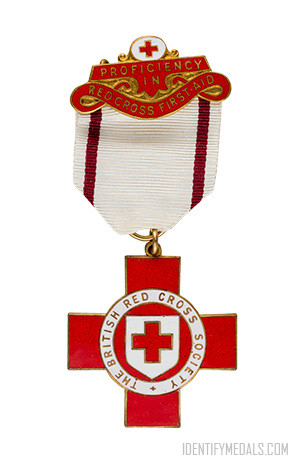
On the obverse of the medal is a red cross enamel medal with a central white shield and another red cross in the center surrounded by a circular white band with the following inscription in gold: “THE BRITISH RED CROSS SOCIETY”.

Suspended to the white with two thin purple striped ribbon is a metal clasp with inscription in gold on red enamel background “PROFICIENT IN RED CROSS FIRST AID” and a red cross on the white circular background.

On the reverse is engraved the ID and the full name of the person awarded the badge. The badge measures approximately 3.7”x 1.6” at its widest points.

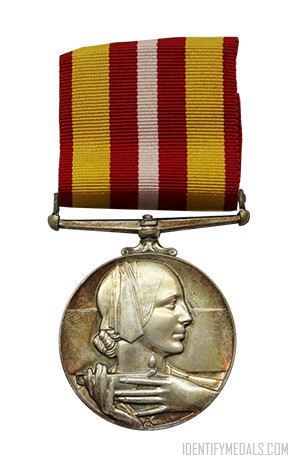
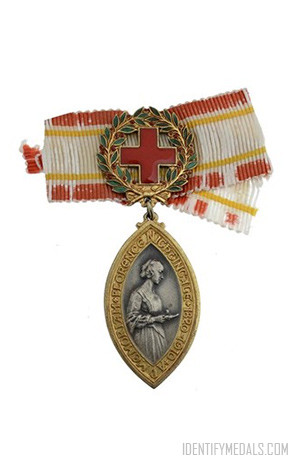
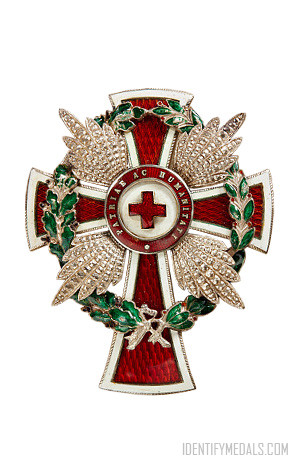
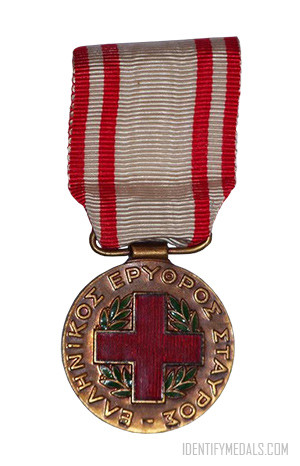
Find Red Cross Medals Online

More Red Cross Medals

The Navy and Marine Corps Medal

The Navy and Marine Corps Medal is the highest non-combat decoration awarded for heroism to the members of the U.S. Navy and Marine Corps.

The Navy and Marine Corps Medal is the highest non-combat decoration awarded for heroism to the members of the United States Navy and United States Marine Corps.

The medal was established by an act of Congress on 7 August 1942 and it was first bestowed during World War II (as retroactive to 6 December 1941). During the mid-20th century, the Navy and Marine Corps Medal was awarded instead of the Silver or Gold Lifesaving Medal, for sea rescues involving risk to life.

For heroic performance to rise to this level it must be clearly established that the act involved very specific life-threatening risk to the awardee.

The Navy and Marine Corps Medal Criteria

The Navy and Marine Corps Medal is typically awarded for actions taken to save or attempt to save the lives of others, such as rescuing individuals from drowning, providing aid during a disaster, or protecting others from harm. It is also presented to those who display significant courage in non-combat situations, such as when risking their lives to protect naval or marine assets or personnel.

The Navy and Marine Corps Medal Design

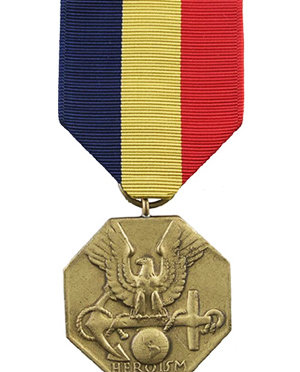
The Navy and Marine Corps Medal is an octagonal bronze medal.

The obverse of the Navy and Marine Corps medal depicts an eagle holding a fouled anchor over a globe. The word Heroism is inscribed below the globe. 

The medal’s ribbon is three equal stripes of navy blue, old gold, and apple red.

Additional awards of the medal are denoted by gold or silver ​516 inch stars.

Buy a Navy and Marine Corps Medal

Note: As an eBay partner, I earn from qualifying purchases. This is all done automatically when you use a link and at no extra cost to you.

Right Now on eBay 
Clicking a link to eBay may result in a referral commission being paid if a purchase is made.
Loading...

The Bukochosho Medal

Time Period: WW2

Institution: 7 December 1944
Country: Medals from Japan Japan

The Rikugun Bukōkishō (陸軍武功徽章 “Badge for Military Merit”), commonly called the Bukōshō, was a military decoration of the Empire of Japan established on 7 December 1944 by Imperial edict.

The medal was awarded by the Imperial Japanese Army (IJA) to living soldiers who had performed with exceptional valor in battle. Airmen, especially fighter pilots defending Japan against enemy bombers, were most likely to win the award. Eighty-nine Bukōshō were awarded during the eight months it was actively awarded.

Emperor Hirohito established the award on 7 December 1944, the third anniversary of the attacks on Hong Kong and Pearl Harbor, which had signaled the start of the broader Pacific War.

The Bukōshō was allowed to be given retroactively to soldiers who had distinguished themselves as far back as 1941 or perhaps 1940. In practice, the award was given disproportionately to fighter pilots flying against the American Boeing B-29 Superfortresses bombing the Japanese homeland.

The Bukochosho Medal Design

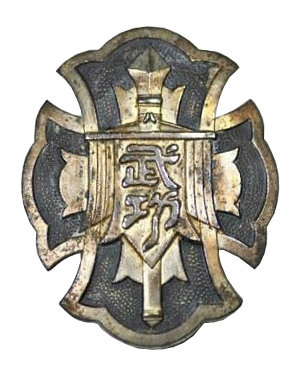
The Bukōshō (as it was popularly known) was presented in two classes, called A and B, or First and Second. The Bukōshō was a pin back badge, cast in iron or steel, featuring two shields (in gilt for A-Class, bronzed for B-Class) forming a cross, with a gilt banner at the center bearing the two kanji characters “Bukō” (Military Merit).

The reverse side (again in gilt for A-Class, bronzed for B-Class) bore the six kanji characters in two columns “Rikugun/Bukōchōshō” (Army/Badge for Military Merit). Both classes were the same size: 50 mm (2.0 in) high and 40 mm (1.6 in) wide.

The Medal for the War of 1941–1945

  • Time Period: WW2
  • Year of Institution: 2 March 1946
  • Country: Greece

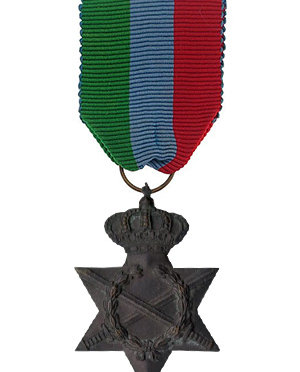
The Medal for the War of 1941–1945 was established on 2 March 1946 and awarded to members of the Royal Hellenic Armed Forces who had seen action. It was created as a star for land operations.

The medal was bestowed upon Royal Hellenic Armed Forces personnel for operational services to the Army in North Africa, the South Aegean Sea and Italy. Several thousands of Army personnel, the majority of the Fleet and the remaining airplanes escaped to Turkey or were evacuated to Egypt after the capitulation of the Continental Greece and the battle of Crete respectively. At the British controlled Middle East the Hellenic Armed Forces were reorganized and reequipped (with British assistance) while more personnel either from Greece or from the existing Greek population in Egypt joined their ranks.

Soon the Hellenic Armed Forces of the Middle East were able to form 2 Brigades, a Special Forces Unit (Sacred Band or Sacred Company in Greek) attached to 1st SAS. The Hellenic Royal Navy with 44 ships and over 8,500 men, became the second-largest Allied Navy in the Mediterranean after the RN, accounting for 80% of all non-RN operations.

The Hellenic Royal Air Force formed 3 Squadrons (the 335 and 336 Fighter Squadrons – equipped with Hurricanes and later with Spitfires – and the 13th Naval Cooperation Squadron which operated with Blenheims and later with Batimores).

The Hellenic Armed Forces participated to the Battle of El Alamein, to the Operations for Liberation of several Greek islands of the Aegean Sea after the capitulation of Italy, to the operation in Sicily and South Italy while several ships of the Hellenic Royal Navy supported the landing in Normany.

The Medal for the War of 1941–1945 Design

The ribbon shows what appears to be water / storage damage.

The Medal for the War of 1940–1941

  • Time Period: WW2
  • Year of Institution: 19 August 1947
  • Country: Greece

The Medal for the War of 1940–1941 was instituted by Royal Decree of August 19th 1947 to recognize the actions of the Royal Greek Armed Forces who took part in the war efforts from the outbreak of the war in Greece in 1940 until the fall of Crete in 1941 (it covers the campaigns in Epirus, Albania, Macedonia, Thrace and Crete.)

The medal was also awarded to foreign forces that fought on Greek soil.

The Medal for the War of 1940–1941 Design

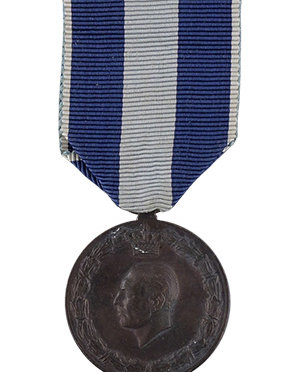
The medal can either be of bronze or of gilt. The riband is of a dark blue color with a pale blue center stripe and two narrow white edge stripes. Some variations have a more grey stripe in the center. Every recipient receives a certificate with the recipients name.

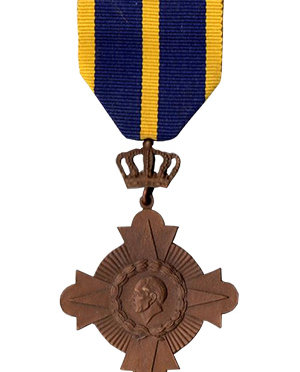
The obverse bears the head of King George II, surrounded with a laurel wreath. The wreath is at the top joined by a crown. In 1983 the obverse was changed because of the changing of Greece from a kingdom to a republic in 1974. From 1983 the obverse shows a headless winged female figure above the inscription “1940-41”. The figure is surrounded by a laurel wreath, at the top joined by the Greek word for “Greece”.

The reverse has original a Greek inscription meaning “1940-41 Eprius, Albania, Macedonia, Thrace, Crete” for Army medals and “1940-41 Aegean, Ionian, Myrtoum, Adriatic” for Navy medals. From 1983 the “1940-41” was removed but the rest remained.

The Medal for the National Resistance (Greece)

  • Time Period: WW2
  • Year of Institution: 22 December 1948
  • Country: Greece

The Medal for the National Resistance was instituted on 22 December 1948 to commemorate the Nation’s Resistance during the Second World War.

It was awarded in one class and bestowed upon those who had actively served in, or had been of assistance to Greek National Resistance Organizations in their struggle against occupying Italo-German forces between 1941 and 1945. 

Those who served with the British Special Operations Executive Military Mission to Greece are eligible for the award. As are escaped prisoners of war who joined Greek Resistance organizations.

The Medal for the National Resistance Design

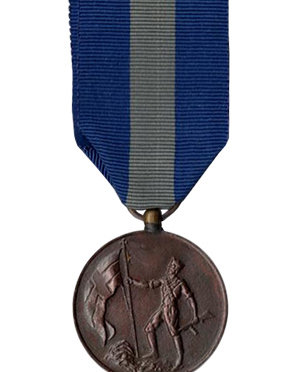
The Medal is a bronze medallion, the obverse of which depicts an armed Greek Resistance Fighter planting the National Flag on a rock. The reverse bears the inscription ‘National Resistance, 1941 – 1945’ in Greek.

The medal is pendent on a riband of dark blue with a wide grey center stripe. Some examples include a small bronze bar bearing the year of service on the riband.

The Maritime War Cross (Greece)

  • Time Period: WW2
  • Year of Institution: 1943
  • Country: Greece

The Maritime War Cross was established in 1943 by the Greek Government in Exile in 3 classes: bronze, silver and gold. It was awarded to the Officers and Sailors of the Hellenic Merchant Navy with at least 6 months of service aboard a merchant vessel.

It was also awarded to Officers of the Hellenic Royal Navy who commanded convoy escorts and also to Officers and Sailors of the Hellenic Royal Navy who served aboard merchant ships during the War.

The Maritime War Cross Design

The medal shows the motto: “Μέγα το της Θαλλάσης Κράτος” (in liberal translation: Powerful is the State that Controls the Sea). The phrase had been used for the first time by Thucydides and it is the motto of the Hellenic Navy.

Some versions of the medal were British made by Spink and Son Ltd, London (this is marked on the reverse of the crown).