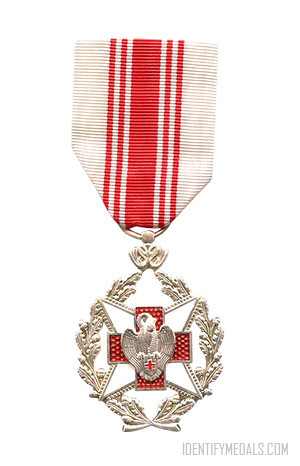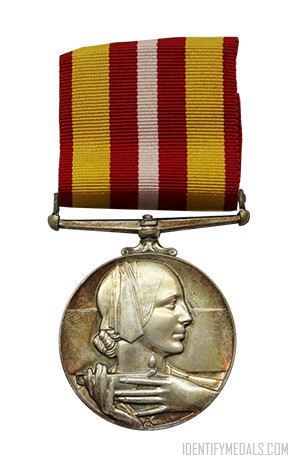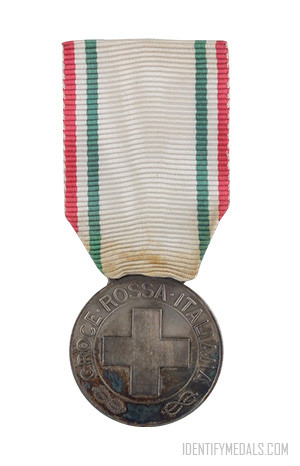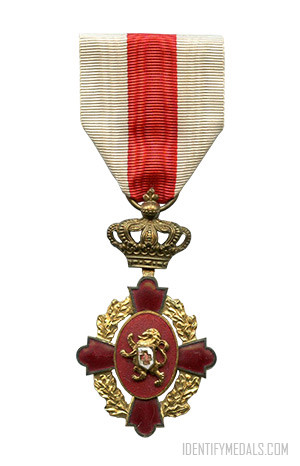
The Royal Hellenic Navy Campaign Cross

  • Time Period: WW2
  • Year of Institution: 22 December 1943
  • Country: Greece

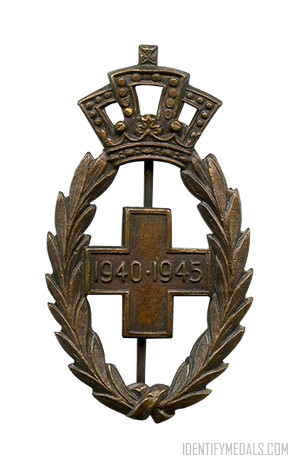
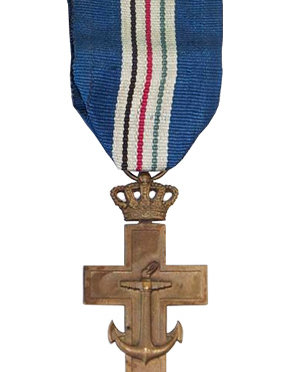
The Royal Hellenic Navy Campaign Cross was instituted by the Law of 22 December 1943 and awarded to officers and sailors of the Royal Hellenic Navy for a minimum of six months’ active service in World War II.

When Italy invaded Greece from Albania on 28 October 1940, the Greek Navy worked with the British Royal Navy to interrupt Italian shipments across the Adriatic. When Greece fell to German invasion in April 1941, much of the fleet steamed to Alexandria in Egypt and joined the British Mediterranean Fleet, continuing the fight against the Italians and Germans. Greek naval forces also escorted convoys in the Atlantic and Indian Oceans and supported the Normandy landings in June 1944.

The Royal Hellenic Navy (RHN) was, after the British Royal Navy, the largest Allied Naval force in the Mediterranean. The RHN fought against the Italians and the Germans in the Aegean Sea and the Eastern Mediterranean, participated in the defense of Malta, escorted convoys in the Atlantic and the Indian Ocean and supported the landings in Sicily, Italy, Southern France and Normandy.

The Royal Hellenic Navy Campaign Cross Design

The medals were issued by Kelaidis of Athens in bronze gilt. They measured 32 mm x 58.5 mm inclusive of its crown suspension. It came in three grades:

  • Gold (gilt) for officers,
  • Silver (silvered) for petty officers and
  • Bronze for sailors.
The Air Medal (USA)

The Air Medal is a decoration of the U.S. Armed Forces created in 1942 and awarded for single acts of heroism or meritorious achievement.

The Air Medal is a military decoration of the United States Armed Forces created in 1942 by Executive Order 9158, signed by Franklin D. Roosevelt. It is awarded for single acts of heroism or meritorious achievement while participating in aerial flight.

The Air Medal is awarded for a variety of accomplishments, including acts of heroism, successful completion of numerous combat missions, participation in aerial combat, or extraordinary performance of aviation duties. It recognizes the significant contributions and sacrifices made by aviators and aircrew members.

The U.S. Air Medal Criteria

The original award criteria set by an Army Policy Letter dated September 25, 1942 was for one award of the Air Medal:

  • per each naval vessel or three enemy aircraft in flight confirmed destroyed. An entire aircrew would be credited for the destruction of a ship, but only the pilot or gunner responsible would be credited for destroying an enemy aircraft.
  • per 25 operational flights during which exposure to enemy fire is expected.
  • per 100 operational flights during which exposure to enemy fire is not expected.

These criteria were altered by the commanding generals of each numbered Air Force to fit the conditions of their theater of operations and to maintain morale.

The Distinguished Flying Cross would usually be awarded for roughly twice to five times the requirements of the Air Medal. This led to automatic “score card” awards of the Air Medal and Distinguished Flying Cross for completing a set number of operational missions rather than distinguished service, meritorious action, or bravery, as had been intended. On August 5, 1943, such score card awards were officially abolished by a Headquarters Army Air Forces Awards Board memorandum due to the embarrassment when airmen received the Air Medal for “score carding” five missions or more but were later removed from flying duties for “lack of moral fibre“. Commanders could still issue the awards on those grounds, but the recipient must perform exceptional or meritorious service as well.

During World War II, the medal’s award criteria varied widely depending on the theater of operations, the aircraft flown, and the missions accomplished. The Army may award the Air Medal for peacetime service, but approval authority is by general-grade officers at the group or brigade level or higher.

The Air Medal Design

The Air Force medal design is prescribed by law. It was created by Walker Hancock, who had competed for the design as a civilian, but prior to the award of the competition had been inducted into the army.

The Air Medal is a Bronze compass rose 1​1116 inches circumscribing diameter and charged with an eagle volant carrying two lightning flashes in its talons. A fleur-de-lis at the top point holds the suspension ring. The points of the compass rose on the reverse are modeled with the central portion plain for engraving the name of the recipient.

The ribbon is 1​38 inches wide and consists of the following stripes:

  1. 18 inch Ultramarine Blue 67118;
  2. ¼ inch Golden Orange 67109;
  3. center ​58 inch Ultramarine Blue;
  4. ¼ inch Golden Orange; and
  5. 18 inch Ultramarine Blue.

Buy an Air Medal

Note: As an eBay partner, I earn from qualifying purchases. This is all done automatically when you use a link and at no extra cost to you.

Right Now on eBay 
Clicking a link to eBay may result in a referral commission being paid if a purchase is made.
Loading...

The Pilot / Observer Badge of the Luftwaffe

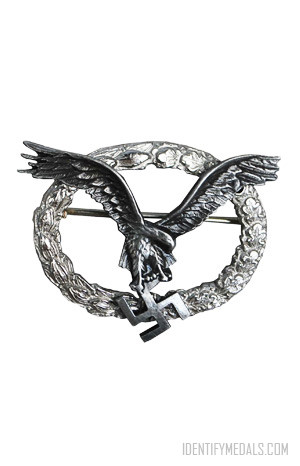
The Pilot/Observer Badge (or Flugzeugführer- und Beobachterabzeichen in German) was a WW2 German decoration instituted by Hermann Göring.

The Pilot/Observer Badge (or Flugzeugführer- und Beobachterabzeichen in German) was a World War II German military decoration instituted on 26 March 1936 by the Commander in Chief of the Luftwaffe Hermann Göring and awarded to Luftwaffe service personnel who had already been awarded the Pilot’s Badge and Observer Badge.

It was  It was worn on the lower part of the left breast pocket of the service tunic, underneath the Iron Cross 1st Class if awarded. It was to replace the older 1933 Aircrew Badge.

The Pilot/Observer Badge Design

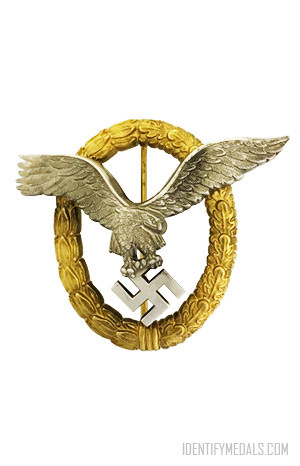
The badge was originally manufactured in bronze, and later zinc. The badge can be distinguished from the Pilot’s Badge by the gold wreath; the Pilot’s Badge had a silver wreath.

There was also a cloth version of the badge which used embroidered bullion for the officer’s version and cotton for the NCO’s version. The presentation case was dark blue, with a blue satin top liner and a blue velvet bottom liner on the inside.

There is an exclusive variant of the Pilot/Observer Badge in Gold with Diamonds (or Gemeinsame Flugzeugführer- und Beobachterabzeichen in Gold mit Brillanten in German). It was bestowed by Göring to honour exceptional achievement and on rare occasions as an honorary award. The first recipients were General Walther Wever, Chief of the Luftwaffe General Staff and General der Flieger Erhard Milch, State Secretary of the Reichsluftfahrtministerium on 11 November 1935.

More Luftwaffe War Badges

Awarded to members of the German Luftwaffe for their achievements and contributions to air warfare, the Luftwaffe War Badges symbolized excellence, courage, and skill in aerial combat and support roles. Explore the complete collection below:

The Panzer Badge or Tank Battle Badge (Nazi Germany)

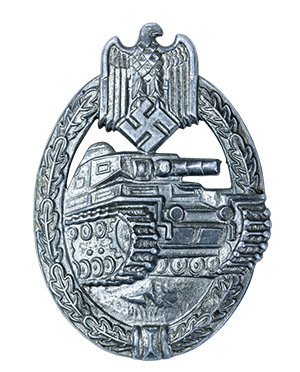
The Panzer Badge (or Panzerkampfabzeichen) was a World War II military decoration of Nazi Germany awarded to troops in armored divisions. 

The Panzer Badge (or Panzerkampfabzeichen in German) was a World War II military decoration of Nazi Germany awarded to troops in armored divisions.

If you know a thing or two about World War II, you might be aware that the German Panzers played one of the major roles, if not the most important one. Led by intrepid commanders such as Erich Von Manstein, Heinz Guderian, Erwin Rommel, and many more, the Panzers broke the front lines with speed, power and destruction following their paths. But the men who led the Panzers through the Russian Steppe or Northern France were the real “Heroes.”

To recognize the achievements of some of these Panzer crews, the OKW (OberKommando Wehrmacht, the German ground army HQ) decided to create a medal for these men. It was first awarded during World War I but was long forgotten since the Germans saw little action during the end of the war.

During the interwar period, a badge was issued for the veterans of the Condor Legion who participated in the Spanish Civil War. But as World War II was starting, the tank crews and their beloved tactics needed something, something to recognize their “Blitz” through the enemy lines.

Famous Recipients of The Panzer Badge

The most decorated generals of the Wehrmacht never got their grasp on this badge, even if their achievements were enormous. No, this badge was meant for the crewmen, those who gave their life for their country. Some of them never saw the end of the war, but some others did.

Otto Carius, per example, is one of the most decorated Panzer ace, having destroyed more than 150 enemy tanks, and most surprinsigly, a flying enemy plane. This particular enemy plane was “annoying” the gunner of the tank, Heinz Kramer, shooting its armor with its machine gun. As the sound of bullets hitting the armor was annoying more and more Mr Kramer, he asked permission to shoot down the plane, and after a first missed shot, shot down the plane. Probably the best tank shot ever. Carius lived until 2015 in Germany and was the last Panzer ace alive.

The most famous Panzer ace, Michael Wittmann, was also awarded with the highest class of the Badge. He was known to have destroyed at least 150+ tanks and more than 130 enemy canons (of any caliber). Unfortunately for him, he ultimately died in Normandy during Operation Overlord in his beloved Tiger. Nonetheless, his legend grew after the war when all of his achievements were discovered.

These folks are some of the most famous recipients of the Panzer Badge, but it would be wrong to forget about the 34,000 others that got the Badge in the different classes with around 22,000 getting the silver one.

There was definitely a lot of recipients during World War II but what is somehow “strange”, is that the Badge is still being given to members of Germany’s land Army, the Heer. If you are a badge “fanatic”, you can try to get one from the Internet but beware of forgeries, as some of them look very close to the original one.

The Panzer Badge Design

The obverse of the Panzer Badge shows a border of oak leaves with a tie at the base and a Panzerkampfwagen IV superimposed in the centre on grassy ground, with its left tank track extending over the edge of the badge. The reverse is plain with a vertical needle style pin, with an oval based hinge and catch.

The badge measures 42.05 mm (w) x 60.09 mm (h) and weights 27.6 grams.

The 50 and 100 engagement badges were struck in a lightweight zinc alloy; this was so that the larger pin did not pull inconveniently on the tunic. The 1957 de-Nazified version lost the eagle and the swastika, but was otherwise unchanged.

The Panzer Classes and Wear

Designed in 1939 by Ernst Peekhaus, the Panzer Badge was first issued in December 1939, when the chief of the OKW, Walter Von Brauchitsch, decided to create a medal dedicated to the sacrifice and the achievements of the Panzer’s crews. Two different classes of the badge were designed for those who received it during world war II. The first and “original” one was the silver Panzer Badge, designed to recognize solely the tank crews.

The “less original” one, the Bronze Panzer Badge, was designed to recognize the crews of armored vehicles (half tracks, trucks,…). As the war was still raging, it was decided that the Badge should evolve. In June 1943, four new classes were created, depending on the amount of engagement the recipent would have take part in: 25, 50, 75 and 100. Depending on which class and the amount of engagement you took part in, the metal used to design the medal and the color of it changed accordingly. 

After the war, it was frowned upon to wear this badge since there was a swastika on the top of it. Thus, West Germany decided in 1957 to authorize to wear the Panzer badge in public but only if the swastika was removed from it.

Note: As an eBay partner, I earn from qualifying purchases. This is all done automatically when you use a link and at no extra cost to you.

More Army/Waffen-SS War Badges

The Army/Waffen-SS war badges were military decorations awarded by Nazi Germany to members of the Army (Heer) and the Waffen-SS. Explore the complete collection below:

Buy a Panzer Badge

Right Now on eBay 
Clicking a link to eBay may result in a referral commission being paid if a purchase is made.
Loading...

The Medal of the Hellenic Red Cross

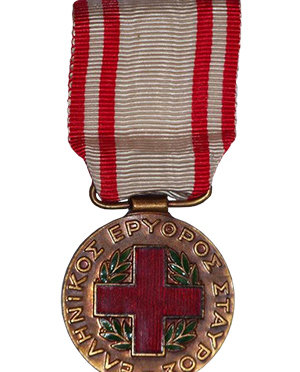
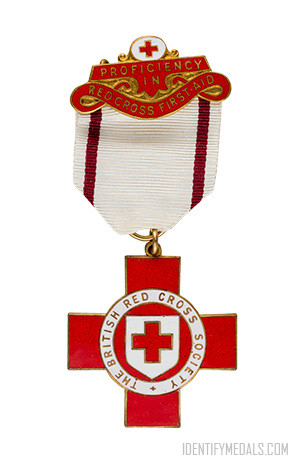
The Medal of the Hellenic Red Cross is medal for service in the ranks during the Italian invasion in 1940 until the Capitulation of Greece.

The Medal of the Hellenic Red Cross is a WW2 medal for service in the Hellenic Red Cross ranks during the Italian invasion in 1940 and until the Capitulation of Greece following the German invasion in April 1941 and the battle of Crete in May of the same year. The medal was awarded to both men and women.

The first initiative for the foundation of the Hellenic Red Cross took place in 1865 as the Kingdom of Greece participated in the 1st Geneva Convention. The Hellenic Red Cross was officially founded in 1877, with the active support of Queen Olga and it was recognized, the same year, by the International Red Cross Committee. Ever since it continues its humanitarian efforts both domestically and abroad whenever and wherever its aid is needed.

The Medal of the Hellenic Red Cross Design

The medal is made of bronze and enamels and measures 30.3 mm in diameter. The obverse depicts a large red cross in finely detailed red enamel, encircled by laurel branches in green enamel; on horizontal loop for suspension.

Find Red Cross Medals Online

More Red Cross Medals

The Legion of Merit

The Legion of Merit is a military award of the United States Armed Forces for exceptionally meritorious conduct and outstanding services.

The Legion of Merit (or LOM) is a military award of the United States Armed Forces given to members of the seven uniformed services of the U.S. and  to military and political figures of foreign governments for exceptionally meritorious conduct in the performance of outstanding services and achievements. It is typically awarded to Army, Marine Corps, and Air Force general officers and colonels, and Navy and Coast Guard flag officers and captains occupying senior command or very senior staff positions. Instances for officers of lesser rank are rare.

The award was created in December 24, 1941, when the Adjutant General formally requested action be initiated to create a Meritorious Service Medal and provide designs for the decoration. These were prepared by Bailey, Banks, and Biddle and given to Assistant Chief of Staff for Personnel by the QMG on January 5, 1942. An act of Congress (Public Law 671—77th Congress) established the Legion of Merit on July 20, 1942.

The Legion of Merit is seventh in the order of precedence of all U.S. military awards and the only U.S. military decoration that may be issued in award degrees. It’s also one of only two U.S. military decorations to be issued as a neck order (the other being the Medal of Honor). It is worn after the Defense Superior Service Medal and before the Distinguished Flying Cross.

The Legion of Merit in History

During the Second World War, Brazilian Army Brigadier General Amaro Soares Bittencourt became the first person awarded the Legion of Merit (Commander) in October 1942. A week later, Lieutenant, junior grade Ann A. Bernatitus, a U.S. Navy Nurse Corps officer, became the first woman and the first member of the United States Armed Forces to receive the Legion of Merit. A year later, General Dwight D. Eisenhower was presented the Legion of Merit by President Roosevelt on November 26.

From 1942 to 1944, the Legion of Merit was awarded for a wide range of achievements, because it was the only decoration below the Silver Star, awarded for combat valor, and the Distinguished Service Medal for meritorious noncombat service. That was, until the Bronze Star Medal was established in 1944.

After World War II, the Legion of Merit was awarded almost exclusively to senior officers in the rank Lieutenant Colonel (Army, Marine Corps and Air Force) or Commander (Navy and Coast Guard) (O-5), and above. In 1969, the Meritorious Service Medal was established as a junior version of the Legion of Merit.

The Legion of Merit Classes

  1. Chief Commander: For Heads of state or government.
  2. Commander: For the equivalent of a U.S. military chief of staff or higher position.
  3. Officer: For Generals or flag officers below the equivalent of a U.S. military chief of staff; colonels or equivalent rank or military attachés.
  4. Legionnaire: For all recipients not included above.

The Legion of Merit Design

Medal Obverse

The Chief Commander Degree of the Legion of Merit Medal is, on a wreath of green laurel joined at the bottom by a gold bow-knot (rosette), a domed five-pointed white star bordered crimson, points reversed with v-shaped extremities tipped with a gold ball. In the center, a blue disk encircled by gold clouds, with 13 white stars arranged in the pattern that appears on the Great Seal of the United States. Between each point, within the wreath are crossed arrows pointing outwards. The overall width is 2 1516 inches (75 mm).[/vc_column_text][vc_column_text]

The Commander Degree of the Legion of Merit Medal has a width of 2 14 inches (57 mm). In the center, a disk for engraving the name of the recipient surrounded by the words “ANNUIT COEPTIS MDCCLXXXII.” An outer scroll contains the words “UNITED STATES OF AMERICA.”

Medal Reverse

The reverse of all of the medals has the motto taken from the Great Seal of the United States, “ANNUIT COEPTIS” (“He [God] has favored our undertakings“) and the date “MDCCLXXXII” (1782), which is the date of America’s first decoration, the Badge of Military Merit, now known as the Purple Heart. The ribbon design also follows the pattern of the Purple Heart ribbon.

Ribbon

The ribbon for all of the decorations is 1 38 inches (35 mm) wide and consists of the following stripes: 116 inch (1.6 mm) white; center 1 14 inches (32 mm) crimson; and 116 inch (1.6 mm) white.

The Chief Commander Degree, a miniature of the decoration in gold on a horizontal gold bar is worn on the service ribbon. One in silver on a horizontal silver bar is worn on the service ribbon for the Commander Degree.

Buy a Legion of Merit

Note: As an eBay partner, I earn from qualifying purchases. This is all done automatically when you use a link and at no extra cost to you.

Right Now on eBay 
Clicking a link to eBay may result in a referral commission being paid if a purchase is made.
Loading...

The Bronze Star Medal

The Bronze Star Medal (also known as Bronze Star) is a United States decoration awarded for heroic achievement or service in a combat zone. 

The Bronze Star Medal (also known as Bronze Star) is a United States decoration awarded to members of the United States Armed Forces for either heroic achievement, heroic service, meritorious achievement, or meritorious service in a combat zone. Officers from the other Uniformed Services of the United States are eligible to receive this award, as are foreign soldiers who have served with or alongside a service branch of the United States Armed Forces. Civilians serving with U.S. military forces in combat are also eligible for the award.

The Bronze Star Medal was established by Executive Order 9419, 4 February 1944 (superseded by Executive Order 11046, 24 August 1962, as amended by Executive Order 13286, 28 February 2003). Colonel Russell P. “Red” Reeder conceived the idea of the Bronze Star Medal in 1943; he believed it would aid morale if captains of companies or of batteries could award a medal to deserving people serving under them.

The Bronze Star Medal Design

The Bronze Star Medal was designed by Rudolf Freund (1878–1960) of the jewelry firm Bailey, Banks & Biddle.

The medal is a bronze star 1 12 inches (38 mm) in circumscribing diameter. In the center is a 316 inch (4.8 mm) diameter superimposed bronze star, the center line of all rays of both stars coinciding. The reverse bears the inscription HEROIC OR MERITORIOUS ACHIEVEMENT with a space for the name of the recipient to be engraved.

The star hangs from its ribbon by a rectangular metal loop with rounded corners. 

When the medal is awarded by the Army and Air Force for acts of valor in combat, the “V” Device is authorized for wear on the medal. When the medal is awarded by the Navy, Marine Corps, and Coast Guard for acts of valor or meritorious service in combat, the Combat “V” is authorized for wear on the medal.

The following ribbon devices must be specifically authorized in the award citation in order to be worn on the Bronze Star Medal, the criteria for and wear of the devices vary between the services:

  • Oak leaf cluster – In the Army and Air Force.
  • 5/16 inch star – In the Navy and Marine Corps and Coast Guard.
  • “V” device.
  • Combat “V”.

The Bronze Star During WW2

Here are some examples of individuals receiving the Bronze Star Medal for their actions during World War II:

  • General Dwight D. Eisenhower: General Eisenhower, the Supreme Commander of the Allied Expeditionary Forces in Europe, was awarded the Bronze Star Medal for his leadership during the planning and execution of the D-Day invasion on June 6, 1944.

  • Sergeant Audie Murphy: Audie Murphy, a highly decorated soldier and later a famous actor, received the Bronze Star Medal for his valorous actions in combat. Murphy demonstrated extraordinary courage and leadership in various engagements throughout the war, including his single-handed stand against German forces in the Battle of Holtzwihr.

  • Lieutenant Colonel James H. Doolittle: Lieutenant Colonel Doolittle, an aviation pioneer, was honored with the Bronze Star Medal for leading the daring Doolittle Raid, the first U.S. air raid on the Japanese mainland. Despite challenging circumstances, his leadership and audacity boosted American morale and dealt a blow to Japan’s strategic capabilities.

  • Private First Class Desmond Doss: Desmond Doss, a conscientious objector and combat medic, was awarded the Bronze Star Medal for his selfless actions during the Battle of Okinawa. Despite being under heavy enemy fire, Doss repeatedly braved danger to rescue and treat wounded soldiers, saving numerous lives.

  • Lieutenant Colonel Benjamin O. Davis Jr.: Lieutenant Colonel Davis, an officer in the Tuskegee Airmen, received the Bronze Star Medal for his exceptional achievements as a fighter pilot. He overcame significant adversity and discrimination to become one of the most respected and highly decorated African American officers of World War II.
Right Now on eBay 
Clicking a link to eBay may result in a referral commission being paid if a purchase is made.
Loading...

The Medal of Freedom (1945)

The Medal of Freedom was a decoration established by President Harry S. Truman to honor civilians whose actions aided in the war efforts.

The Medal of Freedom was a decoration established by President Harry S. Truman to honor civilians whose actions aided in the war efforts of the United States and its allies.

The medal was intended to be awarded by the Secretary of State, the Secretary of War, or the Secretary of the Navy, but Presidents Dwight D. Eisenhower and John F. Kennedy also authorized awards.

The original Executive Order 9586 establishing the medal specified “No more than one Medal of Freedom shall be awarded to any one person, but for a subsequent act or service justifying such an award a suitable device may be awarded to be worn with the medal” and bronze, silver, and gold palm devices were produced and awarded.

The Medal of Freedom (1945) Design

The medal is a bronze disc whose obverse features the profile of the Statue of Freedom of the US Capitol Building, with the word “FREEDOM” in capital letters in an arc at the bottom of the disc.

The reverse features the Liberty Bell surrounded by the words “UNITED STATES OF AMERICA” in capital letters. The medal is suspended on a red ribbon with four thin white stripes.

The Congressional Gold Medal

The Congressional Gold Medal is an award bestowed by the Congress and one of the three highest civilian awards in the United States. 

Institution: 1776
Country: United States
 

The Congressional Gold Medal is an award bestowed by the United States Congress and one of the three highest civilian awards in the United States. Alongside the Presidential Medal of Freedom, it’s the oldest and highest American civilian award.

The medal is awarded to persons “who have performed an achievement that has an impact on American history and culture that is likely to be recognized as a major achievement in the recipient’s field long after the achievement.”

The tradition within the U.S. Congress of awarding gold medals as a form of recognition originated during the American Revolution, initially bestowed upon military personnel. Over time, this practice expanded to include individuals from various professions and, in the late 20th century, even groups. 

At the time of writing this, there have been 184 Congressional Gold Medals awarded.

How the Congressional Gold Medal is Awarded

There are no permanent statutory provisions for the creation of Congressional Gold Medals. When one has been deemed appropriate, Congress has, by legislative action, provided for the creation of a medal on an ad hoc basis.

Since the American Revolution, Congress has commissioned gold medals as its highest expression of national appreciation for distinguished achievements and contributions. The medal was first awarded in 1776 by the Second Continental Congress to General George Washington.

Although the first recipients were military figures who participated in the American Revolution, the War of 1812 and the Mexican–American War, Congress broadened the scope of the medal to include actors, authors, entertainers, musicians, pioneers in aeronautics and space, explorers, lifesavers, notables in science and medicine, athletes, humanitarians, public servants, and foreign recipients.

The medal is normally awarded to persons, but in 1979 the American Red Cross became the first organization to be honored with a gold medal. U.S. citizenship is not a requirement.

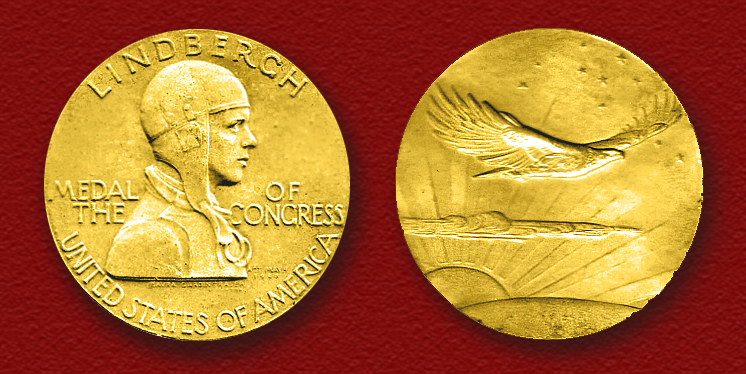
Medal awarded to Charles A. Lindbergh in 1930
Medal awarded to Charles A. Lindbergh in 1930. Image courtesy of Wikipedia.

The Congressional Gold Medal Design

A Congressional Gold Medal is designed by the United States Mint to commemorate the person and achievement for which the medal is awarded specifically. Medals are therefore different in appearance, and there is no standard design.

Congressional Gold Medals are considered non-portable, meaning that they are not meant to be worn on a uniform or other clothing but rather displayed. In rare instances, miniature versions have been made or converted for wear on clothing suspended from a ribbon.

Often, bronze versions of the medals are struck for sale by the U.S. Mint, and may be available in both larger and smaller sizes.

Find This Medal Online

Right Now on eBay 
Clicking a link to eBay may result in a referral commission being paid if a purchase is made.
Loading...

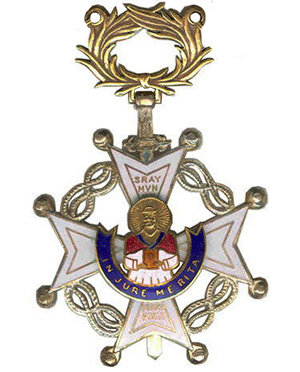
The Order of the Cross of St. Raymond of Peñafort

The Order of the Cross of St. Raymond of Peñafort (or Orden de la Cruz de San Raimundo de Peñafort) is a Spanish civil order of merit established 23 January 1944.

The five classes recognize service to and contributions toward the development and perfection of the law and jurisprudence. The three medals of the order recognize years of unblemished service within the legal and administrative professions under the jurisdiction of the Ministry of Justice. The order is named for St. Raymond of Peñafort, the patron saint of lawyers.

The five classes of crosses of the Order of St. Raymond of Peñafort are as follows:

  • Grand-Cross (Gran Cruz)
  • Cross of Honour (Cruz de Honor)
  • Distinguished Cross 1st Class (Cruz Distinguida de 1.ª Clase)
  • Distinguished Cross 2nd Class (Cruz Distinguida de 2.ª Clase)
  • Single Cross (Cruz Sencilla)

The Order of St. Raymond of Peñafort Design

The medals of the Order of St. Raymond of Peñafort are awarded to legal and administrative professionals working under the jurisdiction of the Ministry of Justice. The medals honor years of unblemished service.

The classes are as follows:

  • Gold Medal of Merit in Justice (Medalla de Oro del Mérito a la Justicia)
  • Silver Medal of Merit in Justice (Medalla de Plata del Mérito a la Justicia)
  • Bronze Medal of Merit in Justice (Medalla de Bronce del Mérito a la Justicia)