The Army of Occupation Medal

The Army of Occupation Medal is a US military award established by the United States War Department in the aftermath of the Second World War.

The Army of Occupation Medal is a United States military award established by the United States War Department on 5 April 1946 in the aftermath of the Second World War. The medal recognizes those who had performed occupation service in either Germany, Italy, Austria, or Japan.

To be awarded the Army of Occupation Medal, a service member was required to have performed at least thirty consecutive days of military duty within a designated geographical area of military occupation.

The original Army of Occupation Medal was intended only for members of the United States Army, but it was expanded in 1948 to include the United States Air Force shortly after its creation. The Navy and Marine equivalent of the Army of Occupation Medal is the Navy Occupation Service Medal.

The Army of Occupation Medal Design

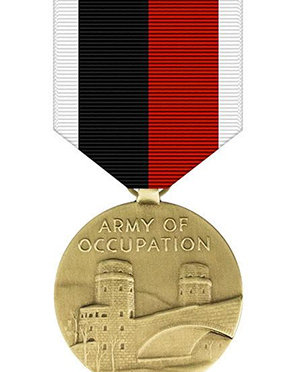
The Army of Occupation Medal is made of bronze and measures 1.25 inches across.

The obverse shows the abutments of the Remagen Bridge with the words “ARMY OF OCCUPATION” inscribed above. On the reverse is Mount Fuji, with a low hanging cloud over two Japanese junks above a wave and the inscribed date “1945”.

The medal was presented with a campaign clasp, denoting either European or Asian service. Campaign clasps were worn on the full sized medal only with no corresponding device when wearing the Army of Occupation Medal as a ribbon on a military uniform. A bronze clasp 0.125 inches wide and 1.5 inches in length with the word “GERMANY” or “JAPAN” is worn on the suspension ribbon of the medal to indicate service in Europe or the Far East.

The Army of Occupation Medal Design

The Army of Occupation Medal is made of bronze and measures 1.25 inches across.

The obverse shows the abutments of the Remagen Bridge with the words “ARMY OF OCCUPATION” inscribed above. On the reverse is Mount Fuji, with a low hanging cloud over two Japanese junks above a wave and the inscribed date “1945”.

The medal was presented with a campaign clasp, denoting either European or Asian service. Campaign clasps were worn on the full sized medal only with no corresponding device when wearing the Army of Occupation Medal as a ribbon on a military uniform. A bronze clasp 0.125 inches wide and 1.5 inches in length with the word “GERMANY” or “JAPAN” is worn on the suspension ribbon of the medal to indicate service in Europe or the Far East.
Find This Medal Online

Right Now on eBay 
Clicking a link to eBay may result in a referral commission being paid if a purchase is made.
Loading...

The American Campaign Medal

The American Campaign Medal is a United States Armed Forces military award created on November 6, 1942.

The American Campaign Medal is a United States Armed Forces military award created on November 6, 1942 and issued by President Franklin D. Roosevelt (Executive Order 9265 ). The first person to ever receive the American Campaign Medal was General George C. Marshall, Chief of Staff of the Army.

Who was awarded the American Campaign Medal?

The American Campaign Medal recognizes military members who have performed service in the American Theater of Operations during World War II. There is a similar medal, named the American Defense Service Medal, that was awarded for active duty service before the United States entered the Second World War.

What are the Requirements of the American Campaign Medal?

There are some specific requirements for the American Campaign Medal. These are as follows: Service within the American Theater between the dates of 7 December 1941 and 2 March 1946 under any of these conditions:

  1. On permanent assignment outside the continental limits of the United States.
  2. Permanently assigned as a member of a crew of a vessel sailing ocean waters for 30 consecutive days or 60 nonconsecutive days.
  3. Outside the continental limits of the U.S. in a passenger status or on temporary duty for 30 consecutive or 60 nonconsecutive days.
  4. In active combat against the enemy, and awarded a combat decoration or with a certificate by the commanding general of a corps, higher unit, or independent force that the Soldier actually participated in combat.
  5. Within the continental limits of the United States for an aggregate period of 1 year.

Who was Awarded the American Campaign Medal?

The American Campaign Medal recognizes military members who have performed service in the American Theater of Operations during World War II. There is a similar medal, named the American Defense Service Medal, that was awarded for active duty service before the United States entered the Second World War.

What are the Requirements of the American Campaign Medal?

There are some specific requirements for the American Campaign Medal. These are as follows: Service within the American Theater between the dates of 7 December 1941 and 2 March 1946 under any of these conditions:

  1. On permanent assignment outside the continental limits of the United States.
  2. Permanently assigned as a member of a crew of a vessel sailing ocean waters for 30 consecutive days or 60 nonconsecutive days.
  3. Outside the continental limits of the U.S. in a passenger status or on temporary duty for 30 consecutive or 60 nonconsecutive days.
  4. In active combat against the enemy, and awarded a combat decoration or with a certificate by the commanding general of a corps, higher unit, or independent force that the Soldier actually participated in combat.
  5. Within the continental limits of the United States for an aggregate period of 1 year.

The American Campaign Medal Design

The American Campaign Medal is made of bronze and measures 1 1/4 inches wide.

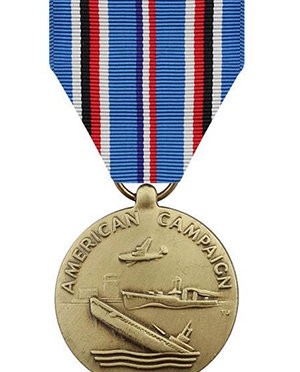
The obverse was designed by Thomas Hudson Jones, a U.S. sculptor for the Army’s Institute of Heraldry. It shows a Navy cruiser underway with a B-24 Liberator bomber flying overhead. In the foreground is a sinking enemy submarine, and in the background is the skyline of a city. At the top of the medal are the words AMERICAN CAMPAIGN.

The reverse of the American Campaign Medal, created by Adolph Alexander Weinman, is the same as used on both the Asiatic-Pacific Campaign Medal and the European-African-Middle Eastern Campaign Medal. It depicts an American bald eagle between the dates 1941 – 1945 and the words UNITED STATES OF AMERICA.

The American Campaign Medal ribbon is 1 3/8 inches wide and the colors are oriental blue in the center stripe divided into thirds of old glory blue (to represent the Americas), white, and scarlet (the continuance of American defense after Pearl Harbor). Between the center and the edges are stripes of white, black, scarlet and white. The white and black stripes represent the German part of the conflict on the Atlantic Coast, while the red and white stripes are for the Japanese colors and refer to that part of the conflict on the Pacific Coast.

The American Campaign Medal Campaign: For the Navy

Recipients of the American Campaign Medal need to have participated in the following escort, armed guard, antisubmarine, and special operations. They are to receive one campaign star for each participation:

The American Campaign Medal Campaign: For the Army

There is an authorized bronze service star for participation in antisubmarine operations (USS Asterion AK-100 and USS Frederick C. Davis DE-136). To qualify for them, individuals have to have been assigned to and present for duty with a unit having antisubmarine campaign credit.

Find This Medal Online

Right Now on eBay 
Clicking a link to eBay may result in a referral commission being paid if a purchase is made.
Loading...

The Recusants Insignia

The Recusant’s Insignia is a French medal to honor French citizens who had evaded the Compulsory Work Service in Germany.

The Recusant’s Insignia is a French medal to honour French citizens who had evaded the Compulsory Work Service (S.T.O.) in Germany and who had therefore participated in the fight against the invader.

The law of August 22, 1950, establishing the status of “recusant”, stated in its first article: “The Republic, grateful to those who accepted all the risks in their fight against the enemy’s war potential, considering the suffering and the prejudice that this courageous and patriotic attitude caused them, proclaimed and determined the right to reparation for recusants and their successors“.

The Recusant’s Insignia Design

The design of the Recusant’s Insignia was decided by a contest opened by a decree of 17 July 1961 and won by artist engraver M. Hollebecq.

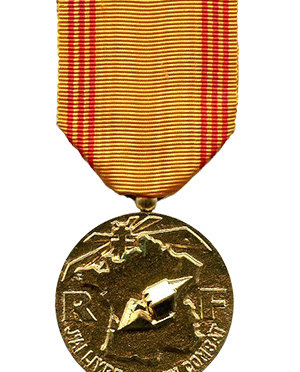
The Recusant’s Insignia measures 36 mm in diameter, is circular and struck from bronze or gilt bronze. Its obverse bears the relief image of a map of France, a broken anvil at its center symbolizes the refusal to work. Above the map, a Cross of Lorraine symbolizing hope and support for the oppressed. On either side, the relief initials “R” and “F” for République Française, and at the bottom the relief semi-circular inscription J’AI LIVRÉ UN BON COMBAT. On the reverse, the circular relief inscription along the top ¾ of the medal circumference AUX RÉFRACTAIRES GUERRE 1939 – 1945.

See also:

The Political Internment Medal

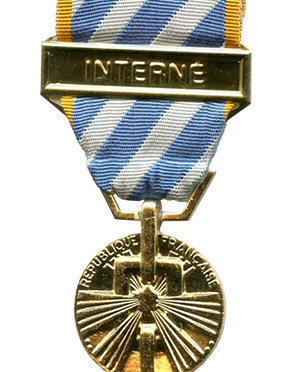
The Political deportation and internment medal is a commemorative medal awarded by the Ministry for veterans and war victims.

The Political deportation and internment medal (or Médaille de la déportation et de l’internement politique) is a commemorative medal awarded by the Ministry for veterans and war victims of the French Republic to its citizens who were deported or interned by the German occupation forces during World War 2.

Created by a law on 9 September 1948, the medal defines the status of political deportees and internees, declaring in its opening article “The Republic, grateful to those who contributed to the salvation of the country, bowed before them and before their families, determined the status of political deportees and internees, proclaim their rights and those of their successors”.

The title of political internee giving the right to wear the Political deportation and internment medal with political internee ribbon was bestowed to French citizens living in France or abroad, interned by the enemy or the Vichy government, for any reason other than for common or criminal offenses. These were interned for a legitimate act accomplished for the cause of the liberation of France; for an administrative or judicial measure resulting in deprivation of freedom; and French citizens living in France or abroad, who were executed by the enemy for any reason other than for common or criminal offenses.

The Political Deportation and Internment Medal Design

Designed by French artist engraver Arthus Bertrand, the medal measures 30 mm in diameter, is circular and struck from bronze or gilt bronze.

Its obverse bears the relief image of four vertical chain links protruding from the medal circumference. It also shows a small relief image of the map of France with six rays of light protruding out to the medal’s outer edges and the inscription RÉPUBLIQUE FRANÇAISE. The reverse bears the same chain links but without the map of France or the rays, and the years “1940” and “1945” in relief instead. Along the circumference it says MÉDAILLE DE LA DÉPORTATION ET DE L’INTERNEMENT).

The Political Deportation Medal

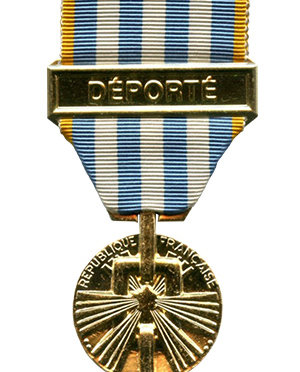
The Political deportation and internment medal is a commemorative medal awarded by the Ministry for veterans and war victims.

The Political deportation and internment medal (or Médaille de la déportation et de l’internement politique) is a commemorative medal awarded by the Ministry for veterans and war victims of the French Republic to its citizens who were deported or interned by the German occupation forces during World War 2.

Created by law on 9 September 1948, the medal defines the status of political deportees and internees, declaring in its opening article “The Republic, grateful to those who contributed to the salvation of the country, bowed before them and before their families, determined the status of political deportees and internees, proclaim their rights and those of their successors”.

The Title of political deportee was bestowed to French citizens living in France or abroad, who were, apart from being interned for common or criminal offenses and for a period of at least three months: Transferred by the enemy from the national territory and then incarcerated or interned in a prison or concentration camp; incarcerated or interned by the enemy in the camps or prisons of Bas-RhinHaut-Rhin and Moselle; incarcerated or interned by the enemy in any other territories exclusively administered by the enemy, in particular Indochina. 

The three-month minimum period was waived for persons having successfully escaped or that contracted an illness or infirmity during their internment arising in particular from torture.

The Political Deportation and Internment Medal Design

Designed by French artist engraver Arthus Bertrand, the medal measures 30 mm in diameter, is circular and struck from bronze or gilt bronze. Its obverse bears the relief image of four vertical chain links protruding from the medal circumference. It also shows a small relief image of the map of France with six rays of light protruding out to the medal’s outer edges and the inscription RÉPUBLIQUE FRANÇAISE. The reverse bears the same chain links but without the map of France or the rays, and the years “1940” and “1945” in relief instead. Along the circumference it says MÉDAILLE DE LA DÉPORTATION ET DE L’INTERNEMENT).

The Medal of a Liberated France

The Medal of a Liberated France was a decoration of the French Republic awarded for contributions to the liberation from German occupation.

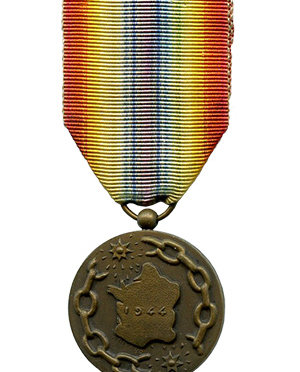
The Medal of a liberated France (or “Médaille de la France libérée”) was a decoration of the French Republic awarded to French and foreign nationals that had made a notable contribution to the liberation of France from the German occupation. It was originally named the “Medal of Gratitude of a Liberated France”.

The Medal of a liberated France was created by decree on 12 September 1947. It could be awarded to soldiers of the allied armies who had participated in war operations on the soil of Metropolitan France, soldiers of allied armies who served as liaison with the French forces or to French nationals who made a notable contribution to the liberation of Metropolitan France or soil under French mandate between 18 June 1940 and 20 August 1945.

The Medal of a liberated France Design

The Medal of a liberated France measures 35mm in diameter and it’s a circular medal struck from bronze.

The obverse bears the relief image of France with the relief date “1944” at its center. A relief chain encircles the image of France with two breaks in its links, one North-east, the other South-west, symbolizing the allied landings. The reverse bears the relief image of a Fasces below a Phrygian cap bisecting the initials “R.F.” and the relief inscription “LA FRANCE A SES LIBERATEURS” along the upper and lower circumference.

The medal hangs from a 36mm wide rainbow coloured silk moiré ribbon with the purple at center.

The Commemorative Medal for Voluntary Service in Free France

The Commemorative Medal for Voluntary Service in Free France is a French commemorative war medal and awarded during WW2.

The Commemorative medal for voluntary service in Free France (or Médaille commémorative des services volontaires dans la France libre in French) is a French commemorative war medal awarded to members of the Free French Forces who fought the Axis forces on most fronts during World War II. It was established by decree on 4 April 1946.

The Free French Forces were especially active in North Africa where they particularly distinguished themselves during the Battle of Bir Hakeim. Also part of the whole, the Free French Naval Forces and Free French Air Force, although limited in numbers and equipment nonetheless took part in most major engagements alongside allied forces including in the Soviet Union.

The Commemorative medal for voluntary service in Free France was awarded to all persons, civilian or military, French or foreign nationals who had voluntarily contracted in the Free French Forces prior to 1 August 1943 (for soldiers), or who had effectively served Free France on the territories controlled by the National Committee in London and in foreign countries prior to 1 August 1943 (for civil servants).

The Commemorative medal for voluntary service in Free France Design

The Commemorative medal for voluntary service in Free France was struck from silvered bronze in the shape of a Cross of Lorraine. Its obverse bears the relief inscription on two lines “FRANCE” on the upper horizontal arm and “LIBRE” on the lower arm. Its reverse bears the dates “18 JUIN 1940” on the upper arm and “8 MAI 1945” on the lower arm.

The Commemorative medal for voluntary service in Free France hangs from a dark blue silk moiré ribbon adorned with 2 mm wide red oblique stripes separated by 4 mm.

The 1943-1944 Italian Campaign Medal (France)

The 1943–1944 Italian campaign medal is a campaign medal awarded to soldiers and sailors of the French Expeditionary Corps of Italy.

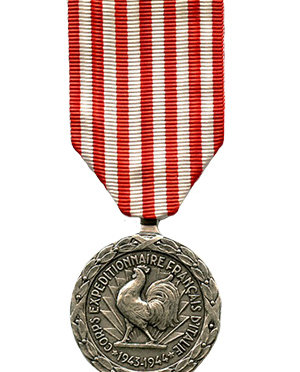
The 1943–1944 Italian campaign medal (or Médaille commémorative de la campagne d’Italie 1943-1944 in French) is a French commemorative campaign medal awarded to soldiers and sailors who served on Italian soil or Italian waters as part of the “French Expeditionary Corps of Italy”. The corps participated in the allied amphibious landing and the ensuing campaign in Italy in 1943 and 1944.

Composed in part of Frenchmen from North Africa and in part with colonial troops, the CEF covered itself with glory during this long campaign and especially during the battle of the GariglianoIn January 1953, Parliament approved the creation of a distinct medal to adequately recognize the valour in combat and the sacrifice of the men of the CEF – who lost more than 7,000 members.

The 1943–1944 Italian Campaign Medal Design

The 1943–1944 Italian Campaign Medal measures 36mm in diameter and is made of silvered bronze medal.

Its obverse bore the left profile view of a Gallic rooster in front of Sun rays surrounded by the relief circular inscription “CORPS EXPÉDITIONAIRE FRANÇAIS D’ITALIE * 1943-1944 *” within a relief laurel wreath along the entire medal circumference. On the reverse, within the same relief laurel wreath, the circular inscription “RÉPUBLIQUE FRANÇAISE” at the bottom a relief five-pointed star, in the center, the relief inscription “CEF”.

The 1943–1944 Italian Campaign Medal hangs from a ribbon passing through a suspension ring. The 36mm wide silk moiré ribbon is composed of seven red and six white alternating vertical stripes of equal width.

The 1939–1945 Commemorative War Medal (France)

The 1939–1945 Commemorative War Medal is a medal of France established in 1946 to recognize individual participation in the Second World War.

The 1939–1945 Commemorative War Medal (or “Médaille commémorative de la guerre 1939–1945” in French) is a commemorative medal of France established in 1946 to recognize individual participation in the Second World War.

The medal was awarded to all soldiers serving under French authority or under a French government in a state of war against the Axis nations, as well as present on board a warship or armed merchant vessel, to French citizens, military or civilian, who fought against the Axis forces or their representatives, and to foreign military who served as Frenchmen in formations at war against the Axis forces.

The 1939–1945 Commemorative War Medal Design

The 1939–1945 Commemorative war medal is hexagonal in shape and struck from bronze. It measures 28mm wide and 38mm high excluding the suspension loop.

The obverse of the medal bears the relief image of a rooster superimposed in front of a Cross of Lorraine. The reverse shows a relief semi circular inscription “RÉPUBLIQUE FRANÇAISE” over a sprig of laurel leaves and the inscription on three lines “GUERRE” “1939” “1945”.

The George Medal

The George Medal (or GM) is a decoration of the United Kingdom and Commonwealth instituted in 1940 by King George VI for gallantry.

The George Medal (or GM) is a decoration of the United Kingdom and Commonwealth instituted on 24 September 1940 by King George VI as an award for gallantry “not in the face of the enemy” where the services were not so outstanding as to merit the George Cross.

During the height of the Blitz in 1940, there was a strong desire to reward the many acts of civilian courage. The existing awards were not judged suitable to meet the new situation, so it was decided that the George Cross and the GM would be instituted to recognize both civilian gallantry in the face of enemy bombing and brave deeds more generally.

The King announced the new awards by saying:

In order that they should be worthily and promptly recognized, I have decided to create, at once, a new mark of honor for men and women in all walks of civilian life. I propose to give my name to this new distinction, which will consist of the George Cross, which will rank next to the Victoria Cross, and the George Medal for wider distribution.

The warrant for the GM, dated 24 January 1941, was published in The London Gazette on 31 January 1941. Although the original warrant did not explicitly permit it to be awarded posthumously, this was changed in December 1977 to allow posthumous awards.

Recipients are entitled to the post-nominal letters GM.

The George Medal Design

The medal is circular and struck in silver. It measures 36 mm (1.4 in) in diameter.

The obverse depicts the crowned effigy of the reigning monarch. To date, there have been four types:

  • George VI, 1940 to 1948. Inscribed GEORGIVS VI D: G: BR: OMN: REX ET INDIAE IMP.
  • George VI, 1948 to 1952. Inscribed GEORGIVS VI DEI: GRA: BRITT: OMN: REX FID: DEF:
  • Elizabeth II, 1952 to late 1950s. Inscribed ELIZABETH II D: G: BR: OMN: REGINA F.D.
  • Elizabeth II, late 1950s to date. Inscribed ELIZABETH II DEI GRATIA REGINA F.D.

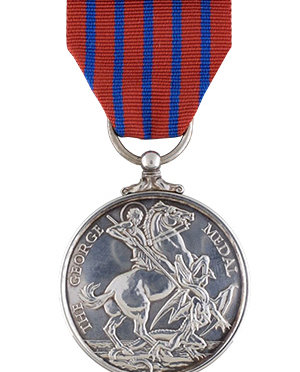
The reverse shows Saint George on horseback slaying the dragon on the coast of England, with the legend THE GEORGE MEDAL around the top edge of the medal.

The ribbon is 31.7 mm (1.25 in) wide, crimson with five narrow blue stripes. The name of the recipient is engraved on the rim of the medal, although some Army awards have impressed naming.

Find This Medal

Right Now on eBay 
Clicking a link to eBay may result in a referral commission being paid if a purchase is made.
Loading...