The Cholm Shield

The Cholm Shield (Cholmschild) is a World War II German military decoration awarded to those who fought in the Cholm Pocket.

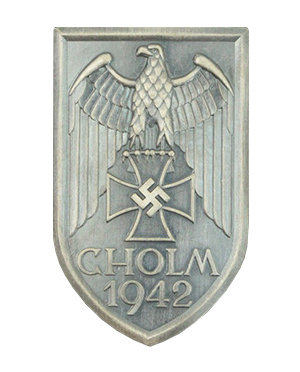
The Cholm Shield (or Cholmschild in German) is a World War II German military decoration instituted on 1 July 1942 and awarded to those who fought in the Cholm Pocket between 21 January and 5 May 1942.

In January 1942, the Soviet Red Army began a series of counteroffensives against the German Army, while the German occupied city of Cholm. By the end of January the city was surrounded and cut off which led to the creation of the Kholm Pocket. A mixed group of Wehrmacht, Luftwaffe and police personnel led by Generalleutnant Theodor Scherer were supplied by air until they were relieved on 5 May 1942.

To receive the shield, military personnel had to:

  • Have served honourably within the Cholm Pocket between the specified dates; or
  • Have flown and landed at the airfield within the pocket for resupply operations

The Cholm Shield is the rarest of the German combat shields with approximately 5,500 recipients. Bestowing of the award ceased as of 1 April 1943.

The Cholm Shield Design

The design of the commemorative shield was done by Polizei-Rottwachtmeister Schlimmer and sent to Adolf Hitler for approval. Professor Richard Klein made a few minor changes to the design.

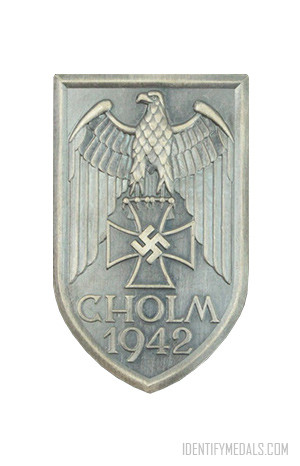
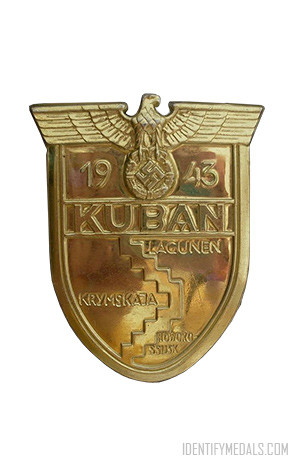
The award features the outline of a shield with a large “open-winged” Wehrmacht-style eagle grasping an Iron Cross with a swastika at its center. Below, in capital letters, is written CHOLM and the date 1942In 1957, the Cholm Shield was denazified (removal of the swastika) to allow recipients to wear the shield on their uniform.

All shields were hollow stamped metal washed in silver. A backing plate was attached to the shield with a number of prongs and affixed to a piece of coloured cloth. The Cholm Shield was worn on the left upper sleeve of the uniform of soldiers and airmen. For civilian clothes a smaller shield roughly 16mm across with a needle fitting could be worn on the left lapel.

More Nazi Germany Shields (Ärmelschilde)

These campaign shields were awarded to members of the Wehrmacht (the unified armed forces of Nazi Germany from 1935 to 1945). They were given for participation in specific battles or campaigns and worn on the left upper arm of the uniform jacket.

The Narvik Shield - German WW2 Medals, Badges and Awards

The Narvik Shield

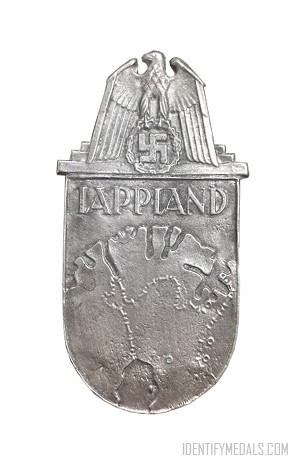
The Narvik Shield (Narvikschild) is a WW2 German military decoration awarded to German forces that took part in the battles of Narvik.
Read More »

The Narvik Shield

The Narvik Shield (Narvikschild) is a WW2 German military decoration awarded to German forces that took part in the battles of Narvik.

The Narvik Shield (or Narvikschild in German) is a World War II German military decoration awarded to all German forces that took part in the battles of Narvik between 9 April and 8 June 1940.

The decoration was instituted on 19 August 1940 by Adolf Hitler. The Oberkommando der Wehrmacht (OKW) published the order the same day.

A total of 8,577 military personnel received the award. It was bestowed by General Eduard Dietl, the commander of Army Group Narvik.

In 1957, the Narvik Shield, along with many other German military decorations of World War II, was reauthorized for wear by qualifying veterans. The new version was without the eagle and swastika symbol of the Third Reich.

The Narvik Shield Design

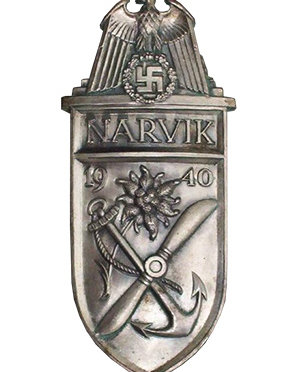
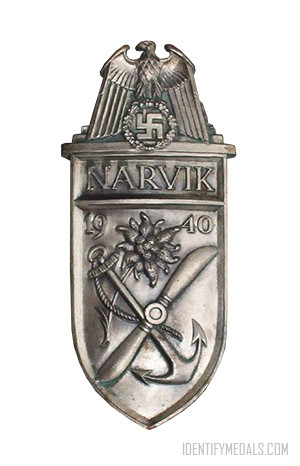
Designed by Professor Dr Richard Klein of Munich, the narrow shield features a pointed bottom and, at its apex, an eagle with down-swept wings clutching a laurel wreath that surrounds a swastika. Below this in capital letters is written NARVIK.

The body of the shield features an edelweiss (representing the Heer mountain troops), an anchor (representing the Kriegsmarine), and propeller (for the Luftwaffe). The anchor and propeller are crossed, with the edelweiss placed at the top of the X. The numbers 19 and 40 appear at the top corners of the main body of the shield.

The shield was hollow backed and stamped from sheet metal which was usually zinc. It was worn on the upper left arm of the uniform. The shield was awarded in two versions; silver-gray versions for army and Luftwaffe and a gilded (golden coloured) version for Kriegsmarine.

More Nazi Germany Shields (Ärmelschilde)

These campaign shields were awarded to members of the Wehrmacht (the unified armed forces of Nazi Germany from 1935 to 1945). They were given for participation in specific battles or campaigns and worn on the left upper arm of the uniform jacket.

The Commemorative Cross of the 11th Army

The Commemorative Cross of the 11th Army is an Italian medal recognized on 15 April 1943 and awarded to members of the 11th Army.

The Commemorative Cross of the 11th Army (or Croce Commemorativa dell’11a Armata in Italian) is an Italian medal recognized on 15 April 1943, and awarded during 1942 to members of the 11th Army who served in the campaign against Greece in 1940-1941.

It honored the efforts and contributions of those who participated in the military operations, reflecting their dedication and bravery in the conflict. The cross serves as a symbol of recognition for the sacrifices and achievements of the 11th Army in this challenging campaign.

The 11th Army

The 11th Army was a unit of the Royal Italian Army during World War II. It played a significant role in the Greco-Italian War, part of the larger Balkan Campaign.

The 11th Army was involved in the initial invasion of Greece in October 1940, which aimed to expand Italian influence in the Balkans. Despite initial setbacks and difficult terrain, the 11th Army’s efforts were part of Italy’s broader strategy in the region. The Commemorative Cross of the 11th Army was later awarded to recognize the service of its members during this campaign.

The Commemorative Cross of the 11th Army Design

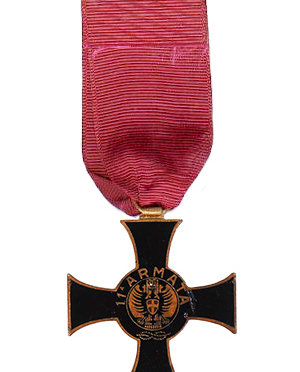
The Commemorative Cross of the 11th Army medal is made of gilt-edged black enamel cross pattée with laterally-pierced cylinder suspension.

The obverse shows with a circular central medallion with the arms of Savoy of a white cross on a red shield imposed on the two-headed Albanian eagle, inscribed 11a ARMATA above and with a knot below. The reverse gilt with the black circular inscription ‘VEEMENZA E TENACIA’ (Vehemence and Tenacity) and dated ‘16 NOVEMBRE 1940 XIX’; on replaced correct ribbon.

The Commemorative Medal for the Victory Over Greece

The Commemorative Medal for the Victory Over Greece was an Italian medal from the World War II period awarded after repelling their attack.

The Commemorative Medal for the Victory Over Greece is an Italian medal from the WW2 period.

Italy invaded Greece on 28 October 1940 from the Italian-occupied Albania. By April 1941, the Hellenic Army had repelled the attack and had pushed the Italians deep inside the Albanian territory. Trying to prevent the imminent Italian defeat, Germany attacked Greece and Yugoslavia, from/with Bulgaria, on 6 Apr. 1941 and forced the continental Greek Forces to capitulate 3 weeks later.

The Commemorative Medal for the Victory Over Greece Design

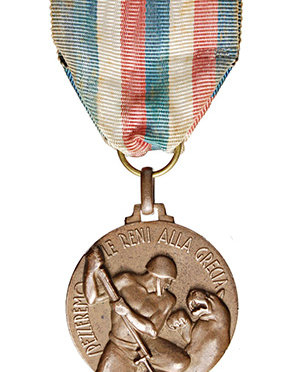
The medal shows on the obverse a dramatic scene of Italian soldier driving bayonette into a lioness. The medal measures 32.5mm in diameter. On the obverse there is the famous phrase of Mussolini “Spezzeremo le reni alla Grecia” (we will split the kidneys of Greece) during his speech on the radio on Nov. 19 1940.

The Commemorative Cross for the Expeditionary Corps in Russia

The Commemorative Cross for the Expeditionary Corps in Russia is an Italian medal given to the Italian Expeditionary Corps in Russia.

The Commemorative Cross for the Expeditionary Corps in Russia (also known as “Ice Cross”) is an Italian medal given to the Italian Expeditionary Corps in Russia – “C.S.I.R.” (Corpo di Spedizione Italiano in Russia).

During World War II, the Italian Expeditionary Corps in Russia was a corps-sized expeditionary unit of the Regio Esercito (Italian Army) that fought on the Eastern Front. In July 1942, the three divisions of the CSIR all became part of the Italian XXXV Army Corps.

The Commemorative Cross for the Expeditionary Corps in Russia Design

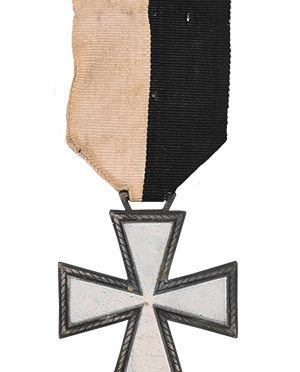
The Commemorative Cross for the Expeditionary Corps in Russia medal is made of zinc alloy and white enamels.

The medal measures 41.3 mm.

The Womens Army Corps Service Medal

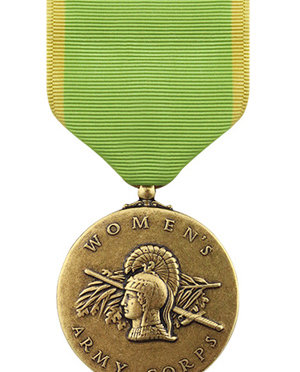
The Women’s Army Corps Service Medal is a United States Army military award created in 1943 by President Franklin Roosevelt.

The Women’s Army Corps Service Medal is a United States Army military award created on July 29, 1943 by Executive Order 9365 by President Franklin Roosevelt. The medal recognizes the service of women to the Army during the Second World War.

The Women’s Army Corps Service Medal was awarded to any service member of the Women’s Army Auxiliary Corps between July 10, 1942 and August 31, 1943 or the Women’s Army Corps between September 1, 1943 and September 2, 1945. The medal ranked in order of precedence below the American Defense Service Medal and above the American Campaign Medal.

The Women’s Army Corps Service Medal is considered obsolete as the United States Army is a combined service without separate service corps for women. The medal was issued as a once-awarded medal, and there are no devices authorized for additional presentations. 

The Women’s Army Corps Service Medal Design

The profile featured on the medal is that of the goddess Pallas Athena; the same profile was used for the Women’s Army Corps branch insignia.

No devices are authorized to be worn on the medal.

Find This Medal Online

Right Now on eBay 
Clicking a link to eBay may result in a referral commission being paid if a purchase is made.
Loading...

The Navy Occupation Service Medal

The Navy Occupation Service Medal is a Navy military award bestowed to commemorate the services of Navy, Marine Corps and Coast Guard.

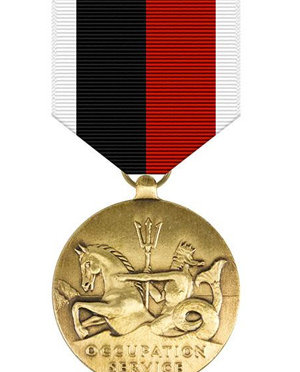
The Navy Occupation Service Medal is a United States Navy military award bestowed to commemorate the services of Navy, Marine Corps and Coast Guard personnel in the occupation of certain territories of the enemies of the U.S. during World War II”.

The Navy Occupation Service Medal also recognizes those personnel who participated in the European and Asian occupation forces during – and following World War II. The medal was additionally awarded to personnel who performed duty in West Berlin between 1945 and 1990.

No more than one Navy Occupation Service Medal may be awarded to an individual. The Navy Occupation Service Medal is the equivalent of the Army of Occupation Medal. No person could receive both awards.

The Navy Occupation Service Medal Design

The Navy Occupation Service Medal was designed by A. A. Weinman,  a German-born American sculptor and architectural sculptor.

The obverse depicts Neptune riding a Hippocampus with the words “Occupation Service”. The reverse shows the words “United States Navy” (or “United States Marine Corps”) and is the same as that of the Dominican Campaign Medal.

The medal is authorized two service clasps: Europe and Asia. The clasps are rectangular with a rope border. If eligible, both clasps may be worn on the medal. The Berlin Airlift Device is also authorized to those who have served 90 days or more in support of the Berlin Airlift between 1948 and 1949.

Find This Medal Online

Right Now on eBay 
Clicking a link to eBay may result in a referral commission being paid if a purchase is made.
Loading...

The Medal for Humane Action

The Medal for Humane Action is a United States Armed Forces military award created in 1949 to recognize military service members.

The Medal for Humane Action is a United States Armed Forces military award created by an act (63 Stat. 477) of the United States Congress on July 20, 1949 to recognize military service members who performed extended duty in support of the Berlin Airlift.

This medal was created for the single purpose of recognizing service during the Berlin Airlift and was never issued again. To be awarded the Medal for Humane Action, a service member had to have performed over 120 days of duty within the geographical boundary of Berlin. Posthumous award was possible to any person who had lost his life while, or as a direct result of, participating in the Berlin airlift, without regard to the length of such service.

Those qualifying were also eligible for either the Army of Occupation Medal, or the Navy Occupation Service Medal, and both medals were authorized for simultaneous award and display.

The Medal for Humane Action Design

The medal is based on the design of the Berlin Airlift Device. It was designed by Thomas Hudson Jones a Buffalo-born sculptor of the Army Heraldic Section.

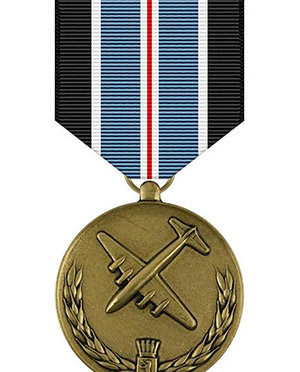
It’s made of bronze and round, and it measures 1.25 inches (32 mm) in diameter. On the obverse, it depicts a Douglas C-54 Skymaster over a wheat wreath. In the center of the wreath is the Coat of arms of Berlin. The reverse shows the eagle, shield, and arrows from the seal of the Department of Defense and reads “For Humane Action / To Supply Necessities of Life to the People of Berlin Germany“.

The medal is suspended by a ribbon of teal blue with black edges separated by thin white stripes. In the center is a red stripe with thin white stripes.

Find This Medal Online

Right Now on eBay 
Clicking a link to eBay may result in a referral commission being paid if a purchase is made.
Loading...

The European-African-Middle Eastern Campaign Medal

The European–African–Middle Eastern Campaign Medal is a United States Armed Forces military award first created in 1942.

The European–African–Middle Eastern Campaign Medal (originally known as the “EAME Ribbon”) is a United States Armed Forces military award first created on November 6, 1942 by Executive Order 9265 issued by President Franklin D. Roosevelt.

The medal recognizes military service members who had performed military duty in the European Theater (to include North Africa and the Middle East) during the years of the Second World War.

The European–African–Middle Eastern Campaign Medal is awarded for any service performed between December 7, 1941 and March 2, 1946, dates inclusive, provided such service was performed between the west and east boundaries.

The European–African–Middle Eastern Campaign Medal Design

The medal is made of bronze and measures 1 3/8 inches in width.

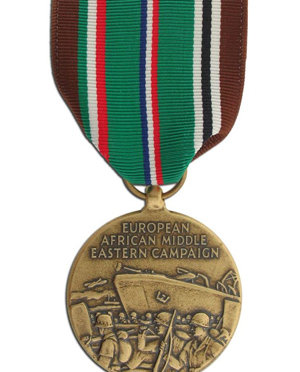
The medal’s obverse was designed by Mr. Thomas Hudson Jones, a U.S. sculptor for the Army’s Institute of Heraldry, based on General Eisenhower’s request that the medal includes an invasion scene. It displays an LST landing craft and troops landing under fire with an airplane in the background below the words EUROPEAN AFRICAN MIDDLE EASTERN CAMPAIGN.

The reverse side of the European–African–Middle Eastern Campaign Medal was designed by Adolph Alexander Weinman and is the same design as on the reverse of the Asiatic–Pacific and American Campaign Medals: An American bald eagle close between the dates 1941 – 1945 and the words UNITED STATES OF AMERICA.

The ribbon is 1 3/8 inches wide and shows a brown stripe that represents the sands of Africa, Irish green for the fields of Europe, white and scarlet for the Italian colors. The center is triparted Old Glory Blue, White and Scarlet.

Find This Medal Online

Right Now on eBay 
Clicking a link to eBay may result in a referral commission being paid if a purchase is made.
Loading...

The Asiatic-Pacific Campaign Medal

The Asiatic–Pacific Campaign Medal was awarded to any U.S. Armed Forces member who had served in the Asiatic-Pacific Theater during WW2.

The Asiatic–Pacific Campaign Medal is a military award from the United States during the Second World War. It was awarded to any member of the United States Armed Forces who had served in the Asiatic-Pacific Theater from 1941 to 1945.

The medal was created on November 6, 1942 by Executive Order 9265 issued by President Franklin D. Roosevelt. The Asiatic–Pacific Campaign Medal was first issued as a service ribbon in 1942. A full medal was authorized in 1947, the first of which was presented to General of the Army Douglas MacArthur.

The Asiatic-Pacific Campaign Medal Design

The Asiatic–Pacific Campaign Medal was designed by Thomas Hudson Jones, a U.S. sculptor for the Army’s Institute of Heraldry.

The reverse was designed by Adolph Alexander Weinman and is the same design as used on the reverse of the American Campaign Medal and European-African-Middle Eastern Campaign Medal.

There were 21 Army and 48 Navy-Marine Corps official campaigns of the Pacific Theater, denoted on the suspension by service stars also known as “battle stars“. Some Navy construction battalion units issued the medal with Arabic numerals.

The European Theater equivalent of the medal was known as the European-African-Middle Eastern Campaign Medal.

Buy an Asiatic-Pacific Campaign Medal

Note: As an eBay partner, I earn from qualifying purchases. This is all done automatically when you use a link and at no extra cost to you.

Right Now on eBay 
Clicking a link to eBay may result in a referral commission being paid if a purchase is made.
Loading...