The Airman’s Cross

The Airman’s Cross (Vliegerkruis) is an important military decoration of the Kingdom of the Netherlands created in 1941 for Dutch military.

The Airman’s Cross (or Vliegerkruis in Dutch) is an important military decoration of the Kingdom of the Netherlands created in 1941. The cross is meant for that Dutch military, who displayed during one of more flights in an aircraft, initiative, courage and perseverance against the enemy or during hostile actions. The cross is also awarded to allied pilots, whose actions or performances in the air were of high importance for the Netherlands.

Till 2007 in total of 735 Airman’s Crosses are awarded, most recently to a F-16 pilot, Air Force Major M. Duivesteijn. This because of his “exceptional courage and perseverance” at a flight above former Yugoslavia within the framework of NATO Operation Allied Force in 1999. Well-known recipients are also Erik Hazelhoff Roelfzema, the “Soldier of Orange“, and Prince Bernhard of the Netherlands.

The Airman’s Cross is the fifth highest military decoration still being awarded for bravery and has precedence after the Cross of Merit.

The Cross of Merit Design

The Airman’s Cross resembles the Dutch Bronze Cross but is worn on a diagonally-striped orange and white ribbon inspired by those of the British Distinguished Flying Cross and Air Force Cross.

The cross is silver with four arms. There is a crowned central medallion bearing an albatross in flight with “INITIATIEF MOED VOLHARDING” (INITIATIVE COURAGE PERSEVERANCE) around the edge of the medallion. The date 1941 appears above the body of the albatross. The reverse is plain.

The Cross of Merit (Netherlands)

The Cross of Merit is an award for working in the interest of the Netherlands with distinguishing valor while faced with enemy action.

The Cross of Merit (“Kruis van Verdienste”) is an award for “working in the interest of the Netherlands while faced with enemy actions and distinguishing oneself through valor and resolute behavior“. One did not have to be on the front line to win this award.

On 20 February 1941, the Dutch government in exile in London instituted several new awards for bravery. The new way that wars were fought, with civilian resistance and the merchant navy in great peril, made this necessary. Amongst the new decorations was the “Cross of Merit” (“Kruis van Verdienste”).

The cross has often been awarded to those who managed to flee to England and to the armed resistance. It was rarely awarded after the Korean War, but since the fighting of the Netherlands army in Afghanistan, Uruzgan, this World War II decoration has been awarded again on a regular basis with the latest on 7 October 2009 to eleven Dutch soldiers.

During the second world war in the Far East this cross was awarded to several people employed by the Koninklijke Paketvaart-Maatschappij (K.P.M.) as some of their merchant navy ships had been commissioned by the Dutch Navy during the Battle of the Java Sea.

The Bronze Cross Design

The medal is a bronze cross with a blue and yellow ribbon. There are several issues and types of this decoration.

In case of repeated awards a large “2” or “3” is pinned to the ribbon.

The Bronze Cross (Netherlands)

The Bronze Cross of the Kingdom of the Netherlands was instituted by Queen Wilhelmina during the German occupation of the Netherlands.

The Bronze Cross of the Kingdom of the Netherlands (or “Het Bronzen Kruis” in Dutch) was instituted on 11 June 1940 by Queen Wilhelmina of the Netherlands while she was residing in London during the German occupation of the Netherlands.

The Bronze Cross has precedence after the Resistance Star East Asia, but is the third-highest military decoration still being awarded for bravery.

Several British, American, Canadian and Polish soldiers are among the 3,501 recipients of the Bronze Cross that is awarded by Royal Decree.

The Bronze Cross Design

The medal is a bronze cross pattée. A wreath consisting of tendrils of oak and laurel leaves is tied around the royal cipher.

The orange ribbon has a Nassau blue stripe in the center. Orange is the color of the Queen, the head of the House of Orange, and blue is the heraldic color of the ancestral house of Nassau.

The Cross has no clasps. If it is awarded again a large Arabic golden figure “2” or “3” is attached to the ribbon.

The Resistance Star East Asia

The Resistance Star East Asia (Verzetsster Oost-Azië) was created to commemorate the resistance against the Japanese occupation of Indonesia.

The Resistance Star East Asia (or Verzetsster Oost-Azië in Dutch) was created by royal decree on 26 October 1948 by Queen Juliana to commemorate the resistance against the Japanese occupation of Indonesia, which went underground after the capitulation of the Royal Dutch East Indies Army. This resistance suffered tremendous losses in live.

The medal honors the Dutch subjects in the Netherlands East Indies who showed strength of mind, determination, or solidarity, and performed praise-worthily help for Dutchmen that were made a prisoner of war or interned by the enemy during World War II. Also those of the Dutch resistance in Southeast Asia are honored.

Due to the loss of the archive of the Resistance Star a lot of historiography about this award is lost. Since 1948 the Resistance Star is awarded in total of 471 times. The star is a high award and has precedence just after the Bronze Lion.

The Resistance Star East Asia Design

The bronze six-pointed star with a flaming sun and the words “de geest overwint” (The spirit triumphs) was designed by Frans Smits.

The star is attached to a purple ribbon which has two golden lanes in the middle. The colors are symbolic: the gold-yellow remembers the custom in Southeast Asia to wrap a valuable gift in a gold-colored cloth. At the reverse side the text “maart 1942 – O.Azië – augustus 1945” (“March 1942 – East Asia – Augustus 1945”) is inscribed.

The Bronze Lion

The Bronze Lion (Bronzen Leeuw) is a high Royal Dutch award intended for servicemen who have shown extreme bravery and leadership in battle.

The Bronze Lion (or Bronzen Leeuw in Dutch) is a high Royal Dutch award intended for servicemen who have shown extreme bravery and leadership in battle favoring The Netherlands.

It was first created in 1944 and has since been issued 1210 times. Proposals for an award are reviewed by the Dutch Board for Bravery Awards, which is part of the ministry of Defense. If awarded they are enforced by a Royal Decree. In some special cases, the Bronze Lion can however be awarded to Dutch or foreign civilians.

The Bronze Lion has precedence after the Order of the House of Orange, but is the second highest military decoration still being awarded for bravery (only preceded by the Military William Order).

The Bronze Lion Design

The Bronze Lion is a cross in bronze, covered by a round shield. On the front is a relief of the crowned Dutch Lion.

The cross is attached to a 37 millimeter wide ribbon, divided into nine equal vertical stripes, alternately orange and ‘Nassau blue’, the strips on either edge are Nassau blue. It is possible for a single person to receive more than one award of the Bronze Lion, in which case a number ‘2’ in gold is added on the ribbon of the Bronze Lion.

The Dutch Cross of Resistance

The Cross of Resistance 1940-1945 (or Verzetskruis 1940–1945 in Dutch) is the second highest decoration for valor in the Netherlands.

The Cross of Resistance 1940-1945 (or Verzetskruis 1940–1945 in Dutch) is the second highest decoration for valor in the Netherlands.

The decoration was awarded for extreme bravery awarded to the Dutch Resistance. The Dutch resistance to the Nazi occupation of the Netherlands during World War II can be mainly characterized as non-violent, and was organized by the Communist Party, churches, and independent groups. A peak of over 300,000 people were hidden from German authorities in the autumn of 1944, tended to by some 60,000 to 200,000 illegal landlords and caretakers, and tolerated knowingly by some one million people, including a few incidental individuals among German occupiers and military.

Dutch counterintelligence, domestic sabotage, and communications networks eventually provided key support to Allied forces, beginning in 1944 and continuing until the Netherlands was fully liberated. A number of resistance groups specialized in saving Jewish children, including the Utrechtse Kindercomité, Landelijke Organisatie voor Hulp aan Onderduikers, Naamloze Vennootschap (NV), and Amsterdam Student Group.

The Cross was awarded 95 times (93 of them posthumously).

The Cross of Resistance Design

By Royal Decree of May 3rd 1946 the Resistance Cross was finally instituted. The formal disruption was: “The Bronze decoration of the Resistance Cross resembled a four armed cross, imbedded on a star of flames and covered with the Royal Crown. On the front one can find St. Joris fighting the dragon. On the arms of the cross are engraved the words ‘Trouw tot in den dood’. On the obverse one can find a flaming sword wit two broken chains“, all according to article 4 of the Royal Decree.

The ribbon is colored in Crimson Red with two golden orange lines.

The Kuban Shield

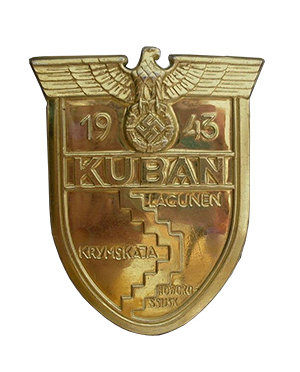
The Kuban Shield is a World War II military decoration awarded to those who fought at the Kuban bridgehead in the Soviet Union.

The Kuban Shield (or Ärmelschild Kuban in German) is a World War II military decoration of Nazi Germany, awarded to those who fought at the Kuban bridgehead in the Soviet Union from February 1943 until it was abandoned in October 1943.

The criteria for award of the shield to military personnel:

  • Served in the bridgehead for 60 days; or
  • Been wounded while defending the bridgehead; or
  • Had been engaged in a single major operation at the bridgehead.

The Kuban Shield Design

The shield is designed in a similar fashion to the Crimea Shield and was struck in sheet metal or zinc and treated with a bronzed wash.

It features a German eagle with outstretched wings clutching a laurel wreath with a swastika. On each side the wreath are the numbers 19 and 43. Directly below the eagle is written KUBAN in block capital letters. Below this name is a stylized map of the Kuban region, with a line representing the defensive line that the men fought to preserve with the location of the bridgeheads – KRYMSKAJALAGUNEN, and NOWOROSSIJSK.

The shield was worn on the upper left sleeve of the tunic. A back plate, which held in place a piece of cloth matching the recipients’ branch of service, was applied to the shield:

  • Green for Heer (army)
  • Blue for Luftwaffe (air force)
  • Black for Panzer units (armoured units)

More Nazi Germany Shields (Ärmelschilde)

These campaign shields were awarded to members of the Wehrmacht (the unified armed forces of Nazi Germany from 1935 to 1945). They were given for participation in specific battles or campaigns and worn on the left upper arm of the uniform jacket.

The Lappland Shield

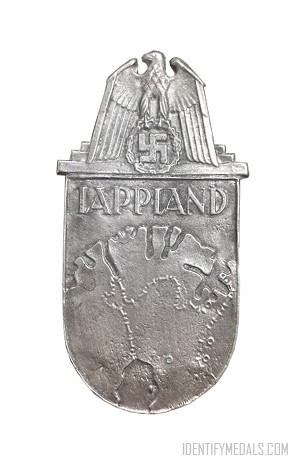
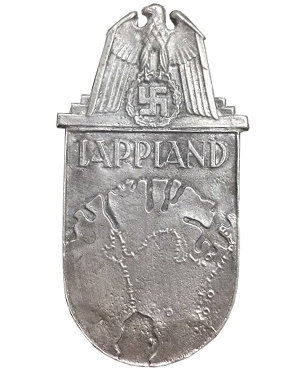
The Lappland Shield (Lapplandschild) is a World War II German military decoration awarded to military personnel who fought in Lapland.

The Lappland Shield (or Lapplandschild in German) is a World War II German military decoration awarded to military personnel which had been fighting a two-front campaign against the advancing Finnish and Soviet Red Army forces in Lapland between November 1944 and the war’s end in May 1945.

The badge was awarded to men of General Franz Böhme’s 20th Mountain Army who had “honorably served” for six months in the region or had been wounded during operations therein. It was authorized in February 1945 and was the last officially instituted German campaign shield of the war.

The Lappland shield continued to be awarded after the end of the war in May, 1945 by the unit commander.

The Lappland Shield Design

The badge consists of a basic shield with flat top and rounded bottom. It incorporates an eagle at the top but without a swastika. Directly below this, in capital letters, is written “LAPPLAND” and beneath it appears a map of the region.

Four small holes were punched in the shield to allow it to be sewn on the upper left sleeve of the uniform, however, it had no back-plate or uniform cloth section attached.

More Nazi Germany Shields (Ärmelschilde)

These campaign shields were awarded to members of the Wehrmacht (the unified armed forces of Nazi Germany from 1935 to 1945). They were given for participation in specific battles or campaigns and worn on the left upper arm of the uniform jacket.

The Crimea Shield - German WW2 Medals, Badges and Awards

The Crimea Shield

The Crimea Shield (Krimschild) is a WW2 German military decoration awarded to military personnel who fought against Soviet Red Army forces.

Read More »

The Demyansk Shield

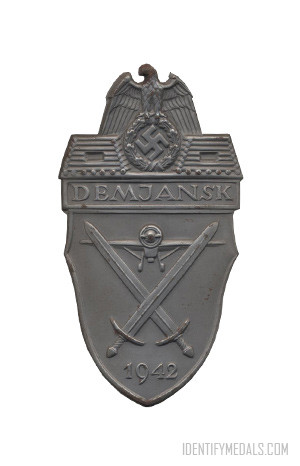
Demyansk Shield is a World War II German military decoration awarded to military personnel who fought in the Demyansk pocket.

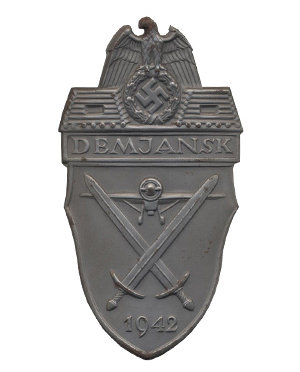
Demyansk Shield (or Ärmelschild Demjansk in German) is a World War II German military decoration instituted on 25 April 1943 by Adolf Hitler and awarded to military personnel who fought in the Demyansk pocket, achieved through the use of an airbridge.

The pocket of German troops had been encircled and cut off by the Red Army around Demyansk, south of Leningrad, during World War II on the Eastern Front. It was not bestowed after 1 July 1944.

Requirements for army, Waffen-SS and auxiliary units included honorable service in the besieged area for 60 days or wounded in the besieged area. For Luftwaffe personnel — 50 combat or re-supply missions over the besieged area.

The Demyansk Shield Design

The Demyansk shield features at its apex an eagle with swooped down wings clutching a laurel wreath that surrounds a swastika in the obverse. This is flanked by two pillboxes with gun ports. Below this is capital letters is written DEMJANSK.

The central portion of shield features a head-on single engine aircraft, two crossed swords and at the base, the year 1942. Two minor variations of the aircraft’s propeller exist with either a curved or straight propeller.

The shield was die struck and produced in silver-washed zinc and later in plain zinc. It was affixed to the upper left sleeve of the uniform via a cloth that matched the color of the uniform of the recipient:

  • Light green-grey (field-grey) for Heer (army)
  • Blue for Luftwaffe (air force)
  • Black for Panzer units (armoured units)
  • Field-grey for Waffen-SS

More Nazi Germany Shields (Ärmelschilde)

These campaign shields were awarded to members of the Wehrmacht (the unified armed forces of Nazi Germany from 1935 to 1945). They were given for participation in specific battles or campaigns and worn on the left upper arm of the uniform jacket.

German WW2 Nazi Awards: The Warsaw Shield

The Warsaw Shield

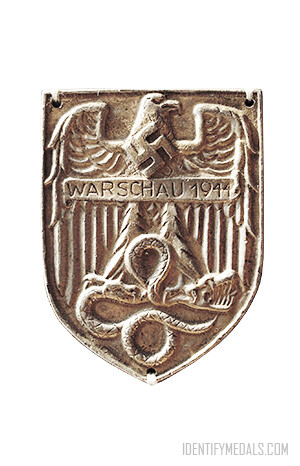
The Warsaw Shield (Ärmelschild Warschau) is a German military decoration for those who took part in the suppression of the Warsaw uprising.

Read More »
The Crimea Shield - German WW2 Medals, Badges and Awards

The Crimea Shield

The Crimea Shield (Krimschild) is a WW2 German military decoration awarded to military personnel who fought against Soviet Red Army forces.

Read More »

The Crimea Shield

The Crimea Shield (Krimschild) is a WW2 German military decoration awarded to military personnel who fought against Soviet Red Army forces.

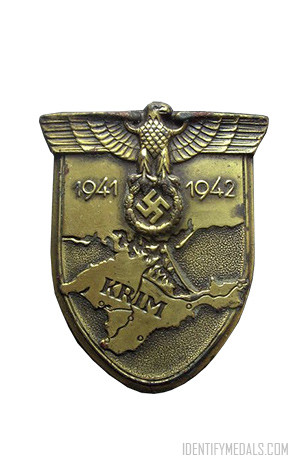
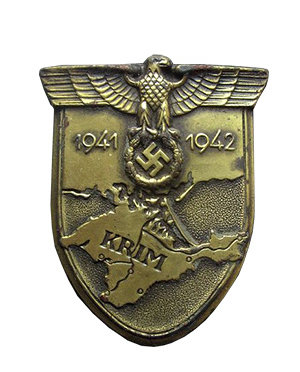
The Crimea Shield (or Krimschild in German) is a World War II German military decoration instituted on 25 July 1942 and awarded to military personnel who fought against Soviet Red Army forces and captured the Crimea region between 21 September 1941 and 4 July 1942 under the command of Generalfeldmarschall Erich von Manstein.

The Wehrmacht’s Army Group South advanced through the Crimean peninsula between the Autumn of 1941 and Summer of 1942. The hostilities that ended with the German capture of Sevastopol on 4 July 1942.

The Crimea Shield was the most widely distributed of the various German ones, with approximately 250,000 of them being awarded. It could be awarded to all members of the Wehrmacht and to Luftwaffe and other units affiliated to the campaign in the specified dates. The following conditions needed to have been met for the award:

  • Served in the area for at least 90 days; or
  • Been wounded while serving in the area; or
  • Had been engaged in at least one major operation against the enemy.

Romanian troops serving in the Crimea were also eligible for the award.

The Crimea Shield Design

The Crimea shield is headed, on the obverse, by the German eagle clutching a laurel wreath surrounding a swastika. Flanking the eagle are the dates 1941 and 1942, which represent the start and end dates of the campaign. This sits on the backdrop of the Crimean peninsula, where the fighting took place, which has the word KRIM stamped across it.

A special pure-gold version of the Crimea Shield was also produced and first bestowed upon Marshal Ion Antonescu, the military dictator of Romania, at the end of the Siege of Sevastopol on 3 July 1942. It was awarded to him in Bucharest by Erich von Manstein, on Adolf Hitler’s behalf. The second and last Golden Krimschild was awarded to von Manstein himself, on 24 November 1942.

More Nazi Germany Shields (Ärmelschilde)

These campaign shields were awarded to members of the Wehrmacht (the unified armed forces of Nazi Germany from 1935 to 1945). They were given for participation in specific battles or campaigns and worn on the left upper arm of the uniform jacket.

The Crimea Shield - German WW2 Medals, Badges and Awards

The Crimea Shield

The Crimea Shield (Krimschild) is a WW2 German military decoration awarded to military personnel who fought against Soviet Red Army forces.

Read More »