The Order of Saint Stanislaus

The Order of Saint Stanislaus is a Russian dynastic order of knighthood founded in 1765 by King Stanisław II Augustus.

The Order of Saint Stanislaus (or Order św. Stanisława in Polish, Орденъ Св. Станислава in Russian) is a Russian dynastic order of knighthood founded as Order of the Knights of Saint Stanislaus, Bishop and Martyr in 1765 by King Stanisław II Augustus of the Polish–Lithuanian Commonwealth.

In 1831 after the downfall of the November Uprising, the order was incorporated into the Chapter of Russian Orders as part of the honours system of the Russian Empire by Emperor Nicholas I of Russia. In 1839, the Russian Order of Saint Stanislaus received new statutes, including granting status of nobility on its recipients in all three classes.

As a result of the Russian Revolution 1917, activities were suspended by the Soviet Union, although it has since been awarded by the head of the Imperial House of Romanov as a dynastic order. When in 1918 Poland regained its independence as the Second Polish Republic, a Polish order was introduced as a successor to the Polish Order of Saint Stanislaus, the Order of Polonia Restituta.

The heads of the Russian Imperial House in exile have continued to award Imperial and Royal Order of Saint Stanislaus. H.I.H. Grand Duchess Maria Vladimirovna, pretender to the Russian throne, and head of the Russian Imperial House, continues to award the Russian Imperial Order of Saint Stanislaus as a dynastic order of knighthood.

The Order of Saint Stanislaus Design

On the star and crosses of all classes, non-Christian recipients will have, instead of the cypher of Saint Stanislaus, a black and gold Imperial Russian double-headed Eagle. According to the Imperial Chapter of Orders and other honors, ed. 1892, the Order of Saint Stanislaus has three degrees, for which the insignia are:

Order of Saint Stanislaus 1st Class

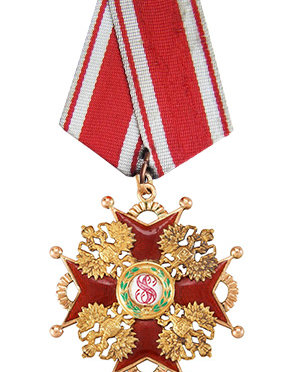
Gold cross, covered with a red enamel face, the four ends of which are further divided in two sharp points; on the edges of the cross a double gold rim; at the eight sharp points golden balls; and among these terminals, bringing them together, are gold semicircles of striped shells; in the center, on a white filigree round shield encircled by a gold border with a green wreath on it, the Latin monogram of Saint Stanislaus, a red “SS”; at each of the axillae, the state symbol of the Russian double-headed eagle in gold. On the rear side of the cross, all gold, with the verso a centered white round enameled shield, which depicts the same monogram “SS”.

It is worn on a moiré red ribbon, the breadth of two and a half inches, double white stripes at the borders, worn over the right shoulder with the star on the left side of the chest.

Silver star, the eight rays centering a white round shield circled with wide green stripes with two gold rims, the external rim wider; on the green enameled band between, gold laurel branches connected in the middle of each by two flowers; center roundel, in white enamel with red letters the cypher of Saint Stanislaus: “SS”; and around the hoop in a white box with gold letters, the motto of the order: Praemiando incitat (“rewarding encourages”) divided at the top with a golden flower.

Order of Saint Stanislaus 2nd Class

Cross of the same form, as for the first class, but of lesser magnitude, worn around the neck, on a ribbon with a width of one or two inches.

Order of Saint Stanislaus 3rd Class

Cross of the same form as the first two classes but worn in the buttonhole on the same ribbon with a width of five-eighths inches.
The Silesian Uprising Cross

The Silesian Uprising Cross is a Polish military decoration awarded to veterans of the Silesian Uprisings those active in Silesia in WW2.

The Silesian Uprising Cross (or Śląski Krzyż Powstańczy in Polish) is a military decoration established in 1946 and awarded to veterans of the Silesian Uprisings (1919-1921) and members of Polish resistance in World War II active in Silesia.

The Silesian Uprisings were a series of three uprisings from August 1919 to July 1921 in Upper Silesia, which was part of the Weimar Republic at the time. Ethnic Polish separatists, seeking to have the area transferred to the newly founded Polish Republic, fought German police and paramilitary forces, as the former sought to keep the area part of the new German state founded after World War I. Following the conflict, the area was divided between the two countries. The rebellions have subsequently been commemorated in modern Poland as an example of Polish nationalism.

The order ceased to be given out in 1999.

The Silesian Uprising Cross Design

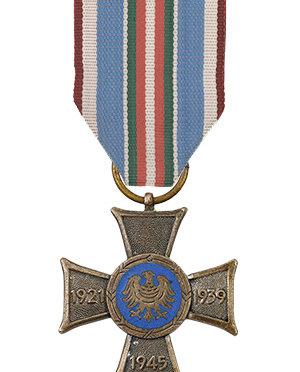
The medal is struck in silvered bronze with blue enamels and measures 36.2 mm in diameter.

The obverse bears the years 1921 on the left arm, 1939 on the right arm, and 1945 on the lower arm. The central disc is light blue enamel and shows the silver Silesian eagle encircled by a stylized wreath. The reverse is not enameled.

The ribbon is light blue with white (inner) and dark red (outer) edges. In the centre there is a wide stripe of green, red, white, red, green, flanked by white pinstripes.

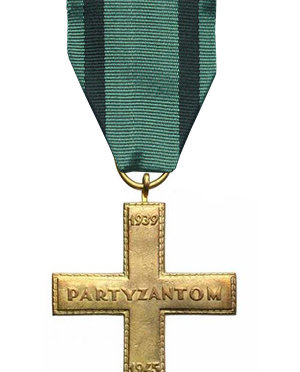
The Partisan Cross (Poland)

The Partisan Cross was a Polish military decoration introduced by the Council of Ministers in 1945 and awarded to World War II partisans.

The Partisan Cross (or Krzyż Partyzancki in Polish) was a military decoration awarded to World War II partisans (part of resistance movement fighting in the countryside). It was introduced by the Council of Ministers on October 26, 1945.

The cross was awarded to organizers, commanders and members of partisan units who fought against Germans on a Polish territory, or to Poles who fought in partisan units in the USSR, Yugoslavia and France, or to foreigners, who fought in partisan units on Polish territory. It could be given also to cities or villages, that distinguished themselves in supporting the partisan movement.

About 55,000 Partisan Crosses were awarded. The Partisan Cross ceased to be awarded in 1999.

The Partisan Cross Design

The Cross is a gold-plated Greek cross with thin arms, 38 x 38 mm.

The obverse shows the eagle in the centre (the Polish coat-of-arms) and an inscription: “ZA – POLSKĘ – WOLNOŚĆ – i LUD” (“For Poland, Liberty and People”) on arms. The reverse bears the horizontal inscription “PARTYZANTOM” (“To partisans”), and the date “1939” on an upper vertical arm and “1945” on a lower arm.

The ribbon is dark green, 35 mm wide, with black strips 7 mm wide, near both edges.

The Order of the Cross of Grunwald

The Order of the Cross of Grunwald is a military decoration created in Poland in November 1943 and conferred for merit in combat.

The Order of the Cross of Grunwald (or Order Krzyża Grunwaldu in Polish) was a military decoration created in Poland in November 1943 by the High Command of Gwardia Ludowa, a World War II Polish resistance movement organized by the Polish Workers Party.

The medal was conferred to Polish or the allied military for valor or merit in combat with Nazi Germany. After the end of the Second World War it continued to be awarded for outstanding merit in commanding or outstanding contribution to the development of the Polish Armed Forces.

On 20 February 1944 it was confirmed by the State National Council and on 22 December by the Polish Committee of National Liberation and further confirmed on 17 February 1960 by the government of the People’s Republic of Poland. It was disestablished by the President of Poland via Parliament in 1992.

The Order of the Cross of Grunwald Design

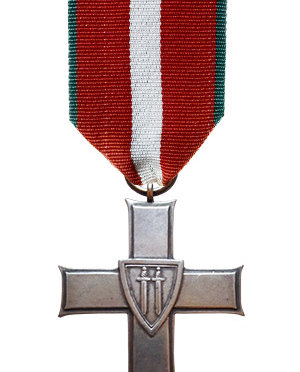
The medal is a cross with 4 equilateral arms with gold edges and pointed ends. It’s struck in silver and measures 45 by 45 mm in diameter. Overall arm length with finials is 16.5 mm and without finials 15 mm. Thickness is 2.5 mm.

The center of the obverse shows a shield within which are two swords facing downwards. In the center of the reverse is also a sword, in which is the transcription 1410 KG 1944 below one another.

The ribbon has a central grey stripe flanked by red with green edges.

The Monte Cassino Commemorative Cross

The Monte Cassino Commemorative Cross was awarded to all soldiers of the Polish II Corps who fought in the battle of Monte Cassino.

The Monte Cassino Commemorative Cross (or Krzyż Pamiątkowy Monte Cassino in Polish) is a commemorative medal awarded to all soldiers of the Polish II Corps who fought in the battle of Monte Cassino and the battles for Piedimonte and Passo Corno.

The Battle of Monte Cassino (also known as the Battle for Rome and the Battle for Cassino) was a costly series of four assaults by the Allies against the Winter Line in Italy held by Axis forces during the Italian Campaign of World War II. The intention was a breakthrough to Rome.

After the capture of Monte Cassino in May 1944, the Polish government-in-exile (in London) created a campaign cross to commemorate the role of the Polish II Corps (often known as Anders Army) in capturing this strategic point, which had long blocked the Allied advance up the Italian peninsula. A consignment of 50,000 crosses was ordered from a manufacturer in Tel Aviv, then part of British-ruled Palestine, where the Polish forces had spent part of 1942 and almost all of 1943 in training.

A total of 48,498 crosses were awarded with accompanying award documents issued in the field to each soldier who took part in the battle. The lists of named cross recipients are held at the Polish Institute and Sikorski Museum.

The Monte Cassino Commemorative Cross Design

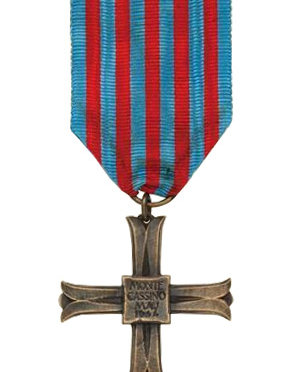
The medal is a cross with 4 equilateral arms, incised grooves and outward curving, radiant tips. It is struck in silver or bronze and measures 40 mm in diameter. The design of the cross echoes that used by the order of St. Benedict, who founded the Monte Cassino Abbey in 529.

The obverse (top left) bears the inscription “MONTE CASSINO MAJ 1944“. The reverse (top right) has the serial number of the medal.

The grosgrain ribbon has alternating vertical stripes of equal width: 6 blue, 5 orange. The ribbon is inserted through a suspension ring attached to a ring suspension attached to a loop in the cross point.

The Cross of Independence (Poland)

The Cross of Independence had three versions and was awarded to individuals who had fought heroically for the independence of Poland.

The Cross of Independence (or Krzyż Niepodległości in Polish) was awarded to individuals who had “fought heroically for the independence of Poland” and existed in three versions. It was the second highest Polish military decoration between World Wars I and II.

The Cross of Independence was established with a decree of the President of Poland of 29 October 1930. It was to be awarded to the people who laid foundations for the independence of the Fatherland before the World War or during it, as well as during the fights between 1818 and 1921, with the exception of the Polish-Russian War. After 1938 it was also awarded to people responsible for the reunification of Zaolzie with Poland.

Although the cross without the swords was awarded mainly to the civilians, all versions were considered to be military decorations.

The recipients of all grades of the Cross of Independence had a right to be elected to the Senate of the Republic of Poland, the right to travel by Polish State Railways free of charge and a right to send their children to the schools of their choice free of charge.

The Cross of Independence had three classes:

  1. Cross of Independence with Swords (1818 awarded by 1938)
  2. Cross of Independence (7917 awarded by 1938)
  3. Medal of Independence (51735 awarded all together)

The Cross of Independence Design

Both the Cross and the Medal were designed by professor Mieczysław Kotarbiński and most of the copies were made by Warsaw-based jeweler Wiktor Gontarczyk.

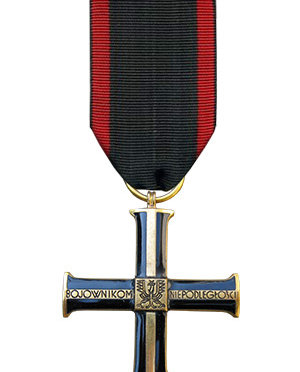
The cross measures 42 by 42 mm and is made of gilt bronze. The obverse has a rectangle shield with stylised eagle in bas-relief. The reverse is covered with black enamel and the motto “Bojownikom Niepodległości” (“To the Fighters for Independence”). The version with Swords had two golden swords crossed above the cross.

The medal of Independence is round, measures 35 mm in diameter, and is made entirely of bronze. On the obverse there is a symbolic depiction of three Hydras (symbolizing three partitioning Powers) stroke with two swords and surrounded by the motto “Bojownikom Niepodległości”. The reverse is plain with letters RP in the center (standing for Rzeczpospolita Polska).

The Volunteer Cross for War 1918-1921

Time Period: Interwar Period, WW1

Year of Institution: 15 June 1939
Country: Poland

The Volunteer Cross for War and the Volunteer Medal for War (or Krzyż i Medal Ochotniczy za Wojnę in Polish) were military decorations from Poland introduced just before the start of World War II and later awarded by the Polish government in exile.

The Volunteer Cross for the War could be awarded to volunteers serving in the years 1918-1921, if they met one of the following criteria:

  • Fallen or wounded on the battlefield,
  • Decorated with the Virtuti Militari Cross or the Cross of Valor,
  • They actively served 3 months, including at least 2 months in units fighting at the front or 6 months as instructors in military schools of weapons and school camps.

The Cross and the Volunteer Medal for War were introduced by an act of the Sejm on 15 June 1939. It was to be awarded to people who volunteered for duty in the years 1918 to 1921 and helped to strengthen the independence of the Polish Republic, covering mainly the Polish-Ukrainian War and Polish-Soviet war.

Because of the German invasion of Poland in 1939 and the outbreak of World War II no decorations were awarded at the time. It was only after 1945 that the Polish government in exile was able to award the decorations. The communist authorities of the People’s Republic of Poland refused to recognize the decoration. After the fall of communism, a very similar decoration, Krzyż za udział w Wojnie 1918-1921, was introduced.

The Volunteer Cross for War 1918-1921 Design

The medal has the form of a straight isosceles cross made of steel and measures 42 by 42 mm. It consists of four equal arms, extended at the ends, with a flattened octagonal cross-section and tied in the centre by a cube.

On the cross arms of the Cross, in the obverse, there is a horizontal inscription: “OCHOTNIKOWI WOJENNEMU”, and on the vertical arms the dates: 1918 and 1921. In the middle of the crossing of the arms there is an image of a white enamel eagle.

The cross and medal were to be worn on a 37 mm wide ribbon in red with two narrow white vertical stripes.

The Cross of Freedom and Solidarity

The Cross of Freedom and Solidarity was established in 2010 to honor killed, wounded or imprisoned members of the democratic opposition.

The Cross of Freedom and Solidarity (or Krzyż Wolności i Solidarności in Polish) was established on 5 August 2010, to honor members of the democratic opposition in Poland who between the years 1956 and 1989 were killed, seriously wounded or injured, arrested, imprisoned or interned for at least 30 days, who lost jobs or were expelled from school or university for at least 6 months as a result of their activities for the benefit of a free and democratic Poland.

Individuals who are found having collaborated with the communist regime may not be awarded.

The Cross of Freedom and Solidarity Design

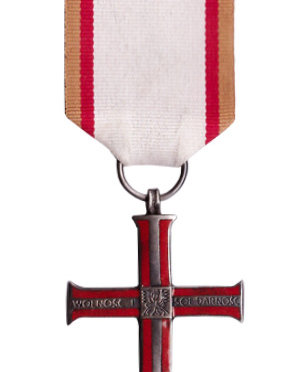
The cross is a red enameled Greek cross struck in silver, similar to that of the Order of the Cross of Independence and the Cross of Independence of 1930. The cross is 42 mm in diameter.

On the obverse, the inscription “WOLNOŚĆ I SOLIDARNOŚĆ” (“Freedom and Solidarity”) is written across the horizontal arms. In the center of the cross carved stylized image of the White Eagle. The reverse side of the cross is smooth.

The Cross of Freedom and Solidarity is suspended from a white ribbon, 38 mm wide. Symmetrically arranged along the edges of the ribbon are gold and crimson stripes each 3 mm wide.

The Cross of Merit with Swords (Poland)

The Cross of Merit with Swords is a military award of Poland established October 19, 1942, by the Polish Government in Exile.

The Cross of Merit with Swords (or Krzyż Zasługi z Mieczami in Polish) is a military award of Poland established October 19, 1942, by the Polish Government in Exile.

The Cross of Merit with Swords is awarded for deeds of bravery and valor during time of war not connected with direct combat, and for merit demonstrated in perilous circumstances.

The Order has three grades:

1. Gold Cross of Merit with Swords
2. Silver Cross of Merit with Swords
3. Bronze Cross of Merit with Swords

The cross may be awarded twice in each grade to the same person.

The Cross of Merit with Swords Design

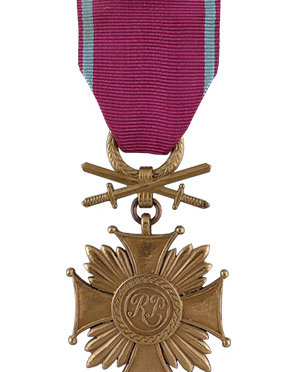
The medal is struck in silver or bronze (the first class with red and white enamels), measures 40.5 mm (w) x 40.5 mm (h) ad weighs approximately 24 grams. The shape is a cross with sunlight rays between the arms.

In the center medallion, in the obverse, are the initials RP (“Rzeczpospolita Polska” or Republic of Poland). The ribbon is red with white edges. The suspension has crossed sowrds.

The medal was awarded with a molded box and a certificate.

The Cross of Merit (Poland)

The Cross of Merit is a civil state decoration of Poland established on June 23, 1923, to recognize services to the state.

The Cross of Merit (or Krzyż Zasługi in Polish) is a civil state decoration of Poland established on June 23, 1923, to recognize services to the state.

At the time of its establishment in 1923, the Cross of Merit was the highest civilian award in Poland. It was given to citizens who went beyond the call of duty in their work for the country and society as a whole.

The Order has three grades:

1. Gold Cross of Merit (Złoty Krzyż Zasługi)
2. Silver Cross of Merit (Srebrny Krzyż Zasługi)
3. Bronze Cross of Merit (Brązowy Krzyż Zasługi)

The Cross of Merit may be awarded twice in each grade to the same person.

The Cross of Merit Design

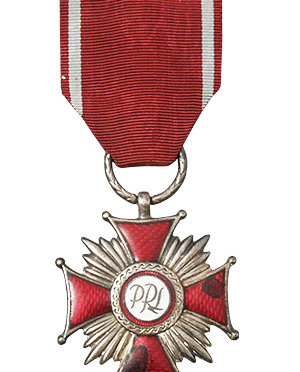
The medal is struck in silver or bronze (the first class with red and white enamels), measures 40.5 mm (w) x 40.5 mm (h) ad weighs approximately 24 grams. The shape is a cross with sunlight rays between the arms.

In the center medallion, in the obverse, are the initials RP (“Rzeczpospolita Polska” or Republic of Poland). The ribbon is red with white edges.

The medal was awarded with a molded box and a certificate.