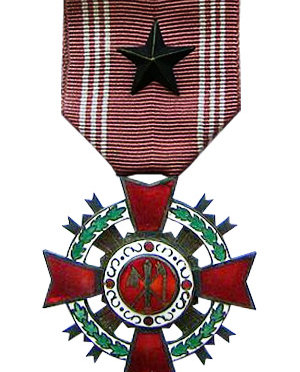
The Order of Military Merit (South Korea)

The Order of Military Merit (무공훈장 in Korean) is the primary military decoration awarded by the South Korean government.

The Order is awarded to a person who rendered “outstanding military services by participating in an action in time of war or in quasi-state of war or by performing his/her duty equivalent to combat, such as responding to the attack of an enemy in a contact area.”

The Order of Military Merit is awarded in five classes and each of these has three grades. In descending order of rank, the classes are:

  • Taeguk Cordon Medal.png Taeguk (태극)
  • Eulji Cordon Medal.png Eulji (을지)
  • Chungmu Cordon Medal.png Chungmu (충무)
  • Hwarang Cordon Medal.png Hwarang (화랑)
  • Inheon Cordon Medal.png Inheon (인헌).

The Order of Military Merit Design

Each class has a first, second or third grade, denoted respectively by a gold star (금색 별), silver star (실버 스타), or an unadorned ribbon.
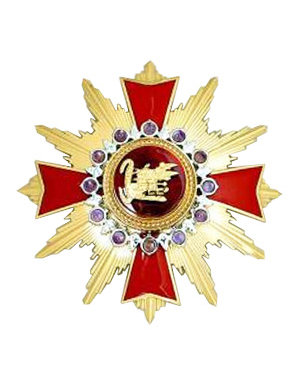
The Grand Order of Mugunghwa

The Grand Order of Mugunghwa is the highest order awarded by the government of South Korea and takes its name from the rose of Sharon.

The Grand Order of Mugunghwa (무궁화대훈장 in Korean) is the highest order awarded by the government of South Korea. It takes its name from South Korea’s national flower, the rose of Sharon (a cultivar native to the Korean peninsula and has great cultural significance in Korean history).

The medal is awarded to the President of South Korea (it may also be awarded to their spouse), heads or former heads of state of South Korean allies, and their spouses for “outstanding meritorious services in the interest of promoting the development and security of the Republic of Korea.”

The Grand Order of Mugunghwa Design

The Order may be made of gold, silver, ruby, and amethyst and consists of an insignia worn around the neck, a badge affixed to sash worn over the shoulder, and a star with a ribbon and a lapel badge as necessary.

The Miguel Hidalgo Order

The Miguel Hidalgo Order (Condecoración “Miguel Hidalgo” or Miguel Hidalgo Decoration) is the highest award that the Mexican State gives to its citizens. The Order forms part of the Mexican Honor System.

The Miguel Hidalgo Order is awarded for eminent or distinguished merits, relevant services rendered unto the Nation or to Mankind, exemplar conduct or life’s work, or heroic acts.

The Order is named after Miguel Hidalgo y Costilla (1753-1811), a Mexican Catholic priest and main leader of the Mexican War of Independence. The award was officially issued in 1975 by  President Luis Echeverría and the Executive Branch of the Government of Mexico.

The Miguel Hidalgo Order Design

The Order consists of four classes, which are represented by a collar, a cross, a band, and a plaque. The Collar is awarded for heroic acts and exemplary conduct, and for services rendered unto the Nation or to Humanity that are of a transcendent and extremely beneficial nature. The cross is awarded for eminent merits,  outstandingly exemplar conduct, and heroic acts which would not merit a collar. The Band is given for distinguished merits and exemplary that warrants making it public knowledge. The plaque is awarded for merits not contemplated by the previous grades.

The badge of the Order is a cross in silver and gold with an eagle on the obverse.

The National Security Voluntary Militia’s Long Service Cross

The National Security Voluntary Militia’s Long Service Cross was established in 1933 and awarded for 10 ys of good services in the militia.

The National Security Voluntary Militia’s Long Service Cross (or Milizia Volontaria per la Sicurezza Nazionale in Italian) is a medal established in Italy on 23 January 1933 by royal decree and awarded for 10 years of good services within the militia.

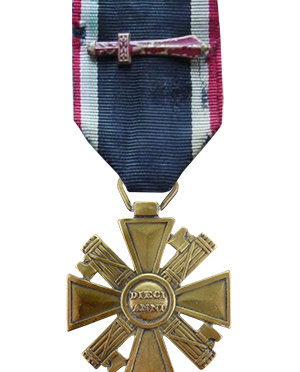
In 1943, it became necessary to also create a decoration for 20 years service. Due to the critical wartime situation, the decision was made to not strike a new cross with a 20 year reverse but instead to institute a ribbon device. This device, a Roman swords colored red, was instituted on 28 January 1943.

The National Security Voluntary Militia's Long Service Cross Design

The medal is a cross-pathée with fasces between the arms. It’s struck in bronze and measures 38 mm wide by 42.3 mm high. The suspension is a laterally-pierced ball.

The obverse shows the initials ‘MVSN’ for the Milizia Volontaria per la Sicurezza Nazionale (National Security Volunteer Militia), popularly referred to at the ‘Blackshirts’.

The reverse has the inscription “DIECI / ANNI” (Ten Years).

The World War I Gold Medal Commemorative

The World War I Gold Medal Commemorative Medal was instituted by the President of the Republic of Italy on the 50th Anniversary of Victory.

The World War I Gold Medal Commemorative Medal (or Medaglia-ricordo in oro della I Guerra Mondiale in Italian) was an award instituted by the President of the Republic of Italy on the 50th Anniversary of Victory.

The medal was awarded in 1968 to all veterans of World War I (or of previous conflicts) who served in arms for at least 6 months before 2.8.1920.

The World War I Gold Medal Commemorative Design

The medal is small, round, and struck in solid gold. It weighs 5 grams and has a mirror finish.

The obverse bears a small star and an “Adrian” helmet over a laurel and oak wreath. On the reverse is the inscription “50° ANNIVERSARIO DELLA VITTORIA 1918 1968” (“50th Anniversary of the Victory – 1918 1968).

The ribbon is a reduced-size one, with twelve narrow vertical stripes in green-white-red repeated four times.

The Commemorative East Balkan Expeditionary Corps Cross

The Orient Balkan Cross was an unofficial medal awarded to the expeditionary corps that fought in the Balkans from 1914 to 1919.

The Orient Balkan Cross (or Croce Commemorativa del Corpo di Spedizione dell’Oriente Balcanico in Italian) was an unofficial medal awarded to the expeditionary corps that had taken part in war operations in the Balkans (Albania and Macedonia) from 1914 to 1919, during the First World War.

The medal was advertised on nr. 8 of the Domenica del Corriere on 23 March 1924, with an announcement that specified that the first specimens would be offered in homage to the king, to generals Diaz and Cadorna and to all general officers who had had a command in Albania and Macedonia. The cross was put up for sale, equipped with a special ribbon, for the benefit of the “National Union of Veterans East Balkan”, Turin, via S. Tomaso, 6.

The Commemorative East Balkan Expeditionary Corps Cross Design

The medal was designed by the painter Adolfo Caly, and advertised in the popular magazine “Domenica del Corriere” and coined by the Fassino firm of Turin. The shape is a Greek cross and it was struck in gilded bronze. The ends of the arms are crenelated and intersected by a ribbon with eyelets and corners.

The obverse has a central medallion with golden beads and a representation of a mosque with a minaret in and orange enameled background. The arms of the cross have blue enamel and black and white borders around the cross arms.

The reverse has no enamels and bears the inscription “ORIENTE BALCANICO / 1914 = 1919 / ALBANIA = MACEDONIA”. Some versions have a trademark on the lower arm.

The ribbon has a black central stripe measuring one-third of the overall width, flanked on both sides by five narrow stripes in red-orange-blue-orange-red.

The Italian Army Commemorative Crosses 1915-1018

The Italian Army Crosses 1915-1018 were a series of crosses awarded to specific members of the Army for their participation in WW1.

The Italian Army Crosses 1915-1018 were awarded after the war to members of specific Italian Armies for their participation in the Great War. The crosses were instituted in 1924 and awarded to various Italian units.

While awarded by the army, recipients often had to purchase the medal itself. Some variations in the crosses exist, but the basic designs remained fairly consistent. The different cross designs were created by different makers and feature various designs.

The Italian Army Crosses 1915-1018 Design

The medals are shaped like a cross and measure approximately 33 mm wide by 44.5 mm high. They were struck in silver or bronze gilt. Some were decorated with enamels.

The Military Order Of The Duchy Of Warsaw

The Military Order Of The Duchy Of Warsaw 1811-1814 is a rare award from the Duchy of Warsaw, which was officially created by Napoleon I.

  • Time Period: Pre-WW1
  • Year of Institution: 1811-1814
  • Country: Poland (Duchy of Warsaw)

The Military Order Of The Duchy Of Warsaw 1811-1814 is a military medal of the Duchy of Warsaw.

The Duchy of Warsaw, also known as Napoleonic Poland, was a Polish client state of the French Empire established by Napoleon Bonaparte in 1807, during the Napoleonic Wars. It comprised the ethnically Polish lands ceded to France by Prussia under the terms of the Treaties of Tilsit. It was the first attempt to re-establish Poland as a sovereign state after the 18th-century partitions and covered the central and south-eastern parts of present-day Poland. The duchy was held in personal union by Napoleon’s ally, Frederick Augustus I of Saxony, who became the Duke of Warsaw and remained a legitimate candidate for the Polish throne.

The duchy’s armed forces were completely under French control via its war minister, Prince Józef Poniatowski, who was also a Marshal of France. The duchy was heavily militarized, bordered as it was by Prussia, the Austrian Empire, and Russia, and it was to be a significant source for troops in various campaigns of Napoleon. The duchy’s army, initially consisting of 30,000 of regular soldiers, were to rise to over 60,000 in 1810, and by the time of Napoleon’s campaign in Russia in 1812, its army totalled almost 120,000 troops (out of a total population of some 4.3 million people).

The Military Order Of The Duchy Of Warsaw Design

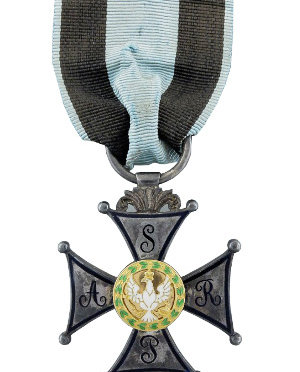
The medal is struck in silver, gold and enamels. It measures 34.5 mm (wide) by 39.9 mm (high) and has an ornate suspension hand.

The Warsaw Uprising Cross

The Warsaw Uprising Cross was a decoration established on July 3, 1981 in order to honor the participants of the Warsaw Uprising of 1944.

The Warsaw Uprising Cross (or Warszawski Krzyż Powstańczy in Polish) was a military decoration from Poland established by law on July 3, 1981 in order to honor the participants of the Warsaw Uprising of 1944.

The decoration was awarded to persons who took an active part in the Warsaw Uprising. In particular:

  • Soldiers of all the formations that fought in the Uprising.
  • Members of the Military Women’s Service, of the Health Care services of the Uprising and other auxiliary insurrectionist services.
  • Other persons who were somehow directly involved in the uprising.

The cross was awarded to Polish citizens as well as persons who, although they held non Polish citizenship at the time, also fought on the Polish side in the Uprising. The Cross could also have been awarded to foreigners if they took part in the Uprising or contributed to the fighting in some major way. Usually, the awards were made on the anniversary of the uprising or on the Victory Day (May 9) (anniversary of Nazi capitulation).

The first Warsaw Uprising Crosses were awarded on 1 August 1981 to 100 former soldiers of the Uprising, among others Gen. Jan Mazurkiewicz (Radosław) – commander of the Home Army, Gen. Franciszek Kamiński – commander of the Bataliony Chłopskie, Col. Maria Wittek – commander of Military Women’s Service, as well as Mieczysław Fogg and Lesław Bartelski.

On 16 October 1992, a law was passed which ended the awarding of the medal on 8 May 1999. The Cross could be awarded post posthumously.

The Warsaw Uprising Cross Design

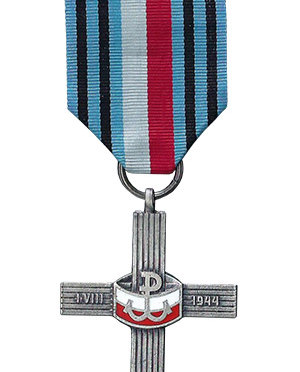
The badge of the Warsaw Uprising Cross is a silver-plated and oxidized isosceles straight cross measuring 42 by 42 mm.

On the obverse of the cross, in the middle, there is an enameled white and red band, on the background of which there is a symbol of Fighting Poland – a stylized anchor with the letter P, and on the horizontal arms the date 1 August – 1944.

On the reverse, on the horizontal arms, there is the inscription “POWSTAŃCOM WARSZAWY” and a laurel wreath in the center of the cross.

The ribbon of the award is 40 mm wide, in the center a white and red strip (national colors), 12 mm wide, on the sides on a navy blue background 14 mm wide, two black stripes (the colors of the ribbon refer to the colors of the Order of Virtuti Militari ribbon).

The Warsaw Uprising Cross was worn on the left side of the breast, in the order of the Greater Poland Uprising Cross , since 1992 it has been worn in the order of the current state decorations .

The badge was designed by the sculptor and medalist Edward Gorol .

The Auschwitz Cross

The Auschwitz Cross was a Polish decoration awarded to honor survivors of Nazi German concentration camps, including Auschwitz.

The Auschwitz Cross (or Krzyż Oświęcimski in Polish) was instituted on 14 March 1985. This Polish decoration was awarded to honor survivors of Nazi German concentration camps, including Auschwitz (Auschwitz is a German name for the Polish town Oświęcim, where the camps were built by Nazi Germans).

The Auschwitz Cross was awarded to Polish citizens, it could also be awarded to persons who were imprisoned as Polish citizens, and at the time of granting citizenship of another country, and in special cases also to citizens of other countries, imprisoned for political reasons, especially participants of the camp resistance movement. The cross could be awarded posthumously.

The Oświęcim Cross was awarded by the Council of State at the request of:

  • Union of Fighters for Freedom and Democracy – in relation to union members.
  • The President of the Office for Veterans – in relation to other persons.
  • The Minister of Foreign Affairs – in relation to Polish citizens permanently residing abroad and citizens of other countries.

The Auschwitz Cross Design

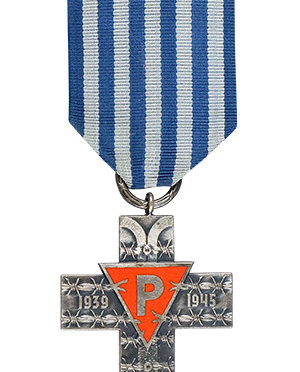
The award is a silver-plated Greek cross with wide arms, 42×42 mm.

The obverse shows barbed wire and camp poles; the year 1939 on the left, and 1945 on the right arm. In the center there is a red enameled triangle with the letter P, as worn by Polish nationals imprisoned in the camps.

The reverse bears the inscription “PRL / WIĘŹNIOM / HITLEROWSKICH / OBOZÓW KONCENTRACYJNYCH” (“People’s Republic of Poland to prisoners of Nazi concentration camps”).

The ribbon of the cross is 40 mm wide, with eleven vertical stripes in light gray and blue colors. The Oświęcim Cross, according to the seniority of Polish decorations , was worn on the left side of the breast after the Partisan Cross.