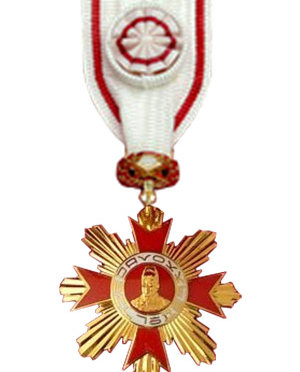
The Order of Science and Technology Merit

The Order of Science and Technology Merit (과학기술훈장 in Korean) is one of the South Korea’s Orders of Merit, awarded to those who have rendered outstanding meritorious services in the interest of improving the science and technology.

This Order is mostly a newly organized order of the Republic of Korea. Before that order was established, the Order of Industrial Service Merit had been bestowed to scientists and technologists.

The Order of Science and Technology Merit is conferred in the following five classes:
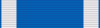
  • ROK Order of Science and Technology Merit Changjo (1st Class) ribbon.png Changjo (Creation) 창조장
  • ROK Order of Science and Technology Merit Hyeoksin (2nd Class) ribbon.png Hyeoksin (Reformation) 혁신장
  • ROK Order of Science and Technology Merit Ungbi (3rd Class) ribbon.png Ungbi (Great Achievement) 웅비장
  • ROK Order of Science and Technology Merit Doyak (4th Class) ribbon.png Doyak (Leap) 도약장
  • ROK Order of Science and Technology Merit Jinbo (5th Class) ribbon.png Jinbo (Progress) 진보장

The Order of Science and Technology Merit Design

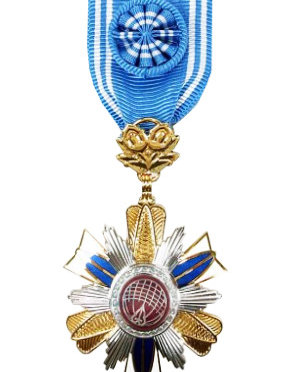
The ribbon of the Order is light blue with white stripes on the sides depending on the class.
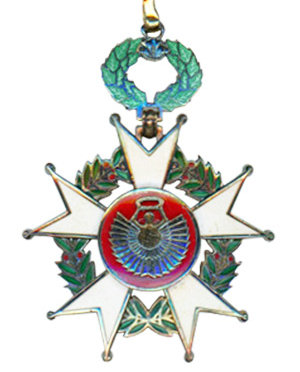
The Order of Sports Merit

The Order of Sports Merit (체육훈장 in Korean) is one of South Korea’s Orders of Merit. It is awarded to those who have rendered outstanding meritorious services in the interest of improving citizen’s physique and national status through sports.

The Order of Sports Merit is conferred in the following five classes:

  • ROK Order of Sports Merit Cheongnyong (1st Class) ribbon.png 1st Cheongnyong (Blue Dragon) 청룡장
  • ROK Order of Sports Merit Maengho (2nd Class) ribbon.png 2nd Maengho (Fierce Tiger) 맹호장
  • ROK Order of Sports Merit Geosang (3rd Class) ribbon.png 3rd Geosang (Giant Elephant) 거상장
  • ROK Order of Sports Merit Baengma (4th Class) ribbon.png 4th Baengma (White Horse) 백마장
  • ROK Order of Sports Merit Girin (5th Class) ribbon.png 5th Girin (“Giraffe” – Although this refers to a mythical animal that on;y appears in times of prosperity and peace. It has also been called Chinese Unicorn or Kylin, Chi-lin and Kirin) 기린장

The Order of Sports Merit Design

The insignia of the order follows the general European usage of sashes, breast stars, etc.

The Order of Cultural Merit

The Order of Cultural Merit (문화훈장 in Korean) is one of South Korea’s orders of merit, awarded by the President of South Korea for “outstanding meritorious services in the fields of culture and art in the interest of promoting the national culture and national development.”

The Order of Cultural Merit was created after the Korean War broke out. The country only had two orders then: The Grand Order of Mugungha and the Order of National Foundation. While the first was awarded only to the President of the country, the second was destined for those that had fought against the Japanese occupation of Korea. However, in addition to the soldiers fighting the Korean War, there were also thousands of other foreigners that had come to the country’s aid. It became apparent that Korea needed an Order for civilians. The Order of Cultural Merit was created to award these people in recognition of their outstanding meritorious contributions.

The Order has been awarded to novelists, poets, composers, painters, sculptors, and dancers, among others.

Since 1973, the Order of Cultural Merit is conferred in five grades:

  • ROK Order of Cultural Merit Geum-gwan (1st Class) ribbon.PNG 1st Class: Geum-gwan Medal (금관) or Gold Crown (also sized for women).
  • ROK Order of Cultural Merit Eun-gwan (2nd Class) ribbon.PNG 2nd Class: Eun-gwan Medal (은관) or Slver Crown.
  • ROK Order of Cultural Merit Bo-gwan (3rd Class) ribbon.PNG 3rd Class: Bo-gwan Medal (보관) or Precious Crown.
  • ROK Order of Cultural Merit Og-gwan (4th Class) ribbon.PNG 4th Class: Og-gwan medal (옥관) or Jeweled Crown.
  • ROK Order of Cultural Merit Hwa-gwan (5th Class) ribbon.PNG 5th Class: Hwa-gwan Medal (화관) or Flower Crown.

The Order of Cultural Merit Design

The insignia of the order is a cross decorated with red enamels. The ribbon is white with red and blue stripes depending on the class. There are different series for the Order of Cultural Merit.

The 1951 Series

The original Order of Cultural Merit was established in 1951 in three classes. All three classes have 40 x 47 mm breast ribbons. Because the colors of the ribbons were not specified in order, there have been observed medals with reversed patterns. The medal had three classes:

  • 1st Class. Order of Cultural Merit – Republic of Korea Medal: With sunrays of different sizes symbolizing the historical development of cultural exchange with foreign countries. The mugunghwa in the center represents national prosperity, and the golden chain, cultural diplomacy. There are also wings of a dove for peace.
  • 2nd Class. Order of Cultural Merit – Presidential Medal: The symbolism is similar to the 1st class, with the chain referring to cultural continuity from antiquity through present and future times.
  • 3rd Class. Order of Cultural Merit – National Medal: The general design and symbolism are similar to the other classes, but there are only three rays. The chain in this case symbolizes the process of cultural cultivation.

The 1957 Series

The 1957 showed no physical changes to the pendants, but the ribbon was discussed in detail in a government-published booklet. For example, the symbolism of the orange, yellow and blue stripes. 

The 1963 Series

A new Decree was issued in 1962, restricting some of the award’s criteria. The pendant for the 1st class was changed to a pendant suspended from a bow, the 2nd class suspended from a triangular or tri-fold ribbon, and the 3rd class a standard breast badge.

The 1967 Series

The Order does not exist as a series for 1967 because it became part of the Order of Civil Merit

The 1973 Series

The Order of Cultural Merit was re-established in five classes in 1973, under the new Decorations Law – which turned into a sort of “Lifetime Achievement Award for the Arts”. The new classes follow the European usage of sashes, breast stars, etc. The 5th class, however, is a rosette on the ribbon. 

The 1984 Series

The 1984 series follows the European usage too, with the addition of a ribbon bar for all classes and a lapel pin. Both follow the ribbon’s colors.

The Order of Saemaeul Service Merit

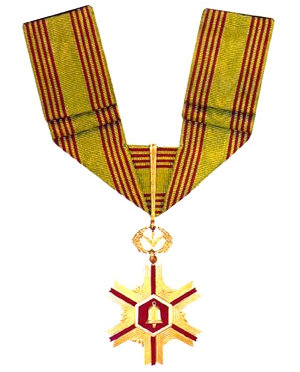
The Order of Saemaeul Service Merit (새마을훈장 in Korean) is an order of merit of South Korea, presented to individuals who contributed to the social development of the country through the New Community Movement.

Also known as the New Community MovementNew Village MovementSaemaul Movement or Saema’eul Movement, this was a political initiative launched on April 22, 1970 by South Korean president Park Chung-hee to modernize the rural South Korean economy. It was based on the Korean traditional communalism called Hyangyak (향약, 鄕約) and Doorae (두레), which provided the rules for self-governance and cooperation in traditional Korean communities.

The Order of Saemaeul Service Merit is divided into five classes:

  • ROK Order of Saemaeul Service Merit (1st Class) Jarip Medal.png Jarip Medal: 자립장 (自立章)
  • ROK Order of Saemaeul Service Merit (2nd Class) Jajo Medal.png Jajo Medal: 자조장 (自助章)
  • ROK Order of Saemaeul Service Merit (3rd Class) Hyeopdong Medal.png Hyeopdong Medal: 협동장 (協同章)
  • ROK Order of Saemaeul Service Merit (4th Class) Geunmyeon Medal.png Geunmyeon Medal: 근면장 (勤勉章)
  • ROK Order of Saemaeul Service Merit (5th Class) Noryeok Medal.png Noryeok Medal: 노력장 (努力章)

The Order of Saemaeul Service Merit Design

The ribbon of the order is light green with a different number of thin red stripes on the sides depending on the class.

The Order of Industrial Service Merit

The Order of Industrial Service Merit (산업훈장 in Korean) is an order of merit of South Korea, presented to individuals and businesses who have contributed to the development of industry and the national economy.

The Order of Industrial Service Merit is divided into five classes:

  • ROK Order of Industrial Service Merit (1st Class) Gold Tower.png Gold Tower: 금 탑(金 塔)
  • ROK Order of Industrial Service Merit (2nd Class) Silver Tower.png Silver Tower: 은 탑(銀 塔)
  • ROK Order of Industrial Service Merit (3rd Class) Bronze Tower.png Bronze Tower: 동 탑(銅 塔)
  • ROK Order of Industrial Service Merit (4th Class) Iron Tower.png Iron Tower: 철 탑(鐵 塔)
  • ROK Order of Industrial Service Merit (5th Class) Tin Tower.png Tin Tower: 석 탑(錫 塔)

The Order of Industrial Service Merit Design

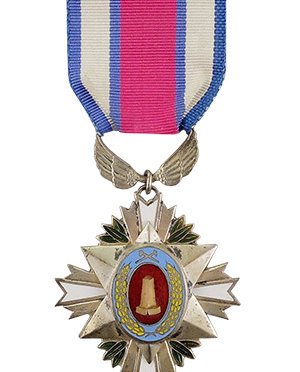
The insignia of the different classes for the Order of Industrial Service Merit all have the same symbolism. The sun shape symbolizes the enhanced,ent of national prestige. The leaves of Mugunghwa symbolize national prosperity. The leaves of the rice plant and the hoe, the increase of production. The tower symbolizes the merits of effort, and the wings symbolize peace.

The ribbon is blue (constancy), white (integrity and innocence), and red (bravery and progressive passion).

The Order of Diplomatic Service Merit

The Order of Diplomatic Service Merit (수교훈장 in Korean) is one of South Korea’s orders of merit and one of the highest civilian awards of South Korea. The Order is awarded by the President of South Korea for “outstanding meritorious services in the interest of enhancing national prestige and promoting amity with allies.”

The Order was instituted on 25 July 1963 and amended in 1967. It is a relatively rare honor. It’s usually awarded to only a handful of people every year, usually to foreign officials or ambassadors for significant contributions in strengthening friendly relations with the Republic of Korea.

The Order of Diplomatic Service Merit is divided into 5 grades, with the first grade containing two classes (the higher of which is reserved for the most high-ranking diplomats):

  • Order of Diplomatic Service Merit (Class 1) Grand Gwanghwa Medal ribbon.gif 1st Grand Gwanghwa Medal (광화대장)
    Order of Diplomatic Service Merit (Class 2) Gwanghwa Medal ribbon.gif 1st Gwanghwa Medal (광화장)
  • Order of Diplomatic Service Merit (Class 3) Heung-In Medal ribbon.gif 2nd Heungin Medal (흥인장)
  • Order of Diplomatic Service Merit (Class 4) Sungrye Medal ribbon.gif 3rd Sungnye Medal (숭례장)
  • Order of Diplomatic Service Merit (Class 5) Chang-Eui Medal ribbon.gif 4th Changui Medal (창의장)
  • Order of Diplomatic Service Merit (Class 6) Sugjeong Medal ribbon.gif 5th Sukjeong Medal (숙정장)

The Order of Diplomatic Service Merit Design

The insignia of the Order of Diplomatic Service Merit is worn affixed to sash worn over the shoulder.

The Order of National Security Merit

The Order of National Security Merit is one of South Korea’s Orders of Merit, given for distinguished service to national security.

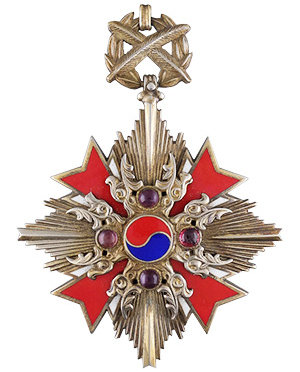
The Order of National Security Merit (보국훈장 in Korean) is one of South Korea’s Orders of Merit. The Order is considered primarily as a military award. It was instituted in 1967 and conferred by the President of South Korea on individuals who have rendered distinguished service to national security, or for “outstanding meritorious services in the interest of national security.”

The Order is divided into five grades:

  • Tong-il Security Medel Ribbon.svg 1st Tongil Medal (통일장)
  • Gugseon Security Medal Ribbon.png 2nd Gukseon Medal (국선장)
  • Cheon-Su Security Medal Ribbon.png 3rd Cheonsu Medal (천수장)
  • Sam IL Security Medal Ribbon.png 4th Samil Medal (삼일장)
  • Gwangbog Security Medal Ribbon.png 5th Gwangbok Medal (광복장)

The Order of National Security Merit Design

The insignia of the Order is a four-piece construction, struck in silver gilt and decorated with red and white enamels. It measures 2.7 mm x 78.5 mm inclusive of its dragon head suspension.

The neck ribbon is white with four thin red stripes on each side and has a slotted tab closure.

The Order of Service Merit

The Order of Service Merit (근정훈장 in Korean) is one of South Korea’s orders of merit.

The Order is awarded by the President of South Korea to public officials, private school teachers, and special post office employees for “outstanding meritorious services by applying himself/herself to his/her duties.”

The Order of Service Merit is divided into five grades:

  • ROK Order of Service Merit (1st Class) Blue Stripes.png 1st Blue Stripes (청조)
  • ROK Order of Service Merit (2nd Class) Yellow Stripes.png 2nd Yellow Stripes (황조)
  • ROK Order of Service Merit (3rd Class) Red Stripes.png 3rd Red Stripes (홍조)
  • ROK Order of Service Merit (4th Class) Green Stripes.png 4th Green Stripes (녹조)
  • ROK Order of Service Merit (5th Class) Aquamarine Stripes.png 5th Aquamarine Stripes (옥조)

The Order of Military Merit Design

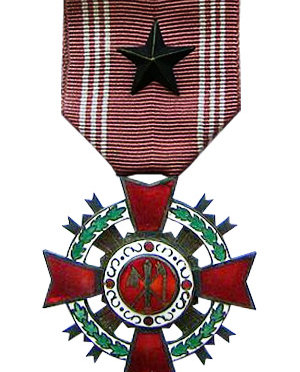
All classes of the Order, established in 1961, had the same ribbon color and stripe pattern (yellow with two navy blue stripes). To distinguish them, there were different attachments added to the bar, with no attachment for the 7th class. These could be auspicious clouds and/or bamboo leaves struck in different materials.

In 1962, all pendants were made smaller and the ribbon colors were changed. There were further changes in 1967, 1969, 1971, 1973, and 1984. Since then, the Order has had five classes.

The Order of Military Merit (South Korea)

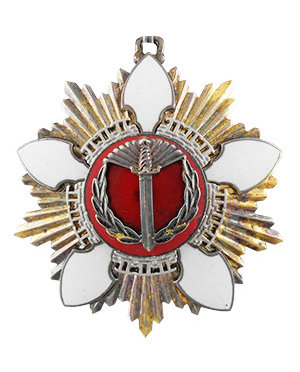
The Order of Military Merit (무공훈장 in Korean) is the primary military decoration awarded by the South Korean government.

The Order is awarded to a person who rendered “outstanding military services by participating in an action in time of war or in quasi-state of war or by performing his/her duty equivalent to combat, such as responding to the attack of an enemy in a contact area.”

The Order of Military Merit is awarded in five classes and each of these has three grades. In descending order of rank, the classes are:

  • Taeguk Cordon Medal.png Taeguk (태극)
  • Eulji Cordon Medal.png Eulji (을지)
  • Chungmu Cordon Medal.png Chungmu (충무)
  • Hwarang Cordon Medal.png Hwarang (화랑)
  • Inheon Cordon Medal.png Inheon (인헌).

The Order of Military Merit Design

Each class has a first, second or third grade, denoted respectively by a gold star (금색 별), silver star (실버 스타), or an unadorned ribbon.

The Order of Civil Merit or Order of the White Star

  • Time Period: Post-WW2
  • Institution: 22 December 1951 (as Order of the White Star)
  • Country: South Korea

The Order of Civil Merit (국민훈장 in Korean) is one of South Korea’s orders of merit. It is awarded by the President of the country for “outstanding meritorious services in the area of politics, economy, society, education, art or science in the interest of improving citizens’ welfare and promoting national development.” The Order was awarded to government employees who distinguished themselves with outstanding services in the performance of their duties. Military personnel and civilian employees were excluded from this award.

The Order is based on the Order of the White Star, which was translated as Order of Civil Merit in the 1958 and 1964 versions. In 1967, the Order was renamed to The Order of Service Merit.

The Order of Civil Merit is divided into five grades:

  • ROK Order of Civil Merit (1st Class) Mugunghwa Medal.png 1st Mugunghwa Medal (무궁화장)
  • ROK Order of Civil Merit (2nd Class) Moran Medal.png 2nd Moran Medal (모란장)
  • ROK Order of Civil Merit (3rd Class) Dongbaek Medal.png 3rd Dongbaek Medal (동백장)
  • ROK Order of Civil Merit (4th Class) Mongnyeon Medal.png 4th Mongnyeon Medal (목련장)
  • ROK Order of Civil Merit (5th Class) Seongnyu Medal.png 5th Seongnyu Medal (석류장)

The Order of Civil Merit Design

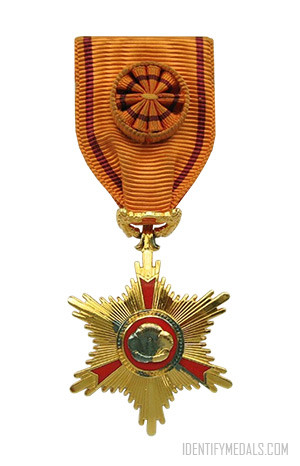
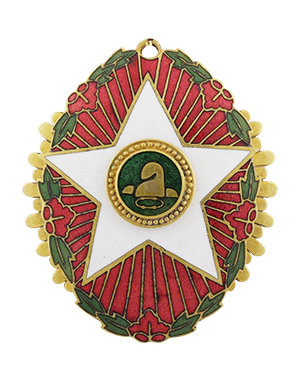
The Order of Civil Merit has four classes. Its design shows a cap in the center of the star, with a chain band around it and a small ring, which binds the ribbon to the cap.

This symbol represents the formal dress of civil officials during the Yi Dynasty (1392-1910). The Mungunghwa and its leaves symbolize national prosperity. The sun rays, national prestige. And the books or scrolls on the suspension the knowledge and wisdom expected from government officials.