The Order of Leopold (Belgium)

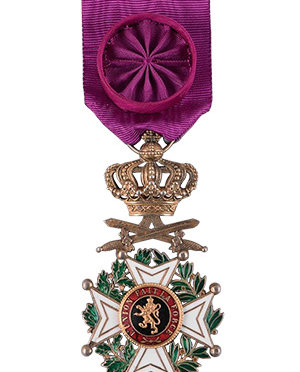
The Order of Leopold (Leopoldsorde / Ordre de Léopold / Leopoldsorden) is the oldest and highest order of Belgium (and one of the three current Belgian national honorary orders of knighthood). Leopold I, first King of the Belgians, is the Founder and First Grand Master of the Order. No membership can be granted to a person before the age of 42, except in the military division.

Established on 11 July 1832 and named in honor of its founder; King Leopold I, it consists of a military, a maritime and a civil division. The Order of Leopold is awarded by Royal order. The Belgian court often used the Grand Cordon as a valuable diplomatic gift, although towards the second half of the 19th century, it was also used as a dynastic order to bestow on family members during major family celebrations such as the wedding of Prince Albert in 1900 (where 15 Grand Cordons were sent to the Bavarian Court). Those who fought in the Belgian revolution became members in great numbers, and King Leopold II bestowed the order upon notable Belgian artists, generals and clergy.

The Order of Leopold is issued in five classes, each coming in three divisions (civil, military and maritime):

  • Grand Cordon; who wears the badge on a collar (chain) or on a sash on the right shoulder, plus the star on the left side of the chest;
  • Grand Officer; who wears a badge on a necklace, plus a star on the left side of the chest (created on 31 December 1838);
  • Commander; who wears the badge on a necklace;
  • Officer; who wears the badge on a ribbon with rosette on the left side of the chest;
  • Knight; who wears the badge on a ribbon on the left side of the chest.

The Order of Leopold Design

The Order of Leopold is based on the French honor tradition with 5 classes. In 1832 Felix de Merode had a design approved by the Chambers for military and civil merit, with the exact colors being defined later the same year. The king approved both the color and grades both civil and military, as well as the official motto L’Union fait la Force/Eendracht maakt Macht.

The collar of the order has nine crowns, nine face-to-face monograms “LR” (“Leopoldus Rex” for King Leopold I), and eighteen lions.

The badge is a white-enameled Maltese Cross (in silver for the Knight class and in gold for the higher classes), with a green-enameled wreath of laurel and oak leaves between the arms of the cross. The obverse features a lion on a black background and the reverse the monogram “LR”. Both discs are surrounded by a red enamel ring with the motto “Unity Is Strength“. The cross is topped by a crown with crossed swords or anchors (or without either) depending on the division.

The ribbon is usually plain purple, although some variations have been noted, such as swords for when awarded in wartime, a vertical gold border on both sides for a special act of valor at war and others.
The Cross for the Proclamation of Bulgarian Independence in 1908

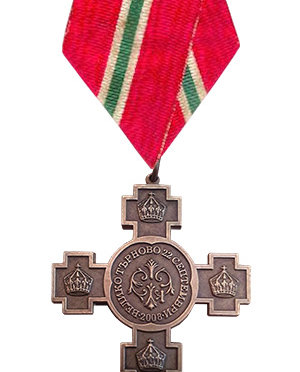
The Cross for the Proclamation of Bulgarian Independence in 1908 is a Bulgarian award given as a commemoration of the declaration of Bulgarian independence in 1908. The cross was only approved and minted during the second half of 1909 – a year after the events.

The cross was awarded to all generals, officers, and junkers who were serving at the time of the declaration of independence, as well as to various civil servants such as war veterans, clergy, local government officials and others.

The commemorative award was intended to be widely given among the Bulgarian nation. According to the registers, more than 11,000 people received the decoration, although the number of minted medals might have been even larger.

The Cross for the Proclamation of Bulgarian Independence in 1908 Design

The medal is a long crosslet cross measuring 40mm with a circular center and raised edges. It was designed by Paul Telge and produced in Germany. There are known very rare variations of the cross where the crowns are positioned towards the central medallion of the cross (possibly trial issues of the medal).

The obverse bears the royal cipher of King Ferdinand I, circumscribed by the text “ТЪРНОВО 22 СЕПТЕМВРИЙ 1908” (“Tarnovo 22 September 1908“), commemorating the place and the date of the declaration of the Independence. Crows are depicted in the four cross-sections of the cross arms.

The reverse bears a Bulgarian lion with a superimposed Saxon shield, circumscribed by “БЪЛГАРСКО ЦАРСТВО” (“Bulgarian Tsardom (Kingdom)”).

The ribbon is red with two white and one green thin stripes through the middle.

The Medal For The Accession Of Knjaz Ferdinand I

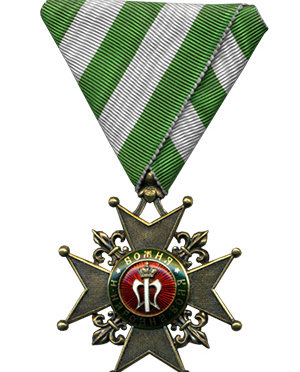
The Medal For The Accession Of Knjaz Ferdinand I is the first decoration that newly elected Prince Ferdinand I implemented, and he did so in order to commemorate his accession to the Throne. Around 2000 awards of this type were given to low ranking clerks, local mayors, senior officers, archbishops, ministers, generals, and foreign nationals.

The designs on the reverse of the medal indicate the background of the new Monarch: The Saxon shield for his dynastical past, and the Maltese cross with lilies as an allusion to His French royal bloodline. The colors of the ribbon reference the Saxe-Coburg-Gotha duchy.

The Medal For The Accession Of Knjaz Ferdinand I Design

The medal is a maltese cross with beaded points, circular center and fleurs-de-lis in between the arms, and measures 42 millimeters in diameter. It manufactured by C. F. Rothe in Vienna.

The obverse of the first class depicts a circle enameled in red, with the royal cipher of Prince Ferdinand I in white with a gilded crown. Inscribed on the green enameled outer ring is “БОЖИЯ И НАРОДНА ВОЛЯ” (“By the will of God and nation“). The second class doesn’t have any enamel on the central medallion, and the third class is silvered instead of gilded.

The reverse has a circular central medallion, enameled in black and golden horizontal stripes (the Saxon coat of arms) with an inscription on the outer ring enameled in green: “25 ЮЛIЙ 2 АВГУСТЪ 1887” (“25th July 2nd August 1887“). 2nd class is gilded and 3rd is silvered.

The ribbon consists of three light-green and two white alternating stripes, triangular when awarded to men and bow-shaped when presented to ladies.

The Order of Saints Cyril and Methodius

The Order of Saints Cyril and Methodius is an award conferred by the Republic of Bulgaria and first established on 18 May 1909 by Tsar Ferdinand I of Bulgaria. The second incarnation is from second on 13 December 1950 by the People’s Republic of Bulgaria, and the third from 29 May 2003 by the current Republic of Bulgaria.

The Royal Order only has one class: Knight, represented by a collar, sash and breast-star. The first Grand Cross of the order to be awarded to the highest state officials. Former King Simeon II of Bulgaria considers this version of the order to be his dynastic order and wears it – from left shoulder to right hip – on official occasions.

The 1950 version was awarded as an honor in the fields of science, culture, or painting and consisted of three classes: First class, Second class and Third class.

The 2003 version is awarded for merit in the fields of art, science, education and culture and has three grades: Collar, 1st Class (Officer) and 2nd Class (Knight).

The Order of Saints Cyril and Methodius Design

Royal order:

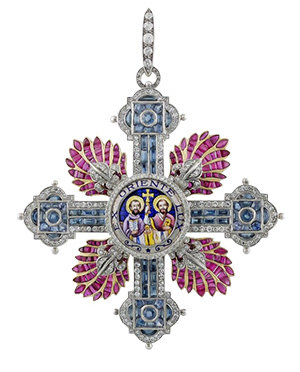
The badge of the Order is a gilded Byzantine cross enameled in light blue. In the cross angles, green enameled beams are mounted, on each of which is a stylized lily. In the medallion resting figures of Saints Cyril and Methodius are seen standing side by side. The medallion is edged with a golden ring on the blue enameled inscription “EX ORIENTE LUX” (light coming from the east). The breast star has the shape of a Maltese cross and is made of silver. In the cross angles, blazing flames are seen with applied lily. In the center of the cross is a representation of a seraph. The ribbon is pale orange.

1950:

The medal is worn on the left chest and it’s round with red, blue or white enamel background. It shows the image of the Saints in relief. On the left side, Cyril, who holds a scroll with the first four letters of the Cyrillic alphabet in the hands. Slightly offset to the right behind Methodius with a Bible under his arm. One five-pointed star is seen on the top of the medal, hanging from a light-blue ribbon. First class: gold medal with red enamel. Second class: silver medal with blue enamel. Third class: silver medal with white enamel.

2003:

The order’s insignia is inspired by the shape of the tsarist era. The medal of the first two grades is a silver-plated Byzantine cross with gilded-silver edges, the 3rd grade is only totally silver-plated. The flames in the cross angle are no longer subject to a lily. On the reverse, instead of the crowned cipher names, the national colors of the country can be found. The ribbon of the Order is orange.

The Order of Civil Merit (Bulgaria)

The Order of Civil Merit was an Order of Merit of the Kingdom of Bulgaria instituted in 1891 and given to civilians for exemplary service.

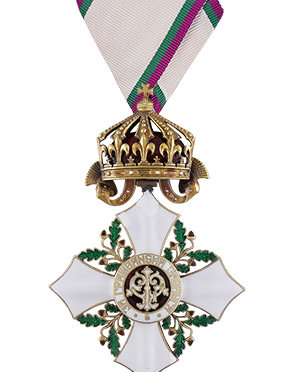
The Order of Civil Merit was an Order of Merit of the Kingdom of Bulgaria instituted on 2 August 1891 and conferred only on civilians and for exemplary service or acts of merit earning the gratitude of the country. The order had six classes. It could be awarded to Bulgarian and foreign citizens with the personal benevolence of the monarch for great merit to the development and consolidation of the civil society.

In 1908, the crown suspension changed from the ‘Knyaz’ (Princely) form to the ‘Tsar’ form, as in this example, when Bulgaria was declared a kingdom.

The following grades exist:

  • Knight/Dame Grand Cross.
  • Knight/Dame Grand Officer.
  • Knight/Dame Commander.
  • Knight/Dame Officer.
  • Knight/Dame.
  • Medal.

The Order of Civil Merit Design

The Order was made in gilt and enamels and measures 61 mm by 122 mm including crown suspension and loop.

The ribbon was white with a green stripe on either side and a red Stripe on either edge (the colors of the Flag of Bulgaria).

The Order of Military Merit (Bulgaria)

The Order of Military Merit is an order established with a decree of the Knyaz in 1900, during the Kingdom and the Republic of Bulgaria.

The Order of Military Merit (or Орден за Военна Заслуга in Bulgarian) is an order established with a decree of the Knyaz on 19 May 1900, during the Kingdom of Bulgaria and the Republic of Bulgaria.

It was given to military figures for immaculate service and special merit; for great contributions for the development and the consolidation of the Bulgarian Army, for participation in peacekeeping, peacemaking and humanitarian operations, for long and immaculate service and contribution for the national security and civil order in Bulgaria.

The following grades exist (the Grand Cross was added in 1933):

  • I grade, Grand Cross. Awarded to senior state officers and military personnel.
  • II grade, Grand Officer. Awarded only to generals.
  • III grade, Commander. Awarded to commanders of regiments (colonels and lieutenant colonels).
  • IV grade, Officer. Awarded to majors and captains who commanded companies.
  • V grade, Knight. Awarded to commanders with rank up to captain, Opalchentsi, volunteers in the Serbo-Bulgarian War, the Balkan Wars, and others.
  • VI grade, Silver Cross. Awarded to sergeants, Opalchentsi, volunteers in the wars and others.

In the 1950s the order was abolished. It was restored in two grades in 2004.

The Order of Military Merit Design

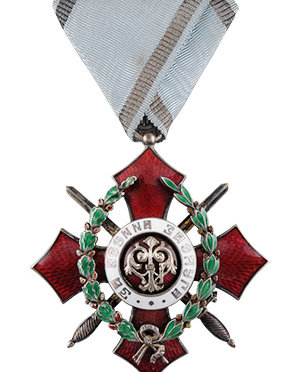
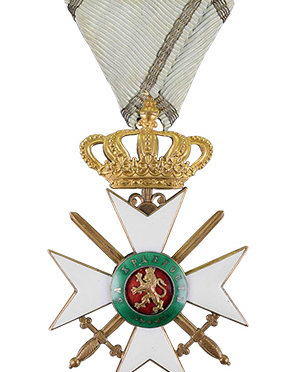
The order has the shape of a Pisan cross with its arms covered in red enamel. There are two swords between them with edges pointing to the top.

In the center of the obverse is the monogram of the founder Knyaz Ferdinand, surrounded by a ring in green enamel with inscription ЗА ВОЕННА ЗАСЛУГА (translated “For Military Merit”). During the war, a laurel wreath was added on top of the arms of the cross, along with a white ring.

The reverse resembles that of the Order of Civil Merit but with a green ring.

The Order Of Saint Alexander

The Order of St Alexander was established by Knyaz Alexander I on 25 December 1881 and named after his patron saint, Alexander Nevsky.

The Order of St Alexander (or Орден “Свети Александър” in Bulgarian) was established by Knyaz Alexander I on 25 December 1881 and named after his patron saint, Alexander Nevsky. It was the second-highest Bulgarian order during the Kingdom of Bulgaria.

The order was awarded to Bulgarian and foreign citizens with the personal benevolence of the Bulgarian monarch, who was the Grand Master. Four grades and Grand and Lesser Necklace were formed and in 1908 a Grand Cross was added. Later, wartime grades with swords in the middle and above the cross were created.

The following grades exist:

  • Great Cross of the Order of St Alexander, Grand and Lesser Necklace.
  • I grade, Grand Cross. Awarded to senior state officers and military personnel.
  • II grade, Grand Officer Cross.
  • III grade, Commander Cross.
  • IV grade, Officer Cross.
  • V grade, Officer Cross.
  • VI grade, Silver Cross.

The Ottoman sultans Abdul Hamid II and Mehmed V were respectively awarded the Grand and Lesser Necklace of the Order of St Alexander with diamonds. They are currently kept in the collection of the Topkapı Palace in Istanbul.

The Order Of Saint Alexander Design

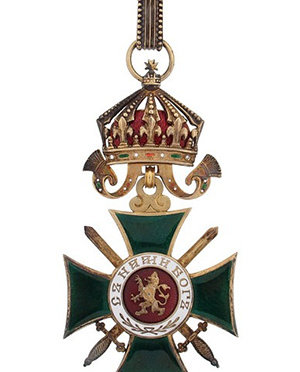
The insignia of the order was a white enameled cross pattée with golden or silver edges according to the grade.

On the pendant of the obverse, there’s a stylized inscription with the name of the order and on the surrounding ring there was the motto СЪ НАМИ БОГЪ (translated “God with us“) with laurel wreaths below.

On the reverse, there’s a white background with inscription 19 ФЕВРАЛЪ 1878 (translated “19 February 1878“), the date of the signing of the Treaty of San Stefano. Above the cross is a royal crown.

The Grand necklace consisted of thirty interconnected medallions with crowned lions, alternated with the monogram of the founder Knyaz Alexander I and eight edges Orthodox cross.

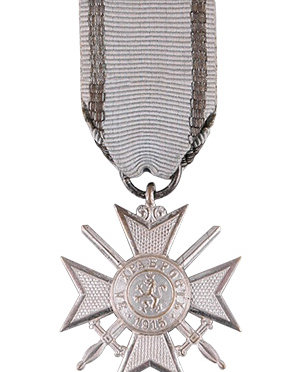
The Soldier Cross for Bravery

The Soldier Cross for Bravery was first established on January 1880 and was awarded to officer candidates, NCOs, and enlisted men, as a token of their exceptional valor and courage during the clashes with the enemy.

This award is the most widely distributed decoration of all the royal Bulgarian decorations. It was presented to both Bulgarian and foreign soldiers as a mark of their outstanding bravery on the battlefield during the six wars fought between 1877 and 1945 and the civil conflicts in the very early years of the new Principality.

The medal was awarded in these classes:

  • 1st Class
  • 2nd Class
  • 3rd Class
  • 4th Class
  • 5th Class

The Soldier Cross for Bravery Design

The medal measures 34mm wide and is a silver/silvered or yellow/gilded Maltese Cross with crossed swords between its arms and circular center. The first type of the crosses was of outstanding quality, possibly of Imperial Austrian manufacture.

On its obverse, the central medallion bears a crowned lion rampant. On the outer ring of the central medallion is inscribed “ЗА ХРАБРОСТЬ” (translated to “For bravery”) and either nine decorative elements, the years “1915” or “1941”, depending on the issue.

The reverse central medallion bears Prince Alexander I’s crowned cypher and on the outer ring is inscribed “КНЯЗЬ НА БЪЛГАРIЯ“ (or “КНЯЗЬ НА БЪЛГАРИЯ”, translated as Knyaz (Prince) of Bulgaria and the year 1879, separated via two stars or dots.

The ribbon is sky-blue with a silvery stripe near both edges.

The Order for Bravery (Bulgaria)

The Order of Bravery was established in 1880 with a decree of Knyaz Alexander Batenberg and is considered the most esteemed Bulgarian order.

The Order of Bravery (or Орден за Храброст in Bulgarian) is an order established on 1 January 1880 with a decree of Knyaz Alexander Batenberg and it’s considered the most esteemed Bulgarian order and the second highest in the Kingdom of Bulgaria and fourth highest in the Republic of Bulgaria. The recipients of the order are called cavaliers.

The Order was modeled after the Order of Military Merit of the Grand Duchy of Hesse, which existed until 1866. It was first awarded on 17 April 1880 to 33 participants of the Russo-Turkish War (1877–1878). On 24 April, the order was awarded for the first time to a civilian person.

On 15 September the Order of Bravery ceased to exist.

There were the following classes or grades:

  • Grand Cross of the Order of Bravery: Awarded only to the ruler (who was a Grand Master of the order), five emissions.
  • Order of Bravery I Grade: 1st class (four emissions), 2nd class (awarded to Bulgarian and foreign generals and foreign rulers).
  • Order of Bravery II Grade: Two emissions.
  • Order of Bravery III Grade: 1st class (until 1915 it was called Order of Bravery III grade), three emissions. 2nd class (since 1915), five emissions.
  • Order of Bravery IV Grade: 1st class (until 1915 it was called Order of Bravery IV grade), seven emissions. 2nd class (since 1915), ten emissions.

The Order for Bravery Design

Between 1937 and 1940, the sign of the I grade, 1st class was used as a symbol of the Bulgarian Air Force in analog with the Iron Cross which was the traditional symbol of the Luftwaffe. Several German officers received this award during World War II.

The Grand Cross consisted of a necklace, a star, and a mantle.

The ribbon is light blue with silver stripes on either side.

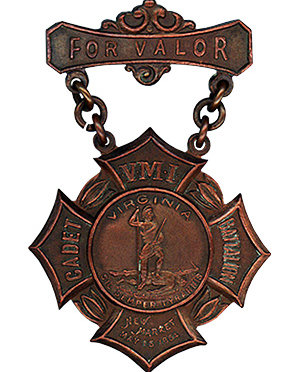
The New Market Cross of Honor

The New Market Cross of Honor is a military decoration issued to cadets of the Virginia Military Institute for their service to the Confederacy.

The New Market Cross of Honor is a military decoration that was issued by the Alumni Association of VMI to cadets of the Virginia Military Institute (VMI) for their service to the Confederacy during the American Civil War. All the cadets had been previously listed on the Confederate Roll of Honor.

The medal was issued in 1904 and presented to the 294 members who marched into combat at the Battle of New Market, which was fought on May 15, 1864 in Virginia during the Valley Campaigns of 1864. A makeshift Confederate army of 4,100 men turned the tide of the battle for the Confederacy, defeating Union Major General Franz Sigel and his Army of the Shenandoah. A notable participant of this battle (and a reci[ient of the medal) was Moses Jacob Ezekiel.

The cadets, numbering 257, were organized into a battalion of four companies of infantry and one of artillery. Ten cadets died as a result of the battle while 45 were wounded and survived. In the case of those killed in battle or no longer living, the medal was given to surviving family members.

The cross was also presented to Eliza Catherine Clinedinst Crim, a New Market resident who had nursed injured cadets after the battle. When she died in 1931, cadets served as her pallbearers and her grave marker said “Mother of the New Market Corps“.

Separately, VMI has awarded a “New Market Medal” to distinguished alumni since 1962.

The New Market Cross of Honor Design

The copper medal measures 1.5″ x 2″ overall. The hanger reads “For Valor“. The drop has the state seal of Virginia and the words: “VMI Cadet Battalion New Market May 15 1864“. The back is marked “V.M.I. Alumni Ass’n” and the name of the recipient.