The Cross of the Mount of Olives

The Cross of the Mount of Olives is a Prussian award founded in 1909 to commemorate the foundation of a hospital on the Mount of Olives.

The Cross of the Mount of Olives (or Ölberg-Kreuz in German) is a Prussian award founded on 24 December 1909 as a decoration to commemorate the foundation of a hospital, the Kaiserin Auguste Victoria-Stiftung on the Biblical Mount of Olives in Jerusalem.

The award was created by Prince Eitel Friedrich of Prussia. His very devout mother, Augusta Victoria of Schleswig-Holstein, was fond of charitable works and built several churches and he and Emperor Wilhelm II of Germany had visited Jerusalem in 1898. They then pledged to build a hospital for Christian pilgrims suffering from malaria.

The Cross of the Mount of Olives was awarded to those who contributed to the Foundation, and the Augusta Victoria Hospital opened its doors in 1910.

The Cross of the Mount of Olives Design

The badge of the decoration is a red-and-black enameled Jerusalem cross, upon which is imposed the white cross of the Johanniterorden, the evangelical noblemen’s society which Prince Eitel Friedrich then headed as Grandmaster.

The badge is suspended from a monogram of the Empress’s initials, “AV”. The ribbon is plain white and the deserving were awarded golden or silver-gilt Crosses.

The Jerusalem Cross

The Jerusalem Memorial Cross is a Prussian decoration established in 1898 and awarded to those who visited Palestine with the King.

The Jerusalem Cross, also known as the Jerusalem Memorial Cross or “Jerusalem-Kreuz; Jerusalem-Erinnerungskreuz” in German, holds historical significance as a Prussian decoration established on October 31, 1898. Its establishment coincided with Emperor Wilhelm II‘s notable visit to Palestine in the same year. This distinguished award was bestowed upon individuals who had the unique privilege of accompanying Emperor Wilhelm II on his pilgrimage to Palestine and participated in the solemn inauguration ceremony of the Lutheran Church of the Redeemer in Jerusalem.

Emperor Wilhelm II’s journey to Palestine and the dedication of the Lutheran Church of the Redeemer marked a significant event in Prussian history, symbolizing the nation’s cultural and religious ties to the Holy Land. The Jerusalem Cross served as a commemorative token of this historic occasion, honoring those who were part of this remarkable pilgrimage. As a testament to their participation in this momentous event, recipients of the Jerusalem Cross were recognized for their role in fostering diplomatic relations, religious unity, and cultural exchange between Prussia and the Holy Land

The Jerusalem Cross Design

The cross is made in the shape of the Jerusalem cross, which consists of a large cross portent with four plain crosslets between the arms. The crosses are red enameled with silver-gilt borders. In the center of the cross is a round gold colored medallion.

The obverse depicts the Imperial Crown of the Prussian German Emperor surmounting the letters IR (Imperator Rex) over the royal cypher of a stylized W II. The reverse of the medallion bears the date 31 October 1898, which is depicted using a large Roman numeral X in the center for October, and a small Roman numeral XXXI at the top. To the left is MDCCC and to the right side IIC for the year 1898.

The Prussian Red Cross Medal

The Red Cross Medal was set up in 1898 by Emperor Wilhelm II and awarded to those who did great service to the sick in peace or wartime.

The Red Cross Medal was set up on 1 October 1898 by Emperor Wilhelm II and awarded to all those who carried out great service to the sick in peace or wartime, or for special achievement in the service of the German Red Cross. This was a peacetime award, as opposed to the Order of the Crown and general honor decorations with the Red Geneva Cross.

The Red Cross Medal was awarded in three classes, the Second and Third classes being worn as circular medals suspended from a red ribbon with white and black stripes.

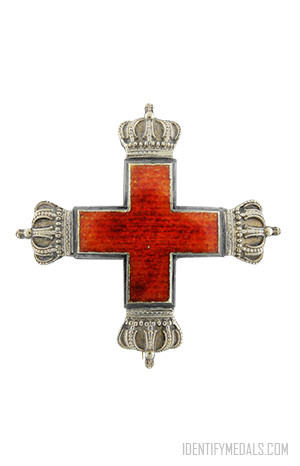
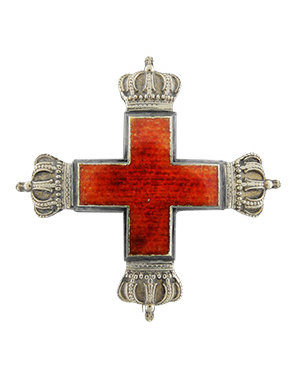
The First Class was a red enameled Geneva Cross with gilded Prussian Royal Crowns at the ends of the arms. This award was worn as a steckreuz on the breast like the Iron Cross. Recipients could be promoted to the next class of the medal with five years time in service, with the first level anyone could be initially appointed to being the Second Class.

Find Red Cross Medals Online

Right Now on eBay 
Clicking a link to eBay may result in a referral commission being paid if a purchase is made.
Loading...

More Red Cross Medals

The German Social Welfare Decoration

The Social Welfare Decoration was created by Adolf Hitler as a civil award for services in the social sector.

The Social Welfare Decoration (or “Ehrenzeichen für deutsche Volkspflege” in German) was created by Adolf Hitler as a civil award for services in the social sector on 1 May 1939.

The decoration was issued in three classes and was awarded for a wide variety of service to the German statsuch as WinterhilfswerkNational Socialist People’s Welfare, medical and rescue work, or care of foreign and ethnic Germans.

The medal was a replacement for the German Red Cross Decoration. The main requirement for the award was that the service rendered should be to the benefit of the civil population. Reinhard Heydrich was awarded the decoration for his running of the Gestapo in the 1930s and for providing “security” to the German people. The infamous Doctor Josef Mengele was also awarded the decoration in 1941, for providing medical services to wounded soldiers and civilians alike on the battlefields of the Eastern Front.

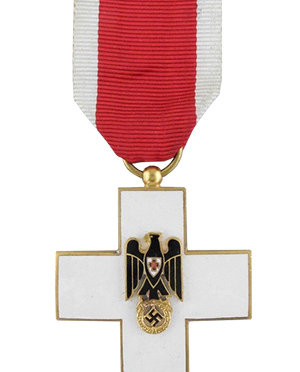
It was conferred in four classes consisting of a white-enameled gold Balkenkreuz with Reich eagle and swastika. A “Medal of Social Welfare” was also issued for lesser degrees of service, not warranting the higher presentation of a class award.

The German Red Cross Decoration

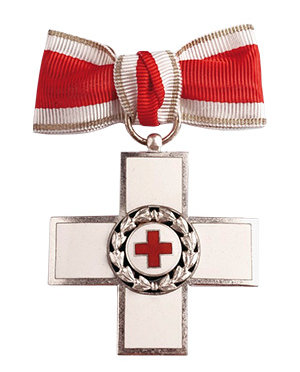
The German Red Cross Decoration (or “Ehrenzeichen des Deutschen Roten Kreuzes” in German) is a decoration founded in 1922.

The German Red Cross Decoration (or “Ehrenzeichen des Deutschen Roten Kreuzes” in German) is a decoration founded in 1922.

It was replaced (by Adolf Hitler) by the Social Welfare Decoration in 1939 and re-founded in its present form on 8 May 1953. It is awarded by the German Red Cross.

The West German Red Cross was recognized by the International Red Cross as the DRK BRD in 1951. The East German Red Cross was recognized by the International Red Cross as the DRK DDR in 1952.

Find Red Cross Medals Online

More Red Cross Medals

The Königgrätz Commemorative Cross

The Königgrätz Commemorative Cross is a Prussian medal instituted in 1866 by Wilhelm I and awarded to officers, NCOs and officials.

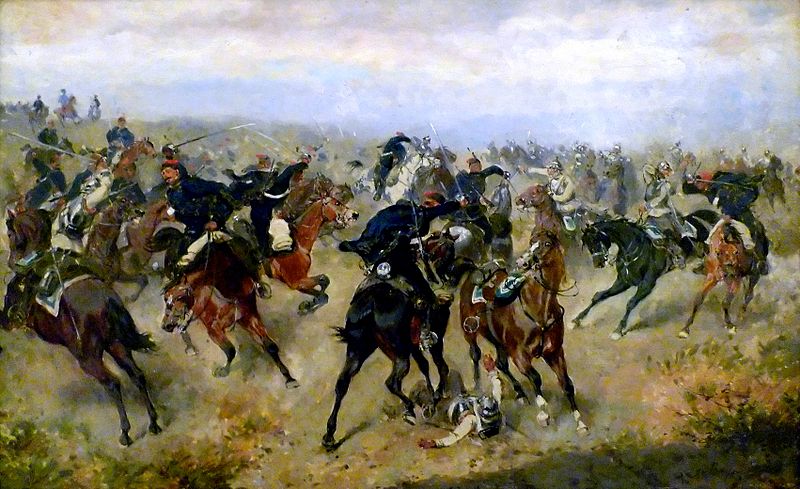
The Königgrätz Commemorative Cross is a Prussian medal instituted on September 20, 1866 by the King of Prussia Wilhelm I. The medal was awarded to Prussian officers, NCOs and other ranks as well as to military officials following the Prussian victory in the Austro-Prussian War (June 17 – July 26, 1866).

This award was named after the Battle of Königgrätz (Schalcht bei Königgrätz, also referred to as the Battle of Sadowa) that took place on July 03, 1866 and  involved the largest number of troops in Europe until that time. The battle ended with one of the highest casualties for a major battle: Austrians and their Saxon allies lost 44,000 men killed in action, wounded and missing in action including 22,000 being held prisoners while Prussians had 360 officers and 8,812 men killed.

A total of 144,000 “combat” crosses and 1,200 non-combatant versions were issued.

The Königgrätz Commemorative Cross Design

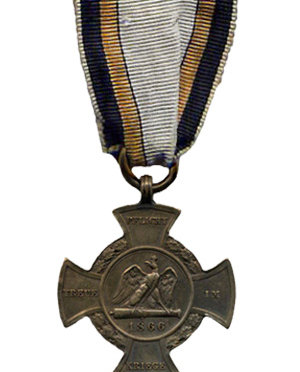
The medal has the shape of a cross pattée with a round medallion superimposed on its center and a round wreath between its arms and is made of bronze from captured Austrian cannons. It was designed by the Prussian court medalist Friedrich Wilhelm Kullrich (1821-1887) and the Prussian royal mint engraver Emil Weigand (1837-1906) and measured 34,5 x 34,5 mm.

A central medallion on its obverse has an image of a crowned Prussian eagle leaning against a captured Austrian cannon (with some variations). There were four different crosses instituted to commemorate “1866 victorious campaign”. All the four crosses share the same reverse design, a crowned cipher of the Prussian king Wilhelm I.

  • Königgrätz Cross: For the military personnel who participated directly in the Battle of Königgrätz. Inscription: “König-Grätz” – “Den 3.” – “Juli” – “1866”.
  • “Main Army” Cross: For the military personnel of a Main army who fought under command of General Eduard Vogel von Falckenstein against troops from Hannover, Hessen, Bavaria, Baden and Wurttemberg. Inscription “Der” – “Main” – “Armee” -“1866”.
  • “Loyal Fighters” Cross: For military personnel who hadn’t participated in the Battle of Königgrätz and were not attached to the Main army. Inscription “Treuen” – “Krie-” – “Gern” – “1866”.
  • “Loyal to its duty in times of war” Cross: For non-combatants. Round wreath is made of oak leaves. Inscription “Pflicht” – “Treue” – “Im” – “Kriege”.

Like other Imperial awards, the Cross was worn either obverse or reverse outwards. The silk ribbon of the first three versions of a Königgrätz Commemorative Cross was black with two yellow-orange and white vertical stripes closer to its edges.

Related Article:

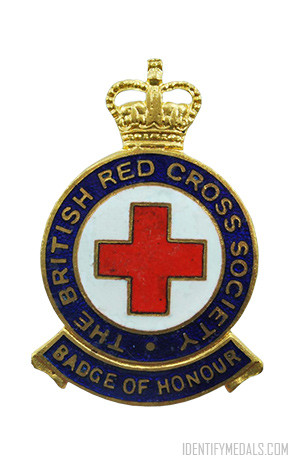
The British Red Cross Medal for Proficiency

Members of the Red Cross had to have three successive certificates in appropriate subjects (nursing, first aid, hygiene and sanitation).

Members of the Red Cross had to have three successive certificates in appropriate subjects (nursing, first aid, hygiene and sanitation) with an interval of at least 12 months between the dates of each certificate gained.

A proficiency badge was awarded after the third successful examination, and after the 4th and subsequent examinations the Red Cross members would be given proficiency bars. Each proficiency badge had the relevant subject on the ornamental brooch and a different ribbon for each subject.

The British Red Cross Society and the Order of St John formed the Joint War Organisation, offering extensive services for the sick and wounded, for prisoners of war, and for civilians needing relief as a result of enemy action, at home and abroad. The joint organization created ambulance departments for the transportation of the wounded, established convalescent homes and auxiliary hospitals, sometimes in private properties across the UK.

The British Red Cross Medal for Proficiency Badge Design

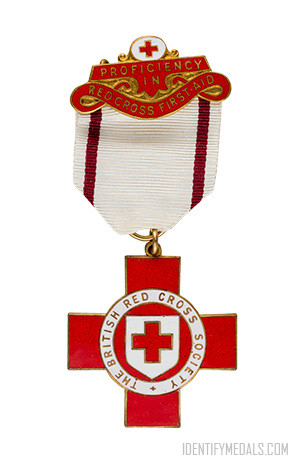
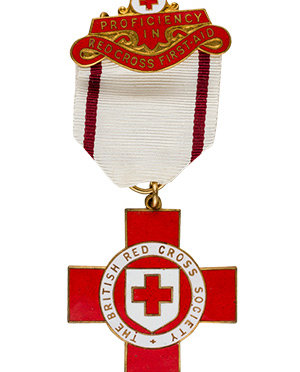
On the obverse of the medal is a red cross enamel medal with a central white shield and another red cross in the center surrounded by a circular white band with the following inscription in gold: “THE BRITISH RED CROSS SOCIETY”.

Suspended to the white with two thin purple striped ribbon is a metal clasp with inscription in gold on red enamel background “PROFICIENT IN RED CROSS FIRST AID” and a red cross on the white circular background.

On the reverse is engraved the ID and the full name of the person awarded the badge. The badge measures approximately 3.7”x 1.6” at its widest points.

Find Red Cross Medals Online

More Red Cross Medals

The Cross to the Heroic Valour in Combat (Argentina)

The Cross to the Heroic Valour in Combat (or Cruz la Nación Argentina al Heroico Valor en Combate in Spanish) is the highest military decoration of the Argentinian Republic.

The medal was first issued in 1982, and according to the Laws 22 607 (1982) and 24 229 it’s to be awarded to military personnel, security forces personnel, civilian police force, Argentinians or foreigners who, in combat motivated by extraordinary circumstances, exhibit heroic acts in the function of war, isolated or in the exercise of command, or ponderable actions or distinguish themselves in conduct.

A totally of 21 medals were given to Argentine heroes of the Falklands War, all of them having fought
in the war, and eight of them having given the medal post-mortem.

The Cross to the Heroic Valour in Combat Medal Design

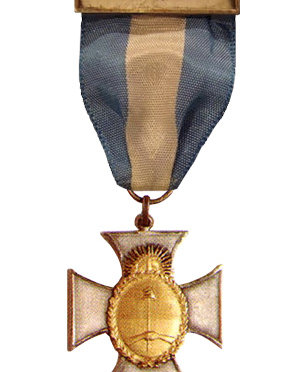
The medal is a circular medal cast in bronze and silver. The decoration consists of a silver cross pattée bearing the Coat of arms of Argentina in gold.

The medal is suspended from a chest ribbon of equal light blue-white-light blue stripes.

The Cross of St. George (Russia)

The Cross of Saint George is a state decoration of the Russian Federation initially established by Imperial Russia between 1807 and 1913.

The Cross of Saint George (or Георгиевский крест in Russian) is a state decoration of the Russian Federation initially established by Imperial Russia between 1807 and 1913.

The award was intended as a reward for “undaunted courage” by the lower ranks (soldiers, sailors and NCOs) of the military. There was only a single class with no restriction as to the number of awards per person. The first soldier to be awarded the Cross of Saint George was a cavalry non-commissioned officer named Yegor Ivanovich Mitrokhin. He received the award for distinction in the battle against the French at Friedland on 2 June 1807.

Over two million Saint George Crosses were distributed during the Great War and before the abdication of the tsar. They went to soldiers, nurses and members of the Red Cross. An enlisted man or NCO could be awarded the 4th class cross for his first brave act. A second notable act could then bring him the 3rd class cross, etc.

The Cross of Saint George could be awarded to foreigners. For example, the cross was awarded to the surviving Prussian veterans of the Napoleonic wars 1813/1815. 4500 decorations were made, although only 4264 were issued and about 1765 were returned to the Chancellery of Russian Orders after the death of their recipients and melted down.

The Cross of Saint George was reinstated into the Russian awards system in 1992.

The Cross of St. George Design

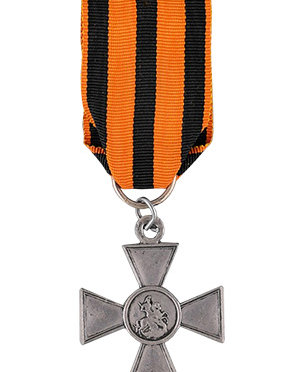
The modern Cross of Saint George is virtually identical to the imperial variant, a 34mm wide cross pattée worn on the left side of the chest with other medals. The first class and second class were struck in gold, the first class with a bow on the ribbon. The third and fourth classes were struck in silver, with the third class marked by a bow.

The obverse has a central medallion bearing the right-facing image of Saint George on horseback slaying the dragon. The reverse of the central medallion bears the Cyrillic monogram of the Order of Saint George “SG” (Russian: «СГ»). The reverse of the two lateral arms of the cross bears the serial number of the award, the left arm having an embossed letter “N” at its left extremity. The class of the cross is embossed on the reverse of the lower arm, “1-я степ” for the first class, “2-я степ” for the second class, “3-я степ” for the third class and “4-я степ” for the fourth class.

All four crosses hang from the standard Russian pentagonal mount covered with an overlapping 24mm wide silk moiré ribbon of Saint George (black and orange bicolor pattern, with three black and two orange stripes). When the cross is not worn, a ribbon bar is worn on the uniform. The ribbon bar is 8mm high by 24mm wide, it bears a 7mm high golden metallic Roman numeral denoting the class of the award.

The Order of St. George (Russia)

The Order of Saint George is the highest military decoration of the Russian Federation and was originally established 26 November 1769.

Time Period: Pre-WW1
Year of Institution: 26 November 1769
Country: Russia & USSR

The Order of Saint George (or Орден Святого ГеоргияOrden Svyatogo Georgiya in Russian) is the highest purely military decoration of the Russian Federation. It was originally established 26 November 1769 as the highest military decoration of the Russian Empire by Empress Catherine the Great.

The current Order of Saint George is awarded to highest and senior military officers for the conduct of military operations to protect the Fatherland from attack by an external enemy which resulted in the complete defeat of the enemy, for the execution of combat and other operations in other states aimed at restoring international peace and security, or for being a model of military science with feats that exemplify military prowess; the Order is also conferred upon officers who were previously awarded state awards of the Russian Federation for distinction in combat.

The order was revived in the Russian Federation on 8 August 2000 by Decree №1463 of the President of Russia. The current award criteria were amended on 7 September 2010 by Presidential Decree 1099.

The Order of St. George Design

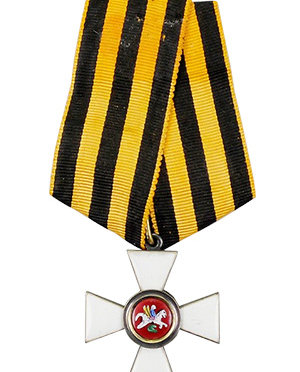
The Cross is a white enameled cross pattée with a central medallion bearing the image of Saint George on horseback slaying the dragon. The cross measures 60mm across in the case of the Order first class (50mm for third class and 40mm for the fourth) and is worn on a sash in the colours of Saint George (orange and black).

The Star is a four-pointed silver gilt star with a gold central medallion bearing the cipher of Saint George “SG” topped by a crown and surrounded by a black enamelled band bearing the motto of the order “For Service and Bravery” (“Za Sluzhbu i Khrabrost“). The star is worn on the left breast for both the Order first and second classes.

The ribbon of the Order of Saint George is orange with three black stripes, commonly called “George’s Ribbon”. It symbolizes fire and gunpowder: the Russian “colors of military glory”, and is also thought to be derived from the colors of the original Russian imperial coat of arms (black eagle on a golden background). It was subsequently associated to the colors of the Russian Guard units.