The Cross of the Mount of Olives

The Cross of the Mount of Olives is a Prussian award founded in 1909 to commemorate the foundation of a hospital on the Mount of Olives.

The Cross of the Mount of Olives (or Ölberg-Kreuz in German) is a Prussian award founded on 24 December 1909 as a decoration to commemorate the foundation of a hospital, the Kaiserin Auguste Victoria-Stiftung on the Biblical Mount of Olives in Jerusalem.

The award was created by Prince Eitel Friedrich of Prussia. His very devout mother, Augusta Victoria of Schleswig-Holstein, was fond of charitable works and built several churches and he and Emperor Wilhelm II of Germany had visited Jerusalem in 1898. They then pledged to build a hospital for Christian pilgrims suffering from malaria.

The Cross of the Mount of Olives was awarded to those who contributed to the Foundation, and the Augusta Victoria Hospital opened its doors in 1910.

The Cross of the Mount of Olives Design

The badge of the decoration is a red-and-black enameled Jerusalem cross, upon which is imposed the white cross of the Johanniterorden, the evangelical noblemen’s society which Prince Eitel Friedrich then headed as Grandmaster.

The badge is suspended from a monogram of the Empress’s initials, “AV”. The ribbon is plain white and the deserving were awarded golden or silver-gilt Crosses.

The Jerusalem Cross

The Jerusalem Memorial Cross is a Prussian decoration established in 1898 and awarded to those who visited Palestine with the King.

The Jerusalem Cross, also known as the Jerusalem Memorial Cross or “Jerusalem-Kreuz; Jerusalem-Erinnerungskreuz” in German, holds historical significance as a Prussian decoration established on October 31, 1898. Its establishment coincided with Emperor Wilhelm II‘s notable visit to Palestine in the same year. This distinguished award was bestowed upon individuals who had the unique privilege of accompanying Emperor Wilhelm II on his pilgrimage to Palestine and participated in the solemn inauguration ceremony of the Lutheran Church of the Redeemer in Jerusalem.

Emperor Wilhelm II’s journey to Palestine and the dedication of the Lutheran Church of the Redeemer marked a significant event in Prussian history, symbolizing the nation’s cultural and religious ties to the Holy Land. The Jerusalem Cross served as a commemorative token of this historic occasion, honoring those who were part of this remarkable pilgrimage. As a testament to their participation in this momentous event, recipients of the Jerusalem Cross were recognized for their role in fostering diplomatic relations, religious unity, and cultural exchange between Prussia and the Holy Land

The Jerusalem Cross Design

The cross is made in the shape of the Jerusalem cross, which consists of a large cross portent with four plain crosslets between the arms. The crosses are red enameled with silver-gilt borders. In the center of the cross is a round gold colored medallion.

The obverse depicts the Imperial Crown of the Prussian German Emperor surmounting the letters IR (Imperator Rex) over the royal cypher of a stylized W II. The reverse of the medallion bears the date 31 October 1898, which is depicted using a large Roman numeral X in the center for October, and a small Roman numeral XXXI at the top. To the left is MDCCC and to the right side IIC for the year 1898.

The Lifesaving Medal

The Lifesaving Medal was a civil decoration of the Kingdom of Prussia awarded to those who had saved a person’s life at risk to their own.

The Lifesaving Medal (on Rettungsmedaille am Band” in German) was a civil decoration of the Kingdom of Prussia.

Established 1 February 1833, it was awarded to individuals who had saved another person’s life, at risk to their own.

This medal is referred to as the Lifesaving Medal on Band to differentiate it from a previous non-portable award established in 1802. Otto von Bismarck received it for rescuing a drowning man.

The Lifesaving Medal Design

The medal is circular and struck in silver. The obverse presents the head of King Friedrich Wilhelm III in relief, facing left, in the center.

Around it is circumscribed FRIEDRICH WILHELM III KÖNIG VON PREUSSEN. The reverse has inscribed FÜR RETTUNG AUS GEFAR (FOR RESCUE FROM DANGER) within an oak leaf wreath, measuring 24.79 mm in diameter, on loop for suspension from the period original ribbon, and in fine condition.

The Prussian Red Cross Medal

The Red Cross Medal was set up in 1898 by Emperor Wilhelm II and awarded to those who did great service to the sick in peace or wartime.

The Red Cross Medal was set up on 1 October 1898 by Emperor Wilhelm II and awarded to all those who carried out great service to the sick in peace or wartime, or for special achievement in the service of the German Red Cross. This was a peacetime award, as opposed to the Order of the Crown and general honor decorations with the Red Geneva Cross.

The Red Cross Medal was awarded in three classes, the Second and Third classes being worn as circular medals suspended from a red ribbon with white and black stripes.

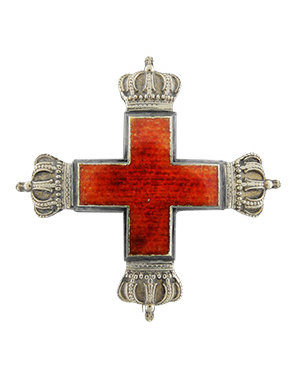
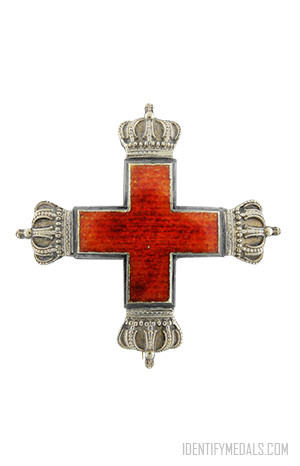
The First Class was a red enameled Geneva Cross with gilded Prussian Royal Crowns at the ends of the arms. This award was worn as a steckreuz on the breast like the Iron Cross. Recipients could be promoted to the next class of the medal with five years time in service, with the first level anyone could be initially appointed to being the Second Class.

Find Red Cross Medals Online

Right Now on eBay 
Clicking a link to eBay may result in a referral commission being paid if a purchase is made.
Loading...

More Red Cross Medals