The Maritime War Cross (Greece)

  • Time Period: WW2
  • Year of Institution: 1943
  • Country: Greece

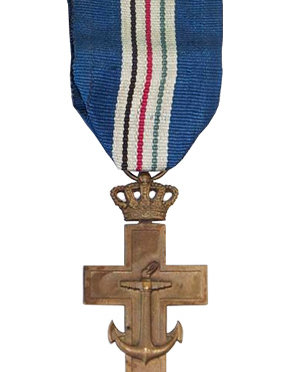
The Maritime War Cross was established in 1943 by the Greek Government in Exile in 3 classes: bronze, silver and gold. It was awarded to the Officers and Sailors of the Hellenic Merchant Navy with at least 6 months of service aboard a merchant vessel.

It was also awarded to Officers of the Hellenic Royal Navy who commanded convoy escorts and also to Officers and Sailors of the Hellenic Royal Navy who served aboard merchant ships during the War.

The Maritime War Cross Design

The medal shows the motto: “Μέγα το της Θαλλάσης Κράτος” (in liberal translation: Powerful is the State that Controls the Sea). The phrase had been used for the first time by Thucydides and it is the motto of the Hellenic Navy.

Some versions of the medal were British made by Spink and Son Ltd, London (this is marked on the reverse of the crown).

The Royal Hellenic Navy Campaign Cross

  • Time Period: WW2
  • Year of Institution: 22 December 1943
  • Country: Greece

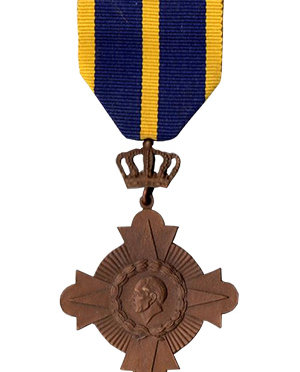
The Royal Hellenic Navy Campaign Cross was instituted by the Law of 22 December 1943 and awarded to officers and sailors of the Royal Hellenic Navy for a minimum of six months’ active service in World War II.

When Italy invaded Greece from Albania on 28 October 1940, the Greek Navy worked with the British Royal Navy to interrupt Italian shipments across the Adriatic. When Greece fell to German invasion in April 1941, much of the fleet steamed to Alexandria in Egypt and joined the British Mediterranean Fleet, continuing the fight against the Italians and Germans. Greek naval forces also escorted convoys in the Atlantic and Indian Oceans and supported the Normandy landings in June 1944.

The Royal Hellenic Navy (RHN) was, after the British Royal Navy, the largest Allied Naval force in the Mediterranean. The RHN fought against the Italians and the Germans in the Aegean Sea and the Eastern Mediterranean, participated in the defense of Malta, escorted convoys in the Atlantic and the Indian Ocean and supported the landings in Sicily, Italy, Southern France and Normandy.

The Royal Hellenic Navy Campaign Cross Design

The medals were issued by Kelaidis of Athens in bronze gilt. They measured 32 mm x 58.5 mm inclusive of its crown suspension. It came in three grades:

  • Gold (gilt) for officers,
  • Silver (silvered) for petty officers and
  • Bronze for sailors.

The Cross for the Bavarian Auxiliary Corps

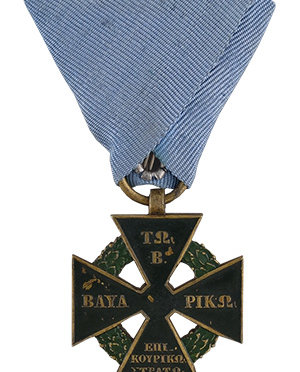
The Cross of the Bavarian Auxiliary Corps medal was created on November 22, 1833 and awarded to 3582 members of the Bavarian Auxiliary Corps who escorted King Otho I (the young Prince Otho of Bavaria) from his native Bavaria to Greece in that same year.

The Royal Bavarian Auxiliary Corps (or Β. Βαυαρικό Επικουρικό Σώμα in GreekKgl. Bayerisches Hilfskorps in German) was a Bavarian Army expeditionary force established in 1832 to accompany Prince Otto as the first king of independent Greece in 1833, to serve as a military force and enforce order until a native military could be established. It replaced the forces maintained there by the Great Powers—chiefly the French troops of the Morea Expedition—as well as the remnants of the Greek forces organized during the Greek War of Independence.

Most of the Bavarians left by 1837, but many remained behind, dominating the Greek army and the administration. This “Bavarocracy” (Βαυαροκρατία) provoked great resentment from the Greeks, and was one of the chief causes of the 3 September 1843 Revolution. Many Bavarians remained behind in Greece and became Greek citizens.

The Cross for the Bavarian Auxiliary Corps Design

The bronze and lacquer Cross features an obverse inscription that translates to “Othon King of the Hellenes,” and a reverse inscription that translates to “To the Royal Bavarian Auxiliary Corps.”

It measures 32.7mm x 37.5mm.

The Cross for the War of Independence 1821-1829

  • Time Period: Pre-WW1
  • Year of Institution: 3 September 1843
  • Country: Greece

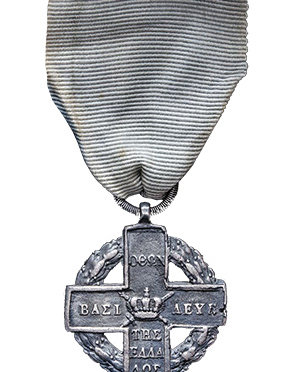
The Cross for the War of Independence 1821-1829 medal is was created in 1834 to be awarded to all those who took part in the Struggle for the Independence of Greece, or the Greek War of Independence.

Its final form and way of conferring were confirmed by the National Assembly of the 3rd of September 1843.

The Greek War of Independence, also known as the Greek Revolution (or Ελληνική ΕπανάστασηElliniki Epanastasi in Greek), was a successful war of independence waged by Greek revolutionaries against the Ottoman Empire between 1821 and 1830. The Greeks were later assisted by the Russian Empire, Great Britain, and the Kingdom of France, while the Ottomans were aided by their North African vassals, the eyalets of Egypt, Algeria, and Tripolitania, and the Beylik of Tunis.

The Cross for the War of Independence 1821-1829 Design

The medal is struck in bronze or silver and weights 11,1 grams. It measures 31 mm.

The Order of Honor (Greece)

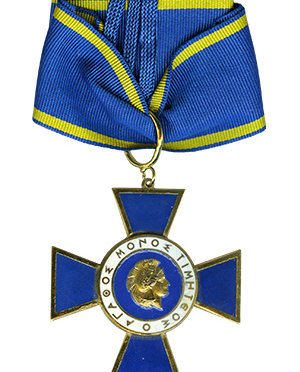
The Order of Honor (or Τάγμα της Τιμής in Greek) is an order of Greece, second in rank to the Order of the Redeemer, and was established in 1975 to replace the abolished Royal Order of George I.

The medal is conferred by the Greek government upon “Greek citizens who are distinguished in struggles for the Fatherland, to senior executives of the public administration, to eminent personalities of the arts and letters as well as to distinguished scientists or individuals who excelled in the field of trade, shipping and industry. It is also conferred upon foreigners who, due to their distinguished position and through their personal worth, have contributed to the promotion of Greece“.

As all Greek orders, the Order of Honor has five classes:

  • Grand Cross (Μεγαλόσταυρος)
  • Grand Commander (Ανώτερος Ταξιάρχης)
  • Commander (Ταξιάρχης)
  • Gold Cross (Χρυσός Σταυρός)
  • Silver Cross (Αργυρός Σταυρός)

The Order of Honor Design

The badge of the order is a blue-enamelled cross, in silver for the Silver Cross class, in gold for the higher classes. The Silver and Gold Crosses have a diameter of 37 mm, while the senior grades have a diameter of 57 mm. A competition followed for the design of the new decoration, won by Konstantinos Kontopanos. His design was finalised in the Presidential Decree 849 of 11 November 1975.

The obverse central disc bears a portrait of the goddess Athena and the legend Ο ΑΓΑΘΟΣ ΜΟΝΟΣ ΤΙΜΗΤΕΟΣ (“Only the righteous should be honoured”) on a white enamel band. The reverse bears a simplified national emblem of Greece in the form of a white Greek cross on blue, and on a circular band the legend ΕΛΛΗΝΙΚΗ ΔΗΜΟΚΡΑΤΙΑ (“Hellenic Republic”) and the year of the order’s founding (1975).

The star of the order is a silver eight-pointed star with straight rays, with the entire badge in the centre. The reverse bears the Greek national emblem in white enamel and the legend ΕΛΛΗΝΙΚΗ ΔΗΜΟΚΡΑΤΙΑ 1975 in gold letters. The ribbon of the Order is blue with orange edges. The first four grades have a ribbon of 35 mm, with 3 mm-wide edges, while the shash of the Grand Cross is 100 mm wide, with edges 8 mm wide.

The Order of Saints George and Constantine

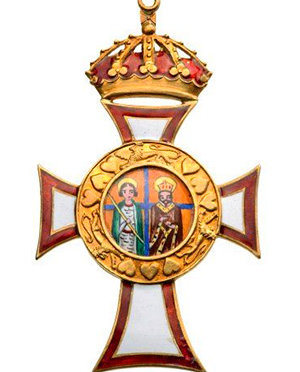
The Royal Family Order of Saints George and Constantine is an order of the Greek royal family established in January 1936 by King George II.

  • Time Period: Pre-WW1
  • Year of Institution: January 1936
  • Country: Greece

The Royal Family Order of Saints George and Constantine (or Βασιλικόν Οἰκογενειακόν Τάγμα Ἁγίων Γεωργίου καὶ ΚωνσταντίνουVasilikon Oikogeneiakon Tagma Agion Georgiou kai Konstantinou) is an order of the Greek royal family.

or the duration of its existence, it has been the second highest decoration awarded by the modern Greek state and the Greek crown, after the Order of the Redeemer. It was instituted in January 1936 by King George II in the memory of his grandfather (King George I) and his father (King Constantine I).

The order is awarded only to men, while the corresponding Order of Saints Olga and Sophia is reserved for women.

The Order of Saints George and Constantine Design

The order’s design was influenced by the royal family’s Danish origin, evoking the appearance of the Order of the Dannebrog. The order is not awarded since 1975 by the Greek state after the abolition of monarchy and today is awarded only by the Greek Royal Family.

The Order has five classes:

  • Grand Cross (‘Μεγαλόσταυρος’) – wears the badge of the Order on a collar or on a sash on the right shoulder, and the star of the Order on the left chest;
  • Grand Commander (‘Ανώτερος Ταξιάρχης’) – wears the badge and the star of the Order on the left chest;
  • Commander (‘Ταξιάρχης’) – wears the badge of the Order on a necklet;
  • Gold Cross (‘Χρυσούς Σταυρός’) – wears the badge on a ribbon on the left chest;
  • Silver Cross (‘Αργυρούς Σταυρός’) – wears the badge on a ribbon on the left chest.

The Royal Order of George I

  • Time Period: Pre-WW1
  • Year of Institution: 16 January 1915
  • Country: Greece

The Royal Order of George I (or Βασιλικόν Τάγμα Γεωργίου Α’) is a Greek order instituted by King Constantine I in 1915 in honor of his father, George I. Since the monarchy’s abolition in 1973, it is considered a dynastic order of the former Greek royal family.

The Order was only the second Greek order to be created after the Order of the Redeemer in 1833 and remained the second senior award of the Greek state for the duration of its existence. The order was closely associated with the Greek monarchy and was hence abolished with the establishment of the Second Hellenic Republic in 1924. The order was restored along with the monarchy in 1935, and continued to be awarded until the final abolition of the monarchy in 1973.

The Order of George I Design

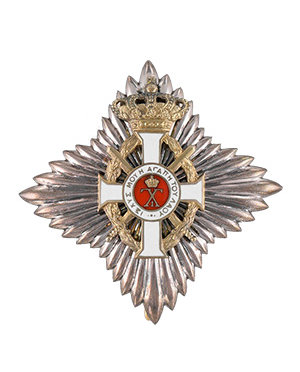
The badge of the Order is a white-enameled Latin cross pattée, in silver for the Silver Cross class, in gold for the higher classes, with a wreath of laurels between the arms of the cross.

The obverse central disc was in red enamel, bearing the royal cypher of George I, two crossed gammas with a crown above and a “I” below, surrounded by a white enamel ring bearing the royal motto ΙΣΧΥΣ ΜΟΥ Η ΑΓΑΠΗ ΤΟΥ ΛΑΟΥ (“The Love of My People is My Strength”). The reverse central disc bears the years of George I’s reign, 1863-1913. The badge is topped by a crown; the military division also had crossed swords behind the badge. The Commemorative Medal’s badge is identical in design, except that the cross is not enameled.

The star of the order is a silver star with straight rays, with eight points for Grand Cross and four points for Grand Commander, and with the obverse of the badge superimposed upon it.

The ribbon of the Order is plain crimson red.

The Cross of Valor (Greece)

The Cross of Valour is the second highest military decoration of the Greek state, awarded for acts of bravery or distinguished leadership.

  • Time Period: Pre-WW1
  • Year of Institution: 13 May 1913
  • Country: Greece

The Cross of Valor (or Αριστείον ΑνδρείαςAristeion Andreias, “Gallantry/Bravery Award“) is the second highest military decoration of the Greek state, awarded for acts of bravery or distinguished leadership on the field of battle.

It has been instituted three times, first on 13 May 1913 during the Balkan Wars but not issued until 1921 during the Greco-Turkish War of 1919–1922, then on 11 November 1940 shortly after the outbreak of the Greco-Italian War and finally in 1974.

The award was liberally distributed during the campaigns of 1921–1922: from the first awards in July 1921 to the end of the war in August 1922. The Cross of Valor continued to be awarded for actions during the Greek Civil War and for the Greek participation in the Korean War, as well as for a few cases from World War II, from 1947 to 1955.

The Royal Decree of 31 March 1921 instituted the Cross of Valor in three grades: Commander’s Cross (Σταυρός Ταξιάρχη), worn as a badge on a necklet, and the Gold Cross (Χρυσούς Σταυρός) and Silver Cross (Αργυρός Σταυρός), worn as badges on chest ribbons. No limit was set on the number of awards in each grade.

The Cross of Valor Design

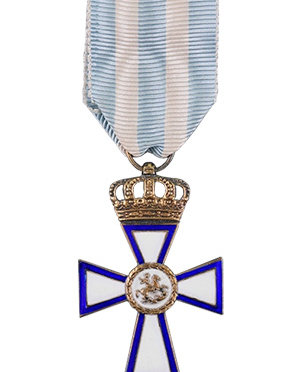
The design of the badge was specified as a “crowned cross, bearing in the middle of the obverse side, in a circle of narrow laurel leaves, the image of St. Demetrios, while on the middle of the reverse side in a similar circle it bears the words ΑΞΙᾼ (“for valor” in Greek)”.

The Silver Cross was to be made entirely of silver, while the Gold and Commander’s crosses were enameled in white with blue edges. The ribbon consists of five pale blue and white stripes. For each repeat award, a silver 4-millimeter star was added to the ribbon.

For World War II awards, a bar with “1940” was placed on the ribbon to distinguish it from the earlier 1913 version.

The Air Force Cross and Medal (United Kingdom)

The Air Force Cross is a British military decoration awarded to officers for “acts of exemplary gallantry while flying against the enemy”

Time Period: WW1 The Great War
Year of Institution: 3 June 1918
Country: Great Britain

The Air Force Cross (or AFC) is a military decoration awarded to officers for “an act or acts of exemplary gallantry while flying, though not in active operations against the enemy“. Since 1993 it’s also given to other ranks, of the United Kingdom Armed Forces, and formerly also to officers of the other Commonwealth countries.

The award was established on 3 June 1918, shortly after the formation of the Royal Air Force (RAF). It was originally awarded to RAF commissioned officers and Warrant Officers, but was later expanded to include Royal Navy and army aviation officers. Recipients of the Air Force Cross are entitled to use the post-nominal letters “AFC”.

Between 1919 and 1932 the AFC was also awarded to civilians, on the same basis as for RAF personnel. The AFC had also been awarded by Commonwealth countries but by 1990’s most, including Canada, Australia, and New Zealand, had established their own honors systems and no longer recommended British honors.

The Air Force Cross and Medal Design

The Cross

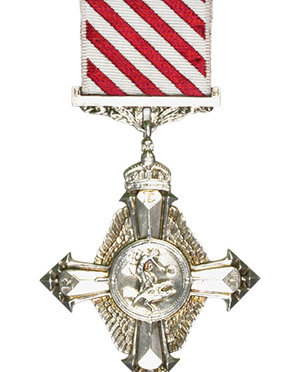
The Air Force Cross is a silver cross measuring 60 millimeters (2.4 in) in height and 54 millimeters (2.1 in) in width, representing aircraft propeller blades, with wings between the arms. It was design by Edward Carter Preston.

The obverse depicts Hermes, riding on the wings of a hawk holding a laurel wreath. At the top of the upper arm is the royal crown, while the other three arms bear the royal cipher of the reigning monarch at the time of issue. The reverse is plain, except for a central roundel bearing the reigning monarch’s cipher and the date ‘1918’. Originally awarded unnamed, from 1939 the year of issue was engraved on the reverse lower limb of cross, and since 1984 it has been awarded named to the recipient.

The suspender is straight and decorated with laurel wreaths. The ribbon bar denoting a further award is silver, with the Royal Air Force eagle in its centre. Bars awarded during World War II have the year of award engraved on the reverse. The 32 mm (1.25 inch) ribbon was originally white with red broad horizontal stripes, but changed in July 1919 to the current white with red broad diagonal stripes at a 45-degree angle.

The Medal

The Air Force Medal is an oval struck in silver and measures 42 mm tall and 32 mm wide. It has a laurel border and features, on the obverse, the sovereign’s effigy. The reverse Hermes mounted on a hawk bestowing a laurel wreath.

The medal is suspended by a pair of wings from a straight bar. The ribbon, originally with horizontal narrow stripes or white and crimson, changed in 1919 to diagonal ones of the same colors.

The Vietnam Distinguished Service Order

The Vietnam Distinguished Service Order was a military decoration of South Vietnam awarded throughout the years of the Vietnam War.

The Vietnam Distinguished Service Order (or Huân-Chương-Việt Nam in Vietnamese) was a military decoration of South Vietnam awarded throughout the years of the Vietnam War. The decoration was bestowed for meritorious or heroic deeds related to wartime operations and was awarded for both combat and non-combat service.

The decoration ranked immediately below the National Order of Vietnam and the Vietnam Military Merit Medal. It was among the less commonly bestowed medals, in contrast to such decorations as the Vietnam Gallantry Cross and Vietnam Campaign Medal.

The Vietnam Distinguished Service Order was also provided to foreign militaries, and in the United States military, the decoration was considered the equivalent of the Legion of Merit. For foreign officers, the 2nd class of the order was also provided to officers.

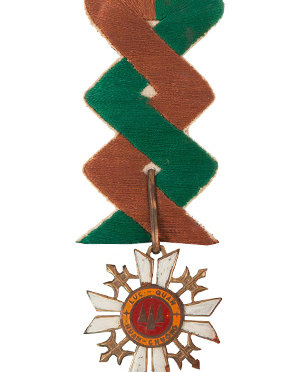
The Vietnam Distinguished Service Order Design

The Vietnam Distinguished Service Order is Maltese cross in white enamel with divided rays. Between the rays are golden trident heads, and in the center is a red disc containing three narrow triangles in gold, surrounded by an orange band containing the words ‘LUC-QUAN HUAN CHUONG’ in gold. On the reverse is stamped the words ‘VIET-NAM‘ in a lined circle. The ribbon is a two-armed embroidered design in tan and green, each arm crossing the other three times and ending in a hanging fringe behind the medal.

There were two classes of the Vietnam Distinguished Service Order, the first class being for officers and the second class for enlisted personnel. The first class of the order was differentiated by a blossom device centered on the medal and ribbon.