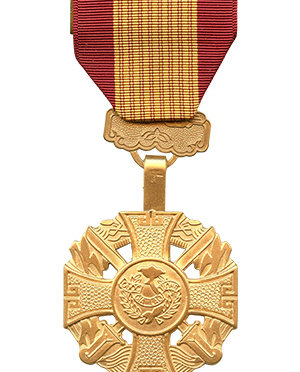
The Vietnam Gallantry Cross (South Vietnam)

All military personnel of all branches were awarded the Vietnam Cross of Gallantry if they had served in Vietnam between 1961 and 1973.

Under the Department of the Army General Order (DAGO) 43, 1970, all military personnel of all branches were awarded the Vietnam Cross of Gallantry if they had served in Vietnam between March 1, 1961 and March 28, 1973.

In addition, according to DAGO 8, 1974, the Vietnam Gallantry Cross, Unit Citation with Palm was awarded to Headquarters U.S. Military Assistance Command (MACV) and all subordinate units during February 8, 1962 to March 28, 1973. This meant that all military personnel who were assigned to units that served in-country Vietnam during this period were considered as assigned to MACV, regardless of service or component.

In other words, the Republic of Vietnam authorized this award for all foreign military personnel and units for valorous achievement and participation during the Vietnam War. Equivalent to the French Croix de Guerre, the medal demonstrates South Vietnam’s gratitude to the American and Allied soldiers who worked, fought, and sacrificed themselves for the freedom of the Republic of Vietnam.

In closing, the Vietnam War has always been a touchy subject. Since the war was quite unpopular, many veterans were not welcomed when they returned, even if they did not personally agree with the conflict. In addition, many Vietnam War vets rarely talked about their experiences during the war and their service—until somewhat recently—went undiscussed.

As a result, besides the Medal of Honor and other prestigious U.S. decorations, many individuals do not know much about the Vietnam War medals, which is unfortunate because they are especially unique.

From the unique device attached to the Republic of Vietnam Campaign Medal to the fact that some medals were issued by a now defunct country—South Vietnam, the medals specifically connected to the Vietnam War have a distinctive story to tell.  

he Republic of Vietnam Gallantry Cross was awarded in four degrees:

  • Gallantry Cross with Palm: cited at the Armed Forces level.
  • Gallantry Cross with Gold Star: cited at the Corps level.
  • Gallantry Cross with Silver Star: cited at the Division level.
  • Gallantry Cross with Bronze Star: cited at the Regiment or Brigade level.

The Gallantry Cross Medal Design

The medal is gold in color, and 35 mm wide. It consists of a Celtic cross with two crossed swords between the arms. The cross is superimposed over a wreath. The center of the cross contains a disc with the outline of the country of Vietnam between two palm branches joined at the bottom. A scroll is on top of the map and is inscribed “QUOC-GIA LAO-TUONG” (Reward of the State).

The suspension ribbon of the medal is 35 mm wide and is made up of the following stripes: 9 mm of Old Glory Red; 17 mm center stripe in Golden Yellow. The center stripe has sixteen strands of Old Glory Red; and 9 mm of Old Glory Red.

The Distinguished Flying Cross (United States)

The Distinguished Flying Cross is an American military decoration for operations by heroism or extraordinary achievement.

The Distinguished Flying Cross is an American military decoration awarded to any officer or enlisted member of the United States Armed Forces who distinguishes himself in support of operations by “heroism or extraordinary achievement while participating in an aerial flight, subsequent to November 11, 1918.”

The first award of the Distinguished Flying Cross was made by President Calvin Coolidge on May 2, 1927, to ten aviators of the U.S. Army Air Corps 🔗 who had participated in the Army Pan American Flight which took place from December 21, 1926, to May 2, 1927. Two of the airmen died in a mid-air collision trying to land at Buenos Aires on February 26, 1927, and received their awards posthumously.
Charles Lindbergh 🔗 received the first presentation of the actual medal about a month later from Coolidge during the Washington, D.C. homecoming reception on June 11, 1927, from his trans-Atlantic flight.

The medal had hurriedly been struck and readied just for that occasion. The first Distinguished Flying Cross to be awarded to a Naval aviator was received by Commander Richard E. Byrd 🔗, USN for his trans-Atlantic flight from June 29 to July 1, 1927, from New York City to the coast of France. Byrd and his pilot Machinist Floyd Bennett 🔗 had already received the Medal of Honor for their historic flight to the North Pole on May 9, 1926.

During World War II, the medal’s award criteria varied widely depending on the theater of operations, aerial combat, and the missions accomplished. In the Pacific, commissioned officers were often awarded the DFC, while enlisted men were given the Air Medal. In Europe, some crews received it for performances throughout a tour of duty, and different criteria were used elsewhere.

The Distinguished Flying Cross in World War II

During World War II, the Distinguished Flying Cross (DFC) was awarded to numerous individuals for their exceptional actions and achievements in aerial combat and aviation operations. Here are a few examples of people who received the DFC for their actions during this time:

  • Lieutenant Colonel Jimmy Doolittle 🔗: Jimmy Doolittle, an American aviator and Air Force general, was awarded the Distinguished Flying Cross for leading the famous Doolittle Raid in April 1942. This daring mission involved the first U.S. air raid on the Japanese mainland, boosting American morale after the devastating attack on Pearl Harbor.

  • Lieutenant Richard I. Bong 🔗: Richard I. Bong, a U.S. Army Air Forces pilot, was awarded the DFC multiple times during World War II. Bong became one of the most successful American fighter aces, achieving 40 confirmed aerial victories. His exceptional skills and bravery earned him the distinction of being the highest-scoring American ace of the war.

  • Lieutenant Colonel John C. Meyer 🔗: John C. Meyer, a fighter pilot in the U.S. Army Air Forces, earned the DFC for his courageous actions during the air campaign in Europe. He was recognized for his exceptional leadership and flying skills, notably during the Battle of the Bulge, where he achieved aerial victories against German aircraft.

  • Lieutenant Colonel Robert M. Hanson 🔗: Robert M. Hanson, a Marine Corps aviator, was awarded the Distinguished Flying Cross for his extraordinary actions as a dive-bomber pilot in the Pacific Theater. He demonstrated exceptional accuracy and bravery in attacking enemy targets, notably during the Battle of Guadalcanal.

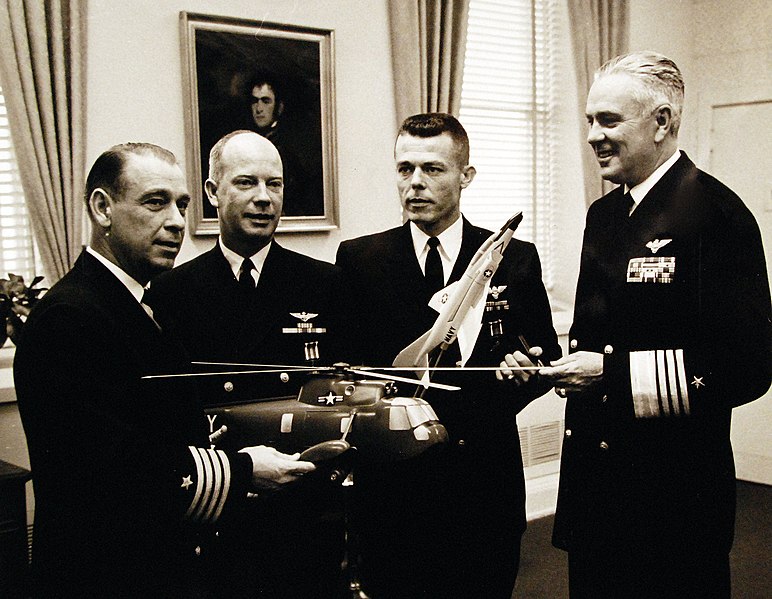
Three Naval Aviators were presented Distinguished Flying Crosses by Chief of Naval Operations Admiral George W. Anderson, USN, (right), in Pentagon ceremonies.
Three Naval Aviators were presented Distinguished Flying Crosses by Chief of Naval Operations Admiral George W. Anderson, USN, (right), in Pentagon ceremonies. Image courtesy of Wikipedia.

The Distinguished Flying Cross Design

The Distinguished Flying Cross is a bronze cross pattee designed by Elizabeth Will and Arthur E. DuBois.

On the obverse is superimposed a four-bladed propeller, 1 11/16 inches in width. Five rays extend from the reentrant angles, forming a one-inch square. The reverse is blank; it is suitable for engraving the recipient’s name and rank. The cross is suspended from a rectangular bar.

The suspension and service ribbon of the medal is 1 3/8 inches wide and consists of the following stripes: 3/32 inch Ultramarine Blue 67118; 9/64 inch White 67101; 11/32 inch Ultramarine Blue 67118; 3/64 inch White 67101; center stripe 3/32 inch Old Glory Red 67156; 3/64 inch White 67101; 11/32 inch Ultramarine Blue 67118; 9/64 inch White 67101; 3/32 inch Ultramarine Blue 67118.

Additional awards of the Distinguished Flying Cross are shown with bronze or silver Oak Leaf Clusters for the Army and Air Force, and gold and silver ​516 Inch Stars for the Navy, Marine Corps, and Coast Guard. The Air Force, Navy, and Marine Corps may authorize the “V” device for wear on the DFC to denote valor in combat; Navy and Marine Corps, Combat “V”.

Fin da Distinguished Flying Cross Design

Right Now on eBay 
Clicking a link to eBay may result in a referral commission being paid if a purchase is made.
Loading...

The Order of the Zähringer Lion

The Order of the Zähringer Lion was instituted on 26 December 1812 by the Grand Duke of Baden in memory of the Dukes of Zähringen.

The Order of the Zähringer Lion was instituted on 26 December 1812 by Karl, Grand Duke of Baden, in memory of the Dukes of Zähringen from whom he was descended.

It remains a very high-level award, sitting just above the Commander’s Cross (a neck order) and the Knight’s Crosses (1st and 2nd Class).

The Grand Duchy of Baden was formed in 1806 during the Napoleonic Wars. Its location on France’s southeastern border led to its devastation when it opposed the French Empire. Its two final Grand Dukes were Friedrich I (1826-1907), who reigned from 1856-1907 and his son, Friedrich II (1856-1928), who reigned from 1907 to the Empire’s end in 1918.

The Order of the Zähringer Lion was awarded in five classes:

  • Grand Cross;
  • Commander, First Class;
  • Commander, Second Class;
  • Knight, First Class; and
  • Knight, Second Class.

A total of 763 of this Order of the Zähringer Lion Grand Cross were awarded between 1815 and 1918.

The Order of the Zähringer Lion Design

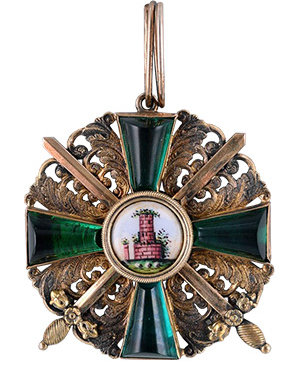
The order’s insignia measures 39.7 mm and consists of a green enameled cross with four arms of equal length, whose angles are filled out with golden clasps. The gold-edged medallion shows the tribal symbol of the Zähringers in coloured enamel. Around the circle is the order’s motto, FÜR EHRE UND WAHRHEIT (German for “FOR HONOUR AND TRUTH”). On the back, the Zähringer lion is portrayed on a red background. The order’s ribbon is green with orange-yellow stripes along the edges.

For special awards, the order was granted with oak leaves and from 1866, it could also be awarded with crossed swords for military services. The oak leaves originally carried an “L” cipher, which went out of use in 1866. Moreover, in exceptional cases, the grand cross award could also be covered in diamonds

The Württemberg Military Merit Order

The Military Merit Order (Militärverdienstorden) was a military order of the Kingdom of Württemberg, which joined the German Empire in 1871.

The Military Merit Order (or Militärverdienstorden in German) was a military order of the Kingdom of Württemberg, which joined the German Empire in 1871.

The order was one of the older military orders of the states of the German Empire. It was founded on February 11, 1759 by Karl Eugen, Duke of Württemberg as the Militär-Carls-Orden, and was renamed the Militärverdienstorden on November 11, 1806 by King Friedrich I. The order underwent several more revisions over the course of the 19th and early 20th centuries. It became obsolete with the fall of the Württemberg monarchy in the wake of Germany’s defeat in World War I.

The order came in three classes. Generally, the rank of the recipient determined which grade he would receive:

  • Grand Cross (Großkreuz)
  • Commander’s Cross (Kommandeurkreuz) and
  • Knight’s Cross (Ritterkreuz).

Between 1799 and 1919, there were an estimated 95 awards of the Grand Cross, 214 of the Commander’s Cross, and 3,128 of the Knight’s Cross, with the bulk of these awards made in World War I; the numbers may only cover native Württembergers.

The Württemberg Military Merit Order Design

The badge of the order was a white-enameled gold cross pattée with curved arms and slightly concave edges. Around the white-enameled center medallion was a blue-enameled gold ring bearing on both sides the motto “Furchtlos und trew” (“Fearless and loyal”).

On the obverse, the medallion bore a green-enameled gold laurel wreath. On the reverse, the medallion bore the monogram of the king of Württemberg at the time of award. The cross was the same size for the Grand Cross and the Commander’s Cross, and slightly smaller for the Knight’s Cross. The Grand Cross and Commander’s Cross, and from 1870 the Knight’s Cross, were topped with a crown. On September 25, 1914, the crown was removed from all grades.

The star of the order, awarded with the Grand Cross only, was a gold-rimmed silver eight-pointed star featuring the ringed medallion of the obverse of the cross.

The ribbon of the order was, until 1818 and after 1914, yellow with broad black stripes near each edge. After November 1917, when the ribbon was worn without the medal, the ribbon bore a green-enameled wreath to distinguish it from other Württemberg decorations on the same ribbon. The ribbon from 1818 to 1914 was blue.

Buy This Medal Online

Right Now on eBay 
Clicking a link to eBay may result in a referral commission being paid if a purchase is made.
Loading...

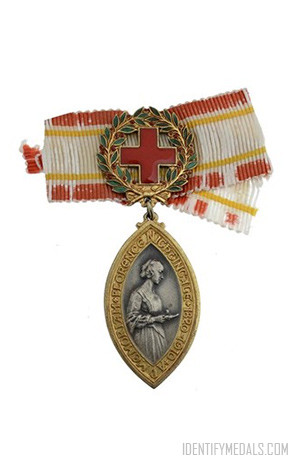
The British Red Cross Badge of Honor

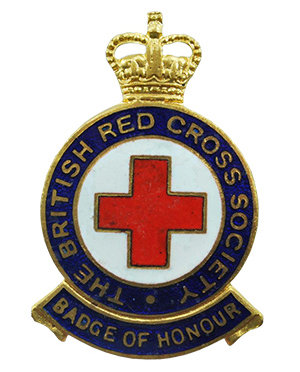
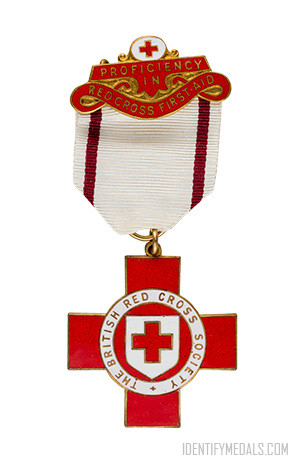
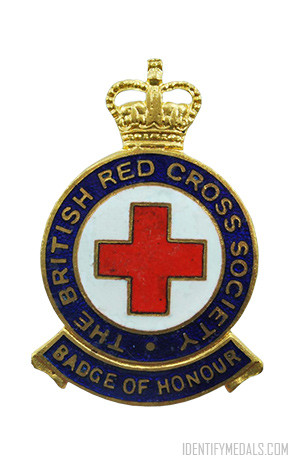
The British Red Cross Badge of Honor was instituted in 1958 and given to people who show exceptional service to the British Red Cross.

The British Red Cross Badge of Honour was instituted in 1958. It’s an award badge given to people who show exceptional service to the British Red Cross.

The Badge has 3 classes:

  • Class 1 “Badge of Honour for Devoted Service”
  • Class 2 “Badge of Honour for Distinguished Service”
  • Class 3 “Queens Badge of Honour”

Badge of Honour for Devoted Service

The award is given to volunteers and staff who have given devoted service to the Society. The Badge is accompanied by a Certificate, which is signed by the Chairman of the Board. The criteria for this award will include the demonstration of service above and beyond the call of duty and actions showing the nominee’s personal involvement and commitment over a longer period of time, furthermore, the recipient’s actions should include devoted and consistent service, showing loyalty and dependability, as well as a certain amount of self-sacrifice and determination.

As a general rule, a minimum period of five years of service should have been completed before receiving this award. Exceptional circumstances may arise when it would be acceptable to make the award sooner.

Badge of Honour for Distinguished Service

The award is given to volunteers and staff for distinguished or exceptional service to the Society. The Badge is accompanied by a Certificate, which is signed by the Chairman of the Board. The recipient should have shown an element of self-sacrifice in time and effort, and should also have demonstrated the ability to initiate innovative ideas, maintain enthusiasm and expand training and service to the community.

Queen’s Badge of Honour

This award may be awarded to any person by the Trustees, with the approval of The President of the Society, His Royal Highness The Prince of Wales, for exceptional service of the highest order to the Society or to the International Red Cross and Red Crescent Movement. The award is accompanied by a certificate, which is signed by The President. The award is limited to thirty holders at any one time.

Find Red Cross Medals Online

More Red Cross Medals

The Henry Dunant Medal

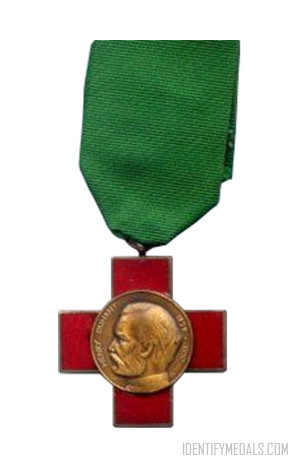
The Henry Dunant Medal is the highest award of the Red Cross. It was created in 1963 and named after the founder of the Red Cross Movement.

The Henry Dunant Medal is the highest award of the Red Cross Movement. It was created in 1963 and named after Henry Dunant, the founder of the Red Cross Movement. In 1963, the idea of creating a medal named in honor of the founder of the International Red Cross was submitted to and approved by the Council of Delegates. This coincided with the 100th anniversary of the Red Cross. In 1965, through the generosity of the Australian Red Cross, the Henry Dunant Medal was established by the International Red Cross Conference in Vienna. The first medals were presented in 1969.

The medal is awarded to “recognize and reward outstanding services and acts of great devotion, mainly of international significance, to the cause of the Red Cross/Red Crescent by any of its members“. 

The medal is presented every two years by the Standing Commission of the Red Cross and Red Crescent, the body that represents the International Committee of the Red Cross, the International Federation of Red Cross and Red Crescent Societies and the various National Red Cross and Red Crescent Societies. This body, representing all of the groups making up the Red Cross Movement, makes five awards of the medal every two years. These limits are placed to ensure the value and prestige of the medal as the highest honour the Red Cross Movement can bestow upon one of its members.

Regulations still allow for the posthumous award of the medal. However, the various groups of the movement have been encouraged to create recognition for those killed in service to the Red Cross. All posthumous nominations for the Henry Dunant Medal should be for, “truly exceptional cases.”

The Henry Dunant Medal Design

The Henry Dunant Medal is in the shape of a Geneva or Greek cross. The arms of the cross are colored with red enamel. In the center of the cross is a circular bronze medallion bearing effigy of Henry Dunant, facing left. Circumscribed around the effigy are the words HENRY DUNANT 1828-1910. The reverse of the medal is plain. To the top arm of the cross is attached a loop for ribbon suspension.

The ribbon is depicted as either solid green, or green with red edges.

Find Red Cross Medals Online

More Red Cross Medals

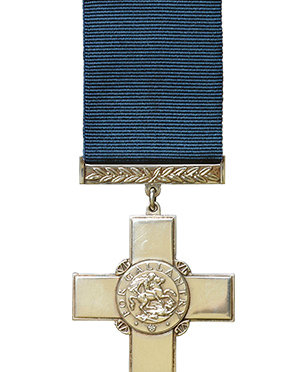
The George Cross (Great Britain)

The George Cross is the second highest award of the UK honors system and it’s awarded for acts of the greatest heroism or courage.

The George Cross (also known as GC) is the second highest award of the United Kingdom honors system and it’s awarded “for acts of the greatest heroism or for most conspicuous courage in circumstance of extreme danger“, not in the presence of the enemy, to members of the British armed forces and to British civilians.

The medal may be awarded to a person of any military rank in any service and to civilians including police, emergency services and merchant seamen. Many of the awards have been personally presented by the British monarch to both recipients and in the case of posthumous awards to next of kin. These investitures are usually held at Buckingham Palace.

The George Cross was instituted on 24 September 1940 by King George VI. At this time, during the height of the Blitz, there was a strong desire to reward the many acts of civilian courage. The existing awards open to civilians were not judged suitable to meet the new situation, therefore it was decided that the George Cross and the George Medal would be instituted to recognize both civilian gallantry in the face of enemy action and brave deeds more generally.

Posthumous awards have been allowed since it was instituted.

The George Cross Criteria

The George Cross is awarded for acts of the greatest heroism or the most conspicuous courage in circumstances of extreme danger. It is intended to recognize acts that exemplify selfless bravery

It can be awarded to both military personnel and civilians and is the highest gallantry award for civilians, as well as for military personnel in situations where military honors would not typically be granted. The GC may also be awarded posthumously.

The cross has been awarded to several foreigners for their acts of exceptional bravery. Examples include:

  1. Malta: Awarded to the entire island of Malta in 1942 for the collective bravery of its citizens during sustained aerial bombardment in World War II.
  2. Rustum Sohrabji Ghandhi: An Indian naval officer awarded in 1952 for his gallantry during a rescue operation.
  3. Michael Pratt: An Australian police officer awarded in 1978 for his actions during a bank robbery.

The George Cross Design

The medal was designed by Percy Metcalfe. The Warrant for the GC (along with that of the George Medal), dated 24 September 1940, was published in The London Gazette on 31 January 1941.

It measures 48 mm in height, with a maximum width of 45 mm. The obverse is a plain silver cross with circular medallion in the center depicting the effigy of St. George and the Dragon, surrounded by the words “FOR GALLANTRY“. In the angle of each limb is the Royal Cypher GVI.

The reverse is plain, with a center engraved with the name of recipient and date of award. The cross is attached by ring to bar ornamented with laurel leaves, through which the ribbon passes.

Find a George Cross

Right Now on eBay 
Clicking a link to eBay may result in a referral commission being paid if a purchase is made.
Loading...

The (Mexican) War Cross

The Mexican War Cross was instituted in 1949 in three classes to be awarded to military in time of war or armed conflict for acts of bravery. 

The War Cross (or Cruz de Guerra in Spanish) was instituted by Presidential Decree on 25 July 1949 in three classes to be awarded to military in time of war or armed conflict for acts of bravery.

Cuauhtémoc was an early 16th Century Aztec ruler who fought heroically against the Spanish conquistadors and was tortured and then unjustly executed by Cortés. Today, Cuauhtémoc is revered in Mexico whilst the world has largely forgotten the victorious Cortés.

The War Cross Design

The medal is a gilt and deep red enamel cross pattée with concave stepped ends to the arms and a loop for ribbon suspension.

The obverse shows the gilt head of Cuauhtémoc in eagle war headdress imposed on a circular central deep red enamel medallion within a gilt ring inscribed in red letters ‘CRUZ DE GUERRA PRIMERA CLASE’ (War Cross First Class). The reverse is plain, with a ribbon with laurel-decorated gilt top bar mounted for wear.

The Decoration for Heroic Valor

The Decoration of Heroic Valor (or Condecoración al Valor Heroico in Spanish) is a Mexican award given to military personnel for exceptional acts of heroism at risk of their own life. The medal may be awarded in both war and peace.

There are three classes:

  • 1st class – solid red ribbon
  • 2nd class – five equal stripes, three red and two white
  • 3rd class – white ribbon with medium width red edges

The Decoration for Heroic Valor Design

The medal is a gilt-edged red-enameled “Lancer Cross” (equilateral cross whose arms resemble lance heads) resting on a gilt “star” of multiple rays that resembles a square with points at the cardinal points.

The oval red central medallion has the number 12, or 3 according to class, surrounded by a white band inscribed Valor Heroico in gold, wit the word Valor in the upper part and Heroico on the bottom, separated by a dash. Between the cross’ arms, and covering the space between them, are four aces that coincide with the square where the inscription is written. The remaining aces augment in longitude towards the center.

The plaque is slightly convex in the exterior part. It has a ring for hanging it and a sixteen-side star in the reverse with the legend Creada en 1926 (Created in 1926) en highlighted uppercase letters.

The medal is suspended from a red and white ribbon (three vertical bands o 10 millimeters each) according to class, with a gilt bar at top inscribed Mexico.

The Mexican Legion of Honor

The  Mexican Legion of Honor is an order of merit awarded to soldiers, veterans, and others who have made outstanding contributions to Mexico.

The modern Mexican Legion of Honor (or Legión de Honor Mexicana in Spanish) is an order of merit awarded to soldiers, veterans, and others who have made outstanding contributions to the national defense, security, or sovereignty of Mexico.

An earlier, post-revolutionary version was organized as a military reserve force, a forerunner to the modern Legion that was founded in 1917 under President Venustiano Carranza to provide an “honorable location for excess officers of the Constitutional Army.” It was available for use as a reserve force in case of national emergency, and also provided training for new recruits.

The modern Mexican Legion of Honor was created in a 1949 decree by President Miguel Alemán Valdés to “honor soldiers during their lifetime” who had contributed to the national defense, or who had contributed in some form to the social achievements enshrined in the Constitution. Eligibility changes included admission for those who had served the country, or completed at least thirty years of active military service.

A 1994 amendment to the original act established some organizational changes, including an official name change to Legión de Honor Militar Mexicana, and added eligibility to those who had “participated in the most preeminent events” of Mexican history, carried out “heroic actions“, or in some way contributed to the military defense of the nation, to guaranteeing national security, or to maintain national sovereignty and independence.

The 1949 reorganization opened the membership first to civilians, and then to women. Although some women were recognized as members, without recognizing either their military rank or their pensions.