The Imperial Order of Guadalupe

The Imperial Order of Guadalupe (originally known as “National Order of Our Lady of Guadalupe”) was established by Emperor Agustín I of Mexico in the fall of 1821 – although its statutes would not be published until February 1822.

The order was originally divided into two classes: Grand Cross and Numerary Member. After the death of the Agustin I, the Order fell out of use and remained inactive for 30 years until Antonio López de Santa Anna convinced Pope Pius IX to recognize it in 1854. It fell into disuse again in August of that same year after the successful Ayutla Revolution and the ousting of Santa Anna from government.

The third and last period of the Order began on June 30, 1863, before the arrival of Maximilian I, by decree of the Provisional Imperial Government. Maximilian I modified the statutes of the Order for the last time on April 10, 1865, renaming the order “Imperial” (instead of “National”) and divided it into four ranks, each with civilian and military divisions:

  • Grand Cross, limited to 30 recipients.
  • Grand Officer, limited to 100 recipients.
  • Commander, limited to 200 recipients.
  • Knight, limited to 500 recipients.

The Cross of Charity or Mercy

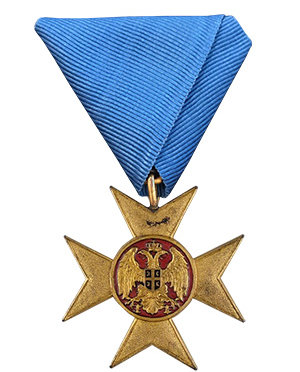
The Cross of Charity or Mercy is a decoration established in the Kingdom of Yugoslavia by King Peter I of Serbia on 7 (19) June 1913. Peter I was the king of Serbia during a period of great Serbian military success, he was remembered by the Serbian people as King Peter the Liberator, and also known as Old King.

The medal was to be awarded to men or women in or out of the military who aided victims of the 1912-13 First Balkan War (which lasted from October 8, 1912 to May 30, 1913), the sick and wounded. It could be awarded to Serbians and non-Serbians alike, to military and civilians, and to Red Cross volunteers. 

During the Balcan War, foreign awards could be granted for service in a red cross or medical capacity. Many women who served with the French or the Serbs were awarded decorations, although there is no gazette entry for them.

The Cross of Charity or Mercy Design

The Cross was manufactured by Arthus Bertrand of Paris and Huguenin Frères of Le Locle, Switzerland. It is made in bronze gilt maltese cross with a loop for ribbon suspension and red and black enamels and measures 39.7 mm.

The obverse bears a central circular red enamel medallion with the inscription in gilt letters ‘For Mercy‘ and circumscribed “For Tending the Wounded and the Sick 1912″.

The reverse shows the Serbian royal arms and the eagle with a fleur de lis beneath its claws.

Men and women versions of this medal are differentiated only by the suspension; a classical light-blue triangular one for men, and a ribbon in a bow shape of the same color for women (although this was not always the case).

The Order of Karađorđe’s Star

The Order of Karađorđe’s Star (or Orden Karađorđeve zvezde in Serbian) is Serbia’s highest civilian and military decoration and was instituted by the royal decree of King Peter I on 1 January 1904, commemorating his recent accession to the Serbian throne as well as the one-hundredth anniversary of the First Serbian Uprising.

The medal originated in the Kingdom of Serbia, and was initially awarded exclusively to Serbian citizens in return for services rendered to the Serbian monarchy, the Serb people and the Serbian state, though it is now bestowed upon Serbs and non-Serbs alike. During the Balkan Wars and World War I, the Order was mostly awarded for acts of bravery on the battlefield.

Following the breakup of Yugoslavia, Serbia ceased using many of the awards and decorations established during the communist period, though it was not until 2010 that the Serbian Government officially reinstated the Order of Karađorđe’s Star as Serbia’s highest decoration.  In February 2012, tennis player Novak Djokovic became the first person to receive the Order after it was reinstated.

The Order of Karađorđe’s Star Design

The Order comes in either gold or silver depending on class. The medals themselves were originally manufactured by foreign makers of decorations and medals, such as France’s Arthus-Bertrand and Switzerland’s Huguenin Fréres; during the interwar period (1919–39) they were produced domestically.

The obverse features a white enameled cross pattée with gilt rays protruding from each of the arms and intersected diagonally by a pair of sabers when the recipient is awarded an Order “with swords”. Orders from the royal period contain a blue medallion at the center depicting a Serbian cross with a fire-steel at each corner, with the words “For Faith and Freedom, 1804” etched into the small circle in the middle of the cross.

The reverse of the Order contains a red medallion depicting a white eagle, with the words “Peter I, 1904” written around it.

The bravery medals awarded from June 1915 forward are almost identical to the Orders awarded before that date, save for the crossed swords being present on all of them regardless of class. Such Orders also lacked the phrase etched into the obverse of the older ones and the date 1904 on the reverse, which marked the centenary of the First Serbian Uprising. Instead, they merely had King Peter’s name on the obverse beside the year when the Order was bestowed.

The Cross for the Defenders of Veracruz

The Cross for the Defenders of Veracruz is a medal issued 1910-1920 when control of Mexico’s government was attempted by several parties. 

The Cross for the Defenders of Veracruz is a medal issued during the early years of the twentieth century, between 1910 and 1920 when control of Mexico’s government was attempted by several parties.

The United States involvement in the Mexican Revolution was varied and seemingly contradictory, first supporting and then repudiating Mexican regimes during the period 1910-1920. For both economic and political reasons, the U.S. government generally supported those who occupied the seats of power, whether they held that power legitimately or not.

When Francisco I. Madero was elected president in October 1911, the U.S. president was a lame duck. The U.S. Ambassador to Mexico, Henry Lane Wilson was initially sympathetic to the new regime, but quickly came into conflict with it. Ambassador Wilson conspired with General Victoriano Huerta to oust Madero.

The United States government under newly inaugurated president Woodrow Wilson refused to recognize Huerta’s government and sent troops to occupy Veracruz. President Wilson’s government recognized the government of Venustiano Carranza in 1915.

The Cross for the Defenders of Veracruz Design

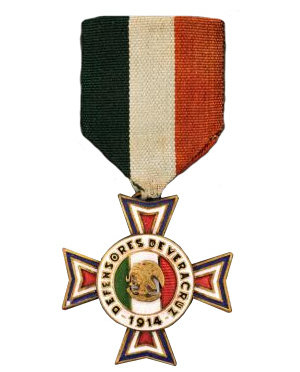
Like many Mexican military decorations, the Cross for the Defenders of Veracruz is typically designed in the shape of a cross. The cross shape is a common motif for such awards. At the center of the cross, there is usually a circular medallion. This medallion often features the image of a Mexican soldier or a patriotic symbol associated with the defense of Veracruz. The image may vary in detail but generally represents the valor and dedication of those who defended the city.

Around the outer edge of the central medallion, there may be an inscription. This inscription typically includes the words “Defensores de Veracruz” (Defenders of Veracruz) or similar phrases, highlighting the purpose and significance of the decoration. The cross often has arms that radiate outward from the central medallion, creating a cross-like shape. These arms are usually plain but may sometimes feature decorative elements or symbols.

The medal is typically suspended from a ribbon that allows it to be worn around the neck or pinned to a uniform. The ribbon’s color and design may vary but often incorporate patriotic colors, such as green, white, and red, which are the national colors of Mexico. At the top of the medal, there is a small ring or loop through which a ribbon or chain is threaded to allow for wearing or display.

The Cross for Revolutionary Merit 1913-14

The Cross of Revolutionary Merit is a medal issued during 1910 and 1920 when control of Mexico’s government was attempted by several parties. 

The Cross of Revolutionary Merit is a medal issued during the early years of the twentieth century, between 1910 and 1920 when control of Mexico’s government was attempted by several parties.

The United States involvement in the Mexican Revolution was varied and seemingly contradictory, first supporting and then repudiating Mexican regimes during the period 1910-1920. For both economic and political reasons, the U.S. government generally supported those who occupied the seats of power, whether they held that power legitimately or not.

When Francisco I. Madero was elected president in October 1911, the U.S. president was a lame duck. The U.S. Ambassador to Mexico, Henry Lane Wilson was initially sympathetic to the new regime, but quickly came into conflict with it. Ambassador Wilson conspired with General Victoriano Huerta to oust Madero.

The United States government under newly inaugurated president Woodrow Wilson refused to recognize Huerta’s government and sent troops to occupy Veracruz. President Wilson’s government recognized the government of Venustiano Carranza in 1915.

The Cross for Revolutionary Merit 1910-11

The Cross of Revolutionary Merit is a medal issued during 1910 and 1920 when control of Mexico’s government was attempted by several parties. 

The Cross of Revolutionary Merit is a medal issued during the early years of the twentieth century, between 1910 and 1920 when control of Mexico’s government was attempted by several parties.

The United States involvement in the Mexican Revolution was varied and seemingly contradictory, first supporting and then repudiating Mexican regimes during the period 1910-1920. For both economic and political reasons, the U.S. government generally supported those who occupied the seats of power, whether they held that power legitimately or not.

When Francisco I. Madero was elected president in October 1911, the U.S. president was a lame duck. The U.S. Ambassador to Mexico, Henry Lane Wilson was initially sympathetic to the new regime, but quickly came into conflict with it. Ambassador Wilson conspired with General Victoriano Huerta to oust Madero.

The United States government under newly inaugurated president Woodrow Wilson refused to recognize Huerta’s government and sent troops to occupy Veracruz. President Wilson’s government recognized the government of Venustiano Carranza in 1915.

The Cross for Military Loyalty (1841)

This set of medals were issued during the period 1835-1841 of armed conflict between settlers and the Mexican army that began in late 1835.

As the number of American settlers in the Mexican state of Texas kept growing, the Mexican government made the decision in 1830 to close the border to all immigration, imposing as well numerous restrictions like the abolition of slavery.

The Mexican government believed the United States had instigated the Texas insurrection (October 2, 1835 – April 21, 1836) with the goal of annexation. The Mexican Congress passed the Tornel Decree, declaring that any foreigners fighting against Mexican troops “will be deemed pirates and dealt with as such, being citizens of no nation presently at war with the Republic and fighting under no recognized flag.”

The revolution began in October 1835, after a decade of political and cultural clashes between the Mexican government and the increasingly large population of American settlers in Texas. Colonists and Tejanos disagreed on whether the ultimate goal was independence or a return to the Mexican Constitution of 1824. In March 1836, a second political convention declared independence and appointed leadership for the new Republic of Texas.

Determined to avenge Mexico’s honor, Santa Anna vowed to personally retake Texas. His Army of Operations entered Texas in mid-February 1836 and found the Texians completely unprepared. Mexican General José de Urrea led a contingent of troops on the Goliad Campaign up the Texas coast, defeating all Texian troops in his path and executing most of those who surrendered. Santa Anna led a larger force to San Antonio de Béxar (or Béxar), where his troops defeated the Texian garrison in the Battle of the Alamo, killing almost all of the defenders.

After the Texans’ defeat in April 1836 of General Santa Anna, Mexico made no further attempt to reconquer the territory, although it refused to recognize its independence. The annexation of Texas as the 28th state of the United States, in 1845, led directly to the Mexican–American War. By the terms of the Treaty of Guadalupe Hildago, signed in 1848, Mexico ceded almost half its national territory to the United States.

The Long Military Service Cross (Spain)

The Long Military Service Cross is a military decoration of the Spanish Armed Forces and Civil Guard for long service.

  • Time Period: Post-WW2
  • Institution: 26 December 1958
  • Country: Spain

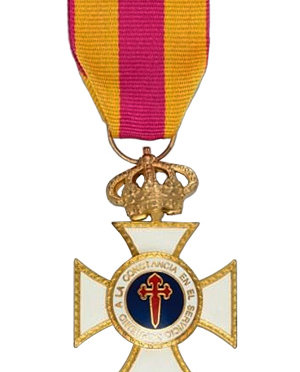
The Long Military Service Cross (or Cruz a la Constancia en el Servicio) is a military decoration of the Spanish Armed Forces and Civil Guard, designed to reward long and meritorious service below the level required for induction into the Royal and Military Order of Saint Hermenegild.

The medal was established by the Spanish government on December 26, 1958, and approved by Juan Carlos I in Royal Decree 682/2002. Regulations for the award were later modified in 2011, by Royal Decree 1385/2011.

The Long Military Service Cross may be awarded to all members of the Spanish Armed Forces, as well as to members of the Civil Guard at or below the rank of Corporal (OR-3). It can be presented in three grades, depending on time of service:

  • Gold for 30 years of meritorious service.
  • Silver for 25 years of meritorious service.
  • Bronze for 15 years of meritorious service.

The Long Military Service Cross Design

The ribbon of the medal is yellow, with a central stripe and thin border of magenta. The medal is a white cross pattée, bordered in either bronze, silver, or gold, and suspended from a crown.

At the center of the cross is a deep-blue enameled medallion, circumscribed by a white-enameled border which reads PREMIO A LA CONSTANCIA EN EL SERVICIO (Award for Constant Service). At the center of the medallion is a red Cross of Saint James, in the style of the Order of Santiago.

The Fidelity Cross (Spain)

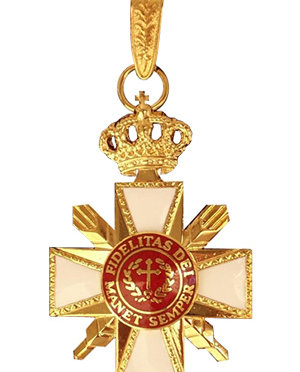
The Fidelity Cross (Cruz Fidélitas) is a medal of the Spanish Armed Forces, primarily awarded to military chaplains to reward service.

  • Time Period: Post-WW2
  • Institution: 25 July 2007
  • Country: Spain

The Fidelity Cross (or Cruz Fidélitas) is a medal of the Spanish Armed Forces, primarily awarded to military chaplains. It is awarded by the military archbishopric to reward faithful service by chaplains, as well as services to the archbishopric by deserving civilians, institutions and other military personnel.

The decree established the award as a decoration of the Archdiocese of Spain, rather than the military, and stipulated that only the current military archbishop had the authority to award grades of the Cruz Fidélitas. However, he may temporarily delegate the power to award any class of the award to any chaplain he sees fit, other than that of Grand Cross.

There are three classes of the Cruz Fidélitas that can be awarded to military chaplains:

  • Cruz de la Cruz Fidélitas (Cross of the Fidelity Cross), awarded for 15 years of service.
  • Encomienda de la Cruz Fidélitas (Commendation of the Fidelity Cross), awarded for 20 years of service.
  • Plata de la Cruz Fidélitas (Plate of the Fidelity Cross), awarded for 25 years of service.

The Fidelity Cross Design

The ribbon of the medal is purple, with two white stripes extending down each side. From the ribbon hands a white-enameled cross bordered in gold, with gold spikes extending between the arms.

In the center of the cross, in the obverse, is the emblem of the Military Archbishopric of Spain, enameled in red. The reverse of the medal features a capital letter “F” relieved in the center of the cross, and the year “2007” on the lower arm, also in relief. A gold crown is used to suspend the cross from the ribbon.

Aside from that of the Cross of Honor, the ribbon bars of each grade also bear a device, dependent on the grade received. The ribbon bars of the Plate, Commendation, and Cross of the Cruz Fidélitas bear a Latin cross fleury, in gold, silver or bronze, respectively. The ribbon bar of the Grand Cross features a Spanish Royal Crown.

The Order of the Cross of St. Raymond of Peñafort

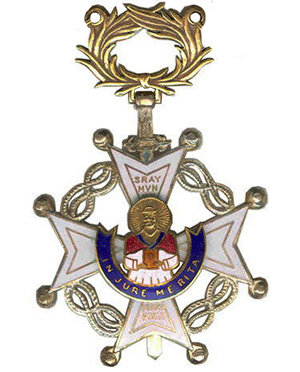
The Order of the Cross of St. Raymond of Peñafort (or Orden de la Cruz de San Raimundo de Peñafort) is a Spanish civil order of merit established 23 January 1944.

The five classes recognize service to and contributions toward the development and perfection of the law and jurisprudence. The three medals of the order recognize years of unblemished service within the legal and administrative professions under the jurisdiction of the Ministry of Justice. The order is named for St. Raymond of Peñafort, the patron saint of lawyers.

The five classes of crosses of the Order of St. Raymond of Peñafort are as follows:

  • Grand-Cross (Gran Cruz)
  • Cross of Honour (Cruz de Honor)
  • Distinguished Cross 1st Class (Cruz Distinguida de 1.ª Clase)
  • Distinguished Cross 2nd Class (Cruz Distinguida de 2.ª Clase)
  • Single Cross (Cruz Sencilla)

The Order of St. Raymond of Peñafort Design

The medals of the Order of St. Raymond of Peñafort are awarded to legal and administrative professionals working under the jurisdiction of the Ministry of Justice. The medals honor years of unblemished service.

The classes are as follows:

  • Gold Medal of Merit in Justice (Medalla de Oro del Mérito a la Justicia)
  • Silver Medal of Merit in Justice (Medalla de Plata del Mérito a la Justicia)
  • Bronze Medal of Merit in Justice (Medalla de Bronce del Mérito a la Justicia)