The Civil Order of Alfonso X the Wise

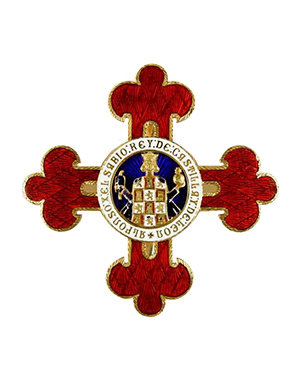
The Civil Order of Alfonso X the Wise (Orden Civil de Alfonso X) is a Spanish civil order from 1939 recognizing education, science, etc.

The Civil Order of Alfonso X the Wise (or Orden Civil de Alfonso X el Sabio) is a Spanish civil order established in 1939 to recognize activities in the fields of education, science, culture, higher education and research.

The order was created on 23 May 1902 by Royal decree as the Order of Alfonso XII. In 1988 the order was reformed and given its current name. The Grand Chancellor is the Minister of Education, Culture and Sport of Spain.

The 1988 reform’s main innovation was to discontinue the previous award’s practice of distinguishing male and female achievements, thereby eliminating explicit sexual discrimination.

It’s awarded in the following grades:

  • Collar
  • Grand-Cross
  • Commander with Plaque
  • Commander
  • Cross
  • Medal

The Crosses of Aeronautical Merit

Crosses of Aeronautical Merit (or Cruces del Mérito Aeronáutico) are Spain’s military award for gallantry or merit in the air. The award can be made in war or at times of peace.

Established on 30 November 1945 by chief of state Francisco Franco as the Order of Aeronautical Merit (Orden del Mérito Aeronáutico) and amended in 1976, 1995, 2003 and 2007. Awarded originally in three classes and a cross in silver for non-commissioned ranks, in 1995 it lost the rank of an order of merit and reduced to two and the number of categories extended to four.

According to the current regulations the decoration is conferred in the following classes:

  • Grand Cross – to generals, admirals or civilian personnel of equivalent rank;
  • Cross – to other officers, non-commissioned ranks or equivalent civilian personnel.

The categories are as follows:

  • with Red Decoration (con distintivo rojo) – for courage, actions, deeds or service during an armed conflict or military operations that involve or may involve the use of armed force and may require significant military or command skills; since 2007 it can be awarded to for acts of gallantry while on an overseas mission and to soldiers fallen during such a mission;
  • with Blue Decoration (con distintivo azul) – for actions, events or extraordinary services including operations resulting from a mandate of the United Nations or of other international organizations;
  • with Yellow Decoration (con distintivo amarillo) – for actions, deeds or service that involve high personal risk and in cases of serious injury or death resulting from such actions or service;
  • with White Decoration (con distintivo blanco) – for actions, deeds or distinguished service during missions of ordinary or extraordinary service in the armed forces or in connection with defense of the country.

Multiple awards of each class and each category to the same individual are possible. The medal is awarded to members of the Spanish Armed Forces, Guardia Civil or civilians.

The Crosses of Aeronautical Merit Design

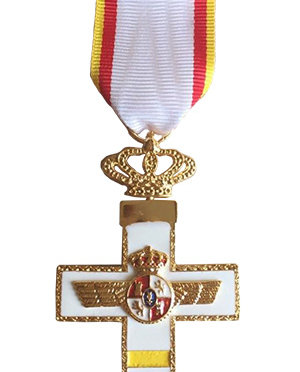
The decoration has the form of a Greek cross with the arms enameled red in the Red Decoration category and white in the remaining categories. The Blue Decoration and Yellow Decoration badges have an additional narrow bar in blue or yellow across the lower arm. The upper arm is surmounted by a Spanish royal crown and has a tablet to engrave the date of bestowal.

The round central shield of the obverse bears the coat of arms of Castile, León, Aragon, Navarre and Granada (until 2003 only alternate coats of arms of Castile and León); in the middle there is a blue oval shield of the House of Bourbon-Anjou. The central shield has gold wings extended to the lateral arms of the cross and is surmounted by a royal crown.

On the reverse there are letters “MA” (Mérito Aeronáutico) on red background. The cross is worn on a ribbon on the left side of chest. Each subsequent award is denoted by a bar with the date of bestowal on the ribbon.

The Grand Cross has the same form as the cross described above but is worn on a sash over the right shoulder. The star added to the class of Grand Cross is gilt, eight-pointed, with the cross superimposed on it; currently between the arms of the cross there are alternate towers (Castile) and lions (León).

The Royal Order of Noble Ladies of Queen Maria Luisa

The Royal Order of Noble Ladies of Queen Maria Luisa is an Order created by King Charles IV of Spain by royal decree in April 21, 1792, at the request of his wife, Queen Maria Luisa, to reward noble women who distinguished themselves for their services and talents.

The Order was defined as a strictly female reward system, ruled by the Queen and composed of thirty bands reserved for the Spanish high nobility. In 1796 the King raised the Order to a nobiliary dignity, granting their holders and their spouses the protocolar treatment of excellence.

A decree was signed on September 18, 1809, dissolving all military orders, including the female one of Maria Luisa, excepting only the order of the Golden Fleece, but this measure was reversed after Bonaparte’s expulsion from Spain and the Bourbon restoration. In a Royal Decree of October 28, 1851, a payment of 3,000 reais was required of members of the Order, to be paid within three months; non-payers would cease to be members.

A Republican decree of July 24, 1931, without expressly referring to this Order, abolished in fact as an official institution. But both King Alfonso XIII, until January 1941, and his son Juan de Borbón, Count of Barcelona, gave some bands of this Order to some princesses of his family; the latest to his daughters, Infantas Infanta Pilar, Duchess of Badajoz and Infanta Margarita, Duchess of Soria, to commemorate their eighteenth birthday.

Currently, and according to the statutes, there is a single category of Noble Lady, limited to 30 members except on the express will of the monarch.

The Royal Order of Noble Ladies of Queen Maria Luisa  Design

Women rewarded by this distinction normally receive it in a formal investiture ceremony described in the statute, in the private rooms of the Queen at the Royal Palace, except in cases of serious illness or disability.

Many women from many countries have received this distinction, one of the major honors that the Spanish monarchy can award to women in recognition of their “services, actions and qualities.”

The Royal Order of Isabella the Catholic

The Royal Order of Isabella the Catholic (Real Orden de Isabel la Católica) is a Spanish civil order granted in recognition of services.

The Royal Order of Isabella the Catholic (or Real Orden de Isabel la Católica) is a Spanish civil order in which membership is granted in recognition of services that benefit the country. The Order is not open to Spaniards exclusively, and it has been used to award many foreigners.

The Order was created on 14 March 1815 by King Ferdinand VII in honor of Queen Isabella I with the intent of “rewarding the firm allegiance to Spain and the merits of Spanish citizens and foreigners in good standing with the Nation and especially in those exceptional services provided in pursuit of territories in America and overseas.”

The Order was reorganized by royal decree on 26 July 1847, as the modern “Royal Order of Isabella the Catholic” with a broader focus than the Americas. In 1938, General Franco, by decree of 15 June, restored the Order in its traditional meaning: to reward meritorious services rendered to the country by nationals and foreigners.

Order Criteria and Organization

The King of Spain is Grand Master of the Order. The Grand Chancellor of the Order is the Minister of Foreign Affairs. Members of the order at the knight and above enjoy personal nobility and have the privilege of adding a golden heraldic mantle to their coat of arms.

Knights at the rank of Grand Cross and Knight of the Collar receive the official style of “His or Her most Excellent Lord”. Knights at the rank of commander and commander by number receive the style of “His or Her Most Illustrious Lord”. Beneath these two officials of the Order, there are currently several grades.

The Classes

The original statutes of the Order, dated 24 March 1815, initially established the order with three classes. Since then, the structure of the order has undergone several changes. Today, the classes are:

First Class

    •  Knight of the Collar (CoYC) (Caballeros del Collar)
    •  Knight Grand Cross (GYC) (Caballeros Gran Cruz)

Second Class

    •  Commander by Number (CnYC) (Encomienda de Número)
    •  Commander (CYC) (Encomienda)

Third Class

    •  Officer’s Cross (OYC) (Cruz de Oficial)

Fourth Class

    •  Knight’s Cross (+YC) (Cruz de Caballero)

Fifth Class

    •  Silver Cross (Cruz de Plata)

Sixth Class

    •  Silver Medal (Medalla de Plata)
    •  Bronze Medal (Medalla de Bronce)

For more detailed information, you can visit the Wikipedia page on the Order of Isabella the Catholic.

The Royal Order of Isabella the Catholic Design

The decoration is a red-enameled cross, with a golden frame. The outer peaks are fitted with small gold balls.

The center of the medallion contains the inscription “A La Lealtad Acrisolada” (To Proven Loyalty) and “Por Isabel la Católica” (For Isabella the Catholic) on white enamel. Above the cross is a green enameled laurel wreath with the band ring.

The ribbon is yellow with a white central stripe, except the “Collar”, the wearing of which can be replaced by a gold-yellow sash with white stripes on the edges.

The Royal and Distinguished Spanish Order of Charles III

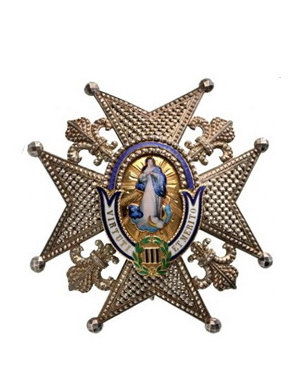
The Royal and Distinguished Spanish Order of Charles III (or Real y Distinguida Orden Española de Carlos III) was established by the King of Spain Carlos III by means of the Royal Decree of 19 September 1771, with the motto Virtuti et mérito.

Its objective is to reward people for their actions in benefit to Spain and the Crown. Since its creation, it has been the most distinguished civil award that can be granted in Spain, despite its categorization as a military order.

The orders of creation demanded two requirements: to be “worthy and affectionate of His Highness“. Two classes were created: the “Great Crosses” and the “Pensioners”, the monarch being discretionary with his authorization. In 1783 the classes were expanded to three with that of “Supernumerary Knights”, whose level of importance was between the previous two.

Those received by the Order took an oath for loyalty towards the king, his family, and the protection of the goods of the Royal House, recognizing him as Great Master, live and die in faith catholic, accepting as indisputable the Mystery of the Immaculate Conception, and attending and receiving communion at mass at least once a year.

The Grand Cross of the Order of Charles III is reserved for those who, having completed relevant service to Spain, having been Presidents of the Congress of Deputies, the Senate, the Constitutional Court of the Supreme Judicial Council, the Supreme Court, Ministers or other senior officials of the state. The maximum number of Grand Crosses are limited to one hundred, not counting those accorded to Ministers.

Knights Collar and Knights Grand Cross of the Order are entitled to be addressed with the style The Most Excellent in front of their name. Other members are entitled to the style of The Most Illustrious.

The Royal and Distinguished Order of Charles III Design

The orders are currently conferred in the following grades:

  • Collar (Collar) – restricted to 25 Spanish citizens (not including members of Spain’s royal family).
  • Grand Cross (Gran Cruz) – restricted to 100 Spanish citizens (limit excludes government ministers).
  • Commander by Number (Encomienda de Número) – restricted to 200 Spanish citizens (limit excludes government ministers).
  • Commander, optional Dame’s Bow (EncomiendaLazo de Dama opcional).
  • Cross (Cruz).

There are no restrictions on the number of foreigners that may be appointed to any of the grades.

The Royal and Military Order of Saint Hermenegild

The Royal and Military Order of Saint Hermenegild (or Real y Militar Orden de San Hermenegildo) is both a general military honor and a legion created by Ferdinand VII of Spain on 28 November, 1814 as a military distinction of the Spanish Cavalry at the conclusion of the Spanish War of Independence in 1814.

The purpose of the Order was to serve as a maximum means of reward for those soldiers who exceeded their military obligations and fought on, surpassing their suffering in battle, and who thus would serve as examples of bravery to His Spanish Majesty’s armies.

Given the desire of the King to create a distinction of extraordinary rank, comparable to others traditional honors, it was decided to put the Order under the Patronage of Saint Hermenegild, the Visigoth King of Seville who was martyred in defense of the Christian faith in the sixth century and who is the patron saint of the Spanish Armed Forces.

According to its first promulgation the Order intends “to compensate and to distinguish to the general officers, commissioned officers and non-commissioned officers of the Spanish Army, Spanish Navy, Spanish Air Force, Common Corps and the Spanish Civil Guard, by their faultless and exemplary conduct in the service of The Crown.”

The monarch of Spain is the Sovereign of the order. The Order is governed by three governing bodies: the Chapter, the Permanent Assembly and the Chancellery.

The Royal and Military Order of Saint Hermenegild Design

The badge of the order is a gold, white enameled cross pattée, surmounted by a royal crown.

The central medallion bears, on the obverse, an effigy of St. Hermenegild on a horseback, surrounded by a blue ring inscribed “PREMIO A LA CONSTANCIA MILITAR” (reward for long military service). On the reverse there is the royal cypher of Fernando VII.

The star has the form of a gold Maltese cross with ball finials and silver rays between the arms and the effigy of St. Hermenegild in the central medallion, surrounded by a white ring with the order’s motto and a green laurel wreath. The medallion of the Grand Cross star is surmounted by a royal crown.

The Crosses of Naval Merit (Spain)

Crosses of Naval Merit (or Cruces del Mérito Naval) are a Spanish military award for gallantry or merit in war or peace. Awarded to members of the Spanish Naval Forces, Guardia Civil or civilians.

Established on 3 August 1866 by Queen Isabella II as the Order of Naval Merit (or Orden del Mérito Naval) and amended many times (in 1918, 1926, 1931, 1938, 1942, 1976, 1995, 2003 and 2007). During the Spanish Civil War it was recognized by both sides of the conflict. Awarded originally in four classes, nowadays it lost the rank of an order of merit and the classes were reduced to two and the number of categories extended to four.

According to the current regulations the decoration is conferred in the following classes:

  • Grand Cross – to generals, admirals or civilian personnel of equivalent rank;
  • Cross – to other officers, non-commissioned ranks or equivalent civilian personnel.

The categories are as follows:

  • with Red Decoration (con distintivo rojo) – for courage, actions, deeds or service during an armed conflict or military operations that involve or may involve the use of armed force and may require significant military or command skills; since 2007 it can be awarded to for acts of gallantry while on an overseas mission and to soldiers fallen during such a mission;
  • with Blue Decoration (con distintivo azul) – for actions, events or extraordinary services including operations resulting from a mandate of the United Nations or of other international organizations;
  • with Yellow Decoration (con distintivo amarillo) – for actions, deeds or service that involve high personal risk and in cases of serious injury or death resulting from such actions or service;
  • with White Decoration (con distintivo blanco) – for actions, deeds or distinguished service during missions or ordinary or extraordinary service in the armed forces or in connection with defense of the country.

Multiple awards of each class and each category to the same individual are possible.

The Crosses of Naval Merit Design

The decoration has the form of a Greek cross with the arms enameled red in the Red Decoration category and white in the remaining categories. The Blue Decoration and Yellow Decoration badges have additional narrow bars in blue or yellow across the lower and lateral arms. The upper arm is surmounted by a Spanish royal crown and has a tablet to engrave the date of bestowal.

The round central shield of the obverse bears the coat of arms of Castile, León, Aragon, Navarre and Granada (until 2003 only alternate coats of arms of Castile and León); in the middle there is a blue oval shield of the House of Bourbon-Anjou. On the reverse there are letters “MM” (Mérito Militar) on red background. The cross is worn on a ribbon on the left side of chest. Each subsequent award is denoted by a bar with the date of bestowal on the ribbon.

The Grand Cross has the same form as the cross described above but is worn on a sash over the right shoulder.

The star added to the class of Grand Cross is gilt, eight-pointed, with the cross superimposed on it; currently between the arms of the cross there are alternate towers (Castile) and lions (León).

The Crosses of Military Merit (Spain)

The Crosses of Military Merit (or Cruces del Mérito Militar) are Spain’s military awards for gallantry or merit in war or peace, awarded to members of the Spanish Armed Forces, Guardia Civil or civilians.

Established on 3 August 1864 by Queen Isabella II as the Order of Military Merit (Orden del Mérito Militar), it has been amended many times (in 1918, 1926, 1931, 1938, 1942, 1976, 1995, 2003 and 2007). During the Spanish Civil War it was recognized by both sides of the conflict.

According to the current regulations the decoration is conferred in the following classes:

  • Grand Cross – to generals, admirals or civilian personnel of equivalent rank;
  • Cross – to other officers, non-commissioned ranks or equivalent civilian personnel.

The categories are as follows:

  • with Red Decoration (con distintivo rojo) – for courage, actions, deeds or service during an armed conflict or military operations that involve or may involve the use of armed force and may require significant military or command skills; since 2007 it can be awarded to for acts of gallantry while on an overseas mission and to soldiers fallen during such a mission;
  • with Blue Decoration (con distintivo azul) – for actions, events or extraordinary services including operations resulting from a mandate of the United Nations or of other international organizations;
  • with Yellow Decoration (con distintivo amarillo) – for actions, deeds or service that involve high personal risk and in cases of serious injury or death resulting from such actions or service;
  • with White Decoration (con distintivo blanco) – for actions, deeds or distinguished service during missions or ordinary or extraordinary service in the armed forces or in connection with defense of the country.

Multiple awards of each class and each category to the same individual are possible.

The Crosses of Military Merit Design

The decoration has the form of a Greek cross with the arms enameled red in the Red Decoration category and white in the remaining categories. The Blue Decoration and Yellow Decoration badges have additional narrow bars in blue or yellow across the lower and lateral arms.

The upper arm is surmounted by a Spanish royal crown and has a tablet to engrave the date of bestowal. The round central shield of the obverse bears the coat of arms of Castile, León, Aragon, Navarre and Granada; in the middle there is a blue oval shield of the House of Bourbon-Anjou. On the reverse there are letters “MM” (Mérito Militar) on red background. The cross is worn on a ribbon on the left side of chest. Each subsequent award is denoted by a bar with the date of bestowal on the ribbon.

The star added to the class of Grand Cross is gilt, eight-pointed, with the cross superimposed on it; currently between the arms of the cross there are alternate towers (Castile) and lions (León).

The Royal and Military Order of Saint Ferdinand

The Royal and Military Order of Saint Ferdinand (or Real y Militar Orden de San Fernando), is a Spanish military order whose decoration, the Laureate Cross of Saint Ferdinand (or Cruz Laureada de San Fernando), is Spain’s highest military decoration for gallantry.

The order is awarded in recognition of action, either individual or collective, to protect the nation, its citizens, or the peace and security of the international community in the face of immediate risk to the bearer. Those eligible are current and former members of the Spanish Armed Forces.

The Sovereign of the Order of San Fernando is the monarch of Spain, who presides over the biennial chapter held in the Royal Monastery of El Escorial. The sovereign’s representative in the Order is the Grand Master, who governs it and is aided by the Maestranza.

Among the conditions laid out by the Royal Military Order of Saint Ferdinand for the granting of the award are:

  • that the sole purpose of the action taken wasn’t the saving of one’s life;
  • that the action was not motivated by improper ambition to honours unnecessarily disregarding one’s (or that of one’s subordinates) life;
  • that, as far as possible, the damage and number of own casualties caused by the action was minimized;
  • that the action was taken in the face of significantly adverse odds or other detrimental factors;
  • that the action taken made a crucial difference to the situation in which it occurred.

The Order of Saint Ferdinand Design

The badge of the Orderis a bronze gilt with red and green. It measures approximately 41.3 mm x 41.5 mm and is usually mounted to a bar with a swing locking clasp.

In the cross, the order is decorated with red enamel on the crossguards on the swords.

The Civil Order of Savoy

The Civil Order of Savoy was founded as an order of knighthood in 1831 by the King of Sardinia, Charles Albert, Duke of Savoy. 

The Civil Order of Savoy was founded as an order of knighthood in 1831 by the King of Sardinia, Charles Albert, Duke of Savoy.

The intention was to reward those virtues not belonging to the existing Military Order of Savoy, founded by Vittorio Emanuele I in 1815. The order has one degree, that of Knight (Cavalieri dell’Ordine civile di Savoia), and is limited to 70 members. Admission is in the personal gift of the head of the House of Savoy.

The civil order was continued on the unification of Italy in 1861, but has been suppressed by law since the foundation of the Republic in 1946. Umberto II did not abdicate his position as fons honorum however, and the now dynastic order remains under the Grand Mastership of the head of the former Royal house. While the continued use of those decorations awarded prior to 1951 is permitted in Italy, they no longer confer any right of precedence in official ceremonies. The military order on the other hand, was revived as the Military Order of Italy and remains a national order today

The Civil Order of Savoy Design

The insignia bears the inscription Al Merito Civile—1831; the letters C.A. on the reverse substituted for V.E. after the death of Charles Albert in 1849.