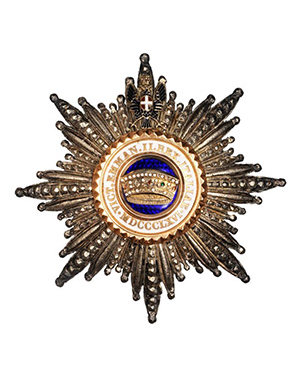
The Order of the Crown of Italy

The Order of the Crown of Italy was a national order founded in 1868 to commemorate the unification of Italy in 1861.

The Order of the Crown of Italy (or Ordine della Corona d’Italia) was founded as a national order in 1868 by King Vittorio Emanuele II, to commemorate the unification of Italy in 1861. It was awarded in five degrees for civilian and military merit.

Compared with the older Order of Saints Maurice and Lazarus (1572), the Order of the Crown of Italy was awarded more liberally and could be conferred on non-Catholics as well; eventually, it became a requirement for a person to have already received the Order of the Crown of Italy in at least the same degree before receiving the Order of Saints Maurice and Lazarus.

The order has been suppressed by law since the foundation of the Republic in 1946. However, Umberto II did not abdicate his position as fons honorum and it remained under his Grand Mastership as a dynastic order. While the continued use of those decorations conferred prior to 1951 is permitted in Italy, the crowns on the ribbons issued before 1946 must be substituted for as many five pointed stars on military uniforms.

The following grades exist:

  • Cavaliere di Gran Croce OCI Kingdom BAR.svg   Knight Grand Cross (Cavaliere di Gran Croce decorati del Grande Cordone)
  • Grande ufficiale OCI Kingdom BAR.svg   Grand Officer (Grande Ufficiale dell’Ordine della Corona d’Italia)
  • Commendatore OCI Kingdom BAR.svg   Commander (Commendatore dell’Ordine della Corona d’Italia)
  • Ufficiale OCI Kingdom BAR.svg   Officer (Ufficiale dell’Ordine della Corona d’Italia)
  • Cavaliere OCI BAR.svg   Knight (Cavaliere dell’Ordine della Corona d’Italia)

The Order of the Crown of Italy Design

The badge of the order was a gilt cross with curved edges, enameled in white, with the so-called Savoy knots between the arms of the cross.

The obverse central disc featured the Iron Crown of Lombardy (as appeared on the Austrian Order of the Iron Crown) on a blue enamel background. The reverse central disc had a black-enameled eagle bearing the Savoy cross on a golden background.

The star of the Grand Cross was an eight-pointed faceted silver star; the central disc featured the Iron Crown on a blue enameled background, surrounded by a white enamel ring bearing the inscription VICT. EMMAN. II REX ITALIAE MDCCCLXVI (Victor Emmanuel II, King of Italy, 1866). There was a black-enameled eagle bearing the Savoy cross above the star.

The star of the Grand Officer was an eight-pointed faceted silver star with ball tips at each point and with the obverse of the badge superimposed upon it.

The ribbon of the order was red-white-red.
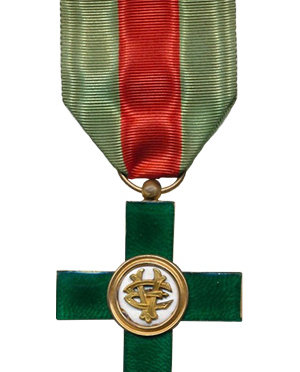
The Order of Merit for Labor

The Order of Merit for Labor is a national order of chivalry for meritorious agriculture, industry and commerce acts.

The Order of Merit for Labour (or Ordine al Merito del Lavoro) was founded as a national order of chivalry in 1923 by King Vittorio Emanuele III of Italy and is awarded to those “who have been singularly meritorious” in agriculture, industry and commerce, crafts, lending and insurance.

It is a continuation of the earlier Ordine al Merito Agrario, Industriale e Commerciale founded in 1901. Members of the order may use the title Cavaliere del lavoro.

The origins of the order lie with King Umberto I who, in 1898, instituted “a decoration for agricultural and industrial merit and a medal of honour.” The first was the exclusive prerogative of large landowners and industrialists, the latter for their employees. This was replaced by the Chivalrous or Knightly Order of Agricultural, Industrial and Commercial Merit in 1901, which was intended by Vittorio Emanuele III to give greater dignity to the earlier award.

Awarded in the single degree of Knight, the order is open to all Italians, living at home and overseas. Every year, on 1 June, 25 new Knights of Labour are invested from a shortlist of 40 candidates. The related Star of Merit for Labour, established in 1923, confers the title of Maestro del Lavoro.

The order is bestowed by decree of the President of the Italian Republic, its head since 1952, on the recommendation of the Minister of Economic Development (successor to the Minister of Industry, Commerce and Craftsmanship). The badge bears the inscription Al merito del lavoro—1901; the V.E. monogram formerly at the centre of the Greek cross, now substituted for the national coat of arms.

The Order of Merit of the Italian Republic

The Order of Merit of the Italian Republic (Ordine al merito della Repubblica Italiana) was founded by the second President in 1951.

The Order of Merit of the Italian Republic (or Ordine al merito della Repubblica Italiana) was founded as the senior order of knighthood by the second President of the Italian Republic, Luigi Einaudi in 1951.

The highest ranking honor of the Republic, it is awarded for “merit acquired by the nation” in the fields of literature, the arts, economy, public service, and social, philanthropic and humanitarian activities and for long and conspicuous service in civilian and military careers. The post-nominal letters for the order are OMRI.

Investiture takes place biannually on 2 June, the anniversary of the foundation of the Republic and on 27 December, the anniversary of the promulgation of the Italian Constitution. However, those awards on Presidential motu proprio, related to termination of service or granted to foreigners may be made at any time.

The order is bestowed by decree of the President of the Italian Republic, as head of the orders of knighthood, on the recommendation of the President of the Council of Ministers. Except in exceptional circumstances, no one can be awarded for the first time a rank higher than Knight. The minimum age requirement is normally 35.

The Order of Merit o the Italian Republic Design

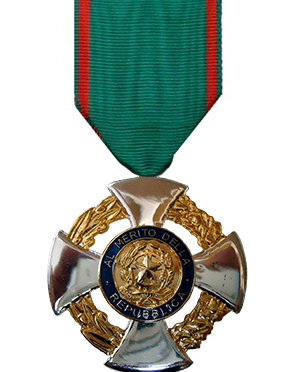
The badge, modified in 2001, bears the inscription Al Merito della Repubblica encircling the national coat of arms on the obverse and the Latin Patriæ Unitati (the union of the country) and Civium Libertati (the liberty of the people) encircling the head of Italia Turrita on the reverse.

The five degrees with corresponding ribbons are as follows (with numbers to June 2013):

  • Knight Grand Cross with Colla
  • 1st Class / Knight Grand Cross
  • 2nd Class / Grand Officer
  • 3rd Class / Commander
  • 4th Class / Officer
  • 5th Class / Knight

The Order of Tahiti Nui

The Order of Saharan Merit (or Ordre du Mérite Saharien) was established in 1958 and rewards services for the development of Saharan regions.

The Order of Saharan Merit (or Ordre du Mérite Saharien) was established in 1958 as a reward for social, scientific, economic or administrative services rendered by French or foreign persons who participated in the development of Saharan regions.

The medal is fashioned in the form of the Agadez cross, a traditional emblem of the Tuareg clans inhabiting the area of the former Sultanate of Agadez in Agadez, Niger.

The order was deprecated by decree on 3 December 1963, and superseded by the Ordre National du Mérite. Extant members of the order are permitted to wear their original decorations.

The Order has three classes:

  • Commandeur (Commander)
  • Officier (Officer)
  • Chevalier (Knight)

The Cross of the Resistance Volunteer Combatant

The Cross of the Resistance Volunteer Combatant (“Croix du combattant volontaire de la Résistance”) is a decoration for the French resistance.

The Cross of the resistance volunteer combatant (or “Croix du combattant volontaire de la Résistance”) is a French decoration that recognizes, as its name implies, those who fought in one of the resistance groups, or who were deported or interned for acts of resistance, or who were killed or injured while taking parts in acts of resistance against the German occupation forces during World War II.

This award was created by a special law in 1954 and awarded to those who had been designated and issued cards certifying them as voluntary resistance fighters. It was issued to all cardholders of voluntary resistance fighter created in 1949, which itself is obtained using the following criteria:

  • Holders of the a card Resistant-Deported or Interned-Resistant.
  • Those executed, killed or injured in an act of resistance.
  • Those who were members of a resistance group, recognized as a fighting unit and who actually fought at least 90 days in the French Forces Combattantes (FFC) or French Forces of the Interior ( FFI) or the French Resistance Interior (RFI).
  • The people who have belonged for 90 days before June 6, 1944, the FFC, FFI, or RFI in an area occupied by the enemy, and have affidavits from two persons well known for their activity in the French Resistance.

The Cross of the Resistance Volunteer Combatant Design

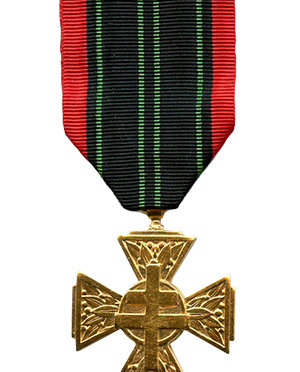
The Cross of the resistance volunteer combatant, a design of engraver Frédéric de Vernon, is a 36 mm wide cross pattée made of gilt bronze.

On the obverse, over the central medallion of the cross, a relief Cross of Lorraine overflowing onto the four cross arms which are covered in laurel leaves. On the reverse, the relief inscription on three lines on the central medallion COMBATTANT VOLONTAIRE RÉSISTANCE.

The cross is suspended by a ring through a suspension loop which is an integral part of the top of the upper cross arm. It hangs from a 36 mm wide black silk moiré ribbon with 5 mm wide red vertical edge stripes, it is further divided by four vertical 1 mm wide green stripes, two at center spaced 2 mm apart and one on each side 2 mm from the red edge stripes.

The Volunteer Combatant’s Cross

The Volunteer combatant’s cross (Croix du combattant volontaire) was a French decoration for volunteers that served during World War II.

The Volunteer combatant’s cross (or “Croix du combattant volontaire”) was a French decoration that originally recognized those who volunteered to serve in a combat unit during World War II. It is the equivalent of the “1914–1918 Volunteer combatant’s cross“.

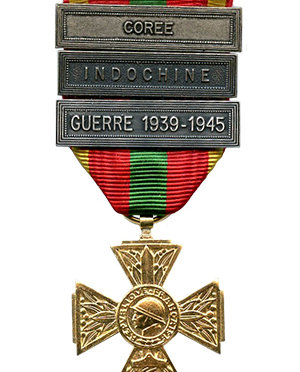
This decoration is equivalent to that awarded to the soldiers of the First World War. At the request of the associations of veterans the state fixed by Act of 4 February 1953, accompanied by a decree of 19 November 1955, the award Croix du Combattant Volontaire 1939–1945, designated for those who volunteered to serve. Additional revisions of the act establishing this award in 1995 and 2007 have added a total of five clasps:

  • Guerre 1939–1945
  • Indochine
  • Corée
  • Afrique du Nord
  • Missions extérieures

The Volunteer combatant’s cross was created to honor those who voluntarily participated in an armed conflict, during which they put their lives at risk.

In this spirit, the candidate for this distinction must provide proof from what he has done is a voluntary act of serving in a combat unit, so that because of his age or his circumstances, he was compelled to any “service obligation” (read “no obligation such “). From what he has in fact been present in a unit recognized fighter, during a specified time.

The Volunteer Combatant's Cross Design

A cross with four arms in bronze, 36 mm wide. Engraved by Frédéric de Vernon.

On the obverse is a round central medallion with the legend surrounding REPUBLIQUE FRANCAISE. An effigy of a helmeted Poilu (World War I infantryman), on a sword drawn vertically on the arms of the cross which is covered with laurel leaves and oak leaves in relief.

On the reverse is, inside the central medallion, a branch of laurel is surrounded by the inscription: COMBATTANT VOLONTAIRE 1939–1945. The reverse of the 1983 version has no date. The cross arms are covered with leaves of laurel and oak forming relief.

Find This Medal

Right Now on eBay 
Clicking a link to eBay may result in a referral commission being paid if a purchase is made.
Loading...

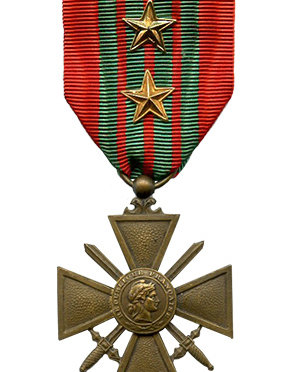
The War Cross 1939-1945

The War Cross 1939–1945 (Croix de guerre 1939–1945) is a French military decoration to honor those who fought with the Allies during WW2.

The War Cross 1939–1945 (or Croix de guerre 1939–1945) is a French military decoration, a version of the Croix de guerre created on September 26, 1939, to honor people who fought with the Allies against the Axis forces at any time during World War II.

Due to the large extent of the war zone, recipients included those who fought during, with, at, or in the following:

  • Battle of France
  • French Forces of the Interior
  • Free French Forces
  • Western Front
  • Middle East Theater
  • Mediterranean Theater
  • African campaigns

The War Cross 1939-1945 Design

The Croix de Guerre was designed by the sculptor Paul-Albert Bartholomé. The medal measures 37 mm in size and is made in the shape of a Maltese cross with two swords crisscrossed through the center.

In the center of the obverse is the profile of the French Republic crested by a Phrygian cap. Around this portrait are the words “République française” (“French Republic”). On the reverse of the medal are the dates of the conflict: 1939–1940, 1939–1945, or simply 1940.

The suspension and service ribbon of the medal has a red background crossed with four green lines in its center.

On every medal and ribbon, there is at least one ribbon device, either in the shape of a palm or of a star, and fashioned from either bronze, silver, or gilded silver (gold).

The French Croix represents a mention in dispatches awarded by a commanding officer. An individual could be awarded the decoration several times, for different actions, and from different sources. The devices are:

  • A bronze star for those who were mentioned at the regiment or brigade level.
  • A silver star, for those who were mentioned at the division level.
  • A silver-gilt (gold) star for those who were mentioned at the corps level.
  • A bronze palm for those who were mentioned at the army level.
  • A silver palm stands for five bronze ones.
  • A silver-gilt (gold) palm for those who were mentioned at the Free French Forces level (World War II only).

Find This Medal

Right Now on eBay 
Clicking a link to eBay may result in a referral commission being paid if a purchase is made.
Loading...

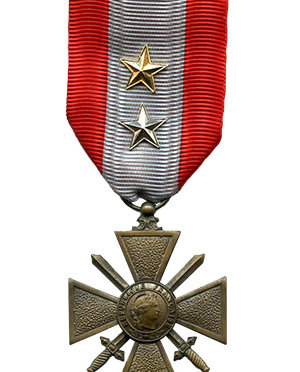
The War Cross for Foreign Operational Theaters

The War Cross for Foreign Operational Theaters or TOE is a French military award denoting citations earned in combat in foreign countries.

The War Cross for Foreign Operational Theaters (or Croix de guerre des théâtres d’opérations extérieurs), also called the Croix de Guerre TOE for short, is a French military award denoting citations earned in combat in foreign countries.

The Armistice of November 11, 1918 ended the war between France and Germany, but French soldiers continued fighting in theaters outside metropolitan France. Combat operations continued in Syria, Palestine, Constantinople, Morocco, French West Africa and French Equatorial Africa.

A law was passed on April 30, 1921 establishing the new Croix de guerre for “Théâtres d’opérations extérieurs” (TOE). It was intended to commemorate the individual citations awarded during operations carried out since November 11, 1918 or that would occur in the future, for war service directly related to an expeditionary force used outside of the borders of France.

The War Cross for Foreign Operational Theaters Design

The Croix de guerre des théâtres d’opérations extérieures is a bronze 37 mm wide cross pattée, between the arms, two crossed swords pointing upward.

It was designed by the sculptor Albert Bartholome. On the obverse in a circular medallion, the effigy of the Republic wearing a cap decorated with a laurel wreath, surrounded by a ring bearing the legend: “RÉPUBLIQUE FRANÇAISE”. On the reverse, in the circular medallion the inscription: “THÉÂTRES D’OPÉRATIONS EXTÉRIEURS”.

The cross is suspended by a ring through the suspension loop to a 38 mm wide grey silk moiré ribbon with 10 mm wide red edge stripes. The Croix de guerre TOE is worn on the left side of the chest and when in the presence of other medals of France, is located immediately after the Croix de guerre 1939 – 1945.

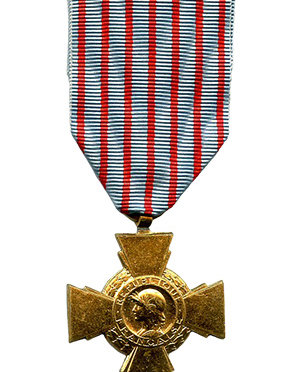
The Combatant’s Cross

The Combatant’s Cross (or “Croix du combattant”) is a French decoration that recognizes those who fought in combat for France.

The Combatant’s Cross (or “Croix du combattant”) is a French decoration that recognizes, as its name implies, those who fought in combat for France.

The Poilus (French combat soldiers) of World War I worked toward recognition by the government, of special status to those who had participated in the bitter fighting of 1914-1918 (as opposed to those who served behind the lines). The law of 19 December 1926 created la “carte du combatant”, or combatant’s card, for veterans of 1914-1918, as well as for the veterans of 1870-1871 and colonial wars before the First World War. The decoration was created only three years later by the law of 28 June 1930.

A decree of January 29, 1948 states that the provisions of the 1930 Act relating to the allocation of the combatant’s card and the Combatant’s Cross were applicable to participants of the 1939-1945 war. The law of 18 July 1952 extended the benefit of the award of the Croix du combattant for Indochina and Korea and the law of December 9, 1974 extended the award of the Combatant’s Cross to operations in North Africa between 1 January 1952 and July 2, 1962.

The Cross is awarded in different cases:

– for service with a unit asserted as combattant unit (front-line service) by the Ministry of Defense: ninety days of service or a wound or illness received or contracted during service, or ninety days of detention by the enemy.

– for service with any unit: mention in dispatches for valor, or direct participation in five fire engagements, or a wound in action, or detention by the enemy without application of the Geneva Convention.

The Combatant’s Cross Design

The medal is a 36 mm wide bronze cross pattée with a laurel wreath between the arms 36 mm across.

On the obverse at center, the effigy of the Republic wearing an Adrian’s helmet crowned with laurel leaves surrounded by the relief inscription REPUBLIQUE FRANCAISE (FRENCH REPUBLIC).

On the reverse the relief inscription CROIX DU COMBATTANT (COMBATTANT’S CROSS) along the lower circumference framing a vertical sword pointing down, rays protruding horizontally and up from the hilt in a 180° arc.

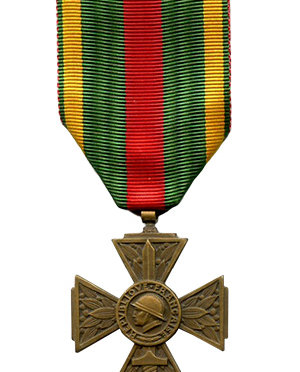
The Volunteer Combatant’s Cross 1914-1918

The Volunteer combatant’s cross 1914–1918 is a French decoration for those who have volunteered to serve in a unit during World War I.

The Volunteer combatant’s cross 1914–1918 (or “Croix du Combattant Volontaire 1914–1918”) is a French decoration that recognizes those who have volunteered to serve on the front in a combat unit during World War I.

When the 1914–1918 Commemorative war medal (France) was established, it was anticipated that a clasp bearing “ENGAGÉ VOLONTAIRE” (“VOLUNTEER ENLISTEE”) would be worn on its ribbon for those who had freely and voluntarily enlisted in the French Armed Forces for combat service. This clasp was produced, however it was short-lived due to parliament demanding the establishment of a special insignia to distinguish the special merit of the voluntary combatant.

The Act of 4 July 1935 created the Croix du Combattant Volontaire, designated for those who volunteered to serve on the front in a combat unit during the Great War.

The qualifications of the candidates have been reviewed by a panel from 1951, twelve members as follows:

  • Minister of National Defence: Chairman;
  • Secretary of State for War: two members;
  • Secretary of State for the Navy: two members;
  • Secretary of State for Air: two members;
  • Office national des mutilés et combattants: two members;
  • Association d’engagés et de combattants volontaires: three members.

The decree of 10 April 1936 extended the award to the few surviving volunteer firefighters from the War of 1870–1871.

The Volunteer Combatant’s Cross 1914-1918 Design

The cross has four arms in bronze and measures 36 mm wide. It is engraved by Frédéric de Vernon.

On the obverse is a round central medallion with the legend surrounding REPUBLIQUE FRANCAISE. Effigy of a helmeted Poilu (World War I infantryman), on a sword drawn vertically on the branches, or of the cross being charged with bay leaves and oak leaves in relief.

On the reverse, inside the central medallion, is a branch of laurel is surrounded by the inscription: COMBATTANT VOLONTAIRE 1914–1918. The cross arms are covered with leaves of laurel and oak forming relief.

A special version was made for the volunteer fighters from the war of 1870–1871 with the dates 1870–1871 on the back replacing those of 1914–1918.