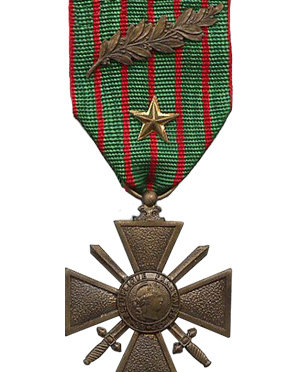
The War Cross 1914-1918

The War Cross 1914-1918 (Croix de guerre) is a French military decoration for French and allied soldiers for valorous service during WW1.

The War Cross 1914-1918 (or Croix de guerre 1914–1918) is a French military decoration created to recognize French and allied soldiers who were cited for valorous service during World War I, similar to the British mentioned in dispatches but with multiple degrees equivalent to other nations’ decorations for courage.

Soon after the outbreak of World War I, French military officials felt that a new military award had to be created. At that time, the Citation du jour (“Daily Citation”) already existed to acknowledge soldiers, but it was just a sheet of paper. At the end of 1914, General Boëlle, Commandant in Chief of the French 4th Army Corps, tried to convince the French administration to create a formal military award. Maurice Barrès, the noted writer and parliamentarian for Paris, gave Boëlle support in his efforts.

Every Croix de guerre awarded carries at least one citation for gallantry or courage to a member of any rank of the French military or of an allied army. Ribbon devices indicate the importance or degree of the soldier’s role during the action cited.

The Croix de guerre 1914-1918 was attributed to:

  • French and allied soldiers individually cited for a wartime act of gallantry;
  • Civilians and militarized personnel individually cited for a wartime act of gallantry;
  • Automatically to soldiers and civilians not specifically cited for a Croix de guerre but awarded the Légion d’honneur or Médaille militaire for the highest acts of wartime valour and gazetted in the Official Journal of the French Republic;
  • Collectively, to army units, ships or air squadrons;
  • To cities and villages, martyrs of war, destroyed, ravaged or bombed by the enemy (2952 towns received the Croix de guerre 1914-1918, in this case, always awarded with palm).

The War Cross 1914-1018 Design

The cross was designed by the sculptor Paul-Albert Bartholomé. It is 37 mm wide, Florentine bronze cross pattée, with two crossed swords pointing up between the arms.

The obverse center medallion bears the relief image of the French Republic in the form of the bust of a young woman wearing a Phrygian cap surrounded by the circular relief inscription RÉPUBLIQUE FRANCAISE (FRENCH REPUBLIC). Not knowing how long the war would last, the reverse centre medallion bears the dates 1914–1915, 1914–1916, 1914–1917 and finally 1914–1918.

The cross is suspended by a ring through a suspension loop cast atop the upper cross arm. It hangs from a 37 mm wide green silk moiré ribbon with seven narrow 1,5 mm wide vertical red stripes evenly spaced and two 1 mm red edge stripes.

Find this Medal Online

Right Now on eBay 
Clicking a link to eBay may result in a referral commission being paid if a purchase is made.
Loading...

The Order of Military Merit (France)

The Order of Military Merit, initially known as the Institution of Military Merit (or Institution du Mérite militaire) was an order of the French Ancien Régime created on 10 March 1759 by King Louis XV. It was created to reward the non-Catholic officers of the French Army.

By the 18th Century there were regiments of Swedish, German, and Swiss troops in service to France, the most famous being the Swiss Guards. Since many of these regiment’s officers were Protestant there lacked a suitable reward for distinguished service. The Order of Saint Louis was intended as a reward for exceptional military officers, but could only be awarded to those of the Roman Catholic faith. King Louis XV created the Institution du Mérite militaire to be an outward sign of distinction, but not an order since French orders were limited to Catholics.

In 1792, after the proclamation of the Republic the Décoration Militaire was abolished. King Louis XVIII continued to make awards of the order while in exile. On 28 November 1814, during the restoration Louis XVIII reaffirmed the Order of Military Merit, increasing the number of Grand Crosses to four and Grand Cordons to eight. The ribbon color was also changed to match that of the Order of St. Louis. The last appointment to the order was made in 1829.

The Order of Military Merit Design

Presented in three grades the names of which were formalized as Knight, Grand Cordon, and Grand Cross in 1785, mirroring those of the Order of St. Louis. King Louis was careful to promote the prestige of the award by appointing the most talented officers. The first Grand Crosses were presented to Swiss Field Marshal Count Waldner and German Lieutenant General Prince William of Nassau-Saarbrücken.

The Order of Saint Louis

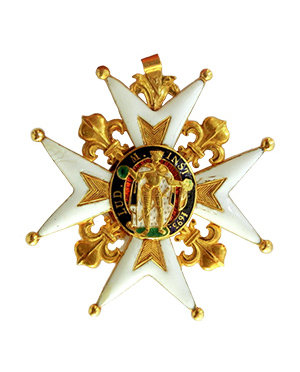
The Royal and Military Order of Saint Louis (or Ordre Royal et Militaire de Saint-Louis) is a dynastic order of chivalry founded 5 April 1693 by King Louis XIV, named after Saint Louis (King Louis IX of France).

It was intended as a reward for exceptional officers, notable as the first decoration that could be granted to non-nobles. By the authorities of the French Republic, it is considered a predecessor of the Legion of Honour, with which it shares the red ribbon (though the Legion of Honour is awarded to military personnel and civilians alike).

The King was the Grand Master of the order, and the Dauphin was automatically a member as well. The Order had three classes:

  • Grand-Croix (Grand Cross)
  • Commandeur (Commander)
  • Chevalier (Knight)

The entire order included 8 Grand Crosses, 28 Commanders and a variable number of Knights. Officers of the Order included, after the Grand Master, a Trésorier (Treasurer), a Greffier (Registrar) and a Huissier (Gentleman Usher).

Conditions for being inducted did not include nobility; however, Catholic faith was mandatory, as well as at least ten years’ service as a commissioned officer in the Army or the Navy. Members of the Order received a pension. Hereditary nobility was granted to a knight’s son and grandsons.

Although officially abolished by the government authorities of the July Revolution in 1830 following the French Revolution, its activities carried on as a dynastic order of the formerly sovereign royal family. As such, it is still recognised by the International Commission on Orders of Chivalry.

The Order of Saint Louis Design

The badge of the order consisted of a portrait of Saint Louis surrounded by the motto « LUD(OVICUS) M(AGNUS) IN(STITUIT) 1693 » (“Louis the Great instituted it in 1693“).

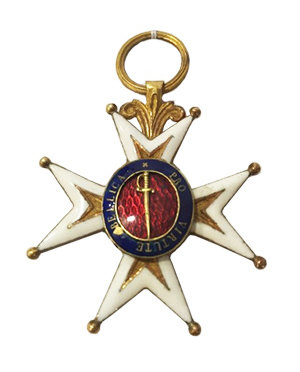
The reverse features a sword interlaced with a laurel crown and a white sash, with the inscription « BELL(ICAE) VIRTUTIS PRAEM(IUM) » (“reward of wartime valour”). Knights wore the badge suspended from a ribbon on the breast, Commanders wore a red ribband (sash) over the right shoulder, and recipients of the Grand Cross wore the ribband as well as a star on the left breast.

The general assembly of the Order was held annually on 25 August, the feast day of Saint Louis, in the residence of the King.

The Order of Saint Michael

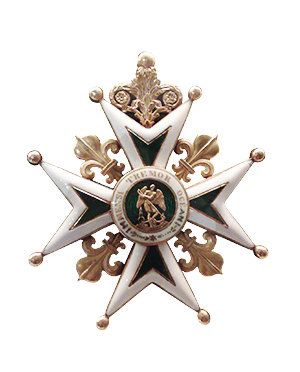
The Order of Saint Michael (or Ordre de Saint-Michel) is a French dynastic order of chivalry founded by Louis XI of France on 1 August 1469.

The Order of Saint Michael (or Ordre de Saint-Michel) is a French dynastic order of chivalry, founded by Louis XI of France on 1 August 1469, in competitive response to the Burgundian Order of the Golden Fleece founded by Philip the Good, duke of Burgundy and Louis’ chief competitor for the allegiance of the great houses of France.

As a chivalric order, its goal was to confirm the loyalty of its knights to the king. Originally, there were a limited number of knights, at first thirty-one, then increased to thirty-six including the king. An office of Provost was established in 1476. The Order of St Michael was the highest Order in France until it was superseded by the Order of the Holy Spirit.

Although officially abolished by the government authorities of the July Revolution in 1830 following the French Revolution, its activities carried on. It is still recognized by the International Commission on Orders of Chivalry.

The Order’s last member died in 1850. However, 10 nominations of knights were conferred in 1929, 1930, and in the 1970s and 1980s. As is mentioned by the French Government, it would be considered as the origin of the Ordre des Arts et des Lettres: “Saint-Michel Order (1460–1830) can be considered as the precursor of the Order of the Arts and Lettres. Originally destined to the aristocracy, from 17th to 18th Centuries it became an order of civil merit, which distinguished many artists, architects, collectors, and people of lettres…”

The motto of the order was “immensi tremor oceani” (meaning the tremor of the immense ocean) derived from the idea of Saint Michael looking out over the Atlantic from Mont Saint-Michel.

The Order of Saint Michael Design

The Order of St. Michael dedicated to the Archangel Michael conveyed to every member a gold badge of the image of the saint standing on a rock (Mont Saint-Michel) in combat with the serpent.

It was suspended from an elaborate gold collar made of scallop shells (the badge of pilgrims, especially those to Santiago de Compostela) linked with double knots. The statutes state that the badge could be hung on a simple chain, and later it was suspended from a black ribbon.

Find This Medal

Right Now on eBay 
Clicking a link to eBay may result in a referral commission being paid if a purchase is made.
Loading...

The Order of the Holy Spirit

  • Time Period: Pre-WW1
  • Institution: 31 December 1578
  • Country: France

The Order of the Holy Spirit (or Ordre du Saint-Esprit, sometimes translated into English as the Order of the Holy Ghost), is a French order of chivalry founded by Henry III of France in 1578. Today, it is a dynastic order under the House of France.

During the French Revolution, the Order of the Holy Spirit was officially abolished by the French government, along with all other chivalric orders of the Ancien Régime, although the exiled Louis XVIII continued to acknowledge it. Following the Bourbon Restoration, the order was officially revived, only to be abolished again by the Orleanist Louis-Philippe following the July Revolution in 1830. Despite the abolition of the order, both the Orléanist and Legitimist pretenders to the French throne have continued to nominate members of the order, long after the abolition of the French monarchy itself. The order is still recognised by the International Commission on Orders of Chivalry.

The King of France was the Sovereign and Grand Master (Souverain Grand Maître), and he made all appointments to the order. Members of the order can be split into three categories:

  • 8 Ecclesiastic members;
  • 4 Officers;
  • 100 Knights.

Initially, four of the ecclesiastic members had to be cardinals, whilst the other four had to be archbishops or prelates.

The Order of the Holy Spirit Design

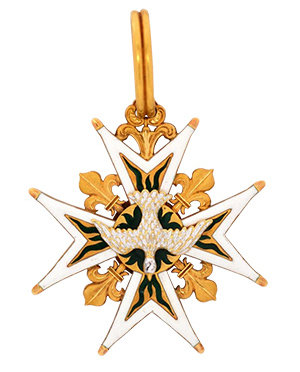
The symbol of the order is known as the Cross of the Holy Spirit (a Maltese Cross). At the periphery, the eight points of the cross are rounded, and between each pair of arms there is a fleur-de-lis. Imposed on the centre of the cross is a dove.

The eight rounded corners represent the Beatitudes, the four fleur-de-lis represent the Gospels, the twelve petals represent the Apostles, and the dove signifies the Holy Spirit. The Cross of the Holy Spirit was worn hung from a blue riband (“Le cordon bleu”).

The badge of the Order is a gold Maltese cross with white borders, each of the eight points ending in a gold ball (points boutonnées) and with a gold fleur-de-lys between each adjacent pair of its arms. At the center of the cross, was set a white dove descending (i.e., with its wings and head pointing downward) surrounded by green flames. The back of this cross worn by the knights was the same as the front except with the medallion of the Order of Saint Michael at the center rather than the dove and flames (those of ecclesiastical members were the same on the back as on the front).

During the ceremonies, the cross of officers and commanders officers was attached to a collar of links of gold fleur-de-lis alternating with links consisting of a white enameled letter H (the first initial of name of the founder) crowned with a gold French royal crown, with identical crowns on either side of it or alternately with a trophy of weapons. Each of these links was surrounded with red enamel flames forming a square around it. More generally, the cross was suspended from a large ribbon of color moirée blue sky, hence the nickname cordon bleu the knights wore.

For the ceremonies of the Order and when the knights of the Order made their Communion, the knights wore a long black velvet mantle sprinkled with embroidered gold and red flames and with a representation of the collar round its edges embroidered in gold, red and silver. The mantle was worn over a white coat (with the star of the Order embroidered on the left breast), waistcoat and puffed hose, heavily embroidered with silver. A black hat with a white plume completed the dress.

The star of the Order had the same design as the front of the badge, but embroidered in silver (later a medal star in silver was used) on both the knights’ coats and their vests.

The Lombok Cross

The Lombok Cross is a military award established to commemorate service in the Dutch intervention in Lombok and Karangasem.

The Lombok Cross (or Lombokkruis in Dutch) is a military award of the Kingdom of the Netherlands, established to commemorate service in the Dutch intervention in Lombok and Karangasem which took place between June and December 1894.

The medal was established on 13 April 1895 by Queen Regent Emma of the Netherlands, acting for the underage Queen Wilhelmina.

The Lombok Cross Medal Design

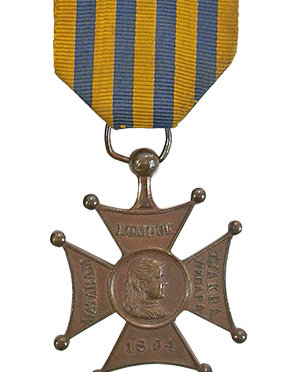
The medal is a bronze Cross pattée with concave ends on the arms and ball finials on the points.

The obverse of the cross bears the effigy of the young queen facing right in the center of the cross. Each arm bears an inscription: On the top is LOMBOKMATARAM, on the left: TJAKRA-NEGARA on the right, and 1894 on the bottom arm.

The reverse of the cross depicts the rampant Dutch lion in a wreath. The arms are inscribed HULDE AAN at the top, LEGER on the left, EN at the bottom, and VLOOT on the right (Homage to Army and Fleet). The medal hangs from a ring suspension on a ribbon 40 mm (1.6 in) wide of nine equal stripes, five in orange-yellow and four of Nassau blue.

The Resistance Memorial Cross

The Resistance Memorial Cross or Commemorative Cross is a medal awarded to members of the Dutch resistance during the Second World War.

The Resistance Memorial Cross or Resistance Commemorative Cross (or Verzetsherdenkingskruis in Dutch) is a medal awarded in the Netherlands to members of the Dutch resistance during the Second World War.

The medal was instituted by Royal Decree (No. 104) on 29 December 1980, after the 35th anniversary of the liberation of the Netherlands. The cross is only awarded at the request of a person eligible to receive it. Approximately 15,000 have been awarded, recorded in the Gedenkenboek verzetsherdenkingskruis.

The Resistance Memorial Cross may be awarded to:

  • Members of resistance groups recognized in the Royal Decree dated 5 September 1944 or to any resistance group known to the Council on Extraordinary Pensions or the 1940-1945 Foundation.
  • Anyone recognized by the Council on Extraordinary Pension as a participant in the resistance, regardless of whether they were awarded a pension.
  • Individuals defined by the Law on the Improvement of the Legal Status of Resistance Fighters (law of 1/20/76, Stb. 19) adjudged as having spent time in service to the resistance.
  • Soldiers of the Dutch Internal Armed Forces in occupied territory.
  • Those who participated in actions during World War II in Japanese or Japanese-occupied territory, which after the war, were designated as resistance of the enemy by the committee.
  • Anyone who does not meet any preceding provisions, may still be considered a participant in the resistance in the judgement of the committee.

The Resistance Memorial Cross Design

The medal comprises a silver cross hung from a striped ribbon. The obverse of the cross bears a vertical flaming sword, surmounted by the Dutch royal crown. Below the sword are the dates 1940 above 1945. The horizontal arms of the cross are inscribed with the words DE TYRANNY VERDRYVEN (“to destroy tyranny”), a line in the Dutch national anthem.

The reverse bears a Dutch lion, and the date of institution, 1980. The cross is suspended by a ring from a ribbon colored with asymmetric stripes: the left half is red-white-blue (for the Dutch flag) and the right half orange (the national color of the Netherlands) with a black border on each edge.

The Airman’s Cross

The Airman’s Cross (Vliegerkruis) is an important military decoration of the Kingdom of the Netherlands created in 1941 for Dutch military.

The Airman’s Cross (or Vliegerkruis in Dutch) is an important military decoration of the Kingdom of the Netherlands created in 1941. The cross is meant for that Dutch military, who displayed during one of more flights in an aircraft, initiative, courage and perseverance against the enemy or during hostile actions. The cross is also awarded to allied pilots, whose actions or performances in the air were of high importance for the Netherlands.

Till 2007 in total of 735 Airman’s Crosses are awarded, most recently to a F-16 pilot, Air Force Major M. Duivesteijn. This because of his “exceptional courage and perseverance” at a flight above former Yugoslavia within the framework of NATO Operation Allied Force in 1999. Well-known recipients are also Erik Hazelhoff Roelfzema, the “Soldier of Orange“, and Prince Bernhard of the Netherlands.

The Airman’s Cross is the fifth highest military decoration still being awarded for bravery and has precedence after the Cross of Merit.

The Cross of Merit Design

The Airman’s Cross resembles the Dutch Bronze Cross but is worn on a diagonally-striped orange and white ribbon inspired by those of the British Distinguished Flying Cross and Air Force Cross.

The cross is silver with four arms. There is a crowned central medallion bearing an albatross in flight with “INITIATIEF MOED VOLHARDING” (INITIATIVE COURAGE PERSEVERANCE) around the edge of the medallion. The date 1941 appears above the body of the albatross. The reverse is plain.

The Cross of Merit (Netherlands)

The Cross of Merit is an award for working in the interest of the Netherlands with distinguishing valor while faced with enemy action.

The Cross of Merit (“Kruis van Verdienste”) is an award for “working in the interest of the Netherlands while faced with enemy actions and distinguishing oneself through valor and resolute behavior“. One did not have to be on the front line to win this award.

On 20 February 1941, the Dutch government in exile in London instituted several new awards for bravery. The new way that wars were fought, with civilian resistance and the merchant navy in great peril, made this necessary. Amongst the new decorations was the “Cross of Merit” (“Kruis van Verdienste”).

The cross has often been awarded to those who managed to flee to England and to the armed resistance. It was rarely awarded after the Korean War, but since the fighting of the Netherlands army in Afghanistan, Uruzgan, this World War II decoration has been awarded again on a regular basis with the latest on 7 October 2009 to eleven Dutch soldiers.

During the second world war in the Far East this cross was awarded to several people employed by the Koninklijke Paketvaart-Maatschappij (K.P.M.) as some of their merchant navy ships had been commissioned by the Dutch Navy during the Battle of the Java Sea.

The Bronze Cross Design

The medal is a bronze cross with a blue and yellow ribbon. There are several issues and types of this decoration.

In case of repeated awards a large “2” or “3” is pinned to the ribbon.

The Bronze Cross (Netherlands)

The Bronze Cross of the Kingdom of the Netherlands was instituted by Queen Wilhelmina during the German occupation of the Netherlands.

The Bronze Cross of the Kingdom of the Netherlands (or “Het Bronzen Kruis” in Dutch) was instituted on 11 June 1940 by Queen Wilhelmina of the Netherlands while she was residing in London during the German occupation of the Netherlands.

The Bronze Cross has precedence after the Resistance Star East Asia, but is the third-highest military decoration still being awarded for bravery.

Several British, American, Canadian and Polish soldiers are among the 3,501 recipients of the Bronze Cross that is awarded by Royal Decree.

The Bronze Cross Design

The medal is a bronze cross pattée. A wreath consisting of tendrils of oak and laurel leaves is tied around the royal cipher.

The orange ribbon has a Nassau blue stripe in the center. Orange is the color of the Queen, the head of the House of Orange, and blue is the heraldic color of the ancestral house of Nassau.

The Cross has no clasps. If it is awarded again a large Arabic golden figure “2” or “3” is attached to the ribbon.