The Cross for Courage and Fidelity

The Cross for Courage and Fidelity is a military award established by Queen Emma of the Netherlands on 7 March 1898 by Royal Decree.

The Cross for Courage and Fidelity (or Kruis voor Moed en Trouw in Dutch) is a military award established by Queen Emma of the Netherlands on 7 March 1898 by Royal Decree. The cross replaced the old Medal for Courage and Fidelity, which had limited prestige and status according to the Netherlands government.

The cross is the second-highest award of the Kingdom of the Netherlands, preceded only by the Military William Order. The cross was awarded to (and is still worn by) natives of the Netherlands East Indies that showed an exceptional display of bravery and fidelity.

The Governor-General of the Netherlands East Indies was authorized to award the cross. A total of 262 bronze and 13 silver crosses have been awarded, most of them in 1925. The last cross was awarded in 1927; after that natives and native soldiers of the Royal Dutch East Indies Army were also eligible to receive the Military William Order.

The cross, nicknamed the “Military William Order for natives”, has been regarded by many as discriminatory to the natives in the Netherlands East Indies.

The Cross for Courage and Fidelity Design

The cross has a resemblance to the Military William Order and is worn with the same ribbon as that order. The shape of the cross itself is somewhat different in the sense that the cross and crown are made of non-enameled silver.

On the cross of the Military William Order a gold spark rod is shown in the middle. However, on the cross for Courage and Fidelity, a heraldic Dutch Lion is shown. Between the arms of this cross two klewangs are added.

The text on the cross has the description “VOOR MOED EN TROUW” (English: for Courage and Fidelity) and at the back “Daden van Moed en Trouw in Nederlands-Indië door inlanders betoond” (English: Deeds of Courage and Fidelity in the Netherlands East Indies by natives awarded). Between the crown and cross is a spark rod, a distinguishing mark of the Order of the Golden Fleece or the Military William Order.

Those recipients who lost the cross during the Japanese occupation of Indonesia could receive a new cross but without an emblazoned crown.

The Dutch Cross of Resistance

The Cross of Resistance 1940-1945 (or Verzetskruis 1940–1945 in Dutch) is the second highest decoration for valor in the Netherlands.

The Cross of Resistance 1940-1945 (or Verzetskruis 1940–1945 in Dutch) is the second highest decoration for valor in the Netherlands.

The decoration was awarded for extreme bravery awarded to the Dutch Resistance. The Dutch resistance to the Nazi occupation of the Netherlands during World War II can be mainly characterized as non-violent, and was organized by the Communist Party, churches, and independent groups. A peak of over 300,000 people were hidden from German authorities in the autumn of 1944, tended to by some 60,000 to 200,000 illegal landlords and caretakers, and tolerated knowingly by some one million people, including a few incidental individuals among German occupiers and military.

Dutch counterintelligence, domestic sabotage, and communications networks eventually provided key support to Allied forces, beginning in 1944 and continuing until the Netherlands was fully liberated. A number of resistance groups specialized in saving Jewish children, including the Utrechtse Kindercomité, Landelijke Organisatie voor Hulp aan Onderduikers, Naamloze Vennootschap (NV), and Amsterdam Student Group.

The Cross was awarded 95 times (93 of them posthumously).

The Cross of Resistance Design

By Royal Decree of May 3rd 1946 the Resistance Cross was finally instituted. The formal disruption was: “The Bronze decoration of the Resistance Cross resembled a four armed cross, imbedded on a star of flames and covered with the Royal Crown. On the front one can find St. Joris fighting the dragon. On the arms of the cross are engraved the words ‘Trouw tot in den dood’. On the obverse one can find a flaming sword wit two broken chains“, all according to article 4 of the Royal Decree.

The ribbon is colored in Crimson Red with two golden orange lines.

The Order of Saint John in the Netherlands

The Order of Saint John in the Netherlands is a religious order dedicated to providing charitable and humanitarian services.

The Bailiwick of Brandenburg of the Chivalric Order of Saint John of the Hospital at Jerusalem (or Balley Brandenburg des Ritterlichen Ordens Sankt Johannis vom Spital zu Jerusalem in German), commonly known as the Order of Saint John or the Johanniter Order, is the German Protestant branch of the Knights Hospitaller, the oldest surviving chivalric order, which generally is considered to have been founded in Jerusalem in the year 1099 AD.

The medieval Dutch Bailiwick of Utrecht and Commandery of Haarlem formed parts of the German Langue (one of the “Tongues”, the major divisions of the medieval Order of Saint John) until, during the Reformation, they associated themselves with the reformed Bailiwick of Brandenburg. Both the Bailiwick of Utrecht and the Commandery of Haarlem were suppressed in 1810, during the Napoleonic occupation.

Dutch knights of the Bailiwick of Brandenburg formed their own commandery within the Johanniterorden in 1909, when the Dutch monarch afforded it royal protection; and the commandery separated from the German Johanniterorden in 1946.

The commandery became an independent order in 1958 and is known as Johanniter Orde in Nederland, now admitting noblewomen as well as noblemen. The Dutch monarch is an honorary commander. With the German and Swedish orders, the Dutch order helped found the Alliance of the Orders of St. John of Jerusalem on June 13, 1961.

The Order of Saint John in the Netherlands Design

Dutch insignia of the Johanniter Orde in Nederland replace Prussian eagles with the Dutch lion.

The Order for Loyalty and Merit

The Order for Loyalty and Merit (or Orde van Trouw en Verdienste in Dutch) is a house order of the Dutch Royal House of Orange-Nassau.

The Order for Loyalty and Merit (or Orde van Trouw en Verdienste in Dutch) is a house order of the Dutch Royal House of Orange-Nassau. The Order came into being as a result of Queen Juliana‘s reorganization of The House Order of Orange in 1969.

The Order for Loyalty and Merit is conferred “upon those persons who have loyally and faithfully, and with merit and character assisted the Head of State or the members of the Royal House during their obligations and their daily work.”

The order has two grades:

  1. Cross for Loyalty and Merit in Gold;
  2. Cross for Loyalty and Merit in Silver.

The Order for Loyalty and Merit Design

The cross in gold or silver is worn on a ribbon on the left chest. The decorations are awarded after 25 and 40 years of service.

The monarch is lenient as far as the number of years in her service are concerned. Hardly anyone manages to work until his or her 65th birthday. Many servants of the Queen receive their Cross of merit for Loyalty and Merit in Gold after 35 years in the Royal Household.

The Order of the Crown (Netherlands)

The Order of the Crown is a house order that came into being as a result of the reorganization of the Order of the House of Orange.

The Order of the Crown (or Kroonorde in Dutch) is a house order of the Dutch Royal House that came into being as a result of Queen Juliana‘s reorganization of the Order of the House of Orange in 1969.

The 18 classes of the house order were no longer felt to be appropriate in the ever more egalitarian Dutch society of the 1960s. The Order was divided into five subdivisions. As a house order, it is not subject to ministerial responsibility or influence but is awarded at the discretion of the Dutch monarch alone.

The Order of the Crown is intended for “foreigners who have rendered special service to the Dutch King or his House“. The former queen, Beatrix, instituted a silver medal to commemorate state visits.

The Order of the Crown has the traditional five grades and three medals. This allows the Dutch monarch to dispense the decorations according to rank especially during state visits.

The Order of the Crown Design

The insignia vary considerably depending on the grade:

  1. Grand Cross (Grootkruis) – badge may be worn on a sash on the right shoulder, plus a 4-pointed star on the left chest;
  2. Grand Honorary Cross with Star (Groot erekruis met Plaque) – wears the badge on a necklet, plus a 4-pointed star on the left chest;
  3. Grand Honorary Cross (Groot erekruis) – wears the badge on a necklet;
  4. Honorary Cross with Rosette (Erekruis met Rozette) – wears the badge on a ribbon with a rosette on the left chest;
  5. Honorary Cross (Erekruis) – wears the badge on a ribbon on the left chest;
  6. Medals in Gold, Silver and Bronze (Medaille in goud, zilver en brons) – wears the medal on a ribbon on the left chest.

The Order of the House of Orange

The Order of the House of Orange is a dynastic order of the House of Orange-Nassau, the royal family of the Netherlands.

The Order of the House of Orange (or Huisorde van Oranje in Dutch) is a dynastic order of the House of Orange-Nassau, the royal family of the Netherlands. The order was instituted by Queen Wilhelmina of the Netherlands on 19 March 1905 and is not subject to ministerial responsibility or influence, but is awarded at the discretion of the Dutch monarch alone.

In 1905, Queen Wilhelmina felt the need for a House Order because the Order of the Oak Crown of the Grand Duchy of Luxembourg, used by her father and grandfather to reward Dutch subjects, was no longer available to her, as succession to the throne of Luxembourg was directed by the House treaty of the House of Nassau in a way comparable to the Salic Law within its constitution in 1890.

The Order of the House of Orange had a very complex nomenclature, with 18 different classes and medals.

More than 3200 decorations were conferred between 1905 and 1969, mostly to Court Dignitaries, the Queen’s household, and doctors and lawyers who could choose between sending a bill for their services or a decoration in the House Order.

Since the reorganization in 1969 the House Order itself has these grades:

  1. Grand Cross (Grootkruis) – badge may be worn on a sash on the right shoulder, plus an 8-pointed star on the left chest;
  2. Grand Honorary Cross (Groot erekruis) – wears the badge on a necklet;
  3. Honorary Cross (Erekruis) – wears the badge on a ribbon on the left chest.

The Order of the House of Orange Design

The insignia vary considerably amongst these awards; however they all share the same orange ribbon, symbolizing the House of Orange. The ribbon bar of the Order of the House of Orange was… well, orange.

The Combat Action Medal of the Bundeswehr

The Combat Action Medal of the Bundeswehr is a military decoration awarded by the German Bundeswehr for active participation in action.

The Combat Action Medal of the Bundeswehr (or Einsatzmedaille Gefecht in German) is a military decoration awarded by the German Bundeswehr for active participation in combat actions or for the suffering from terrorist attacks.

It is awarded only once and, if the recipient was killed in action, posthumously. The medal was initiated by then minister of defense Karl-Theodor zu Guttenberg and introduced by the President of Germany, Christian Wulff in 2010.

The date of qualifying operations is from 29 April 2009 to the present. In 2011, the medal was awarded to a non-german soldier for this first time.

The Combat Action Medal of the Bundeswehr Design

The Combat Action Medal is a special class of the German Armed Forces Deployment Medal and shares many design features and the same ribbon.

The medal is gold in colour, with a black and red enameled border around the edge. The German Federal Eagle in the center is enameled in black. On the suspension ribbon of the medal, and the service ribbon worn in undress, is a gold coloured clasp with the word Gefecht(Combat).

The Badge of Honor of the Bundeswehr

The Decorations of Honor of the Bundeswehr are a series of military decorations of the Bundeswehr awarded for loyal service.

  • Time Period: Post-WW2
  • Institution: October 29, 1980 and October 10, 2008
  • Country: Germany

The Decorations of Honour of the Bundeswehr (or Ehrenzeichen der Bundeswehr in German) are a series of military decorations of the Bundeswehr awarded as a “visible commendation for loyal service and exemplary execution of duties“.

The decorations were introduced in 1980 on the occasion of the 25th anniversary of the Bundeswehr by then Minister of Defence Hans Apel and subsequently approved by President of the Federal Republic Karl Carstens.

The first awards were made on November 6, 1980. In 2008, the decorations were updated and received three grades exclusively reserved for heroic deeds. The new awards were the result of a petition by German citizens to restore the order of the Iron Cross.

Receiving one grade of the award is not a requirement for receipt of the next higher one. If earned, all grades of the award may be worn at the same time.

The Badge of Honour of the Bundeswehr Design

The Medal is round, shows a German eagle on a Cross pattée surrounded by a wreath of oak leaves.

On the reverse it reads FÜR BESONDERE VERDIENSTE BUNDESWEHR (For special merits — Bundeswehr). There is an oak leaf above the word Bundeswehr and that side is also surrounded by an oak leaves wreath.

The ribbon is black with two red stripes beside it and golden stripes on the edges as the colors of the German flag, the ribbon bar has a small clasp of the decoration grade attached to it.

The Bundeswehr Cross of Honor for Valor

The Bundeswehr Cross of Honor for Valor is the highest military decoration of Germany and their first combat valor award since World War II.

The Bundeswehr Cross of Honour for Valour (or Ehrenkreuz der Bundeswehr für Tapferkeit in German) is the highest military decoration of the Bundeswehr, and the highest class of the Bundeswehr Cross of Honour. The decoration is the first combat valour award presented by Germany since World War II.

Since World War II, Germany has seen its military as a defensive force, but during the 1990s Germany began playing a bigger role with its military within the European Union. After the September 11 attacks on the United States, Germany joined ISAF in Afghanistan and has continued to deploy Bundeswehr troops to areas under combat conditions.

The President of Germany Horst Köhler granted authorization for this valour decoration on 18 September 2008. On 10 October 2008, the directive creating the Bundeswehr Cross of Honour for Valour became law upon being published in the Federal Law Gazette and the Federal Gazette. The first recipients of the Cross of Honour for Valour were four soldiers caught up in a suicide attack by Taliban forces on 20 October 2008 southwest of Kunduz, Afghanistan.

The Bundeswehr Cross of Honour Design

The Medal is round, shows a German eagle on a Cross pattée surrounded by a wreath of oak leaves.

On the reverse it reads FÜR BESONDERE VERDIENSTE BUNDESWEHR (For special merits — Bundeswehr). There is an oak leaf above the word Bundeswehr and that side is also surrounded by an oak leaves wreath.

The ribbon is black with two red stripes beside it and golden stripes on the edges as the colors of the German flag, the ribbon bar has a small clasp of the decoration grade attached to it.

The Order of Sidonia

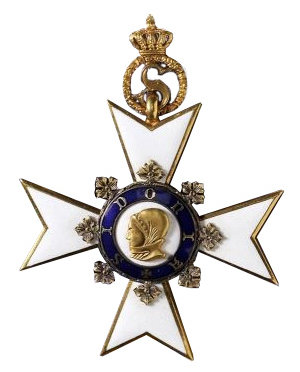
The Order of Sidonia was created on March 14, 1871 by King Johann the German. It’s the Kingdom of Saxony’s chivalric order for women.

The Order of Sidonia was created on March 14, 1871 by King Johann the German. It’s the Kingdom of Saxony’s chivalric order for women, granted to female members of the Saxon nobility until the fall of the monarchy in 1918. By awarding this order, King Johann aimed to reinforce the values and responsibilities associated with the Saxon nobility, encouraging other noblewomen to aspire to such standards.

Named in honor of Saint Sidonia, this order was established to recognize and reward the exemplary service and noble qualities of female members of the Saxon nobility.

The order was granted exclusively to female members of the Saxon nobility. Recipients were typically women who had shown notable service in charitable activities, cultural endeavors, or had supported the monarchy in various capacities.

The Order of Sidonia Design

Members of the Sidonian Order wore a Maltese cross of gold and enamel, suspended from a purple bow with white and green stripes.

Members of the royal family wore a sash instead of the bow. At the apex of the Maltese cross, a medallion featured an image of a helmeted female figure, surrounded with the name “Sidonia”.