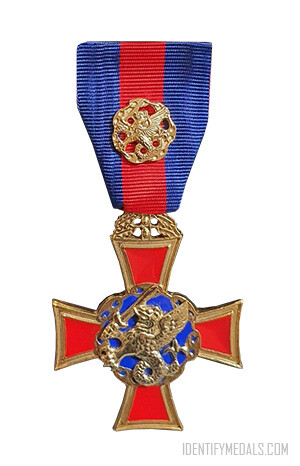
The St George’s Cross (Portugal)

The St George’s Cross is a Portuguese military medal created in 2000 and awarded for extraordinary performance and personal qualities.

The Medal of the Cross of Saint George is a Portuguese military decoration, established on December 22, 2000. It is awarded to military personnel and civilians, both national and foreign, who demonstrate exceptional technical-professional competence, extraordinary performance, and significant personal qualities. Recipients of this medal contribute substantially to the efficiency, prestige, and mission fulfillment of the General Staff of the Armed Forces (EMGFA).

The Medal of the Cross of Saint George was the penultimate of five specialized medals created to recognize services to the General Staff of the Armed Forces. It was established after the three branch-specific medals created in 1985 and before the Ministry of National Defense’s private medal, which was introduced in 2002.

The Medal of the Cross of Saint George is awarded according to the following criteria:

  • 1st Class (MPCSJ): General officers and captains or colonels.
  • 2nd Class (MSCSJ): Frigate captains or lieutenant colonels and lieutenant captains or majors.
  • 3rd Class (MTCSJ): Other officers and sergeant majors.
  • 4th Class (MQCSJ): Other sergeants and enlisted personnel.
The St George’s Cross Design

The insignia of the Medal of the Cross of Saint George is designed to reflect the esteemed service and contributions of its recipients. Each class features a distinct design, symbolizing the level of achievement and rank of the awardee.

  • 1st Class (MPCSJ): This class features an elaborate medal adorned with intricate details, typically worn on a neck ribbon or sash. The design includes elements such as gold accents and the national coat of arms, symbolizing high honor and leadership.
  • 2nd Class (MSCSJ): Similar to the 1st Class but slightly less elaborate, this medal is also worn on a neck ribbon. It maintains prestigious design elements to denote significant contribution and command.
  • 3rd Class (MTCSJ): A medal worn on a neck ribbon, reflecting the commendable service of officers and sergeant majors. The design is simpler than the higher classes but retains important symbols of military excellence.
  • 4th Class (MQCSJ): The most basic design, worn on a chest ribbon. It recognizes the valuable contributions of sergeants and enlisted personnel, featuring essential elements like the national emblem.

The Medal of Military Merit (Portugal)

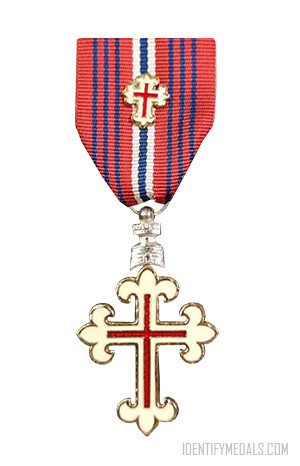
The Medal of Military Merit is a military medal created in 1946 and awarded to individuals with exceptional qualities and virtues.

The Medal of Military Merit (or Medalha de Mérito Militar in Portuguese) is a prestigious Portuguese military decoration established on 28 May 1946.

It is awarded to individuals who demonstrate exceptional military qualities and virtues. The Medal of Military Merit can also be awarded to foreign military personnel.

The Medal of Military Merit is divided into several classes, each corresponding to specific military ranks:

  • Grand Cross of the Military Merit Medal (GCMM): Awarded exclusively to General Officers.
  • First Class (MPMM): Awarded to General Officers, Colonels, or Sea Captains.
  • Second Class (MSMM): Awarded to Lieutenant Colonels, Frigate Captains, Majors, or Captain-Lieutenants.
  • Third Class (MTMM): Awarded to Captains, First Lieutenants, other lower-ranking officers, and Sergeant-Majors.
  • Fourth Class (MQMM): Awarded to other sergeants and enlisted ranks.

The Medal of Military Merit Design

The insignia of the Medal of Military Merit is a testament to the distinguished service of its recipients. The medal itself is designed to reflect the honor and prestige associated with military excellence. Each class of the medal features a distinct design that corresponds to the recipient’s rank.

  • Medal for Military Merit GCMM Grand Cross (GCMM): The highest class, featuring an elaborate and ornate design, often with gold elements. It includes a sash worn over the shoulder and a star badge displayed on the chest.
  • Medal for Military Merit MPMM First Class (MPMM): Characterized by a prominent medal worn on a ribbon around the neck, with an accompanying chest star.
  • Medal for Military Merit MSMM Second Class (MSMM): Similar to the First Class, but with design elements that denote a slightly lower rank.
  • Medal for Military Merit MTMM Third Class (MTMM): Features a medal worn on a ribbon around the neck, typically without the additional chest star.
  • Medal for Military Merit MQMM Fourth Class (MQMM): The simplest design, worn on a ribbon pinned to the chest.
The War Cross (Portugal)

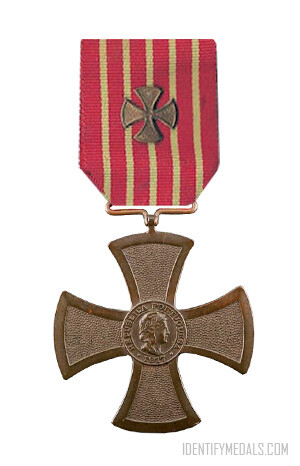
The War Cross is a military decoration established in 1916 and awarded to officers and soldiers who showed courage and determination.

The War Cross is a Portuguese military decoration established by Decree No. 2:870 of the President of the Republic of Portugal on November 30, 1916.

It was created to honor officers and soldiers who demonstrated bravery, determination, composure, and other commendable qualities in the face of the enemy during combat operations.

The Minister of War was designated to award this decoration, with the official statute and design issued on July 26, 1917. Originally, the War Cross had four classes and was awarded to Portuguese soldiers participating in World War I. Later, it was extended to those serving in battles in Portuguese colonies. On May 28, 1946, the statute and design of the decoration were revised, and further changes were made by the Minister of Defense on December 20, 1971.

The War Cross' Award Criteria

According to the 1917 statute, the War Cross could be awarded to Portuguese army officers and soldiers for acts of valor, determination, and composure on the battlefield. The 1946 decree expanded eligibility to include soldiers from allied armies, as well as Portuguese and foreign civilians.

The 1971 decree further specified that the decoration could be awarded to Portuguese soldiers and civilians, both domestic and foreign, who cooperated with the Portuguese army.

The Order 's Design

The War Cross badge is made of bronze and resembles a Maltese cross, formed by the intersection of five circles. The design is consistent across all classes.

The obverse features a central depiction of a woman’s head with a laurel wreath, symbolizing the Republic, surrounded by the inscription “REPÚBLICA PORTUGUESA 1917.” This design is inspired by the French medal of the same name.

Initially, the reverse displayed the coat of arms of Portugal. In the 1946 redesign, the obverse adopted the coat of arms, and the reverse featured the inscription “Cruz de Guerra” (War Cross). The 1971 redesign added two crossed swords and a laurel wreath to the reverse, while the obverse remained as per the 1946 design.

The medal is worn on a red ribbon with seven narrow green stripes. Symbols on the ribbon denote the class:

  • Class I: Golden cross with a laurel wreath
  • Class II: Golden cross
  • Class III: Silver cross
  • Class IV: No additional device

The Military Valor Medal (Portugal)

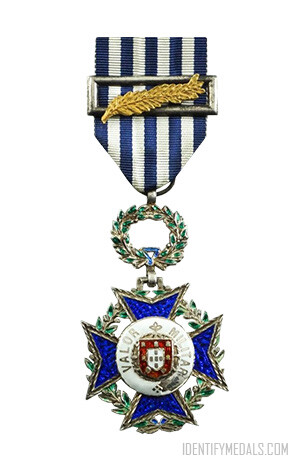
The Military Valor Medal was established on 2 October 1863, it is awarded for heroic deeds of extraordinary selflessness and bravery.

The Military Valor Medal is a distinguished military decoration and the second highest honor in Portugal. Established on 2 October 1863, it recognizes acts of extraordinary bravery, selflessness, and exceptional decision-making in circumstances of proven or suspected danger to life, whether in war or peace.

The Medal is available in three grades:

  • Gold (Ouro): Awarded for exceptional bravery and selflessness characterized by valor, decisiveness, and willingness to risk one’s life.
  • Silver (Prata): Awarded for bravery and selflessness in the face of danger, characterized by valor and decisiveness.
  • Bronze (Cobre): Awarded for courage and decisiveness, characterized by bravery and selflessness.

The Military Valor Medal Design

Gold Grade

  • Obverse: Features a straight-lined patée cross, chiseled in gold, resting on a circular crown of laurel leaves. At the center is the national emblem, consisting of the national coat of arms on a golden armillary sphere, surrounded by a blue border with the inscription “VALOR MILITAR” in gold letters.
  • Reverse: Plain gold, engraved with the recipient’s name, rank, and the year of award.
  • Ribbon: Made of wavy silk with nine longitudinal stripes (five blue and four white) and a central national shield on a golden armillary sphere. The ribbon bar, buckle, and pendant are also in gold. A golden palm is added to the ribbon when awarded for campaign services.

Silver Grade

Similar to the Gold Grade, but the national coat of arms on the ribbon, ribbon bar, buckle, and pendant are in silver.

Bronze Grade

The Bronze Grade features the ribbon bar, buckle, and pendant in bronze and does not include the national coat of arms on the suspension ribbon.

The Order of Merit of the Portuguese Royal House

The Order of Merit of the Portuguese Royal House is a dynastic order of knighthood conferred for outstanding Merit in the Monarchist Cause.

The Order of Merit of the Portuguese Royal House (or Ordem do Mérito da Casa Real Portuguesa or Ordem do Mérito da Causa Monárquica in Portuguese) is a dynastic order of knighthood awarded for extraordinary services to the Portuguese Royal House and outstanding merit in the Monarchist Cause.

Established by Duarte Pio, Duke of Braganza, on 12 April 1993, the Order recognizes exceptional contributions to the Monarchical Cause and services rendered to the Royal House between 1973 and 1993. The Head of the Portuguese Royal House serves as the Royal Patron, while Dr. José António da Cunha Coutinho, Baron of Nossa Senhora da Oliveira, is the Chancellor of the Order.

The Order of Merit of the Portuguese Royal House Ranks

The Order includes the following traditional ranks of Knighthood:

  • Grand Collar
  • Grand Cross
  • Commander
  • Knight/Dame
  • Medal of Honour

Previously, the Order also conferred the Medal of Dedication to the Monarchist Cause, Youth Medal of Dedication to the Monarchist Cause, and Youth Medal of Fidelity, but these were discontinued following a reform by the Grand Master.

The Order of Merit of the Portuguese Royal House Design

The sash of the Order is intricately designed, featuring the colors and emblematic elements associated with the Portuguese monarchy. The badge typically includes a cross or star, adorned with the emblem of the Royal House of Braganza, symbolizing loyalty and service to the monarchist cause.

Higher ranks such as the Grand Collar and Grand Cross include more elaborate insignia with gold and enamel details, and are worn with a sash over the shoulder or around the neck.

The Order of Saint Michael of the Wing

The Order of Saint Michael of the Wing is a Portuguese Roman Catholic dynastic order founded around 1147 for the Conquest of Santarém.

The Royal Equestrian and Military Order of Saint Michael of the Wing (or Ordo Equitum Sancti Michaelis sive de Ala in Latin, Real Ordem Equestre e Militar de São Miguel da Ala in Portuguese) is a dynastic Roman Catholic order believed to have been founded in 1147 by King Afonso I of Portugal at the Alcobaça Monastery.

The order was established to commemorate the Conquest of Santarém from the Moors, with the name honoring Saint Archangel Michael, who is said to have appeared in the form of a wing in the sky to aid in the victory.

The medieval history of the Order, including claims of recognition by Pope Alexander III in 1171, is largely based on documents from the 16th to the 18th century. The International Commission on Orders of Chivalry classifies it as an “Institution of chivalric character,” founded as a chivalric order and later revived by the dynastic successors of the original authority (2004). Originally, the knights of the Order were under the jurisdiction of the Abbot of the Cistercian Alcobaça Monastery and shared prayers and duties with other military orders during the Reconquista.

The Order is considered to have been revived twice: first in 1828 or 1848 by King Miguel I of Portugal to support the Miguelist movement, and secondly in 1981 by later Portuguese monarchists, with recognition by the Royal House of Braganza in 1986.

The Order of Saint Michael of the Wing Ranks

The Royal Equestrian and Military Order of Saint Michael of the Wing features several ranks, each with distinct insignia and purposes:

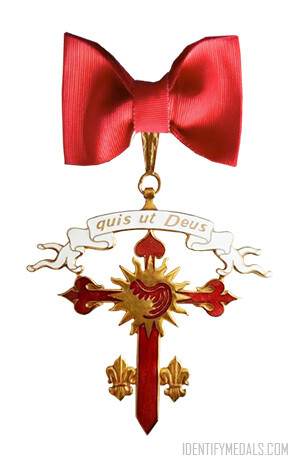
  • Grand Collar: This rank, marked by an insignia surmounted by a crown, is exclusively reserved for the Grand Master. Members of the grand council, such as the Grand Chancellor and Chancellor, wear it without the crown.
  • Grand Cross with Collar of the Royal Brotherhood: This collar, worn by the Grand Master, Royal Patrons, Bishops, Vice-Chancellors, Grand Chaplains, and Judges, as well as Delegates of the Royal Brotherhood when in representative roles, can also be bestowed on royalty, heads of state, and VIP members of the Order for extraordinary services. This collar, instituted in 2021 for the Order’s 850th anniversary, differs from the Grand Collar of the Order.
  • Grand Cross: Worn with a cross on a sash over the right shoulder and a gold plaque on the chest.
  • Grand Officer: Worn with a cross around the neck and a gold breast star.
  • Commander: Worn with a cross around the neck and a silver breast star.
  • Knight: Worn with a cross around the neck, similar in size to the Commander’s cross.

The Order of Saint Michael of the Wing Design

The insignia of the Order of Saint Michael of the Wing is highly symbolic and varies by rank. The Grand Collar, exclusive to the Grand Master, features an elaborate design with a crown. The Grand Cross with Collar of the Royal Brotherhood, instituted in 2021, is notable for its special use in the Order’s anniversary and for its distinction from the traditional Grand Collar.

For the Grand Cross, a cross is worn on a sash draped over the right shoulder, accompanied by a gold plaque. Grand Officers wear the cross around their necks with a gold breast star, while Commanders wear a similar neck cross with a silver breast star. Knights wear a neck cross of the same size as that of the Commanders.

The Order of the Colonial Empire

The Order of the Colonial Empire was initially a Portuguese order of knighthood established in 1932 to reward services to the colonies.

The Order of the Colonial Empire (or Ordem do Império Colonial in Portuguese) was a Portuguese honor established on 13 April 1932. This colonial order of knighthood recognized the services of soldiers and civilians in the Portuguese colonies in Asia and Africa.

The Order was composed of five grades:

  • Grand Cross: Wore the badge on a sash over the right shoulder and the star on the left chest.
  • Grand Officer: Wore the badge on a necklet and the star on the left chest.
  • Commander: Wore the badge on a necklet and the star on the left chest.
  • Officer: Wore the badge on a ribbon with a rosette on the left chest.
  • Knight: Wore the badge on a ribbon on the left chest.
The Commander grade was removed during the 1960s, and the Order itself was discontinued following the Carnation Revolution in 1974.

The Order of the Colonial Empire Design

The badge featured an enamel Cross of the Order of Christ, silver for Knights and gilt for higher grades, with the lesser Coat of Arms of Portugal in enamel and gilt at the center.

The star was an eight-pointed faceted star, gilt for Grand Cross and Grand Officer, and silver for Commander, with the badge of the Order at the center.

The ribbon of the Order was red with black central and edge stripes.

The Order of Merit (Portugal)

The Order of Merit is awarded those responsible for meritorious acts or services performed in the exercise of any functions.

The Order of Merit (or Ordem do Mérito in Portuguese) is a prestigious Portuguese honorific order that recognizes individuals for meritorious acts or services performed in any capacity, both public and private, demonstrating self-sacrifice for the benefit of the community.

The President of the Portuguese Republic, acting as the Grand Master of the Portuguese Honorific Orders, bestows these decorations. The Order of Merit can be awarded both during a recipient’s lifetime and posthumously, to Portuguese and foreign citizens alike, as well as to localities or institutions that are legal entities governed by public law or recognized for public utility. Recipients have included ambassadors, businesspeople, military personnel, athletes, and musicians.

The Order of Merit traces its origins to April 1927 with the creation of the Order of Instruction and Benefaction (Ordem da Instrução e da Benemerência). This initial order aimed to recognize services furthering education in Portugal. In 1929, it was divided into two distinct orders: the Order of Benefaction, focused on social causes and public assistance, and the Order of Public Instruction. The Order of Benefaction was renamed to the Order of Merit in 1976.

The Order of Merit Grades

The Order of Merit is organized into several classes, listed in descending order of seniority:

  • Grand Cross (Grã-Cruz – GCM)
  • Grand Officer (Grande-Oficial – GOM)
  • Commander (Comendador or Comendadeira – ComM)
  • Officer (Oficial – OM)
  • Medal (Medalha – MedM)
  • Honorary Member (Membro Honorário – MHM)

The Order of Merit Design

The badge features a star or cross with intricate designs symbolizing merit and excellence. Higher classes such as the Grand Cross and Grand Officer include more elaborate decorations, often incorporating gold and enamel work, as well as additional symbols representing the recipient’s contributions to society.

The ribbon of the Order is typically adorned with colors and patterns that signify the Order’s values and history. For instance, the ribbon may feature blue and white stripes, reflecting the traditional colors associated with Portuguese national honors.

The insignia worn by recipients can vary in complexity and design according to their specific class within the Order, with higher ranks displaying more ornate and detailed decorations.

The Order of Prince Henry

The Order of Prince Henry is a Portuguese order of knighthood established in 1960 to mark the 500th anniversary of Prince Henry’s death.

The Order of Prince Henry (or Ordem do Infante Dom Henrique in Portuguese) is a distinguished Portuguese order of knighthood established on 2 June 1960 to mark the 500th anniversary of Prince Henry the Navigator’s death. Prince Henry was a pivotal figure in the Age of Discovery. The Order underwent minor reforms in 1962 and 1980.

This five-tier order recognizes significant contributions to Portugal, particularly in the expansion of its culture, history, and values, with a focus on maritime history. Membership in each grade is limited by the Order’s constitution, and titles are awarded by the President of Portugal, who serves as the Grand Master.

The Order of Prince Henry Grades

The Order of Prince Henry consists of several classes, listed in decreasing order of seniority:

  • Grand Collar (Grande-Colar – GColIH)
  • Grand Cross (Grã-Cruz – GCIH)
  • Grand Officer (Grande-Oficial – GOIH)
  • Commander (Comendador – ComIH)
  • Officer (Oficial – OIH)
  • Knight/Dame (Cavaleiro – CvIH / Dama – DmIH)
Additionally, there are a Silver Medal (Medalha de Prata – MedPIH) and a Gold Medal (Medalha de Ouro – MedOIH). The Grand Collar is a special distinction that can only be awarded to heads of state.

The Order of Prince Henry Design

The insignia of the Order features ribbons and medals characterized by equal stripes of blue, white, and black, either horizontal or vertical, along with a ruby-enameled golden cross pattée.

The stars of the Grand Officer and Grand Cross include the inscription “Talant de bien faire”.

Military Order of Saint James of the Sword

The Military Order of Saint James of the Sword was founded in 1172 and s endorsed by papal legate Cardinal Hyacinthus of Acardo.

The Military Order of Saint James of the Sword (or Ordem Militar de Sant’Iago da Espada in Portuguese) is a distinguished Portuguese order of chivalry. Its full title is the Ancient, Most Noble, and Enlightened Military Order of Saint James of the Sword, of the Scientific, Literary, and Artistic Merit.

History

Founded in 1172, the Order originated from the Order of Santiago, established in the Kingdom of León in 1170 to protect pilgrims traveling to Santiago de Compostela. The Order expanded into Portugal in 1172 under King Afonso I, who granted them lands, but they were expelled in 1179 due to conflicts with León. They returned in 1186 under King Sancho I.

The Order played a significant role in the Reconquista and later Portuguese conquests, such as the capture of Ceuta in 1415. In 1288, King Denis of Portugal separated the Portuguese branch from the Castilian Order, which was confirmed by Pope John XXII in 1320.

Transition and Modern Era

During the 1383–1385 Portuguese succession crisis, the Order supported John I. In 1418, the mastership was secured for his son, and eventually, the Order’s leadership became intertwined with the Portuguese royal family.

In 1789, Pope Pius VI and Queen Maria I reformed the Order into a secular institution. The Order lost its properties and privileges after the 1834 liberal revolution. Though abolished in 1910 with the fall of the monarchy, the Order was later re-established as an order of merit.

The Order of Saint James of the Sword Grades

The Order of St. James of the Sword, as currently awarded by the Portuguese government, has six classes:

  • Grand Collar (GColSE): Wears the badge of the Order on a special collar (chain) and the gold star of the Order on the left chest.
  • Grand Cross (GCSE): Wears the badge of the Order on a gilt collar (chain) or on a sash over the right shoulder, and the gold star of the Order on the left chest.
  • Grand Officer (GOSE): Wears the badge of the Order on a gilt collar (chain) and the gold star of the Order on the left chest.
  • Commander (ComSE): Wears the badge of the Order on a gilt collar (chain) and the silver star of the Order on the left chest.
  • Officer (OSE): Wears the badge of the Order on a gilt collar (chain) and on a ribbon with a rosette on the left chest.
  • Knight (CavSE) or Dame (DamSE): Wears the badge of the Order on a silver collar (chain) and on a plain ribbon on the left chest.

The Order of Saint James of the Sword Design

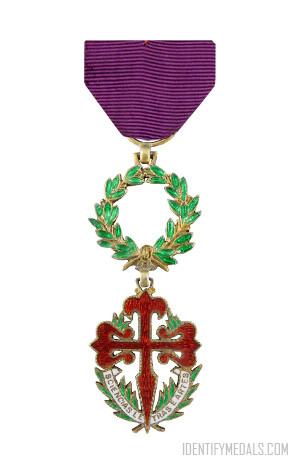
The insignia of the Order prominently features the Cross of St. James.

The badge is a gilt cross with red enamel, similar to the Order’s emblem but with a longer lower arm, encircled by a wreath of green-enameled palm leaves. At the bottom of the badge is a white-enameled scroll with the inscription “Ciência Letras e Artes” (Science, Literature, and Art). The Grand Collar badge differs by having no scroll and a laurel wreath instead of palm leaves.

During the monarchy, the badge was topped by the Sacred Heart of Christ.

The star of the Order has 22 asymmetrical rays, gilt for the Grand Collar, Grand Cross, and Grand Officer, and silver for the Commander. The central disc is white enamel with a miniature of the modern badge. Under the monarchy, the Sacred Heart of Christ was placed at the top of the star.

The ribbon of the Order is plain lilac.