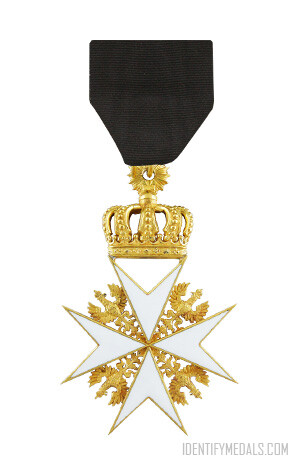
The Order of Saint John (Bailiwick of Brandenburg)

The Order of Saint John (Bailiwick of Brandenburg) was established as the Order of Saint John or the Johanniter Order in 1099.

The Bailiwick of Brandenburg of the Chivalric Order of Saint John of the Hospital at Jerusalem (or Balley Brandenburg des Ritterlichen Ordens Sankt Johannis vom Spital zu Jerusalem in German), commonly referred to as the Order of Saint John or the Johanniter Order (Johanniterorden), is the German Protestant branch of the Knights Hospitaller. The order, considered the oldest surviving chivalric order, is believed to have been established in Jerusalem in 1099.

The current leader, or Herrenmeister (Master of the Knights/Grand Master), is Oskar Prince of Prussia. The order comprises approximately four thousand knights globally, classified as either Knights of Justice (Rechtsritter) or Knights of Honour (Ehrenritter). Membership is by invitation only and is not restricted to German nationals or speakers. Though the order no longer requires noble status for membership since 1948, most members still come from the nobility. The order includes seventeen commanderies in Germany and one each in Austria, Finland, France, Hungary, and Switzerland, along with a global commandery with subcommanderies in twelve other countries, including Australia, Belgium, Canada, Colombia, Denmark, Italy, Namibia, Poland, South Africa, the UK, the US, and Venezuela.

The Order of Saint John (Bailiwick of Brandenburg) Design

The cloak of the Order is primarily black, featuring a prominent white, linen eight-pointed cross on the left breast. Most knights wear cloaks made of black wool, while French knights add distinctive white wool collars.

The basic insignia is a white-enamelled Maltese cross. Since 1668, the crosses have featured crowned Brandenburg (later Prussian) eagles between the arms. For Knights of Justice, Honorary Commanders, Commanders, and the Herrenmeister, the eagles are gold, while for Knights of Honour and Honorary Members, the eagles are enamelled black with gold crowns. The cross’s size varies by rank: 5 cm for Knights of Justice, 5.5 cm for Commanders and Honorary Commanders, 6 cm for Knights of Honour, and 7 cm for the Herrenmeister. Each cross is worn on a black-moire ribbon around the neck.

Members may also wear a plain Maltese cross as a star or ‘breast badge,’ typically made of plain linen, with enamelled stars in silver or silver gilt for formal occasions. Additionally, a smaller white-enamelled Maltese cross in gold or silver may be worn on the left lapel of a knight’s suit or sportcoat.
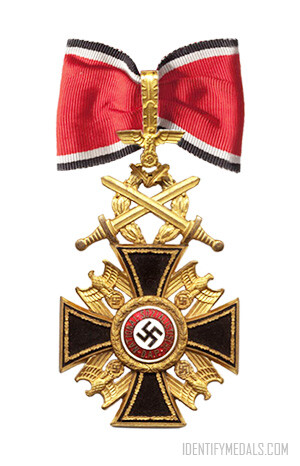
The German Order (WW2)

The German Order was the highest honor the Nazi Party could confer on an individual for exceptional services to the state and party.

The German Order (or Deutscher Orden in German) was the highest honor the Nazi Party could confer on an individual for exceptional services to the state and party.

Designed by Benno von Arent, it was first awarded posthumously by Adolf Hitler to Reichsminister Fritz Todt at Todt’s funeral in February 1942. A second posthumous award was given to SS-Obergruppenführer Reinhard Heydrich during his funeral in June of the same year.

Due to its frequent posthumous bestowal, it was cynically referred to as the “dead hero order.” The only two recipients who survived the war were Konstantin Hierl and Artur Axmann.

Hitler viewed the German Order as his personal decoration, reserved for those whose contributions he deemed exceptionally valuable to the state, party, and people. This exclusivity, combined with the presence of Hitler’s facsimile signature on the reverse, led to it being informally known as the “Hitler Order.” The awardees were intended to form a special confraternity, symbolizing their distinguished status within the Nazi regime.

The German Order Design

The German Order’s design incorporated elements reminiscent of the Iron Cross and the Order of the German Eagle.

It featured a black enamel cross measuring 48.5 mm across, with a central medallion of 20.5 mm. Between the cross’s arms were national eagles with furled wings, each clutching a wreath. The center displayed the Golden Party Badge.

The design was inspired by the regalia of the Grand Master of the Teutonic Order, the Marian Cross, theKnight’s Cross of the Iron Cross, and the Knight of Justice of the Order of St. John (Bailiwick of Brandenburg). Although intended to be awarded in three grades, only the neck order (the highest grade) was ever issued. It is considered the second rarest Nazi Germany award after the National Prize for Art and Science.

The Danzig Cross

The Danzig Cross or Danziger Kreuz was a Nazi decoration established in the Free City of Danzig prior to its incorporation into Germany.

The Danzig Cross (or Danziger Kreuz in German) was a Nazi decoration established in the Free City of Danzig. Instituted on August 31, 1939, by Danzig Gauleiter Albert Forster, this decoration recognized individuals who contributed significantly to the development of the Nazi Party in Danzig prior to its incorporation into Germany on September 1, 1939.

By December 1939, a total of 88 first-class crosses and 253 second-class crosses had been awarded, most during a ceremony on October 24, 1939. Among the recipients was Hans Frank, who received his award on May 19, 1940.

As a decoration from the National Socialist government of Danzig, the Danzig Cross was recognized as an official state award and could be worn on both Nazi Party and Wehrmacht uniforms. After Germany’s defeat in 1945, all Nazi-era decorations were banned. The Danzig Cross was not re-authorized for wear by the Federal Republic of Germany in 1957.

The Danzig Cross Design

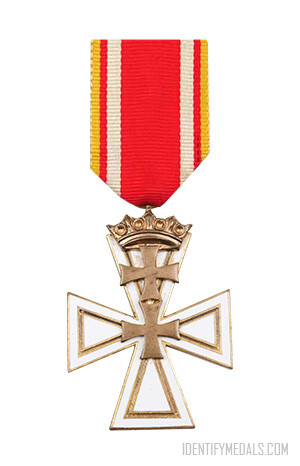
The Danzig Cross was designed by Benno von Arent. The cross featured elongated upper and lower arms and was crafted from white enamel with gilt outlines. The top arm and center displayed the coronet and twin cross from the Danzig coat of arms, also in gilt. The reverse side of the cross was plain, marked by the manufacturer Huelse Berlin.

  • Second Class Cross: Measures 43mm in height and 31mm in width. It is attached to a red ribbon with yellow and white stripes along its edges.
  • First Class Cross: Slightly larger at 60mm by 44mm, it is convex and features a pin on the reverse, allowing it to be worn on the left side of the jacket.

The Nazi Party Long Service Award

The Nazi Party Long Service Award was a distinguished political decoration presented in the form of a badge by the Nazi Party.

The Nazi Party Long Service Award, officially known as Die Dienstauszeichnung der NSDAP in German, was a distinguished political decoration presented in the form of a badge by the Nazi Party.

Instituted on April 2, 1939, by Adolf Hitler, this award recognized long-term service of male and female members of the NSDAP. The decoration was first bestowed on January 30, 1940. 

Due to the Nazi Party’s relatively short existence (1920–1945), the awards were granted before the actual service years were completed. The period from February 1925 to January 1933 was considered the “Kampfzeit” (Time of Struggle), and service during this time was counted double. Continuous service in any Nazi Party organization or formation qualified, with exceptions for up to two years of compulsory military service, military service against the Republican Government in the Spanish Civil War (1936-1939), and German military service post-September 1939.

The Nazi Party Long Service Award Classes

The award featured three classes: ten years (bronze), fifteen years (silver), and twenty-five years (gold).

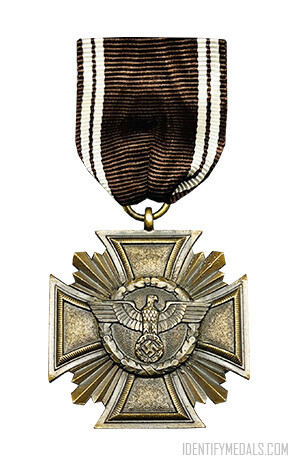
Ten-Year Award: The ten-year service medal (3rd class) was a bronze medal measuring 43mm, suspended from a dark brown ribbon with two narrow white side stripes. The reverse side featured raised lettering.

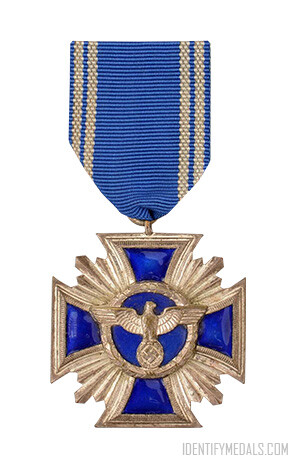
Fifteen-Year Award: The fifteen-year service medal (2nd class) had a similar design but was plated in silver and featured dark blue enamel on the cross arms and the center section. The reverse side inscription was in blue enamel with silver lettering. The ribbon was blue with two narrow silver-gray side stripes.

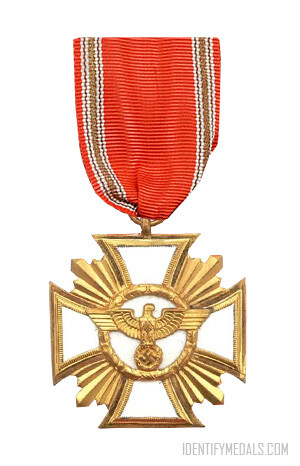
Twenty-Five-Year Award: The twenty-five-year service medal (1st class) was gold-plated with white enamel on the cross arms and center section. The reverse inscription was white enamel with gold lettering. The ribbon was red with white edge stripes and a small gold center stripe. This medal was sometimes awarded posthumously.

Nazi Party Long Service Award - 25 Years.
Nazi Party Long Service Award - 10 Years.
The Nazi Party Long Service Award - Germany Medals, Interwar
The Nazi Party Long Service Award - 15 Years.
Nazi Party Long Service Award - 25 Years.

The Nazi Party Long Service Award Design

Each medal bore the inscription “Treue für Führer und Volk” (Loyalty to Leader and People) on the reverse side. The service award was a four-pointed cross with slightly curved arms, featuring a national eagle and an oak leaf wreath at the center.

When awarded to men, the medals were worn on the left breast pocket medal bar. Women wore the award as a neck order or a brooch medal from a 15mm ribbon. On the small ribbon bar, the ribbon included a small national eagle within a wreath in the class-specific color.

All three classes could be worn simultaneously.

The Ordre de la Sincérité (Order of Sincerity)

The Ordre de la Sincérité was a knighthood order established in 1705 by the House of Hohenzollern in the German Margrave of Bayreuth.

  • Time Period: Pre-WW1
  • Institution: 17 November 1705
  • Country: Germany (German Margrave of Bayreuth)

The Order of Sincerity, originally known as “Ordre de la Sincérité” due to the 18th-century French-speaking courtiers, was a knighthood order established by the German Margrave of Bayreuth.

This order was later renamed the Order of the Brandenburg Red Eagle and eventually became known as the Order of the Red Eagle.

The Order of Sincerity was founded on November 17, 1705, by Margrave George William of Brandenburg-Bayreuth, a member of the House of Hohenzollern. Similar to many knighthood orders of small German courts, it initially fell into disuse. It was revived in 1712 in Brandenburg-Bayreuth and again in 1734 in Brandenburg-Ansbach, where it was renamed the “Order of the Brandenburg Red Eagle.” In 1777, its statutes were revised, and it was referred to as the “Order of the Red Eagle.” This order was limited to fifty knights and was conferred in one class. The church associated with the order was the Ordenskirche St. Georgen in Bayreuth.

In January 1792, the Kingdom of Prussia acquired Brandenburg-Bayreuth and Brandenburg-Ansbach. On June 12, 1792, King Frederick William II revived the order as a Prussian royal order. It became the second-highest order in the kingdom, following the Order of the Black Eagle. Although it was abolished as a state order in 1918, it continues to exist as a House Order of the House of Hohenzollern.

The Ordre de la Sincérité Design

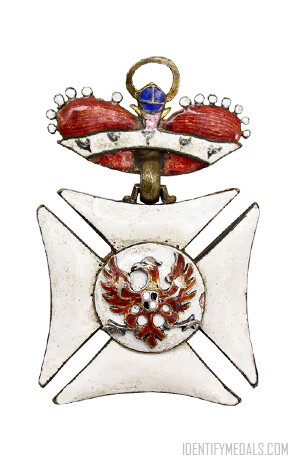
The medal features a white enamel cross with broad arms. The cross is a Maltese cross, characterized by its four equal arms that are narrower at the center and wider at the ends.

At the center of the cross, in the obverse, there is a circular medallion with a red eagle, which is a significant symbol in German heraldry. The eagle is detailed with red enamel and appears to be crowned and holding a scepter and orb, signifying sovereignty and authority.

The top of the medal is adorned with an enameled crown. The crown is red with white and blue details and attached to a loop.

The ribbon of the order is orange. 

Find This Medal

Right Now on eBay 
Clicking a link to eBay may result in a referral commission being paid if a purchase is made.
Loading...

The Blücher Order

The Blücher Order was established in 1965 and supposed to be awarded to NVA soldiers as a valor award in a time of war.

The Blücher Order (or Blücher-Orden in German) was a military decoration in the German Democratic Republic, named after Prussian Field Marshal Gebhard Leberecht von Blücher, celebrated in the GDR for his role in defeating Napoleon Bonaparte’s forces.

Established in 1965 by Walter Ulbricht, Chairman of the Council of State, the Blücher Order was intended to be awarded to soldiers of the National People’s Army (NVA) for acts of valor during wartime. However, the GDR never entered a state of war, and as a result, the decoration was never officially awarded. On January 25, 1985, the National Defence Council ordered the immediate minting of 8,000 medals, but these were never distributed for their intended purpose. Today, some of these medals are exhibited in the Military History Museum of the Bundeswehr, and a bronze medal is displayed at the Canadian War Museum.

The Blücher Order Design And Classes

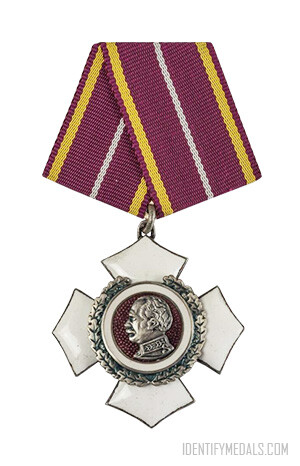
The Blücher Order came in two main types: a cross and a medal, each divided into three classes—bronze, silver, and gold.

The Blücher Cross

The cross was designed as a white cross with a central portrait of Gebhard Leberecht von Blücher, surrounded by a wreath of oak leaves. The color of the oak leaves indicated the class of the award: bronze, silver, or gold. The cross was suspended from a red ribbon with two yellow stripes along its edges. Additionally, the silver class featured a silver stripe in the center of the ribbon, and the gold class featured a gold stripe.

The Blücher Medal

The medal was round, displaying an image of the cross on its front. It was attached to a yellow ribbon, with blue stripes down its center, which varied in color according to the medal class.

The Southern Cross of Honor

The Southern Cross of Honor a commemorative medal established by the United Daughters of the Confederacy to honor Confederate veterans.

The Southern Cross of Honor was a commemorative medal created in 1899 by the United Daughters of the Confederacy to recognize the service of Confederate veterans.

The idea for the Cross of Honor was conceived by Mary Ann Erwin in 1898 and designed by her and Sarah E. Gabbett. The first medal was issued on April 26, 1900, to Captain Alexander S. Erwin. Initially produced by Charles W. Crankshaw of Atlanta, Georgia, and later by Schwaab Stamp & Seal Co. and Whitehead & Hoag, the medal’s issuance was managed by Anna Davenport Raines until her death in 1913. The program, which began with the intention to end in 1913, continued until 1959, with at least 78,761 medals awarded.

Eligibility and Allocation

The Cross of Honor could only be awarded through the United Daughters of the Confederacy and was not available for purchase.

It was given to living Confederate veterans in recognition of their honorable service in any branch of the Confederate military.

The final medal was awarded posthumously in 1951 to Rear Adm. Raphael Semmes. Wearing the medal without entitlement is a Class 3 misdemeanor in Virginia, punishable by a fine of up to $500. The Cross of Honor, akin to the Union’s GAR Medal, was never authorized for wear on U.S. military uniforms.

The Southern Cross of Honor Design

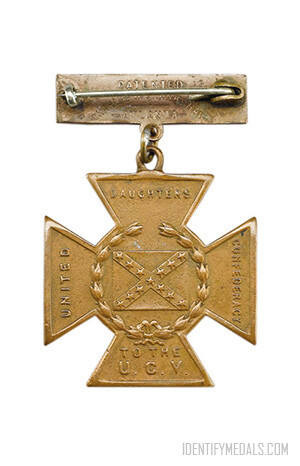
The medal is a cross pattée, suspended from a metal bar designed for engraving, and lacks a cloth ribbon.

The obverse side features the Confederate battle flag at the center, encircled by a wreath. The arms of the cross bear the inscription “UNITED DAUGHTERS OF THE CONFEDERACY TO THE U. C. V.

The reverse displays the Confederate States’ motto “DEO VINDICE” (With God as our Vindicator) and the dates “1861 1865,” surrounded by a laurel wreath. The arms on this side are inscribed with “SOUTHERN CROSS OF HONOR.”

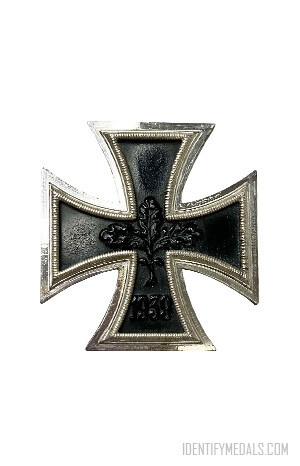
The Iron Cross (EK 1957)

The Iron Cross 1957 was introduced to allow German veterans to wear their WWII decorations in a denazified form.

Institution: 26 July 1957
Country: Germany

The Iron Cross 1957 was officially established on July 26, 1957. It aimed to honor the bravery and leadership of those who had served during World War II while adhering to new legal requirements.

Following the end of World War II, Germany underwent significant political and social changes, including the denazification process to remove Nazi symbols from public life. By the mid-1950s, many German veterans sought recognition for their wartime service without the stigma associated with Nazi imagery. In response, the Federal Republic of Germany (West Germany) introduced the Iron Cross 1957.

This version allowed veterans to wear their decorations in a form that conformed to post-war regulations, promoting reconciliation and respect for individual bravery.

The Iron Cross 1957 Criteria

The criteria for the Iron Cross 1957 remained the same as those of the 1939 version. It was awarded to recognize acts of bravery and leadership in combat. Veterans who had earned the Iron Cross during World War II were eligible to wear the 1957 version, ensuring that their wartime service could be publicly acknowledged without the associated Nazi symbols

More Variations of the Iron Cross

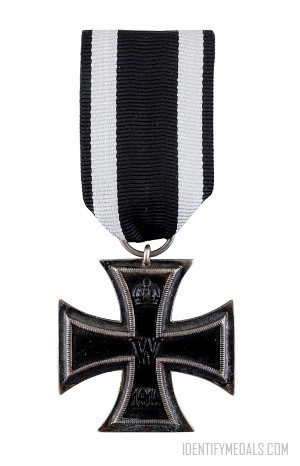
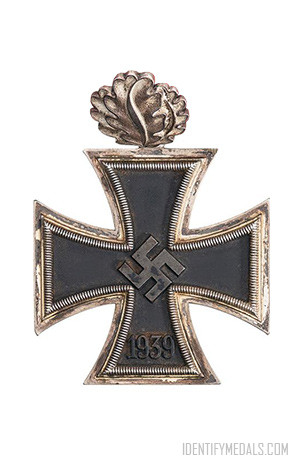
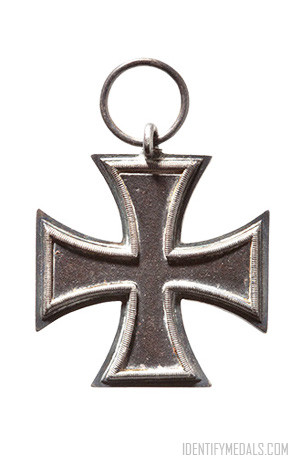
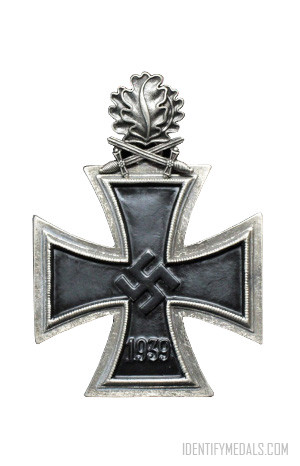
The Iron Cross, a prestigious German military decoration, has undergone several variations since its inception. For example, the Iron Cross 1813 was instituted during the Napoleonic Wars by King Frederick William III of Prussia, the Iron Cross 1914 was awarded during World War I, it was reinstated by Kaiser Wilhelm II, and the Iron Cross 1939 was revived by Adolf Hitler for World War II, with modifications including a swastika.

Find the Iron Cross Medal Online

Right Now on eBay 
Clicking a link to eBay may result in a referral commission being paid if a purchase is made.
Loading...

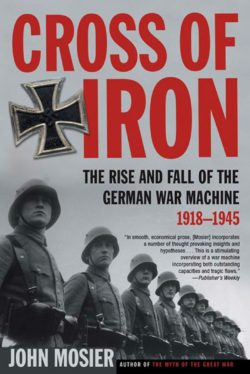
Further Reading About the Iron Cross

Discover the stories behind the Iron Cross with these compelling books and delve into the rich history and significance of this prestigious military decoration.

The Aeronautical Merit Medal 

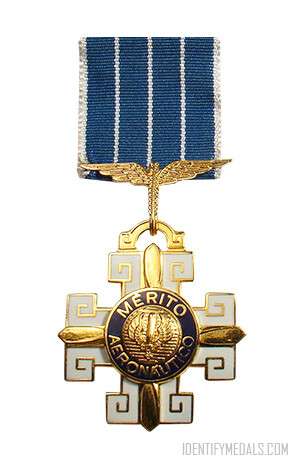
The Aeronautical Merit Medal was created on 11 October 1985 to reward military and civilian personnel for performance in the Air Force.

The Aeronautical Merit Medal (or Medalha de Mérito Aeronáutico in Portuguese) is a military decoration established on October 11, 1985.

It is awarded to military and civilian personnel, both national and foreign, who demonstrate exceptional technical-professional competence, extraordinary performance, and significant personal qualities, thereby contributing to the efficiency, prestige, and mission fulfillment of the Portuguese Air Force.

This medal was one of the first three branch-specific medals created in 1985 for each branch of the Armed Forces. It preceded the Medal of the Cross of Saint George, established by the General Staff of the Armed Forces in 2000, and the Medal of National Defense, created by the Ministry of National Defense in 2002.

The Aeronautical Merit Medal is awarded according to the following criteria:

  • 1st Class (MPMA): Awarded to general officers and colonels.
  • 2nd Class (MSMA): Awarded to lieutenant colonels and majors.
  • 3rd Class (MTMA): Awarded to other officers and sergeant majors.
  • 4th Class (MQMA): Awarded to other sergeants and enlisted personnel.

The Naval Cross (Portugal)

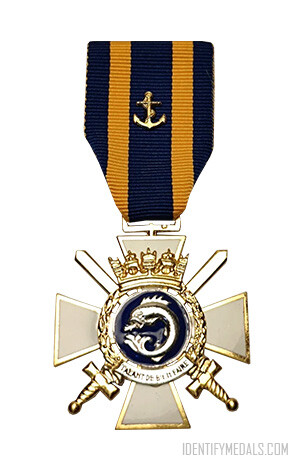
The Naval Cross Medal is a Portuguese military decoration created in 1985 and awarded for contributions to the Portuguese Navy.

The Naval Cross Medal is a Portuguese military decoration established on October 11, 1985. It is awarded to military personnel and civilians, both national and foreign, who demonstrate exceptional technical-professional competence, extraordinary performance, and significant personal qualities. Recipients of this medal contribute substantially to the efficiency, prestige, and mission fulfillment of the Portuguese Navy.

One of the first three branch-specific medals created in 1985, the Naval Cross Medal preceded the Medal of the Cross of Saint George, introduced in 2000 by the General Staff of the Armed Forces, and the Medal of National Defense, introduced by the Ministry of Defense in 2002.

The Naval Cross Medal is awarded according to the recipient’s rank and the nature of their contributions. General officers and captains of the sea and war receive the 1st Class (MPCN). Frigate captains and lieutenant captains are eligible for the 2nd Class (MSCN). The 3rd Class (MTCN) is designated for other officers and sergeant majors, while the 4th Class (MQCN) is for other sergeants and enlisted personnel.