The Military Order of Aviz

The Military Order of Aviz is a Portuguese order of chivalry founded in 1146. It gave its name and coat of arms to the Aviz Dynasty.

The Military Order of Saint Benedict of Aviz, established in 1146, is a Portuguese order of chivalry. Initially known as the Knights of Saint Benedict of Aviz, it gained prominence for its military role during the Reconquista and later became tied to the Aviz Dynasty (1385-1580). The order was originally a monastic military group inspired by the Knights Templar.

King Afonso I granted the knights the town of Évora in 1166, and they were first known as the Friars of Santa Maria of Évora. After capturing Aviz, the order adopted the Benedictine rule and became the Knights of Saint Benedict of Aviz. They gained wealth and influence, especially during the Age of Discoveries, and their mission evolved from military conquest to aiding Portuguese expeditions.

In 1789, Pope Pius VI and Queen Maria I secularized the order. It was briefly abolished in 1910 with the end of the monarchy but was revived in 1917 as an order of merit. Today, the Military Order of Aviz is one of the “Ancient Military Orders” and is awarded for outstanding military service. It is administered by a chancellor and a council of eight members, appointed by the President of the Republic, who serves as grand master.

The Military Order of Aviz Grades

The Order of Aviz, as currently awarded by the Portuguese government, is divided into six classes:
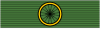
  • Grand Collar (GColA): Introduced in 2021, it outranks all other classes.
  • Grand Cross (GCA): Wears the badge of the Order on a sash over the right shoulder, and the gold star of the Order on the left chest.
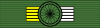
  • Grand Officer (GOA): Wears the badge of the Order on a necklet, and the gold star of the Order on the left chest.
  • Commander (ComA): Wears the badge of the Order on a necklet, and the silver star of the Order on the left chest.
  • Officer (OA): Wears the badge of the Order on a ribbon with a rosette on the left chest.
  • Knight (CvA) or Dame (DmA): Wears the badge of the Order on a plain ribbon on the left chest.
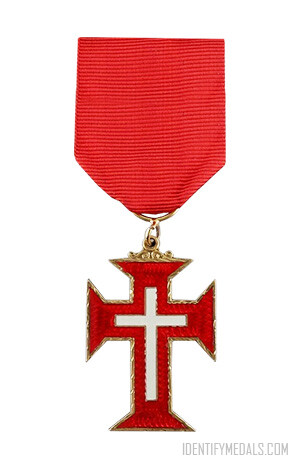
The Military Order of Aviz Design

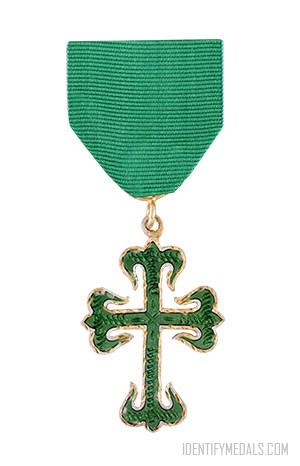
The badge of the Order features a gilt cross with green enamel, similar to the Order’s emblem but with an elongated lower arm. Under the monarchy, this badge was topped with the Sacred Heart of Christ.

The star of the Order is an eight-pointed, faceted star, gilt for the Grand Cross and Grand Officer, and silver for the Commander. The central disc is white enamel, displaying a miniature of the modern badge. During the monarchy, the star also included the Sacred Heart of Christ at the top.

The ribbon of the Order is plain green.

The Military Order of Christ

The Military Order of Christ was founded in 1319 after the Templars were abolished. It is one of the Ancient Military Orders.

The Military Order of Christ is the reconstituted form of the former Knights Templar in Portugal. Originally established in 1319 with the support of King Denis of Portugal, the order emerged after the Knights Templar were disbanded by Pope Clement V in 1312. Unlike other European monarchs, King Denis refused to persecute the Templars and instead transformed them into the Order of Christ.

This transformation was recognized by Pope John XXII in 1319, allowing the new order to inherit the Templars’ assets. The Order of Christ played a significant role in Portugal’s history, especially during the Age of Discoveries, amassing considerable wealth and influence. In 1789, Queen Maria I secularized the order. Although it was extinguished with the fall of the Portuguese monarchy in 1910, it was revived in 1917, with the President of Portugal serving as its Grand Master.

Today, the Military Order of Christ, alongside the Orders of Aviz and St. James of the Sword, forms the “Ancient Military Orders,” managed by a chancellor and council appointed by the President. It now honors outstanding service to the Republic and can be awarded to both military officers and civilians, including foreigners, members of parliament, the diplomatic corps, the judiciary, the civil service, and other public authorities.

The Military Order of Christ Grades

The Order of Christ, as currently awarded by the Portuguese government, is divided into six classes:

  • Grand Collar (GCol): Wears a grand collar, the badge of the Order on a sash over the right shoulder, and the star of the Order in gold on the left chest. This rank was introduced in 2021.
  • Grand Cross (GCC): Wears the badge of the Order on a sash over the right shoulder, and the star of the Order in gold on the left chest.
  • Grand Officer (GOC): Wears the badge of the Order on a necklet, and the star of the Order in gold on the left chest.
  • Commander (ComC): Wears the badge of the Order on a necklet, and the star of the Order in silver on the left chest.
  • Officer (OC): Wears the badge of the Order on a ribbon with a rosette on the left chest.
  • Knight (CvC) or Dame (DmC): Wears the badge of the Order on a plain ribbon on the left chest.

The Military Order of Christ Design

The grand collar of the Order features alternating simple crosses of the Order and armillary spheres, all gilded and connected by a double chain of simple links. At the center are two interlocked branches of quercus coccifera, also gilded. The cross of the Order hangs from the necklace, surrounded by an open-cut laurel wreath with its fruits, tied with crossed ribbons, all in gold.

The badge of the Order is a gilt cross with enamel, resembling the Order’s emblem but with a longer lower arm. Historically, civil knights wore a badge with the Sacred Heart of Christ above it, while military knights had a gilt, blue, and white enamel Maltese Cross with shields resembling the Portuguese coat of arms, surrounded by a palm wreath and topped by a gilt crown.

The star of the Order has 22 asymmetrical rays, gilt for Grand Cross and Grand Officer, and silver for Commander. The central disc is white enamel with a miniature of the modern badge. During the monarchy, the Sacred Heart of Christ was at the top of the star.

The ribbon of the Order is plain red.

The Civil Defense Cross of Honor (Norway)

The Civil Defense Cross of Honor is awarded to Norwegian civil defence personnel for helping to prevent loss of life or damage to property.

The Civil Defence Cross of Honor (or Sivilforsvarets hederskors in Norwegian) is a prestigious medal awarded by the Directorate for Civil Protection and Emergency Planning of Norway.

It recognizes Norwegian civil defense personnel who demonstrate exceptional ingenuity in dangerous conditions to prevent loss of life or damage to equipment and property. The medal was established on November 6, 2003.

The Civil Defense Cross of Honor Design

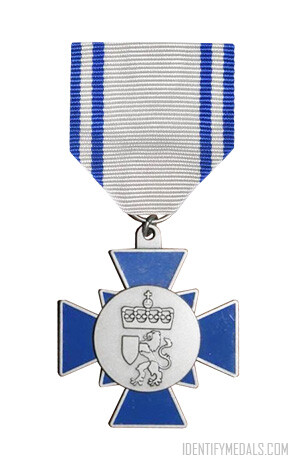
The Civil Defence Cross of Honor is crafted from silver and designed as a cross.

The obverse features blue-enamelled arms with a central medallion depicting a crowned lion holding a shield, which is the emblem of the Civil Defence.

The reverse side is plain silver, bearing the inscription “Honor et caritas” (Honor and Charity) in the center.

The ribbon is white or silver-grey with double blue edge stripes, complementing the medal’s design and significance.

The Norwegian Police Cross of Honor

The Norwegian Police Cross of Honor is awarded by the head of the National Police Directorate of Norway to Norwegian police personnel.

The Norwegian Police Cross of Honor (or Politiets hederskors/Politiets heiderskross in Norwegian) is a distinguished medal awarded by the head of the National Police Directorate of Norway.

It recognizes Norwegian police personnel who have demonstrated exceptional ingenuity in perilous conditions to prevent loss of life or damage to equipment and property.

Although the award was discontinued in 2012, it was reinstated in 2019 and awarded to retired Director of Public Prosecutions Tor-Aksel Busch, making it an active award once again.

The Norwegian Police Cross of Honor Design

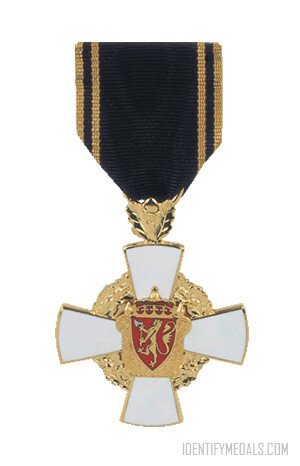
The Norwegian Police Cross of Honour is a cross made of gilded metal, suspended from a stylized spray of oak leaves.

The obverse features white-enameled arms of the cross, with the center displaying the emblem of the Norwegian Police Service: the Norwegian Coat of Arms (a gold lion on a red field) on a gold background engraved with fasces, surrounded by a wreath of oak leaves.

The reverse side, which is not enamelled, bears the inscription “HONOR ET MERITUM” (Honour and Merit) in three lines on a circular design at the center of the cross.

The ribbon is black with double yellow edges, adding a striking contrast to the medal’s design.

The King Haakon VII Freedom Cross

The King Haakon VII Freedom Cross is awarded for for outstanding achievement in wartime and was established in Norway on 18 May 1945.

The King Haakon VII’s Freedom Cross (or Haakon VIIs Frihetskors in Norwegian) was instituted in Norway on May 18, 1945. This distinguished medal is awarded to both Norwegian and foreign military and civilian personnel in recognition of exceptional achievements during wartime.

As a significant honor, it holds the fifth position in the Norwegian order of precedence. The Freedom Cross symbolizes the gratitude and recognition of the Norwegian state for extraordinary contributions to the war effort, reflecting the enduring legacy of King Haakon VII’s leadership during challenging times.

The King Haakon VII Freedom Cross Design

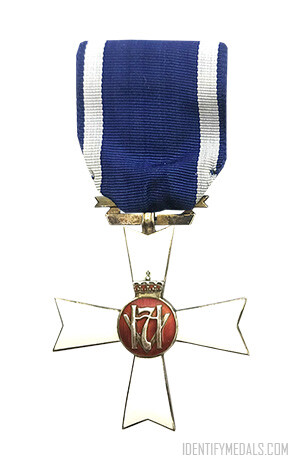
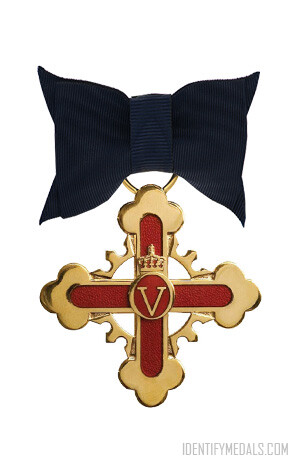
The medal is designed as a Maltese cross. On the obverse, it features a circular red field at the center, displaying the gilded silver monogram of King Haakon VII over the letter V, symbolizing victory.

The reverse side is engraved with the inscription: “Alt for Norge 7 juni 1945” (All for Norway 7 June 1945), marking the date when King Haakon VII returned to Norway after five years of forced exile during World War II. The medal is suspended from a blue ribbon adorned with narrow white stripes along both edges.

The Royal Norwegian Order of Merit

The Royal Norwegian Order of Merit is an award reserved usually for foreigners and diplomats and was instituted by King Olav V in 1985.

The Royal Norwegian Order of Merit (or Den Kongelige Norske Fortjenstorden in Norwegian) was established by King Olav V in 1985.

This prestigious order is awarded to individuals who have rendered exceptional service in the interests of Norway, including foreigners, Norwegian citizens residing abroad, diplomats from the Ministry of Foreign Affairs, foreign civil servants in Norway, and Norway’s honorary consuls. Unlike the Royal Norwegian Order of St. Olav, which is typically awarded to Norwegian citizens living in Norway, the Order of Merit recognizes contributions from those outside the country or those serving Norway in an international capacity.

Nominations for the Order are processed through the Protocol Department of the Royal Ministry of Foreign Affairs. The King grants the Order based on recommendations from the Lord Chamberlain of the Court, the Chief Protocol Officer of the Royal Ministry of Foreign Affairs, and the Head of Chancery of the Royal Norwegian Order of St. Olav.

The Order of Merit Grades

The order has five grades:

  • Grand Cross Commander, subdivided into:
    • Commander with Star 
    • Commander
  • Knight, subdivided into:
    • Knight 1st Class 
    • Knight

The Order of Merit Design

The Order features a distinctive deep blue moiré ribbon. The Grand Cross is worn on a broad sash draped over the right shoulder.

The Commander’s Cross is suspended from a ribbon worn around the neck. The Knight’s Cross is displayed on the left breast, also attached to a ribbon.

For women, both the Commander’s Cross and the Knight’s Cross are worn on the left breast, with the ribbon fashioned into a bow. Unlike the Order of St. Olav, the insignia of the Royal Norwegian Order of Merit is owned by the recipient.

The Order of St. Olav

The Royal Norwegian Order of Saint Olav was instituted by King Oscar I in 1847 and is a Norwegian order of chivalry.

The Royal Norwegian Order of Saint Olav (or Den Kongelige Norske Sankt Olavs Orden; or Sanct Olafs Orden, the old Norwegian name) is a prestigious order of chivalry established by King Oscar I on August 21, 1847. Named after King Olav II, who is venerated as St. Olav, this order honors remarkable achievements for the benefit of Norway and humanity.

In 1904, shortly before the union with Sweden was dissolved in 1905, King Oscar II instituted the Order of the Norwegian Lion. However, no appointments were made by his successor, King Haakon VII, making the Order of St. Olav the sole order of chivalry in Norway for the next 80 years. The reigning monarch of Norway serves as the Grand Master of the order, which has been used to recognize outstanding contributions.

Since 1985, the order has been primarily awarded to Norwegian citizens, though foreign heads of state and royalty may still be honored as a courtesy.

Grades and Classes

The Order of Saint Olav consists of three main grades, with some grades further divided into classes. It recognizes both civilian and military contributions, with the Grand Cross being the highest distinction. The collar is a separate honor awarded to recipients of the Grand Cross who are deemed exceptionally worthy.

  • Grand Cross (Storkors): Awarded to heads of state as a courtesy and, in rare cases, to individuals for merit. Recipients wear the badge on a collar (chain) along with a star on the left chest. If the collar is not worn, the badge may be worn on a sash over the right shoulder.
  • Commander: This grade is divided into two classes:
    • Commander with Star (Kommandør med stjerne): Recipients wear the badge on a necklet and a star on the left chest.
    • Commander (Kommandør): Recipients wear the badge on a necklet.
  • Knight: This grade is also divided into two classes:
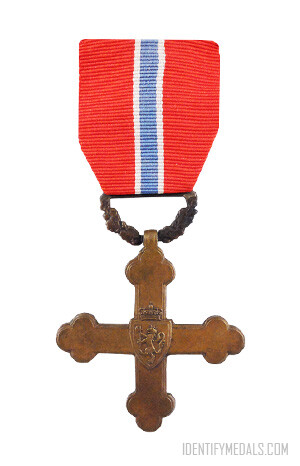
    • Knight 1st Class (Ridder av 1. klasse): Recipients wear the badge on a ribbon on the left chest.
    • Knight (Ridder): Recipients wear the badge on a ribbon on the left chest.

The Order of St. Olav Design

The collar of the Order is made of gold and features a series of decorative elements: five enamelled and crowned “O” monograms, five enamelled and crowned Norwegian coat-of-arms, and ten gold crosses bottony, each flanked by two battle axes with silver blades and golden shafts, a design also seen in the coat of arms of the Church of Norway.

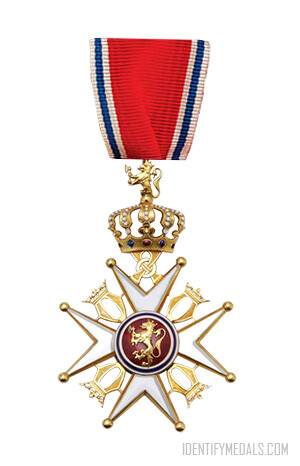
The badge of the Order is a white enamelled Maltese Cross. For the knight class, the cross is silver, while for higher classes it is gilt. Between the arms of the cross are crowned “O” monograms. The central disc on the obverse side is red, showcasing a golden Norwegian lion holding a battle-axe. The reverse disc bears King Oscar’s motto, “Ret og Sandhed” (“Justice and Truth”), and both discs are surrounded by a white-blue-white ring. The cross is topped with a crown, and military awards include crossed swords between the crown and the cross.

The star of the Order for the Grand Cross is an eight-pointed silver star with faceted rays, featuring the badge of the Order minus the crown. The star for the Commander with Star is a silver faceted Maltese Cross with gilt crowned “O” monograms between the arms. The central disc is red with a golden Norwegian lion bearing a battle-axe, surrounded by a white-blue-white ring.

The ribbon of the Order is red with white-blue-white edge stripes.

The Norwegian War Cross

The Norwegian War Cross was established in 1941 by King Haakon VII and is the highest ranking gallantry decoration of Norway.

The War Cross (or Bokmål: Krigskorset in Norwegian) stands as Norway’s highest gallantry award, recognizing acts of extraordinary bravery or exceptional leadership during combat. Recipients of this prestigious medal may receive additional swords on the ribbon for further acts of valor, though this is exceedingly rare. 

Established on May 23, 1941, by King Haakon VII via royal resolution while he was in exile in London during the German occupation of Norway, the War Cross was initially awarded for both combat and non-combat achievements. Notably, some early recipients included members of the British Royal family and individuals who made significant contributions to Norway’s war effort, with non-combat awards presented without the sword.

On May 18, 1945, the statutes were revised to limit the award to military personnel for combat-related actions exclusively, ensuring all subsequent decorations included the sword. Concurrently, Haakon VII’s Freedom Cross was introduced to honor civilian contributions.

The awarding of the War Cross ceased in 1949 but was revived on June 26, 2009, when the statutes were amended once more to recognize post-1945 actions.

In 2022, the Norwegian Armed Forces commissioned composer Marcus Paus to create a major work celebrating the stories of War Cross recipients. This initiative aims to serve as a significant “identity-building and unifying” project for the Norwegian armed forces, preserving and honoring the legacy of the medal’s recipients.

The War Cross Design

Initially, prior to 1945, the War Cross could be awarded either with or without a sword-shaped clasp on its ribbon. If an individual received the War Cross more than once, a star-shaped clasp was added to the ribbon for each subsequent award.

After 1945, the War Cross was always conferred with a sword-shaped clasp on its ribbon. For additional awards, additional sword-shaped clasps are added to the ribbon.

The Valor Cross (Denmark)

The Valor Cross or Tapperhedskorset was established in 2011 and is awarded for outstanding acts of courage in combat.

The Valor Cross (or Tapperhedskorset in Danish) is Denmark’s highest military decoration, established on 14 November 2011 and first awarded on 18 November 2011.

The Valor Cross is awarded for extraordinary courage demonstrated during combat, where the soldier acts selflessly in a clearly dangerous situation. The actions must either contribute significantly to accomplishing an important mission or save the lives of others. It is Denmark’s highest military honor, equivalent to the British Victoria Cross or the United States’ Medal of Honor.

Since its inception, the Valor Cross has been awarded only once. The first recipient, Sergeant Casper Westphalen Mathiesen of the Engineer Regiment in Skive, Denmark, was honored for his actions on 19 February 2010 while serving with ISAF in Afghanistan. During a firefight, Sergeant Mathiesen risked his life to protect a wounded comrade, successfully holding off the enemy and enabling his comrade to receive medical attention.

The Valor Cross Design

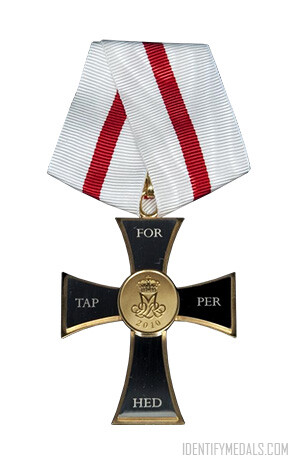
The Valor Cross is a silver cross pattée with a gilded edge, featuring a longer lower arm.

The obverse side displays a gold medallion at the center, adorned with the Queen’s monogram above the year 2010. Each arm of the cross carries three letters of the inscription “FOR TAPPERHED” (meaning “for valour”). The reverse side is engraved with the recipient’s name, rank, and the location and year of the honored event.

The cross is suspended from a white ribbon with a red center stripe. When worn as a ribbon bar, it resembles the Defence Medal for Bravery but includes a miniature of the gold medallion from the center of the cross.

The Medal of Merit for Blood Donation

The Medal of Merit for Blood Donation was established in 1979 and is currently awarded to voluntary blood donors.

The Medal of Merit for Blood Donation is a civil state decoration in Luxembourg, established in 1979 by Grand Duke Jean. This medal honors voluntary blood donors and is awarded by the Grand Duke upon the recommendation of the Minister of Health, who is advised by the Council of Order.

The Medal of Merit for Blood Donation was instituted on 22 October 1979, and initially, the Council of Order comprised five members. A decree on 4 February 1985 expanded the council to seven members, requiring a minimum of six to make a recommendation. Council members are appointed for four-year terms, with the possibility of reappointment. The current council was appointed on 17 February 2016. Foreign donors can also receive the medal if they have donated blood to a recognized Luxembourg organization.

The medal is awarded in three grades:

  • Gold Medal (eighty donations)
  • Silver Medal (forty donations)
  • Bronze Medal (twenty donations)

The plaques, edges of the cross, and the crown are gilded, silver, or bronze, depending on the grade of the medal.

The Medal of Merit for Blood Donation Design

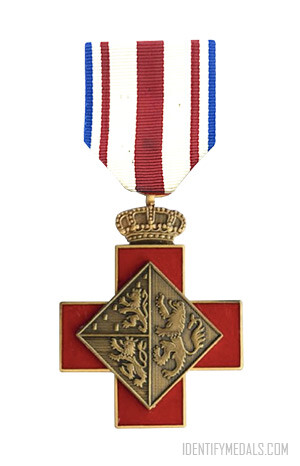
The badge of the Medal of Merit for Blood Donation is a red-enamelled Red Cross, crowned and featuring diamond-shaped plaques.

The obverse displays the coat of arms of the Grand Duchess of Luxembourg, which combines three coats of arms with lions. The upper left quarter shows the lion of Nassau, the lower left quarter features the lion of Luxembourg, and the right half displays the lion of Belgium.

The reverse depicts the profile of Grand Duchess Joséphine Charlotte facing left, surrounded by the inscription “S.A.R Joséphine Charlotte Grande-Duchesse de Luxembourg” (H.R.H. Joséphine Charlotte Grand Duchess of Luxembourg).

The ribbon is white with a red stripe in the middle, flanked by thin blue-white-red stripes at the edges.