The Distinguished Aviation Cross (Philippines)

The Distinguished Aviation Cross is a military decoration of the Armed Forces presented for heroism or achievement during aerial operation.

The Distinguished Aviation Cross is a prestigious military honor bestowed by the Armed Forces of the Philippines, recognizing acts of heroism or exceptional achievement in aerial operations.

This cross is granted to individuals serving within the Philippine Air Force or the air components of the Philippine Army or Philippine Navy. It acknowledges voluntary actions undertaken in the face of substantial danger, surpassing the usual expectations of duty. The recognized accomplishment must demonstrate an exceptional and remarkable nature, highlighting distinguished heroism or extraordinary achievement while engaging in aerial flight.

The Distinguished Aviation Cross Design

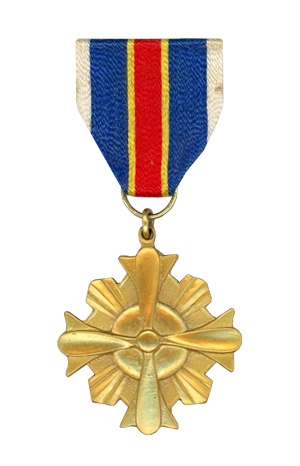
The medal, crafted from gold-colored metal, takes the shape of a diamond. Positioned on the diamond is a Maltese cross featuring a radiant golden sun at its center, with rays extending between the arms of the cross. Above the sun, a four-bladed propeller is superimposed, with each blade extending beyond the cross’s edges.

This cross is hung from a ribbon of blue, bordered with white, and embellished with a central red stripe edged in gold.
The Gold Cross (Philippines)

The Gold Cross is a decoration established by the Armed Forces of the Philippines to recognize gallantry in action.

The Gold Cross Medal (GCM) is a military decoration within the Armed Forces of the Philippines, acknowledging acts of bravery in combat. Ranked as the third highest military honor in the Philippines for heroism, it is conferred by the Chief of Staff of the Armed Forces of the Philippines or other senior commanders to deserving members of the Armed Forces for acts of gallantry in action that do not warrant the award of the Distinguished Conduct Star.

The Gold Cross Design

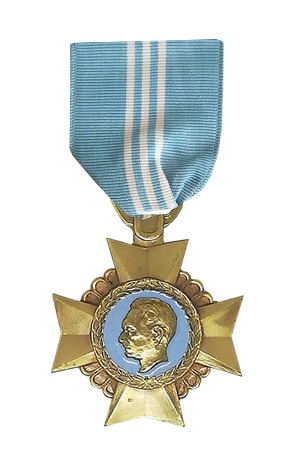
The design of the medal features a golden Maltese cross with a distinctive grooved border between its arms. Positioned at the center of the cross, in gold relief, is a left-facing profile of Manuel L. Quezon displayed on a dark blue disc. Surrounding the disc is a wreath of laurel leaves in gold, elegantly superimposed on the cross.

A golden metal loop is fixed at the top arm of the cross for suspension, while the medal hangs from a ribbon characterized by a light blue hue with three narrow vertical white lines running through its center.

The Philippines’s Presidential Medal of Merit

The Philippines’s Presidential Medal of Merit is an honor established in 2003 and given by the Republic of the Philippines.

The Presidential Medal of Merit (or Pampanguluhang Medalya ng Merito) is a distinction bestowed by the Republic of the Philippines. Originally named the Presidential Merit Award, it was rebranded as the Presidential Medal of Merit through Executive Order 236 on September 19, 2003.

The Presidential Medal of Merit is granted to individuals, whether Filipino or foreign, for various reasons. For instance:

  • a. Exceptional service to the President, the Administration, or cabinet members.
  • b. Achievement in international events or fields such as literature, sciences, arts, entertainment, and other civilian domains, contributing to national pride and artistic excellence.
  • c. Recognition of retiring cultural workers or artists who have served the government in official or advisory capacities, or foreign artists who have promoted Philippine culture.
  • d. Acts of merit that elevate the reputation of the Republic of the Philippines, including leading the Philippine delegation or materially contributing to the success of significant international conferences or events that bring honor and distinction to the country, such as Presidential visits abroad and major international gatherings held within the Philippines.

The Order of the Golden Heart

The Order of the Golden Heart is an order of the Philippines created in 1954 and awarded for distinguished services and aid.

The Order of the Golden Heart (or Orden ng Gintong Puso) is a distinguished order in the Philippines. Established initially as the Golden Heart Presidential Award through Executive Order 40-A on June 21, 1954, it was later elevated to the Order of the Golden Heart by Executive Order 236 on September 19, 2003.

This order aims to officially recognize individuals, whether Filipino or foreign citizens, who have provided exceptional services or significant financial or material assistance. Their contributions extend to the advancement of moral, social, and economic conditions among the Filipino populace, as well as their voluntary efforts in serving the Filipino community.

The Order of the Golden Heart Ranks

The Order of the Golden Heart consists of the following ranks:

  • Grand Collar (GCGH) (Maringal na Kuwintas): Bestowed upon a former or current head of State or government.
  • Grand Cross (GCrGH) (Maringal na Krus): Granted to a Crown Prince, Vice President, Senate President, Speaker of the House, Chief Justice, or an equivalent official. It may also be awarded to foreign ministers or other cabinet-level officials, as well as Ambassadors, Undersecretaries, Assistant Secretaries, or individuals of comparable rank.
  • Grand Officer (GOGH) (Maringal na Pinuno): Conferred upon Chargé d’affaires, Minister, Minister Counselor, Consul General, executive director, or individuals of similar rank.
  • Commander (CGH) (Komandante): Bestowed upon Chargé d’affaires a.i., Counselor, First Secretary, Consul General (in the consular section of an Embassy), Consular officer with a personal rank exceeding Second Secretary, Director, or individuals of comparable rank.
  • Officer (OGH) (Pinuno): Awarded to Second Secretaries, Consuls, assistant directors, or individuals of similar rank.
  • Member (MGH) (Kagawad): Conferred upon Third Secretaries, Vice Consuls, Attachés, Principal Assistants, or individuals of comparable rank.
The Order of the Golden Heart Design

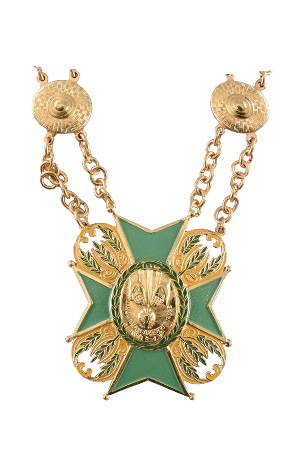
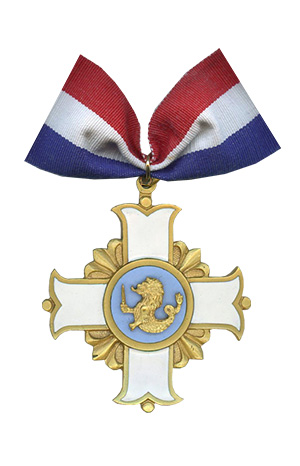
The badge and plaque consist of a green-enamelled Maltese cross, adorned with an oval golden medallion depicting open hands embracing a shining golden heart. Above this motif is the Latin motto “MANUM TUAM APERVIT INOPE,” and the entire medallion is encircled by a laurel crown in green. Between the laurel branches are golden laces and green leaves. Originally designed as a medal by Gilbert Perez, it was later adapted into the badge of the Order by Galo Ocampo.

The ribbon of the Order is red, while the original award featured a tricolor ribbon of blue, white, and red.

The Philippines Armed Forces Medal of Valor

The Philippines Armed Forces Medal of Valor was established in 1935 and is awarded for a conspicuous deed of personal bravery.

The Medal of Valor (or Medalya ng Kagitingan in Filipino) stands as the highest military honor bestowed by the Armed Forces of the Philippines, recognizing acts of exceptional bravery and selflessness that surpass the call of duty, setting the recipient apart from their comrades.

Defined within the Philippine Army Awards and Decorations reference material FC 1–0062, adapted from the Armed Forces of the Philippines Awards and Decorations Handbook, Second Edition published in 1997, this prestigious award is reserved for “heroism in combat” and holds paramount importance in the order of precedence of awards and decorations of the Armed Forces of the Philippines.

Conferred by the President of the Philippines, the Medal of Valor is presented to members of the Armed Forces of the Philippines and allied military personnel, including recognized guerrilla forces. Such is the esteem in which the medal is held that the President is required to salute both the medal and the individual adorned with it.

According to Philippine Republic Act No. 9049, recipients of the Medal of Valor are entitled to a lifetime monthly gratuity of ₱20,000, separate from any salary or pension provided by the government. President Rodrigo Duterte increased this monthly gratuity to ₱75,000 in 2016, underscoring the nation’s enduring gratitude for acts of extraordinary courage and sacrifice.

The Philippines Armed Forces Medal of Valor Design

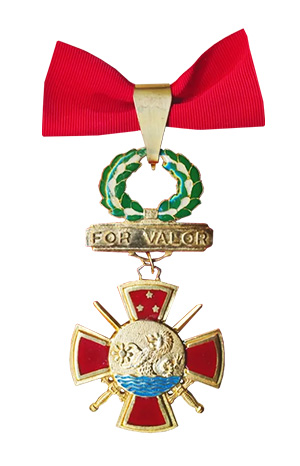
The medal features a disc adorned with a raised golden sea-lion clutching the eight-rayed Philippine sun, surrounded by water waves depicted as five blue ripples. Positioned atop a red cross with golden borders are crossed golden swords, with the uppermost section of the cross adorned with three golden stars arranged in a triangular pattern.

Connecting the medal to a sampaguita wreath, comprised of ten white buds and twenty-two green leaves, is a golden bar inscribed with the phrase “For Valor.” This wreath serves as a link to the crimson neck ribbon, adorned with eight golden stars arranged horizontally in two parallel lines. Similarly, the service ribbon, worn in lieu of the medal itself, features a crimson hue with eight golden stars, aligned horizontally in two parallel lines, with five stars on the top line and three on the bottom.

While some sources refer to the medal as the “Medal For Valor” due to the phrase embossed on the bar, others, including official Philippine government sources, identify it as the “Medal of Valor.”

Symbolically, the sea-lion represents the Office of the President of the Philippines, while the eight-rayed sun signifies the eight Philippine provinces that rebelled against Spanish rule. The blue ripples symbolize the Armed Forces of the Philippines, while the crossed swords represent conflict with the enemy in defense of the nation. The three stars correspond to Luzon, Visayas, and Mindanao, the three island groups of the Philippines, and the sampaguita wreath signifies the highest honor for courage and gallantry. The red coloration symbolizes bravery.

The Order of Sikatuna

The Order of Sikatuna was established in 1953 and is the national order of diplomatic merit of the Republic of the Philippines.

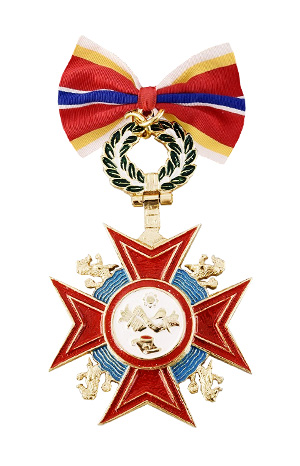
The Order of Sikatuna (or Orden ng Sikatuna in Filipino) serves as the Republic of the Philippines’ premier national order of diplomatic merit. It is bestowed upon individuals who have exhibited exceptional and commendable service to the nation, diplomats, officials, and citizens of foreign countries who have made significant contributions to fostering, developing, and enhancing relations between their respective nations and the Philippines, as well as personnel of the Philippine Department of Foreign Affairs (DFA), both domestically and abroad.

The Secretary of Foreign Affairs is authorized to confer the Order of Sikatuna on behalf of the President, recognizing individuals for their outstanding achievements and contributions to diplomatic relations.

History of the Order of Sikatuna

President Elpidio Quirino established the “Order of Sikatuna” through Executive Order No. 571 on February 27, 1953. Section 2 of the executive order explains that the Order of Sikatuna commemorates the first treaty, known as the Pacto de Sangre, between the Philippines and a foreign country.

According to President Quirino’s order, this treaty symbolizes the historic blood compact, commonly referred to as the sandugo, between Bohol native chieftain Datu Sikatuna and Spanish conquistador Miguel López de Legazpi. However, recent scrutiny has questioned the accuracy of this premise, as historical records indicate that the first blood compact occurred 44 years earlier between Ferdinand Magellan, representing the Spanish crown, and Raia Siaiu, the king of the island-port of Mazaua. 

The Order of Sikatuna Classes

The Order of Sikatuna has six classes (which changed in 2003). At the time of writing this, these are:

  • Grand Collar (GCS) (Raja) – Awarded to a former or current Head of State and/or government.
  •   Grand Cross (GCrS) (Datu) – The Grand Cross is divided into two categories:
    • (i) Gold (Katangiang Ginto) and
    • (ii) Silver (Katangiang Pilak).
      It may be conferred upon a Crown Prince, Vice President, Senate President, Speaker of the House, Chief Justice, or individuals holding equivalent positions, as well as foreign ministers, cabinet-level officials, ambassadors, undersecretaries, assistant secretaries, or individuals of similar rank or status.
  • Grand Officer (GOS) (Maringal na Lakan) – Granted to Chargé d’affaires, e.p., ministers, minister counselors, consuls general overseeing consular posts, executive directors, or individuals of comparable rank.
  • Commander (CS) (Lakan) – Bestowed upon Chargé d’affaires a.i., counselors, first secretaries, consuls general in the consular section of an Embassy, consular officers with a personal rank higher than Second Secretary, directors, or individuals holding similar positions.
  • Officer (OS) (Maginoo) – Conferred upon Second Secretaries, consuls, assistant directors, or individuals of similar rank.
  • Member (MS) (Maharlika) – Awarded to Third Secretaries, Vice Consuls, Attachés, Principal Assistants, or individuals holding comparable positions.
The Quezon Service Cross

The Quezon Service Cross was established in 1946 and is the highest national recognition of the Republic of the Philippines.

The Quezon Service Cross (or Krus ng Serbisyo ni Quezon in Filipino) stands as the highest national honor bestowed by the Republic of the Philippines. Since its establishment in 1946, only a select few Filipinos have been recipients of this prestigious recognition.

The creation of the award dates back to October 21, 1946, through Joint Resolution No. 4 of the 1st Congress of the Philippines, which holds the authority of law. Known as the Quezon Service Cross, this decoration is bestowed by the President of the Philippines with the consent of the Congress of the Philippines. It is conferred upon Filipino citizens who have exhibited exemplary service to the nation, elevating the prestige of the Republic of the Philippines or contributing significantly to the enduring welfare of its people.

Nominees for the Quezon Service Cross must demonstrate services deserving of the award, measured against the standard established by the notable contributions of the late President Manuel L. Quezon, in whose honor the decoration is named. President Manuel Roxas proposed the establishment of this honor, also known as the Congressional Quezon Service Cross, as its conferral necessitates approval from the Congress of the Philippines and is rarely granted.

Only six Filipinos have been conferred this decoration:

The Quezon Service Cross Design

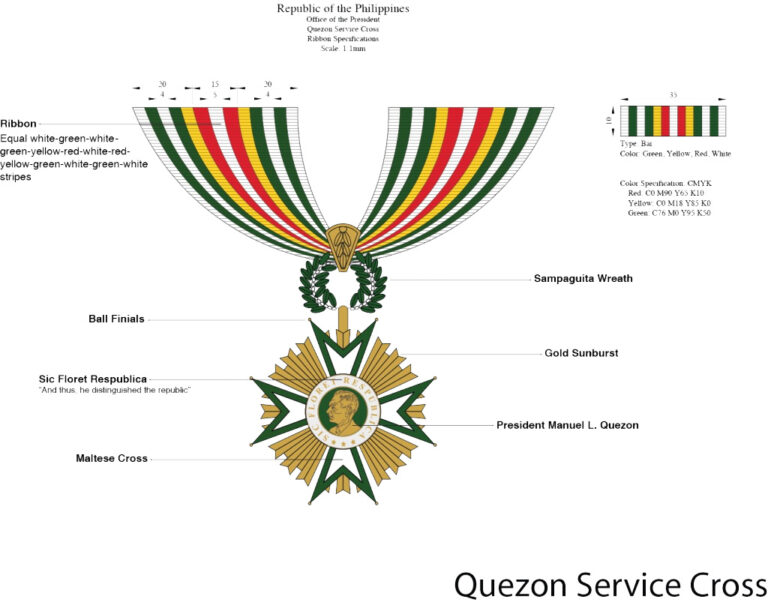
Quezon Service Cross diagram.

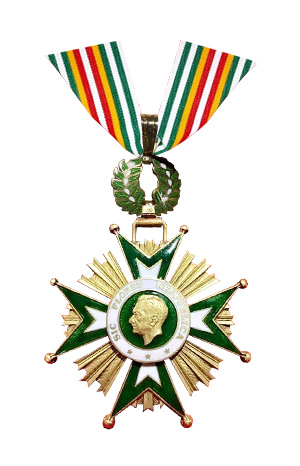
The badge of the Quezon Service Cross consists of a Maltese cross suspended from a ribbon, with intricate details and symbolism incorporated into its appearance. The obverse features the inscription “Sic floret Respublica” (“He distinguished the Republic“) and has a relief of President Manuel L. Quezon. The wreath is a Sampaguita design.

The ribbon has equal bars of white, green, white, green, yellow, red, white, red, yellow, green, white, green, and white.

The Charlotte Cross

The Charlotte Cross was a decoration founded in 1916 by King Wilhelm II to honor his wife and awarded for care-related services.

The Charlotte Cross, established on January 5, 1916 by King Wilhelm II in tribute to his wife, Queen Charlotte, was bestowed upon individuals regardless of rank, who demonstrated exceptional care for the sick and wounded in times of war. It also recognized other valuable caregiving services during World War I.

The Charlotte Cross Design

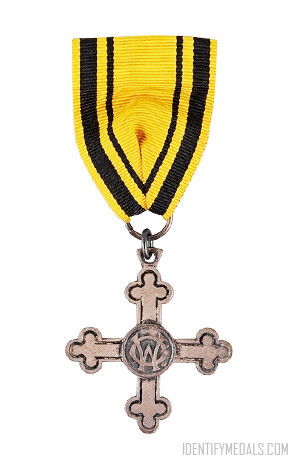
The emblem comprises a silvered white metal cross botonny, featuring a central medallion. The front of the medallion displays the intertwined initials “C” and “W” for Charlotte and Wilhelm, while the reverse side bears the year 1916.

Initially crafted from pure silver, the crosses changed to other materials at the onset of World War I.

It was tradition to wear the emblem on the left breast, attached to a yellow ribbon bordered by narrow and wide black stripes on either side.

The German Knight’s Cross Freikorps Detachment Von Randow

The German Knight’s Cross Freikorps Detachment Von Randow (or Randow Cross) was created by Captain Alfred von Randow in March 1919.

The Freikorps Detachment von Randow German Knight’s Cross, also known as the “Randow Cross,” was created and designed by Captain Alfred von Randow in March 1919. It was primarily bestowed upon members of the Volunteer Detachment von Randow, a unit formed on January 5, 1919, tasked with ensuring security in the Baltic region.

This decoration aimed to foster camaraderie within the unit and serve as a memento of past experiences. Initially, it comprised two grades: the standard Knight’s Cross and a Silver Breast Star. The Grand Cross, accompanied by the Breast Star in Gold, was bestowed upon Commanders who displayed extraordinary merit. The Knight’s Cross was awarded for four months of exemplary service, while the Silver Breast Star recognized six months of commendable service.

The first ceremony honoring recipients took place on April 12, 1919, just nine days after the initial batch of crosses was delivered. Recipients received their awards along with certificates. In May 1919, two additional grades were introduced: the Gold Breast Star and the Grand Cross. The Knight’s Cross was further divided into I and II Class.

Although primarily awarded between 1919 and 1923, sporadic awards continued until 1928. Following the NSDAP’s rise to power in 1933, the award was entirely discontinued.

The Randow Cross Design

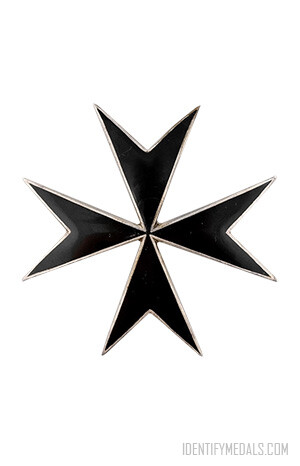
The cross features a quadrilateral eight-point design with black enamel. Because it was produced by several German manufacturers, its size may vary depending on the maker.

The I Class Cross was traditionally worn on the left breast pocket, secured by a vertical pin and the II Class Cross was worn suspended from a black ribbon, adorned with a clasp in the shape of crossed swords and a crown. Both the Breast Star in Silver and Gold were affixed to the tunic pocket. The Grand Cross was worn as a decorative neckpiece.

The Medal for Service at the Chernobyl Nuclear Disaster

The Medal for Service at the Chernobyl Nuclear Disaster or Chernobyl Liquidators Medal was awarded for participation in the nuclear clean up.

The Chernobyl Nuclear Disaster Service Medal or Chernobyl Liquidators Medal holds a unique distinction as the sole medal globally granted for involvement in a nuclear cleanup operation. The initial responders to the catastrophic Chernobyl event were firefighters, unaware of the peril they faced and assured of minimal radiation exposure. Lacking proper protective gear, they wore only lightweight gas masks. Tragically, many have since perished, while others endure a slow and agonizing decline.

Initially, authorities opted to conceal information from the public, and first responders received standard Firefighter’s Bravery medals. The disaster occurred just before the scheduled May Day parade, leading thousands to march outdoors, unwittingly inhaling radioactive particles instead of remaining indoors. This negligence is regarded by many Russians as another instance of the Party elite’s disregard for Soviet citizens. It wasn’t until the wind carried radioactive dust beyond the border that substantial action was taken, including the deployment of specialized military units.

Upon the medal’s establishment, it was conferred upon all those who sacrificed their lives and well-being in the aftermath of the incident.

The Chernobyl Liquidators Medal Design

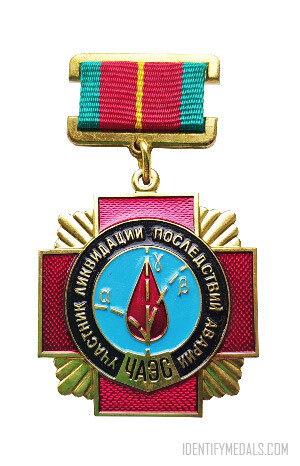
The medal is crafted with a gilded finish complemented by enamel in black, red, and turquoise hues. At the heart of the design and in the obverse lies a depiction of the atom splitting into Alpha, Beta, and Gamma radiation.