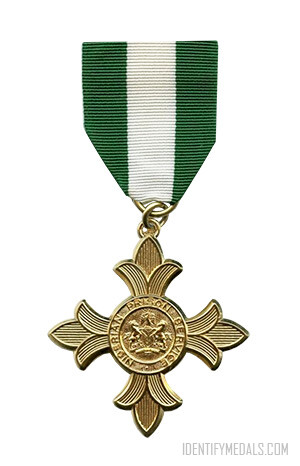
The Nigerian Prison Service Cross

The Nigerian Prison Service Medal is a decoration awarded to members of the prison service for conspicuous acts of gallantry.

The Nigerian Prison Service Cross is a decoration awarded to members of the prison service for conspicuous acts of gallantry in the course of duty.

The Nigerian Correctional Service (NCoS), formerly referred to as the Nigerian Prison Service (NPS), is a governmental body in Nigeria responsible for managing prisons. Situated in Abuja, it operates under the jurisdiction of the Ministry of the Interior and the Civil Defence Immigration and Correctional Service. President Muhammadu Buhari officially changed its name from the Nigerian Prisons Service to the Nigerian Correctional Service on August 15, 2019, following the enactment of the Nigerian Correctional Service Act of 2019.
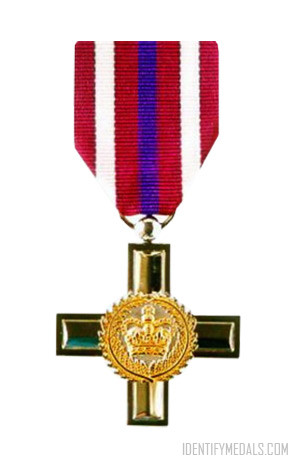

The New Zealand Gallantry Decoration

The New Zealand Gallantry Decoration (or NZGD) is the third-level military decoration of the New Zealand armed forces.

The New Zealand Gallantry Decoration (NZGD) holds the distinction of being the third-level military decoration within the New Zealand armed forces.

This prestigious decoration was established through a Royal Warrant on September 20, 1999, as an integral component of the new, homegrown New Zealand Gallantry system. The medal, including the potential for posthumous awards, is bestowed in recognition of “remarkable acts of gallantry in situations fraught with danger” that occur during war, warlike operational service, and peacekeeping missions.

In honor of continued acts of exceptional gallantry deserving of recognition, bars may be added to the NZGD. Those who receive this distinguished decoration are entitled to utilize the postnominal letters “N.Z.G.D.”

The New Zealand Gallantry Decoration Design

The New Zealand Gallantry Decoration measures 46mm in diameter.

The obverse is a faceted silver cross surmounted by the Royal Crown and fern frond wreath emblem. The reverse has the inscription “FOR GALLANTRY – MO TE TOANGA“.

The suspension is a ring suspension.

Find This Medal

Right Now on eBay 
Clicking a link to eBay may result in a referral commission being paid if a purchase is made.
Loading...

The New Zealand Order of Merit

The New Zealand Order of Merit was an order of merit established by royal warrant on 30 May 1996 by Elizabeth II, Queen of New Zealand.

The New Zealand Order of Merit is a prestigious order of merit within New Zealand’s royal honors system. Queen Elizabeth II of New Zealand established it through a royal warrant on May 30, 1996.

This order is bestowed upon individuals who have provided commendable service to the Crown and the nation across various fields of endeavor. It recognizes outstanding contributions, talents, and merits, both in civil and military roles, symbolizing exceptional dedication to the people of New Zealand.

In terms of precedence, the New Zealand Order of Merit holds a position immediately following the Order of New Zealand in the hierarchy of honors.

The New Zealand Order of Merit Classes

The Sovereign of New Zealand serves as the titular head of the order, while the Chancellor of the order is the governor-general. Appointments to the order are made across five distinct levels:

  • Knight or Dame Grand Companion (GNZM)
  • Knight or Dame Companion (KNZM or DNZM)
  • Companion (CNZM)
  • Officer (ONZM)
  • Member (MNZM)

Between 2000 and 2009, the highest levels of the Order were known as Principal Companion (PCNZM) and Distinguished Companion (DCNZM), without the use of “Sir” or “Dame” titles.

The total number of Knights and Dames Grand Companion (including Principal Companions) is capped at 30 living individuals. Additionally, there are annual limits for new appointments, which stand at 15 Knights or Dames Companion, 40 Companions, 80 Officers, and 140 Members.

In addition to the five levels, the order features three distinct types of membership. Ordinary membership is exclusively available to citizens of New Zealand or a Commonwealth realm. “Additional” members, appointed for special occasions, do not count towards the numerical limits. Individuals who are not citizens of a Commonwealth realm may receive “Honorary” membership, and if they subsequently adopt citizenship from a Commonwealth realm, they become eligible for Additional membership.

The New Zealand Order of Merit Design

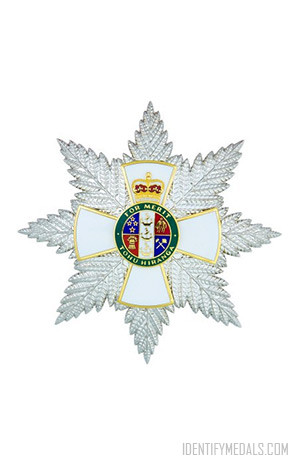
For the three highest classes of the Order, the badge is fashioned as a cross with gently curved edges, crafted from gold and white enamel. At its center, in the obverse, is the New Zealand coat of arms enclosed within a green enamel ring bearing the motto “For Merit Tohu Hiranga,” all crowned by a regal crown.

Officers and Members receive badges in similar designs, but in silver-gilt and silver, respectively.

The collar of the Order, an exclusive adornment worn solely by the Sovereign and Chancellor, consists of interconnected links featuring the central medallion of the order’s badge and “S”-shaped Koru designs. In the center of this arrangement is the New Zealand coat of arms. Dangling from the coat of arms is the order’s badge.

The star of the Order takes the form of an eight-pointed star, with each arm intricately designed to resemble a fern frond. At the heart of this star, the Order’s badge is prominently displayed. Grand Companions proudly wear a gold star, while Knight Companions don a silver one.
The wearing of these badges varies by class: Grand Companions wear theirs on a sash over the right shoulder, although the Governor-General often opts to wear it as a neck decoration instead of the Collar. Knight Companions and Companions don their badges on a neck ribbon (for men) or a bow on the left shoulder (for women), while Officers and Members wear theirs from a ribbon on the left lapel (for men) or a bow on the left shoulder (for women).

The ribbon and sash, on the other hand, are simple and unadorned, featuring a plain red ochre color.

Find This Medal

Right Now on eBay 
Clicking a link to eBay may result in a referral commission being paid if a purchase is made.
Loading...

The New Zealand Cross (1999)

The New Zealand Cross (1999) was instituted in 1999 and is New Zealand’s highest award for bravery, not in the face of the enemy.

The New Zealand Cross (NZC) stands as New Zealand’s highest honor for acts of extraordinary bravery, particularly in situations not involving combat. It was officially established through a Royal Warrant on September 20, 1999, as part of New Zealand’s efforts to create a distinct bravery award system, replacing British honors.

This prestigious medal, which can also be awarded posthumously, is bestowed in recognition of acts of immense bravery in situations of utmost peril. While primarily a civilian award, it is also conferred upon members of the armed forces who display remarkable courage in non-operational settings, as New Zealand’s gallantry awards are reserved for those involved in war or warlike operational service, including peacekeeping missions.

The addition of bars to the NZC acknowledges recipients’ repeated acts of bravery that warrant this distinguished award. Those honored with the New Zealand Cross are entitled to use the postnominal letters “NZC.” This medal took the place of the George Cross in recognizing acts of bravery within or deserving recognition from New Zealand. 

The Victoria Cross for New Zealand Design

The design of the New Zealand Cross draws inspiration from the original New Zealand Cross (1869), with the ribbon color altered to distinguish it from the Victoria Cross.

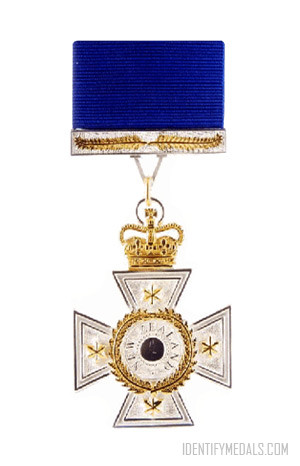
This distinctive decoration takes the form of a silver cross pattée, standing at 52 millimeters in height and 38 millimeters in width. Each of its arms is adorned with a gold six-pointed star, creating a striking visual contrast.

At the heart of the cross lies the inscription ‘New Zealand,’ encircled by a gracefully rendered gold fern wreath. Atop the cross, one finds the regal Saint Edward’s Crown in gold, affixed by a ring and a seriffed ‘V,’ which attaches it to a bar embellished with gold fern leaves, serving as a passage for the ribbon.

On the reverse side of the medal, the words “FOR BRAVERY – MO TE MAIA” are elegantly inscribed, symbolizing the valor and courage for which this distinguished award is granted.

Find This Medal

Right Now on eBay 
Clicking a link to eBay may result in a referral commission being paid if a purchase is made.
Loading...

The New Zealand Cross (1869)

The New Zealand Cross was introduced in 1869 during the New Zealand Wars, fought between the Māori and forces raised by European settlers.

The New Zealand Cross was established in 1869, during the New Zealand Wars, a conflict between the indigenous Māori people and European settlers (Pākehā) aided by British troops. Throughout this turbulent period, marked by bravery and unwavering commitment to duty, numerous acts of gallantry and devotion were displayed by local militia, armed constabulary, and volunteers.

On March 10, 1869, without verifying the facts and under the mistaken belief that colonial troops were ineligible for the Victoria Cross unless under British command, Sir George Bowen, the Governor of New Zealand, introduced the New Zealand Cross as the highest honor in the country. This decision drew criticism in England, where it was seen as encroaching on Queen Victoria’s prerogatives. Nevertheless, Queen Victoria eventually endorsed this move.

The New Zealand Cross was awarded sparingly, with only 23 recipients. The first six awards were published in the New Zealand Gazette in 1869, followed by one award in 1870. Remarkably, the remaining 16 awards were not gazetted until between 1875 and 1910, some six to 44 years after the commendable actions they recognized.

The New Zealand Cross Design

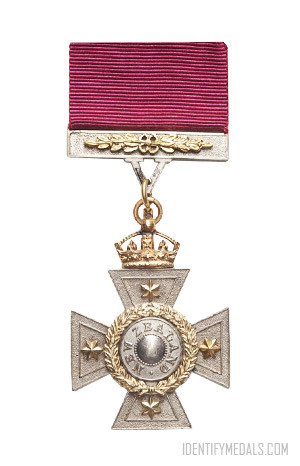
The New Zealand Cross takes the shape of a silver cross pattée, with distinctive features adorning both its obverse and reverse sides. On the obverse, the central portion proudly bears the gilded gold inscription ‘NEW ZEALAND,’ encircled by an elegant laurel wreath. Each arm of the cross boasts a six-point gold star, and atop the cross rests a regal gold Imperial State Crown.

The reverse of the medal shows two concentric circles, with the recipient’s name skillfully engraved between them and the date of the heroic action etched within the inner circle.

A crimson ribbon passes through a silver suspender clasp embellished with delicate gold laurel leaves.

The first 20 medals crafted in 1871 included a distinctive feature on the reverse of the suspender clasp – the cartouche of the goldsmiths, Messrs Phillips Brothers and Son of Cockspur Street, London. However, this detail was omitted from a subsequent batch of five medals produced in 1886.

The Victoria Cross for New Zealand

The Victoria Cross for New Zealand is a military decoration awarded members of the New Zealand Armed Forces for valor or gallantry.

The Victoria Cross for New Zealand (VC) is a prestigious military decoration presented for acts of valor or gallantry in the presence of the enemy, recognizing the courage of individuals within the New Zealand Armed Forces. This commendation is not bound by rank, encompassing all services and even civilians under military command.

Established in 1999, the Victoria Cross for New Zealand is part of New Zealand’s updated honors system, replacing several British awards with homegrown distinctions.

It draws its inspiration from the original British Victoria Cross, initially introduced by Queen Victoria in 1856 to acknowledge acts of valor during the Crimean War. Notably, the Victoria Cross for New Zealand has been awarded just once, on July 2, 2007, recognizing Lance Corporal Willie Apiata for his actions in 2004. The medal itself is crafted from gunmetal sourced from cannons seized by the British during 19th-century campaigns, possibly in Russia or China. Australia and Canada similarly feature their own versions of the Victoria Cross, serving as the highest accolades for gallantry within their respective military personnel.

The Victoria Cross for New Zealand Design

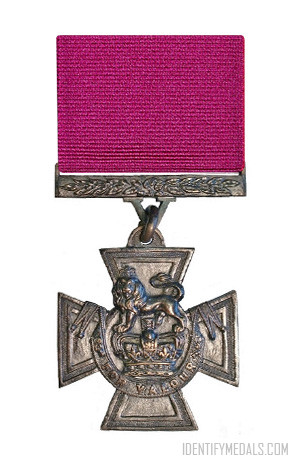
The Victoria Cross for New Zealand faithfully adheres to the original design of the Victoria Cross. This distinguished decoration takes the form of a cross pattée with straight edges, measuring approximately 36 millimetres (1.4 inches) in both width and height. At its center, the cross bears a crown, atop which rests a majestic lion, accompanied by the inscription “For Valour.”

The cross gracefully hangs from a ring, connected to a seriffed “V”-shaped bar adorned with laurel leaves, through which the crimson ribbon is threaded. On the reverse side of the suspension bar, one finds an engraved record of the recipient’s name, rank, number, and unit. The reverse of the medal features a circular panel at its center, displaying the date of the act for which it was bestowed.

The ribbon is crimson, measuring 38 millimetres (1.5 inches) in width.

Find This Medal

Right Now on eBay 
Clicking a link to eBay may result in a referral commission being paid if a purchase is made.
Loading...

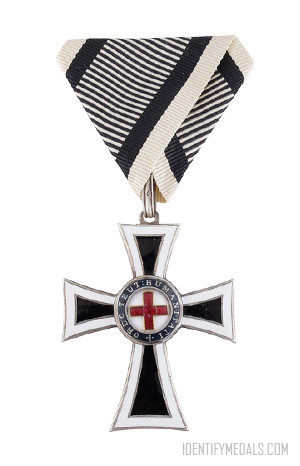
The Marian Knight Cross (Order Of The German Knights)

The Marian Knight Cross (Marianerkreuz) is the symbol for the military Order created in 1128 to care for sick and wounded Christian pilgrims.

The roots of this Order can be traced back to the Order of the Knights of the Hospital of St. Mary of the Teutons in Jerusalem. It was initially established in 1128 as a military Order with the purpose of providing assistance to ailing and injured Christian pilgrims and establishing hospitals in the Holy Land. On November 19, 1190, Duke Friedrich from Swabia formally founded the Order.

During its Imperial Austrian iteration, this Order was bestowed upon nobles and clergy members who demonstrated dedication to the fields of nursing and the compassionate practice of mercy.

The Order gained recognition as a Roman Catholic Order, with subsequent Popes endorsing it. However, it faced abolition by Napoleon Bonaparte in 1809. It was subsequently reinstated in 1815 under the patronage of Imperial Austria and underwent reforms under Emperor Ferdinand I in both 1840 and 1871.

The Marian Knight Cross Design

The Marian Knight Cross is struck in silver and measures 35 by 42 mm. 

Find This Medal

Right Now on eBay 
Clicking a link to eBay may result in a referral commission being paid if a purchase is made.
Loading...

The Order of the Star of South Africa

The Order of the Star of South Africa is a South African National Order instituted by the Republic of South Africa and discontinued in 2002.

The Order of the Star of South Africa, a South African National Order, featured seven distinct decorations across both military and non-military categories. Established on July 1, 1975, by the Republic of South Africa, these decorations were awarded by the State President and, beginning in 1994, the President of South Africa. They were bestowed upon general and flag officers of the South African Defence Force in recognition of their outstanding contributions to national defense and security. This order replaced the 1952 Star of South Africa decoration and later included a civilian division in 1978.

The order drew its name from the Star of South Africa, the first significant diamond discovered in South Africa in 1869, along the banks of the Orange River. This discovery ignited the New Rush and led to the establishment of Kimberley.

Initially, the order exclusively recognized military merit, with two distinct classes:

  • The Star of South Africa, Gold (post-nominal letters SSA): Awarded for meritorious military service that enhanced the efficiency and readiness of the South African Defence Force, contributing significantly to national security.
  • The Star of South Africa, Silver (post-nominal letters SSAS): Recognizing exceptionally meritorious service of major military importance.

However, the order was discontinued on December 2, 2002, concluding its legacy of honoring those who played crucial roles in South Africa’s defense and security.

The Order of the Star of South Africa Design

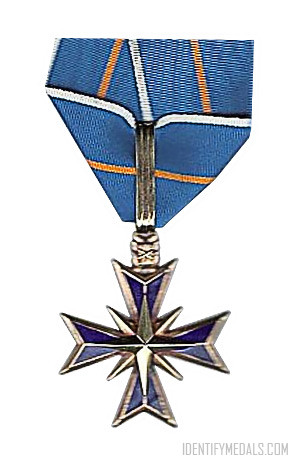
The order’s obverse side features a gold or silver Maltese cross adorned with blue enamel. Two four-pointed stars are layered atop one another and upon the cross, with a central diamond. The pre-1994 South African Coat of Arms is depicted on the reverse side. In the SSA and SSAS classes of both divisions, protea flowers are positioned between the cross’s arms.

Each class possesses its distinct ribbon, with the first three classes worn around the neck and the others on the chest. Within the military division, the SSA ribbon is a plain dark blue, while the SSAS ribbon combines dark blue with a white central band. Until 1988, the Star of South Africa, Gold also featured a gold neck chain for ceremonial events.

In the non-military division, the ribbons exhibit dark blue with various combinations of orange and white bands:

  • Orange edges for the SSA.
  • White edges for the SSAS.
  • White edges and an orange center band for the CSSA.
  • White edges and an orange center band flanked by two white bands for the OSSA.
  • White edges with three white center bands for the MSSA.

Recipients of the SSA and SSAS classes also wear eight-pointed breast stars, showcasing the decoration’s obverse.

Find This Medal Online

Right Now on eBay 
Clicking a link to eBay may result in a referral commission being paid if a purchase is made.
Loading...

The Air Force Cross

The Air Force Cross is the United States Air Force and the United States Space Force’s second-highest military decoration.

The Air Force Cross is a prestigious military decoration awarded by the United States Air Force. It is presented to members of the U.S. Air Force who have demonstrated extraordinary heroism and valor in combat situations. Established in 1960, the Air Force Cross is the second-highest military award specifically for Air Force personnel, ranking below the U.S. Medal of Honor.

The Air Force Cross recognizes acts of exceptional courage and bravery performed by individuals while involved in military operations against an enemy force. It honors those who have displayed selflessness, dedication, and extraordinary leadership in the face of great danger. The recipients of the Air Force Cross have often risked their lives above and beyond the call of duty to protect their fellow servicemembers and achieve mission objectives.

The Air Force Cross Medal Criteria

The criteria for receiving the Air Force Cross are stringent, requiring evidence of extraordinary heroism that is not quite at the level required for the Medal of Honor. The actions for which the Air Force Cross is awarded must be of great significance and involve personal risk, demonstrating bravery and valor beyond what is expected in the normal course of duty.

Similar to other military awards, the Air Force Cross is usually accompanied by a citation that describes in detail the recipient’s heroic actions. These narratives serve to honor the individual’s extraordinary deeds and provide a lasting tribute to their courage and commitment to duty.

The Air Force Cross Medal Design

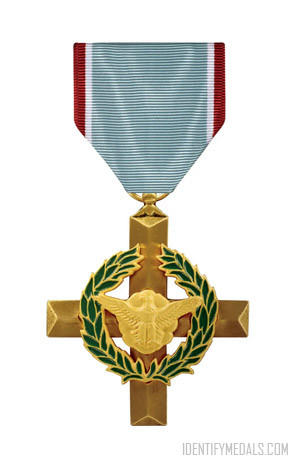
The Air Force Cross is composed of a bronze cross featuring an oxidized satin finish. Adorning the center of the cross, on the obverse, is a gold-plated American bald eagle, its wings displayed against a backdrop of clouds inspired by the crest of the Department of the Air Force Seal. The eagle is encompassed by a laurel wreath, delicately finished with green enamel. On the reverse side of the medal, there is no design, allowing for personalization through engraving. Recipients’ rank (abbreviated), first name, middle initial, last name, and branch of service can be engraved in capital letters.

The ribbon associated with the Air Force Cross, serving as both the decoration’s ribbon and service ribbon, displays a vibrant Brittany blue hue. The edges of the ribbon are adorned with a striking red border, while a slim white vertical stripe resides within the red edges. The ribbon closely resembles the one used for the Army’s Distinguished Service Cross, with the exception of a lighter blue center stripe. This subtle variation in color signifies the close connection between these distinguished awards.

Right Now on eBay 
Clicking a link to eBay may result in a referral commission being paid if a purchase is made.
Loading...

Imperial Order of St. Benedict of Avis

The Imperial Order of St. Benedict of Avis is a Brazilian military order established in 1843 and awarded in three grades.

  • Time Period: Pre-WW1
  • Institution: 9 September 1843
  • Country: Brazil

The Imperial Order of St. Benedict of Avis (or Imperial Ordem de São Bento de Avis in Portuguese) is a military order established on 9 September 1843 and awarded in three grades. 

It’s believed this order originates from the Portuguese Military Order of Aviz – which, in turn, dates back to medieval times. Other theories inlve a Spanish origin based on the Order of Calatrava.

The Order of Avis had a religious character, which was deprived in September 1843 when the Republic was proclaimed. 

Since the deposition of Emperor Pedro II (the last Brazilian monarch), the order continues to be used as a house order awarded by the Heads of the House of Orleans-Braganza. The Grand Mastership of the order is disputed between the Petrópolis and Vassouras branches of the Imperial family. 

Classes of the Order of Avis

The Order of Avis has the following classes:

  • Grand Cross (Grã-Cruz)
  • Commander (Comendador)
  • Knight (Cavaleiro)

The Order of Avis Medal Design

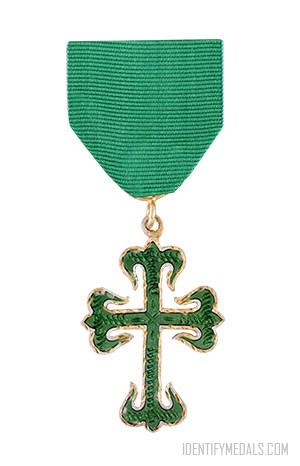
The obverse of the Order of Avis’ insignia is a white star with five forked tips and doorknobs. It sits on a garland of tobacco and coffee branches, and the pendant has an imperial crown. In the center is a white medallion with a florid green cross embroidered in gold. 

The Knight’s insignia is a green enamelled florid cross.